
This article breaks down everything you need to know about theta decay: what it is, how it works, why it accelerates near expiration, how to use it in the wheel strategy, and how to avoid the mistakes that catch beginners off guard.
Author: David Romic - retail options trader and active member in the options trading communities on Reddit (u/thedavidromic). I share wheel strategy setups, trade management, and lessons learned from real positions.
TLDR: Theta Decay in Plain English
Here's the shortest possible explanation of theta decay, written so that anyone can understand it.
Theta decay means options lose value over time. Every single day that passes while you're in a trade, an options contract is worth a little bit less - even if the stock price doesn't move at all.
Think of it like an ice cube sitting on a counter. The ice cube is the option's value. Every minute (every day, in trading terms), a tiny bit of ice melts away.
Simple example: You sell a put option on a $50 stock and collect $2.00 in premium. That $2.00 represents $200 per contract (options cover 100 shares). If the stock stays above $50, that $2.00 slowly shrinks - maybe $1.80 after a week, $1.20 after three weeks, $0.30 in the last few days - until it hits $0 at expiration. You keep the entire $200.
Who does theta decay help? Option sellers (that includes wheel strategy traders). The ice is melting in your favor.
Who does theta decay hurt? Option buyers. They paid for that ice cube, and it's disappearing on them.
The key takeaway: Wheel strategy traders sell options specifically because theta decay puts time on their side. Every day that passes without a major stock move is a day they get paid for doing nothing.
What Is Theta Decay?
Theta decay - also called time decay or simply "theta" - is one of the most fundamental concepts in options trading. It measures how much value an options contract loses with each passing day, assuming everything else stays the same.
Every option's price is made up of two components: intrinsic value and extrinsic value. Intrinsic value is the real, tangible value - how much the option would be worth if you exercised it right now. Extrinsic value is everything else: the time remaining until expiration, the volatility of the stock, and the probability that the option could become profitable.
Theta decay specifically targets the extrinsic value. As time passes, the extrinsic portion of an option's price shrinks. When the option finally reaches expiration, extrinsic value drops to zero - the option is worth only its intrinsic value (if it has any) or nothing at all.
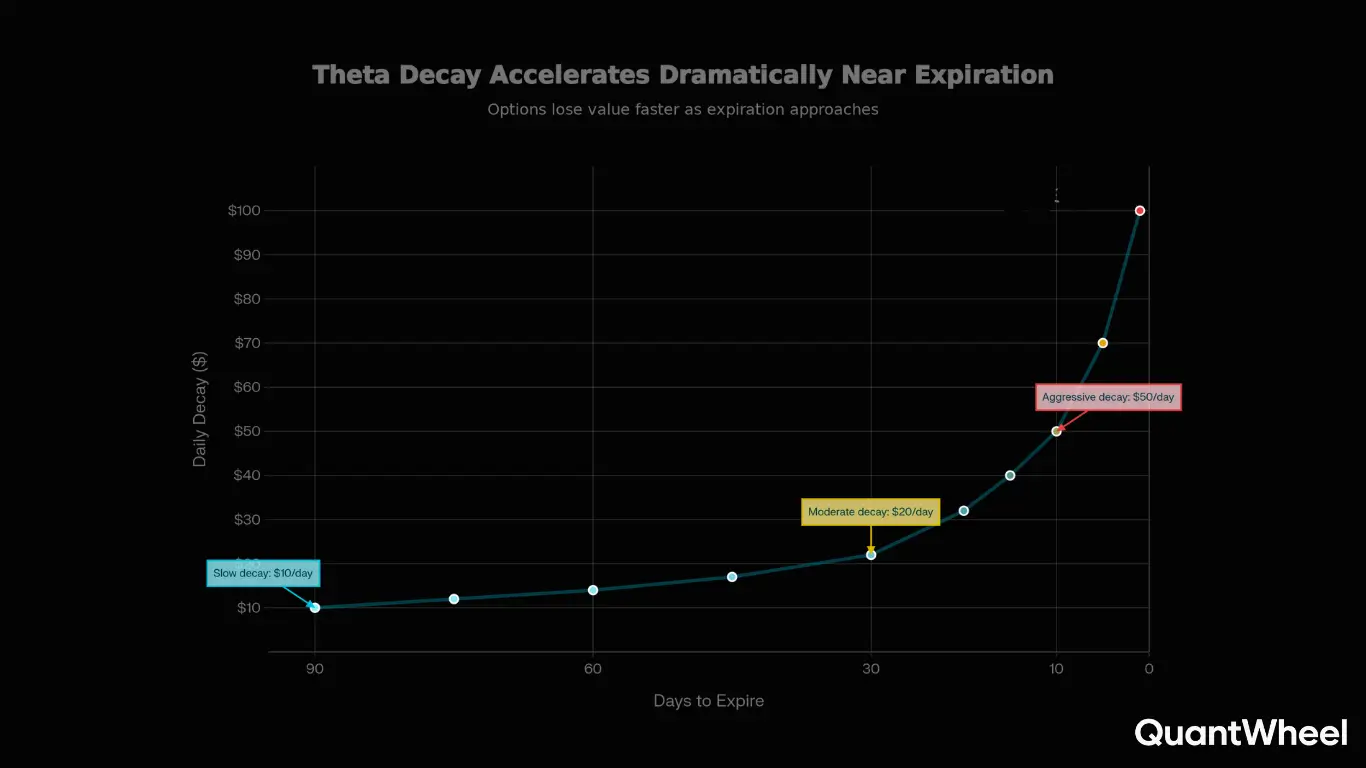
Here's the critical insight: theta decay is not linear. It doesn't shrink at the same rate every day. In the early life of an option - say 90 days out from expiration - theta decay is slow, barely noticeable. But as you enter the final 30 to 45 days, the decay speeds up dramatically. In the final week, its fastest.
This non-linear acceleration is what makes the 30-to-45-day window so attractive for premium sellers.
How Theta Is Measured
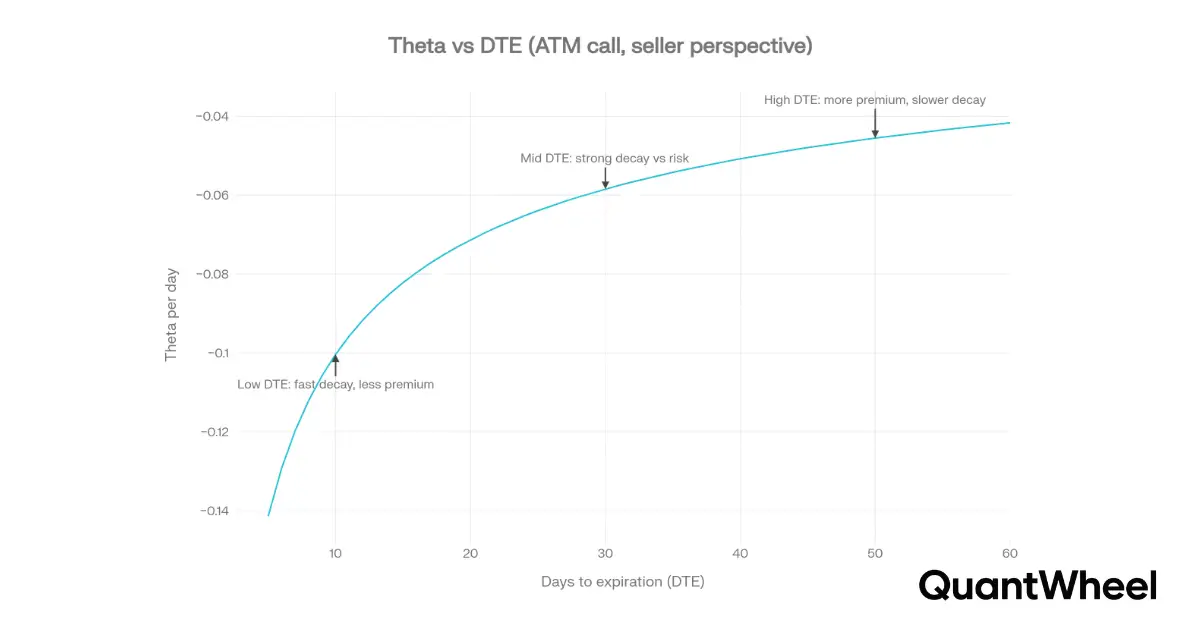
Theta is expressed as a negative number for option buyers and represents the dollar amount an option loses per day. For example, if an option has a theta of -0.05, it theoretically loses $5 per contract per day (since each contract represents 100 shares).
If you sold that option, theta works in reverse for you. That $5 daily loss for the buyer is a $5 daily gain for you. The contract you sold is becoming cheaper every day, which means if you wanted to buy it back to close your position, it would cost you less than what you sold it for.
Let's look at a concrete scenario. Say you sell a cash-secured put on a stock trading at $100. The put has a strike price of $95 and you collect $3.00 in premium. The theta on this option is -0.06.
That means each day, the option loses roughly $6 in value (0.06 × 100 shares). After 10 days - assuming the stock price and volatility don't change - the option's value has dropped from $3.00 to approximately $2.40. You could buy it back for $2.40, pocket the $0.60 difference ($60 per contract), and move on. Or you could wait and let theta continue doing the work.
The Theta Decay Curve: Why Timing Matters
The theta decay curve is one of the most important visuals in options trading. Imagine a graph where the horizontal axis is days until expiration and the vertical axis is the option's extrinsic value. The curve starts flat on the left (far from expiration) and then drops sharply as you approach expiration on the right.
This shape tells you something critical: not all days are created equal. A day of theta decay at 60 days to expiration might only erode $3 of value. But a day of theta decay at 7 days to expiration might erode $12 or more. The decay accelerates because as time runs out, there's less and less chance for the stock to make a big enough move to change the option's outcome.
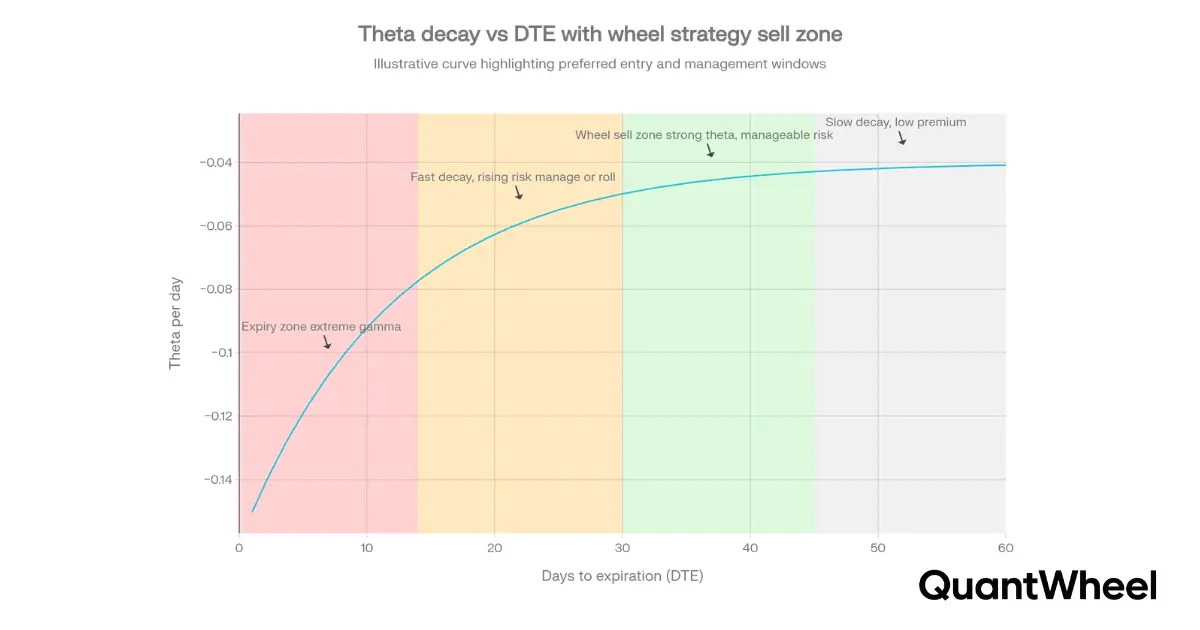
This is exactly why many wheel strategy traders sell options with 30 to 45 days until expiration (DTE). They're entering the position right at the point where theta decay starts to accelerate, capturing the steepest part of the curve while still leaving enough time to manage the position if things go sideways.
How Theta Decay Affects Different Options
Not all options experience theta decay equally. The rate of decay depends on several factors: how close the option is to the money, how much time remains, and how volatile the underlying stock is.
At-the-Money Options: Maximum Theta Decay
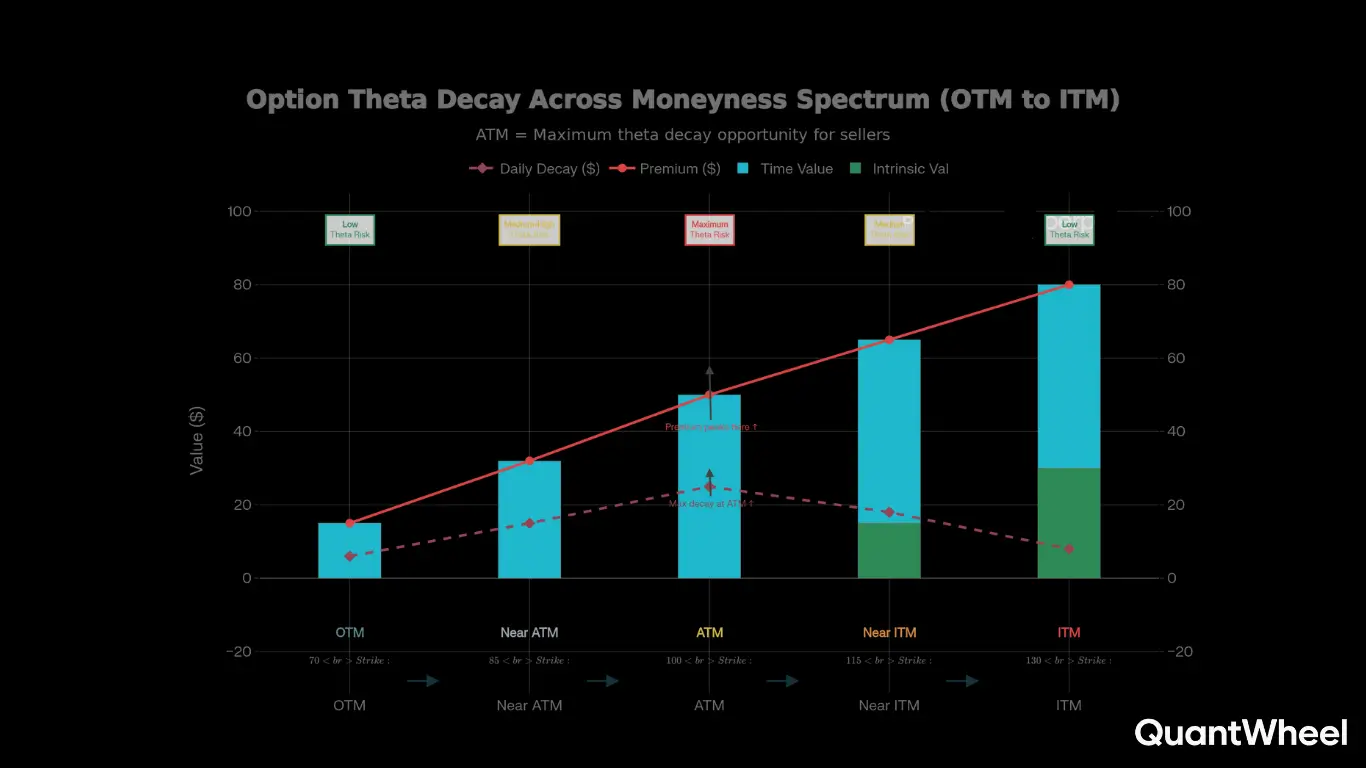
At-the-money (ATM) options - where the strike price is very close to the current stock price - experience the fastest theta decay. This is because ATM options have the most extrinsic value. Since they're right at the tipping point between being worth something and expiring worthless, their entire premium is essentially a bet on time and movement.
For wheel strategy traders, this matters when choosing strikes. Selling ATM options collects more premium and benefits from faster decay, but it also means a higher probability of assignment. Many traders balance this by selling slightly out-of-the-money options where theta decay is still strong but the probability of assignment is lower.
Out-of-the-Money Options: Moderate but Steady Decay
Out-of-the-money (OTM) options - the bread and butter of most wheel traders - experience moderate theta decay. They have less extrinsic value to begin with, so the dollar amount of daily decay is smaller. However, these options are more likely to expire worthless, which is exactly what a premium seller wants.
A typical wheel trade might involve selling a put with a delta of around 0.20 to 0.30. These options are comfortably OTM and experience steady, predictable theta decay. The premium is smaller than an ATM option, but the probability of keeping the full premium is significantly higher.
In-the-Money Options: Slow Theta Decay
In-the-money (ITM) options have the slowest theta decay because most of their value is intrinsic - tied to the actual difference between the stock price and the strike price. Since intrinsic value doesn't decay with time, only the smaller extrinsic portion erodes.
For wheel traders, this is most relevant when managing covered calls on assigned stock. If the stock has moved significantly above your covered call strike, the option is deep ITM and theta decay is doing very little work. This is when you might consider rolling the position or accepting assignment.
Theta Decay and the Wheel Strategy: Why Premium Sellers Love Time
The wheel strategy is built on theta decay. Every phase of the wheel - selling cash-secured puts, getting assigned, and selling covered calls - revolves around collecting premium that decays over time.
Here's how theta decay plays into each phase of the wheel.
Phase 1: Selling Cash-Secured Puts
You sell a cash-secured put, collecting premium upfront. From that moment, theta decay is working for you. Every day that the stock stays above your strike price, the put option loses value. Your goal is for the option to expire worthless, letting you keep the full premium.
For example, say you sell a 30-DTE put on a $75 stock at the $70 strike and collect $1.50 in premium ($150 per contract). At 30 DTE, the theta might be -0.04, meaning the option loses about $4 per day. By 15 DTE, theta might accelerate to -0.07 ($7 per day). In the final week, it could reach -0.12 ($12 per day).
If the stock stays above $70, you ride theta decay down to zero and pocket the $150. If the stock drops below $70, you get assigned at an effective cost basis of $68.50 ($70 strike minus $1.50 premium) and move to phase 2.
Phase 2: Managing Assigned Stock
When you get assigned, theta decay pauses momentarily - you now own stock, not options. But here's where tracking gets complicated. Your real cost basis isn't the $70 strike price your broker shows. It's $68.50 after accounting for the $1.50 premium you collected.
This is where most wheel traders run into problems. Brokers typically don't adjust cost basis for collected premium. You need to track this yourself - or use software like QuantWheel that automatically adjusts your cost basis when assignments happen. Getting this number wrong means your profit calculations, your breakeven points, and eventually your tax reporting are all off.
Phase 3: Selling Covered Calls
Now you own the stock and begin selling covered calls against it, putting theta decay back to work in your favor. You sell a call above your adjusted cost basis, collect premium, and watch time do its thing again.
Each covered call premium further reduces your effective cost basis. If you collected $1.50 on the put and then collect $1.00 on a covered call, your adjusted cost basis drops to $67.50. Theta decay is generating income on stock you already wanted to own, and each day that passes brings you closer to keeping that premium.
After managing multiple rounds of puts, assignments, and calls, tracking your true cost basis across the full wheel cycle becomes a real accounting challenge. This is exactly the problem that QuantWheel's Wheel Native Journal was designed to solve - it tracks the entire cycle from CSP to assignment to covered calls and automatically calculates your adjusted cost basis at every step.
The Math Behind Theta Decay: Understanding the Formula
For traders who want to understand the numbers behind theta decay, here's a simplified breakdown. You don't need to calculate this by hand - any options chain will show you the theta value - but understanding the math helps you make better decisions.
The theoretical theta of an option is derived from the Black-Scholes pricing model. Without getting deep into calculus, here's the practical version:
Theta (Θ) ≈ -(Stock Price × Volatility × N'(d1)) / (2 × √Time)
Where N'(d1) is the standard normal probability density function evaluated at d1 from the Black-Scholes model.
In plain English, theta is influenced by three main things:
1. Time remaining: Less time = faster decay. This is the square root relationship, which is why decay accelerates as expiration approaches.
2. Volatility: Higher volatility = higher theta (in dollar terms). High-IV options have more extrinsic value, which means there's more value to decay. This is why selling options on high-IV stocks generates more premium.
3. Stock price: Higher-priced stocks generally have higher absolute theta values, though the percentage decay rate may be similar across price levels.
The Square Root Rule
One of the most useful mental shortcuts for theta decay is the square root rule. It helps you estimate how premium decays over time.
If an option has 64 days to expiration, the square root of 64 is 8. If it has 16 days to expiration, the square root of 16 is 4. The ratio of the square roots (8:4, or 2:1) approximates the ratio of the option's extrinsic values.
This means an option with 64 DTE might be worth roughly twice as much in extrinsic value as the same option with 16 DTE - not four times as much, as you might expect from a linear relationship. This square root behavior is what creates the hockey-stick-shaped theta decay curve.
For wheel traders, the takeaway is practical: you don't get four times the premium by selling options four times further from expiration. The sweet spot - the best premium-per-day-of-risk - sits in that 30-to-45-DTE range where the decay curve steepens.
Theta Decay and Implied Volatility: The Relationship Every Trader Needs to Understand
Theta and implied volatility (IV) are closely linked, and understanding their relationship is crucial for wheel strategy success.
Higher implied volatility means higher option premiums, which means more extrinsic value, which means more value for theta to decay. When IV is elevated - say, before an earnings announcement or during a market selloff - options premiums swell. For premium sellers, this is prime time. You're collecting fatter premiums, and theta decay has more material to work through.
But there's a catch. High IV also means the market expects larger price movements. The extra premium you collect is compensation for the increased risk that the stock makes a big move against your position. Theta decay doesn't protect you from a 15% gap down. It only erodes the time value - delta and directional risk are separate concerns.
This is why experienced wheel traders look at IV rank or IV percentile rather than just the raw IV number. A stock with 40% IV might seem moderate, but if its typical IV is 20%, it's actually at extremely elevated levels. Selling options when IV rank is high means you're collecting above-average premium and theta decay has more to work with.
The Volatility Crush Effect
One of the most dramatic examples of theta-adjacent decay is the volatility crush after earnings. Before an earnings announcement, IV inflates because the market is pricing in uncertainty. After the announcement - regardless of whether the news is good or bad - IV collapses because the uncertainty is resolved.
This crush can cause options to lose 30-50% of their value overnight, even if the stock doesn't move much. While this isn't technically theta decay (it's vega-driven), the practical effect is similar: the option you sold becomes dramatically cheaper to buy back.
Some wheel traders intentionally sell options just before earnings to capture this crush, though this is a more aggressive approach that carries the risk of a large stock move. The conservative approach - and the one that aligns with QuantWheel's "boring is profitable" philosophy - is to sell options with 30-45 DTE and avoid holding through binary events.
Common Theta Decay Mistakes and How to Avoid Them
Understanding theta decay conceptually is one thing. Using it effectively is another. Here are the most common mistakes traders make when building strategies around time decay.
Mistake 1: Selling Too Far Out from Expiration
New traders sometimes sell options with 90 or 120 DTE, thinking more time means more premium. While the total premium collected is higher, the daily theta decay is painfully slow. You're tying up capital for months while theta barely moves the needle.
The fix: target the 30-to-45-DTE sweet spot. You capture the steepest part of the decay curve, free up capital sooner, and can reinvest in new positions more frequently. Over the course of a year, selling twelve 30-DTE options beats selling four 90-DTE options in most scenarios.
Mistake 2: Ignoring Directional Risk
Theta decay doesn't help you if the stock drops 20%. A cash-secured put that's decaying nicely at $0.06 per day becomes irrelevant if the stock gaps down $15 overnight. Theta is one force acting on the option, but delta - the option's sensitivity to stock price changes - can overwhelm theta in a single session.
The fix: always consider the stock you're selling options on, not just the premium. Sell puts only on stocks you'd genuinely want to own at the strike price. That way, even if theta doesn't save you and you get assigned, you're holding a stock that fits your investment thesis.
Mistake 3: Not Understanding Theta Acceleration
Some traders sell options at 45 DTE, see the premium barely move in the first two weeks, and panic-close the position thinking it's not working. They don't realize that theta decay is back-loaded. The real acceleration comes in the final 15-20 days.
The fix: be patient and understand the decay curve. If you sold a 45-DTE option and 15 days have passed with the option still healthy, you're entering the fast-decay zone. This is where the strategy starts to really pay off. Closing too early means leaving money on the table.
Mistake 4: Selling Options on Low-IV Stocks
If a stock has very low implied volatility, the premium you collect is tiny, and theta decay produces negligible daily income. You're taking on assignment risk for a reward that barely moves the needle.
The fix: use an options screener to find stocks with elevated IV rank. This is where QuantWheel's Options Screener comes in - it scans hundreds of tickers in seconds and filters for wheel-appropriate opportunities based on IV rank, delta, DTE, and annualized yield so you're not wasting time on low-premium trades.
Mistake 5: Failing to Track Premium Decay Across the Full Wheel Cycle
This is the most overlooked mistake. Traders track theta decay on individual positions but lose sight of the big picture across a full wheel cycle. After collecting premium on a put, getting assigned, selling multiple covered calls, and eventually exiting - what was your actual return? How much of that was theta decay vs stock appreciation vs luck?
Without accurate tracking of premiums collected, cost basis adjustments, and cycle-level P&L, you can't answer these questions. You're running a premium collection business without proper bookkeeping.
Theta Decay Strategies: Putting Time Decay to Work
Now that you understand how theta decay works, here are the specific strategies that premium sellers use to capitalize on it.
Strategy 1: The 30-45 DTE Sweet Spot
This is the most common approach among disciplined wheel traders. Sell options with 30-45 days to expiration to capture the acceleration zone of theta decay. Close at 50% of max profit (when the option has lost half its value) and redeploy capital into a new position.
Why 50%? Because the last 50% of premium takes disproportionately longer to decay (or requires the stock to stay perfectly behaved). By closing at 50% profit, you lock in gains, free up capital, and reduce exposure to late-cycle risks like gamma spikes.
Strategy 2: Weekly Premium Collection
More active wheel traders sell weekly options (5-10 DTE) to capture the very steepest part of the decay curve. The daily theta decay is enormous relative to the premium - in percentage terms, a 7-DTE option might decay at 3-5% of its value per day compared to 1-2% for a 30-DTE option.
The trade-off: weekly options require more active management, more frequent rolls, and higher transaction costs. They also leave less room to manage if the trade goes against you.
Strategy 3: Selling Into High IV Events
When a stock's IV spikes - due to market uncertainty, sector news, or approaching earnings - premium sellers can collect outsized premiums. Theta decay plus an eventual IV crush creates a powerful combination that can shrink option prices rapidly.
The conservative approach: sell options after an IV spike has occurred (not before a known catalyst like earnings). This captures elevated premium without the binary event risk.
Strategy 4: Calendar-Based Theta Harvesting
Some traders sell near-term options against longer-term options (calendar spreads) to isolate theta decay. The near-term option decays faster than the long-term option, generating a profit from the differential decay rates.
While this isn't a pure wheel strategy play, understanding the mechanics helps wheel traders appreciate why shorter-dated options decay faster and how to think about time as a tradeable variable.
Theta Decay in Different Market Conditions
Theta decay doesn't exist in a vacuum. Market conditions dramatically influence how effective theta-based strategies are.
Bull Markets
In a steady uptrend, theta decay works beautifully for put sellers. Stocks are rising, puts stay out of the money, and the premium you collected decays to zero. This is the easy environment. The danger is complacency - assuming every trade will work because the last 20 did.
Bear Markets
Bear markets are where theta decay meets its harshest test. Stock prices drop rapidly, delta overwhelms theta, and put sellers face assignment at prices well above the current market. Theta decay doesn't stop in bear markets, but it becomes irrelevant when the stock drops $20 while your option only decayed $0.50.
The key in bear markets: position sizing, strike selection, and only wheeling stocks you genuinely want to hold long-term. If you get assigned on a quality stock at a fair price, you can sell covered calls and continue the wheel while waiting for recovery.
Sideways Markets
Sideways, range-bound markets are theta sellers' paradise. Stocks chop around without going anywhere meaningful, and premium decay is the primary force acting on options. Wheel traders in sideways markets can run the strategy almost mechanically: sell put, collect premium, repeat.
High Volatility Environments
When the VIX spikes and fear grips the market, option premiums swell - and so does the raw theta value. Selling options in high-volatility environments collects more premium and sees faster dollar-value decay. However, the elevated volatility reflects real risk, and position sizing should reflect that.
How to Read Theta on an Options Chain
When you pull up an options chain on your broker or platform, theta is listed alongside the other Greeks for each contract. Here's how to interpret what you see.
A theta value of -0.04 means the option is expected to lose $4 per contract per day. If you sold this option, you're earning approximately $4 per day in time decay (all else being equal). Over a 30-day holding period, that's roughly $120 in theta-driven profit - though the actual amount depends on how much of the extrinsic value remains.
When comparing options to sell, look at theta relative to the premium collected. An option with a premium of $2.00 and a theta of -0.05 has a higher decay rate (2.5% per day) than an option with a premium of $5.00 and a theta of -0.08 (1.6% per day). The first option is decaying faster as a percentage, which means you're capturing premium more efficiently.
Also pay attention to how theta changes as the option approaches expiration. Your broker's options chain gives you a snapshot of today's theta, but tomorrow's theta will be different - typically higher as expiration approaches. This means your daily income from time decay actually increases as the trade progresses (assuming the stock cooperates).
Theta Decay vs. the Other Greeks: How They Interact
Theta doesn't work in isolation. It's constantly interacting with the other Greeks, and understanding these interactions helps you manage positions more effectively.
Theta vs. Delta
Delta is your biggest friend or foe alongside theta. While theta steadily erodes value in your favor, delta can cause sudden, large changes in option value when the stock moves. A cash-secured put with a delta of -0.25 loses about $25 per $1 stock drop, per contract. If the stock drops $5 in a day, that's a $125 loss - wiping out weeks of theta decay in a single session.
The takeaway: theta gives you daily income, but delta determines your P&L on volatile days. Choosing lower-delta options (further out of the money) reduces delta risk while still capturing meaningful theta decay.
Theta vs. Vega
Vega measures sensitivity to changes in implied volatility. When IV rises, options become more expensive (bad for sellers who want to buy back). When IV falls, options become cheaper (good for sellers).
Theta and vega often push in opposite directions. A spike in IV increases the option's price (vega effect), temporarily offsetting theta decay. Conversely, falling IV amplifies the downward pressure on the option's price, stacking on top of theta decay for a double benefit.
Theta vs. Gamma
Gamma becomes increasingly important as expiration approaches - the same window where theta decay accelerates. High gamma means the option's delta is changing rapidly with small stock movements, making the position harder to predict and manage.
This is the theta-gamma tradeoff: the last few days before expiration offer the fastest theta decay, but also the most gamma risk. A stock that's near your strike price in the final days can whipsaw the option's value wildly, even as theta is aggressively eroding it. Many traders avoid this tension by closing positions before the final week.
Building a Theta Decay Income System
If you're using the wheel strategy to generate consistent income, theta decay is your engine. Here's how to build a systematic approach around it.
Step 1: Define your universe. Select 15-30 stocks that you'd genuinely want to own. These should be companies with solid fundamentals, sufficient options liquidity, and a price point that fits your account size.
Step 2: Screen for elevated IV. Within your universe, identify stocks where IV rank is above 30 (ideally above 50). This means premiums are above their typical levels, giving theta more extrinsic value to work through.
Step 3: Select your strike and DTE. Sell puts with 30-45 DTE at a delta of 0.20-0.30. This puts you comfortably out of the money with strong theta decay and a statistical edge.
Step 4: Set your exit rules. Close at 50% of max profit or manage at 21 DTE (whichever comes first). These mechanical rules remove emotion and ensure you're capitalizing on the steepest decay while managing risk.
Step 5: Track everything. Record your premium collected, your theta at entry, your exit price, and your actual vs. theoretical decay. Over time, this data reveals which stocks, strike selections, and DTE windows produce the best theta-decay results for your specific approach.
This fifth step is where many traders fall apart. Managing 10 or more positions across various stages of the wheel - some in CSP phase, some assigned, some with covered calls - creates a tracking nightmare. You're calculating cost basis adjustments, aggregating premium collected, and trying to figure out your actual return. QuantWheel was purpose-built for exactly this scenario, tracking the full wheel cycle from entry to exit, automatically adjusting for assignments, and giving you a clear picture of your theta-driven income.
$1 for 7 days • Cancel anytime • 14-day money-back guarantee
Risk Disclosure: Options trading involves substantial risk and is not suitable for all investors. Past performance does not guarantee future results. This content is for educational purposes only and should not be considered investment advice. Always do your own research and consider consulting with a financial advisor before making investment decisions.
The examples used in this article are for educational purposes only and are not recommendations to buy or sell any security.