Free tool
Cost Basis After Assignment Calculator
Your broker shows the strike you paid. Your real cost basis is lower, because you kept the premium. This free tool does the math through the whole wheel cycle. No signup.
Educational tool, not investment advice.
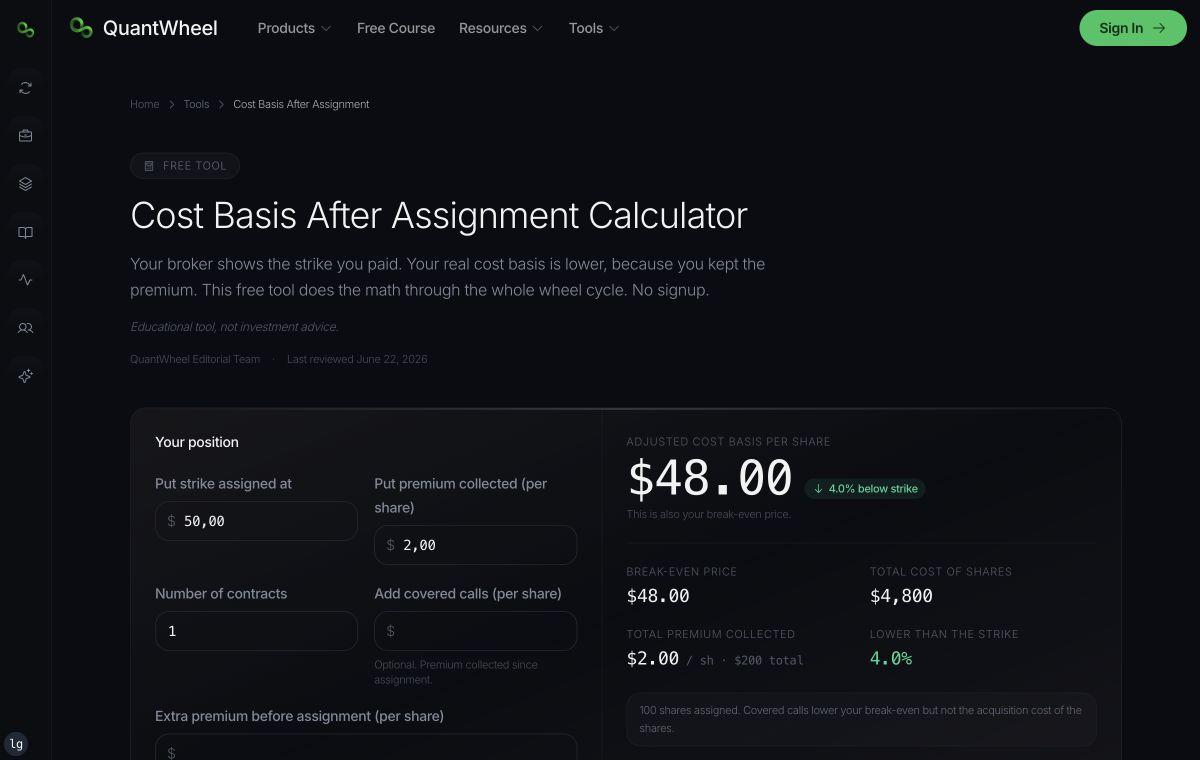
Your position
Optional. Premium collected since assignment.
Optional. Net credit from rolling the put.
Adjusted cost basis per share
This is also your break-even price.
- Break-even price
- $48.00
- Total cost of shares
- $4,800
- Total premium collected
- $2.00 / sh · $200 total
- Lower than the strike
- 4.0%
100 shares assigned. Covered calls lower your break-even but not the acquisition cost of the shares.
What is your cost basis after an options assignment?
Your cost basis after a put assignment is the strike price minus the premium you collected. Sell a 50 dollar put, collect 2.00, get assigned, and your real cost basis is 48.00 per share, not 50.00. Every covered call you sell against those shares lowers it again. That lower number is your true break-even.
This matters because your broker rarely shows it. While you hold the shares, most broker screens display the raw strike you paid. They do not subtract the premium you collected. So the cost basis on your screen reads higher than your real break-even, and that one gap is where people misjudge a winning position for a losing one.
How to calculate cost basis after assignment
Four steps. You can do it by hand, or let the tool above do it.
- Start with the strike you were assigned at.
- Subtract the premium you collected when you sold the put.
- Subtract every covered-call premium you have collected on those shares since.
- The result is your cost basis per share. Multiply by 100, then by your contract count, for the total.
For tax, one detail is worth knowing. The IRS treats an assigned put's premium as a reduction to the cost basis of the shares you buy, under IRS Publication 550. So for the put leg, your economic break-even and your tax basis agree.
Why the wheel makes this hard
One position is one subtraction. Easy. The wheel is where it breaks.
Run ten or fifteen wheels at once. Roll a few. Get assigned on some. Sell calls against others. Now your real cost basis lives across a dozen rows of a spreadsheet that you last updated two trades ago. Forgetting the real cost basis after adjustments is one of the four things that quietly wreck a wheel trader's records. It bites hardest at tax time.
Cost basis through a full wheel cycle
Here is one clean cycle on a 50 dollar stock, one contract.
- Sell the 50 put. Collect 2.00. If assigned, your basis is 48.00.
- Get assigned. You own 100 shares at a 48.00 basis.
- Sell a covered call. Collect 1.50. Your basis drops to 46.50.
- Total premium collected so far is 3.50 per share, which is 350 dollars.
| Stage | Premium collected | Cost basis | Break-even |
|---|---|---|---|
| Broker screen after assignment | none shown | 50.00 | 50.00 |
| After the put premium | 2.00 | 48.00 | 48.00 |
| After the first covered call | 1.50 | 46.50 | 46.50 |
That is a break-even 7 percent below the number on the broker screen. Keep the wheel turning through more calls and the gap widens.
One honest note on taxes
The put premium reduces your share basis for tax, as above. Covered-call premiums are different. The tax code treats them as their own option transactions, not as a basis reduction, and wash-sale rules and holding periods add more. So the break-even this tool shows, which subtracts covered-call premium, can differ from the basis you file. Use this for your real break-even and your trade decisions. Confirm your filing figures with a tax professional. The Options Clearing Corporation publishes the Options Disclosure Document, which covers assignment mechanics in full.
Frequently asked questions
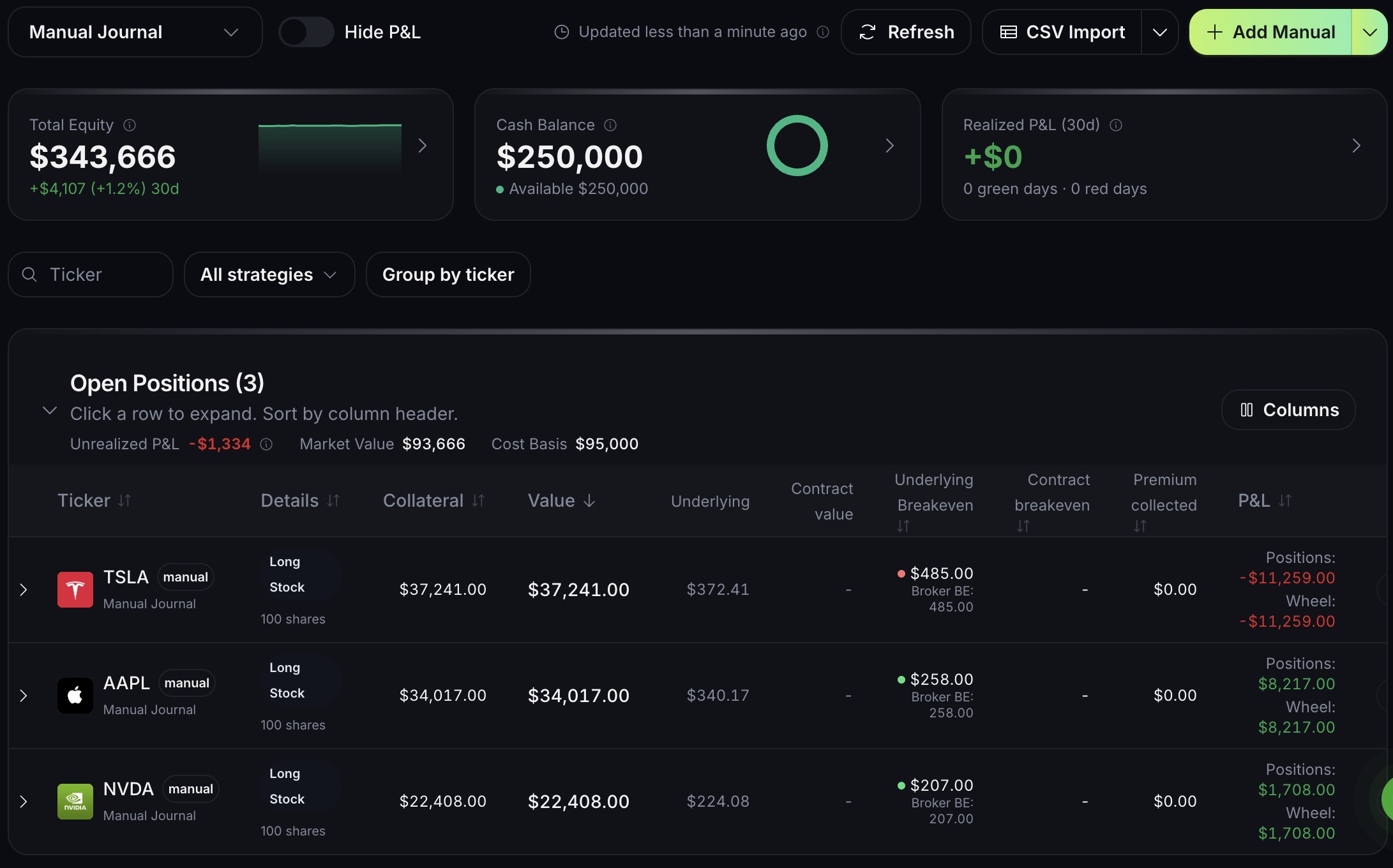
This tool handles one position. The wheel asks you to handle fifteen, through every roll and assignment, without a spreadsheet that breaks the week you forget to update it. That is what QuantWheel's Options Journal does. It adjusts your real cost basis the moment you are assigned and carries it through the full cycle. Your portfolio, your broker, your real numbers.
Related free tools: Optimal Roll, Options Calculator. Plus the deeper guide at the QuantWheel Free Course.
Options trading involves substantial risk and is not suitable for all investors. Before trading options, you should read the Options Disclosure Document available from the Options Clearing Corporation. Past performance does not guarantee future results. This tool is for educational purposes only and is not investment, tax, or legal advice. Cost-basis and tax rules can be complex, including wash sales and holding periods. Consult a licensed professional for advice specific to your situation.
Next step
Where to go next
Try the whole product with sample positions. No account needed.
$1 for 7 days • Cancel anytime • 14-day money-back guarantee