Free tool
Wheel Strategy Calculator
Model the whole wheel. The cash-secured put, the assignment, the covered calls. See the premium you would collect and the break-even at each step. Free, no signup.

Educational tool, not investment advice. The figures are math from the numbers you enter, not a projection or an offer.
Your trade
What you would collect after assignment.
Premium collected this cycle
Across the put and the covered call, one full turn of the wheel.
- Cash to secure the put
- $5,000
- Break-even price
- $47.80
Return on that cash
4.4%over 60 days
Annualized, about 27% if you repeated it all year.
Illustrative only. Markets do not promise a repeat.
The risk
If the stock falls below your strike, you can be assigned shares worth less than your break-even.
What is the wheel strategy?
The wheel is an options income strategy with three repeating steps. You sell a cash-secured put on a stock you would be glad to own. If the put is assigned, you buy the shares and sell covered calls against them. If the shares get called away, you keep the premium and start again. You are collecting option premium through the cycle, not betting on direction.
The calculator above estimates the premium and break-even for one full turn, from the numbers you enter.
How to use this wheel strategy calculator
- Enter the stock or strike you are looking at.
- Enter the put premium you would collect, and its days to expiration.
- Enter the covered-call premium you would expect after assignment, and its days.
- Read the premium, the break-even, and the return on the cash you tie up.
Change any input and the numbers move with it. That lets you compare two strikes, or two expirations, in seconds.
How wheel strategy returns are calculated
The wheel earns in two places. The put premium, and the covered-call premium if you are assigned. Your return is the premium divided by the cash you set aside to secure the put. To annualize, you scale that return to a year by the days the trade runs.
The annualized figure has a catch, and it is the kind of thing most calculators skip. It assumes you repeat the same trade, at the same premium, every cycle for a year. Real markets do not promise that. Treat annualized as a way to compare two trades, not as income you will earn.
Is the wheel strategy profitable? An honest look
The wheel can produce steady premium income in flat and gently rising markets. That is the appeal. It is not free money, and two things can go against you.
If the stock drops hard after you are assigned, the premium only cushions part of the loss. You hold shares worth less than your break-even, and you may sell covered calls for a while to climb back. If the stock rips higher, your covered call caps the gain. You keep the premium and miss the rest.
Conservative, consistent, a little boring. That is the point. The wheel trades a slice of upside for a steadier stream of premium, and it fits best on quality stocks you actually want to hold. The Options Clearing Corporation publishes the Options Disclosure Document, which lays out the risks and mechanics in full.
Worked example, one full wheel on a 50 dollar stock
One contract, secured with 5,000 in cash.
| Step | Premium | Break-even |
|---|---|---|
| Sell the 50 put, 30 days out | 1.00 | 49.00 |
| Assigned, own 100 shares | — | 49.00 |
| Sell a covered call, 30 days out | 1.20 | 47.80 |
Total premium for the cycle is 220 dollars, the break-even drops to 47.80. The tool shows the period return and an annualized figure beside these, both as illustrations, both next to the risk line.
The numbers a calculator cannot show you
A calculator shows premium and yield. It cannot show assignment risk on the morning the market gaps down. It cannot show the cost of cash tied up securing a put. It cannot show the tax treatment of each leg. And it assumes you find a comparable trade next cycle, which takes screening and time.
That gap between the math and the doing is the whole reason a workflow beats a spreadsheet.
Frequently asked questions
A calculator shows what one wheel could earn on paper. The hard part is finding the right strikes across hundreds of tickers, then running the cycle as a system instead of a guessing game. That is what QuantWheel does. It screens for cash-secured puts and covered calls that fit your rules, then journals every cycle and keeps your real break-even current through assignments and rolls. One workflow instead of checking 3 to 4 tools.
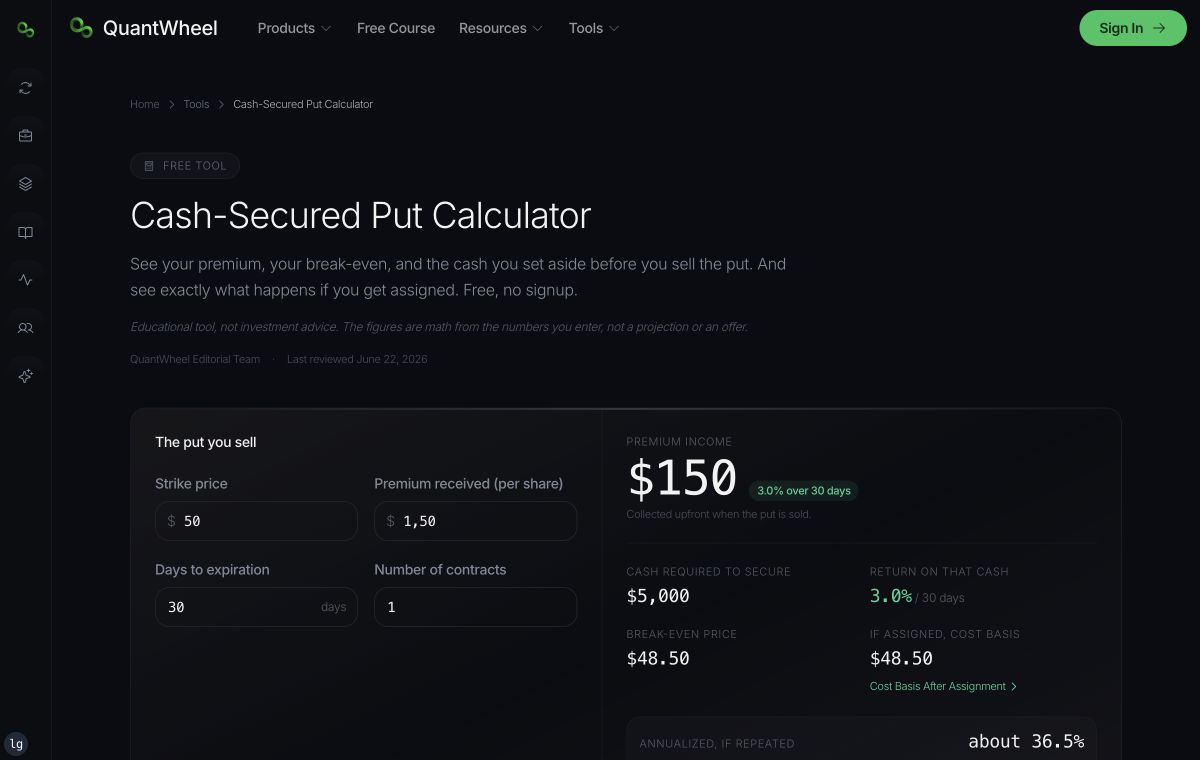
Related free tools: Cash-Secured Put Calculator, Cost Basis After Assignment Calculator, Optimal Roll.
Options trading involves substantial risk and is not suitable for all investors. Before trading options, you should read the Options Disclosure Document available from the Options Clearing Corporation. Past performance does not guarantee future results. The figures in this tool are illustrative calculations from the inputs you provide. They are not a projection, an expected return, or an offer. This tool is for educational purposes only and is not investment advice. Consult a licensed professional for advice specific to your situation.
Next step
Where to go next
Try the whole product with sample positions. No account needed.
$1 for 7 days • Cancel anytime • 14-day money-back guarantee