
You have been selling cash-secured puts for three months. You collect premium every week. Your spreadsheet shows a nice growing income stream. Then one morning, the stock gaps down 5% on an earnings miss, and your position swings from a comfortable profit to a painful loss faster than you expected.
Something you've probably experienced: - You stare at the screen wondering: "How did my delta go from 0.25 to 0.60 overnight?"
The answer: Gamma.
This guide breaks down gamma in plain language, shows you how it works with real numbers, and explains specifically why it matters for premium sellers and wheel strategy traders.
TLDR: Gamma Explained in 60 Seconds
Gamma is the Greek that measures how fast your option's delta changes when the stock price moves $1.
Here is the simplest way to think about it. Imagine you are in a car. Delta is your speed - how fast the car is going right now. Gamma is your acceleration - how quickly your speed is changing.
Why it matters for wheel traders: When you sell options (cash-secured puts and covered calls), you have negative gamma. This means when the stock moves against you, your losses accelerate. The closer you are to expiration, the stronger this acceleration becomes. This is why experienced wheel traders close or roll positions around 21 days before expiration and do not sell weekly options carelessly.
Simple example: You sell a put option with a delta of -0.25 and a gamma of 0.03. The stock drops $1. Your new delta is approximately -0.28. The stock drops another $1. Your new delta is approximately -0.31. Each dollar the stock drops, your position gets 0.03 delta worse. That is gamma at work.
The key numbers to remember:
- Gamma is highest for at-the-money options
- Gamma increases sharply near expiration
- Long options = positive gamma (large moves help you)
- Short options = negative gamma (large moves hurt you)
- Most wheel traders target 30-45 DTE to keep gamma manageable
What Is Gamma in Options Trading?
Gamma is one of the options Greeks, a set of measurements that describe how an option's price responds to different market factors. Specifically, gamma measures the rate of change of delta for every $1 change in the underlying stock price.
To truly understand gamma, you first need a quick refresher on delta. Delta tells you how much an option's price is expected to change when the stock moves $1. A call option with a delta of 0.50 should increase by roughly $0.50 when the stock rises $1. A put option with a delta of -0.30 should increase by roughly $0.30 when the stock falls $1.
But here is the problem: delta is not constant. As the stock price moves, delta itself changes. That change in delta is gamma.
This is exactly why the car analogy works so well. Delta is your speed. Gamma is how fast that speed changes. And just like in a car, acceleration can work for you or against you depending on which direction you are headed.
How to use this in your trading?
Pick option‑selling trades where you’re short as little gamma as possible near your strike (sell further out‑of‑the‑money or slightly out‑of‑the‑money) so your delta doesn’t blow up against you if the stock runs. Here's an example of a good trade which QuantWheel has found and gave it a great rating (62):
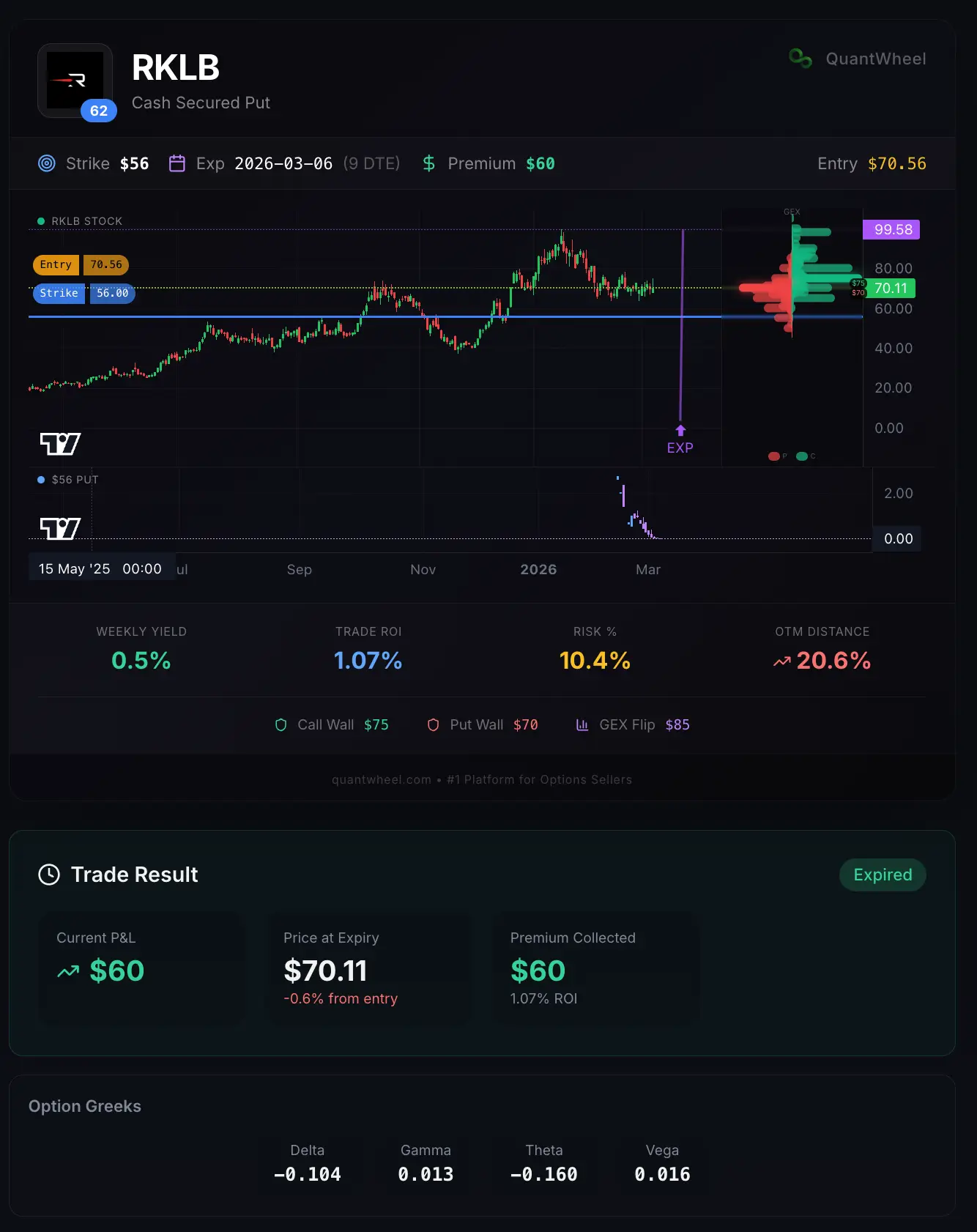
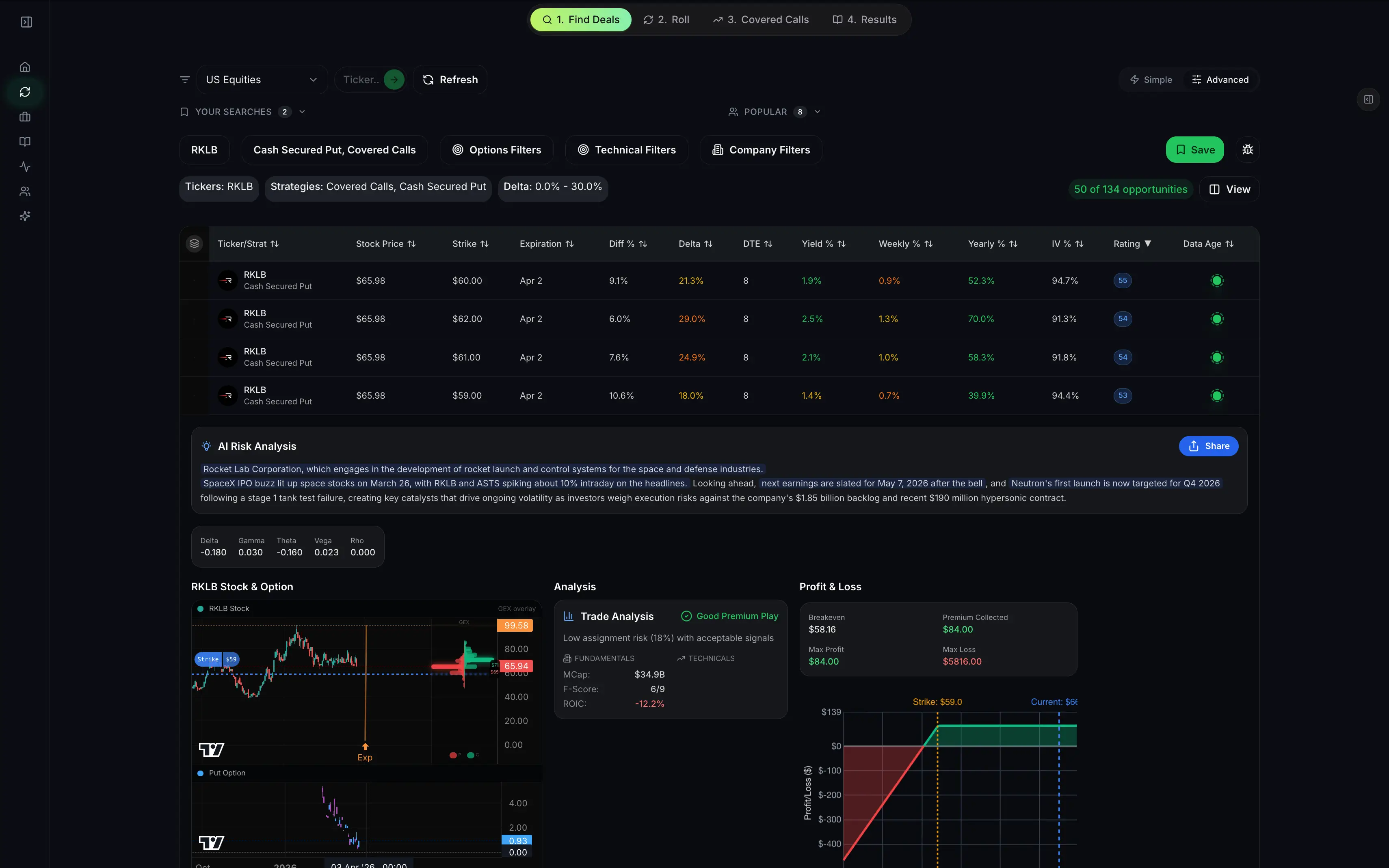
Low delta at the time of the trade, 20% otm (slightly OTM), gamma of 0.013, put wall at $70 and the stock trading at $70 - everything working in our favour with a goal of not getting assigned, just as every Cash - Secured put trade should be. Some more trades of $RKLB like the one above:
How Gamma Works: The Mechanics
Gamma Is Always Positive for the Option Itself
Whether you are looking at a call or a put, the gamma of the option itself is always positive and falls between 0 and 1.00. This means that as the stock price moves in the favorable direction for an option, its delta gets stronger. As the stock moves against the option, delta gets weaker.
For calls: when the stock rises, delta increases (moves toward 1.00). When the stock falls, delta decreases (moves toward 0).
For puts: when the stock falls, delta becomes more negative (moves toward -1.00). When the stock rises, delta becomes less negative (moves toward 0).
The sign of your gamma exposure - positive or negative - depends on whether you are long or short the option.
Long Options Have Positive Gamma
When you buy an option, you have positive gamma. This means large price moves benefit you. If the stock moves in your favor, your delta gets stronger, so your profits accelerate. If the stock moves against you, your delta gets weaker, so your losses decelerate.
Positive gamma is like having the wind at your back. The more the stock moves, the more delta works in your favor.
Short Options Have Negative Gamma
When you sell an option, you have negative gamma. This is the opposite situation. If the stock moves against your short position, your delta exposure gets worse. Your losses accelerate. If the stock moves in your favor, your delta improvement slows down. Your wins decelerate.
Negative gamma is the price you pay for collecting premium. You receive theta (time decay) income, but you accept that large moves can hurt disproportionately.
This trade-off between theta income and gamma risk is the fundamental tension at the heart of every premium-selling strategy, including the wheel.
Where Gamma Is Highest (and Why It Matters)
Not all options have the same gamma. Understanding where gamma is highest helps you choose which options to sell and when to exit them.
At-the-Money Options Have the Highest Gamma
Options whose strike price is closest to the current stock price have the most gamma. This is because at-the-money options are at the tipping point - a small move in either direction can push them from "likely expiring worthless" to "likely being exercised" or vice versa.
A far out-of-the-money option with a delta of 0.05 has very little gamma. The stock would need to move a lot before that option becomes relevant. A deep in-the-money option with a delta of 0.95 also has low gamma because it is already almost certain to be exercised.
But an at-the-money option with a delta around 0.50? Every dollar the stock moves dramatically shifts the probabilities. That is where gamma lives.
For wheel strategy traders, this matters for strike selection. Selling at-the-money options collects more premium but exposes you to significantly more gamma risk than selling options at the 0.20 or 0.30 delta range. Most experienced wheel traders target out-of-the-money strikes specifically to keep gamma lower and more manageable.
Gamma Increases as Expiration Approaches
This is the single most important gamma concept for options sellers. Gamma spikes dramatically in the final weeks and days before expiration. Here is why.
Imagine an at-the-money option with 60 days to expiration. There is plenty of time for the stock to move in either direction, so the option's delta changes gradually.
Now imagine that same at-the-money option with 2 days to expiration. The stock is right at the strike price. A $1 move up means it expires in-the-money. A $1 move down means it expires worthless. The delta has to swing from 0.50 to nearly 1.00 or 0 in just two days. That extreme sensitivity is gamma working at maximum intensity.
This is why short-dated options - and especially 0 DTE (zero days to expiration) options - carry enormous gamma risk. The premium you collect from selling them might look attractive, but a small adverse move can create losses that far exceed the premium received.
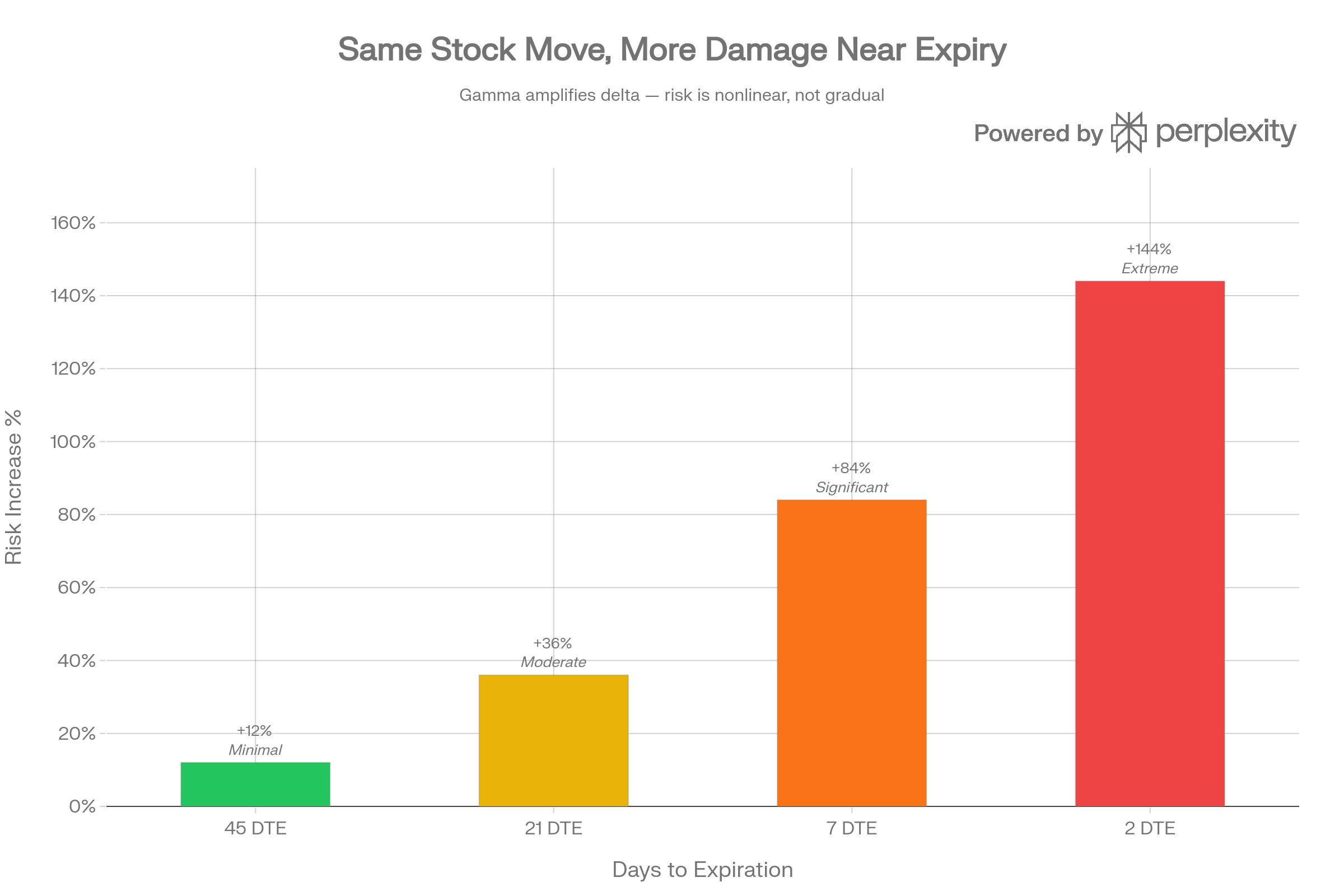
For context, data from options research consistently shows that gamma for at-the-money options can be two to three times higher in the final week before expiration compared to 30 to 45 days out. This exponential increase is why the 21-day rule exists: many systematic premium sellers close or roll their positions with at least 21 days remaining before expiration to avoid the worst of the gamma spike.
The Gamma Curve Visualized
If you were to plot gamma against time to expiration for an at-the-money option, you would see a hockey stick curve. Gamma stays relatively flat and manageable from 60 days down to about 21 days. Then it begins to curve upward. From 14 days to expiration, it steepens noticeably. From 7 days, it rises sharply. And in the final 1 to 2 days, it can spike dramatically.
For premium sellers, this curve is your risk timeline. The further right you are on it (closer to expiration), the more gamma risk you carry.
Gamma and Delta: The Relationship Every Trader Must Understand
Gamma does not exist in a vacuum. It is the link between the stock price and your position's delta. Understanding this relationship is crucial for managing any options position.
Delta Tells You Where You Are, Gamma Tells You Where You Are Going
Think of delta as a snapshot - it tells you your current directional exposure at this exact moment. If your position has a delta of -0.25, you are effectively short 25 shares of stock right now.
Gamma tells you how that snapshot will change. If your gamma is -0.03, then for every $1 the stock drops, your effective short position gets 3 shares worse (your delta moves from -0.25 to -0.28).
This is why looking at delta alone is not enough. Two positions can have the same delta but very different gamma, which means they will behave very differently as the stock moves.
Example: Same Delta, Different Gamma
Suppose you sold two different puts, both with a delta of -0.25:
Put A: 45 days to expiration, gamma of 0.02 Put B: 7 days to expiration, gamma of 0.08
Both have the same starting delta. But if the stock drops $3:
- Put A's delta moves to approximately -0.31 (-0.25 + 3 × 0.02 gamma adjustment... in practice slightly more complex due to gamma itself changing, but this gives the directional picture)
- Put B's delta moves to approximately -0.49 - nearly doubling the directional risk
Same starting point. Vastly different outcomes. The difference is gamma. This is exactly why selling short-dated options "for more premium" is dangerous. The extra theta income comes with exponentially more gamma exposure.
How Gamma Affects Your Profit and Loss
Positive gamma creates a convex payoff - your gains accelerate and your losses decelerate. This is what option buyers enjoy.
Negative gamma creates a concave payoff - your gains decelerate and your losses accelerate. This is what option sellers deal with.
For wheel strategy traders, this means your worst losses tend to come faster than your best wins accumulate. You might collect $200 in premium over two weeks through steady theta decay, then lose $500 in a single day when the stock gaps against you. That is not random bad luck. That is the mathematical reality of negative gamma.
Understanding this asymmetry is what separates traders who survive long-term from those who blow up after a few months of "easy" premium income.
Gamma Risk for Premium Sellers
If you sell cash-secured puts, covered calls, or run the wheel strategy, you are a premium seller. And every premium seller needs to understand gamma risk intimately.
What Is Gamma Risk?
Gamma risk is the danger that your position's delta will change rapidly and unfavorably as the underlying stock moves. For short options positions, this means your directional exposure can increase much faster than you anticipated.
The key insight is that gamma risk is nonlinear. A $1 move against you is manageable. A $3 move is not just three times worse - it is worse than three times because gamma has been increasing your delta exposure with every dollar the stock moved.
The Theta-Gamma Trade-Off
Every premium seller is implicitly making the theta-gamma trade-off. You are collecting theta (time decay) as income. In exchange, you are accepting gamma risk - the possibility that a large move wipes out your accumulated theta income and then some.
On a quiet day when the stock does not move much, theta works in your favor and gamma is largely irrelevant. On a volatile day when the stock makes a big move, gamma dominates and can overwhelm weeks of theta income.
This is the fundamental bargain of selling options. There is no free lunch. The premium you collect is compensation for bearing this gamma risk. Traders who forget this - who treat premium income as "free money" - tend to learn the lesson painfully.
Why Near-Expiration Gamma Risk Is Especially Dangerous
As covered above, gamma spikes near expiration. For premium sellers, this creates a specific danger pattern.
Imagine you sold a put option 30 days ago. It has been decaying nicely, and you have collected most of the premium. With 3 days to expiration, it is nearly at the money. You think: "I will just let it expire worthless and keep the rest."
This is exactly when gamma risk is at its peak. The option has very little extrinsic value left, so the theta benefit is tiny. But the gamma is enormous, meaning any move against you will rapidly push the option deep in-the-money.
This is why holding short options through the final week of expiration just to squeeze out the last 10% to 15% of premium is one of the most common mistakes premium sellers make. The risk-reward of holding is terrible: you are risking large gamma-driven losses to capture a small remaining theta benefit.
Practical Gamma Risk Scenarios for Wheel Traders
Scenario 1: Cash-secured put near expiration You sold a $50 put for $2.00 premium, 30 DTE. With 5 days to expiration, the stock is at $50.50, and the put is worth $0.20. Gamma is high. The stock drops to $48 overnight on bad news. The put is now deep in-the-money and worth around $2.30. You went from being up $1.80 to being down $0.30 in one move. Gamma accelerated your delta from about -0.45 to nearly -1.00 during that drop.
Scenario 2: Covered call after earnings You own 100 shares of a stock at $75 and sold a $80 call for $1.50. With 4 days to expiration, the stock spikes to $82 on an earnings beat. Gamma drives the call's delta from 0.40 to 0.90+ rapidly. You are now deeply in-the-money on your short call, and if you want to roll, the cost has increased dramatically.
These are not rare edge cases. They are the normal reality of selling options near expiration. Understanding gamma is what prepares you for them.
Gamma and the Wheel Strategy
The wheel strategy - selling cash-secured puts, getting assigned, then selling covered calls - is inherently a short gamma strategy. Every leg of the wheel involves selling an option, which means you carry negative gamma throughout.
Short Gamma Is the Cost of Doing Business
In the wheel, you profit when the stock stays relatively stable or moves slowly in your favor. Theta decay is your primary income source. Gamma is the risk you accept in exchange for that income.
This does not mean the wheel is bad. It means you need to understand that your risk profile is asymmetric. Small moves are great for you. Large moves are disproportionately bad.
The traders who succeed with the wheel long-term are not the ones who collect the most premium. They are the ones who manage gamma risk best.
How Gamma Affects Each Leg of the Wheel
Cash-Secured Put Phase: You sell a put and collect premium. You have negative gamma. If the stock drops slowly, theta decay helps you profit. If the stock drops sharply, gamma accelerates your losses as delta moves against you. The risk is getting assigned at a bad price on a stock that has moved well below your strike.
Covered Call Phase: After assignment, you sell a covered call on the shares you now own. Again, you have negative gamma (from the short call). If the stock rises sharply, the short call's delta moves rapidly toward 1.00, capping your upside and making the call expensive to buy back or roll.
In both phases, gamma is working against you on large moves. This is why the wheel works best on relatively stable, range-bound stocks with high implied volatility - stocks where you collect good premium but face fewer large price swings.
Gamma-Aware Strike Selection for the Wheel
Here is where understanding gamma directly improves your trading decisions.
At-the-money options have the highest gamma but also the highest premium. Out-of-the-money options have lower gamma and lower premium.
Many beginning wheel traders are tempted to sell at-the-money puts for maximum premium. But the higher gamma means their position is much more sensitive to adverse moves. More experienced wheel traders often prefer selling puts at the 0.20 to 0.30 delta range. The premium is lower, but the gamma is significantly reduced, providing a wider margin of safety.
The sweet spot for most wheel traders is finding strikes that offer enough premium to make the trade worthwhile while keeping gamma at a level where a normal adverse move does not wipe out your profits.
The 21-Day Exit Rule and Gamma
Many systematic premium sellers follow a guideline of closing or rolling positions when there are approximately 21 days until expiration. This is not an arbitrary rule. It is directly tied to gamma.
At 21 DTE, gamma is still relatively low and manageable. The position has captured roughly 50% to 70% of its maximum theta decay. Beyond this point, the remaining theta capture diminishes while gamma begins to accelerate upward.
The math consistently shows that the risk-adjusted return of holding options from 21 DTE to expiration is worse than opening a new position at 30 to 45 DTE. You are better off closing, pocketing the profit, and redeploying capital into a new trade with manageable gamma.
When you manage 15 or more wheel positions, tracking the DTE on each one and remembering when to roll or close becomes a serious challenge. This is where QuantWheel's position tracking and real-time alerts come in - it tracks your DTE and notifies you when positions approach the gamma danger zone, so you do not have to remember manually.
Gamma Versus Other Options Greeks
Gamma does not operate in isolation. It interacts with the other Greeks in ways that affect your overall position. Here is how gamma relates to each.
Gamma and Theta: The Core Trade-Off
Theta and gamma are inversely related for the option seller. High theta income tends to come with high gamma risk. Low gamma risk tends to come with low theta income.
The options that generate the most theta per day - at-the-money, short-dated options - also have the most gamma. The options with the least gamma - far out-of-the-money, long-dated options - also have the least theta.
This is not a coincidence. The market prices options to compensate buyers for time decay. The higher the gamma (and therefore the greater the benefit of large moves), the more theta the option buyer pays.
For wheel traders, the practical takeaway is that you cannot just maximize theta and ignore gamma. You need to find the right balance for your risk tolerance and account size. Most experienced wheel traders land on selling options in the 30 to 45 DTE range, at the 0.20 to 0.30 delta level, as a reasonable theta-gamma trade-off.
Gamma and Vega: Volatility Exposure
Vega measures how much an option's price changes when implied volatility shifts. For options sellers, you are typically short vega - you benefit when implied volatility decreases.
Gamma and vega often move in the same direction for at-the-money options. When implied volatility is high, gamma tends to be somewhat spread out across more strikes. When implied volatility is low, gamma concentrates more heavily at-the-money.
High implied volatility environments present an interesting dynamic for wheel traders. The premium is higher (which you want), and gamma is somewhat dispersed (which is better). But the underlying stock is also more likely to make large moves (which is worse). Understanding this interplay helps with stock selection for the wheel.
Gamma and Delta: Dynamic Risk
As discussed earlier, gamma is the bridge between price movement and delta change. For portfolio management, what matters is your aggregate delta exposure across all positions and how quickly that exposure changes (your aggregate gamma).
If you are running ten wheel positions, each with a delta of -0.25 and gamma of -0.02, your portfolio gamma is -0.20. This means a $1 move across the market (if your stocks are correlated) shifts your total delta by 0.20 - the equivalent of 20 shares of exposure appearing from nowhere.
This is why sector concentration is dangerous for wheel traders. If all your positions are in tech stocks and the sector drops 3%, the gamma effect across your portfolio compounds.
Gamma Exposure (GEX) and Market Dynamics
Beyond individual positions, gamma plays a crucial role at the market level through what traders call Gamma Exposure, or GEX. While this is a more advanced topic, understanding the basics helps you make better decisions about when to sell premium.
What Is Gamma Exposure?
Market makers who sell options to retail traders are constantly managing their gamma risk by hedging with the underlying stock. When the market's aggregate gamma exposure is positive (market makers are long gamma from selling puts that retail bought), market makers buy dips and sell rallies, which dampens volatility.
When aggregate gamma exposure is negative, market makers sell into dips and buy into rallies, which amplifies volatility. The price level where gamma exposure flips from positive to negative is called the gamma flip point.
Why GEX Matters for Wheel Traders
In positive gamma environments, the market tends to be calmer and mean-reverting. This is ideal for selling premium. Theta decay works reliably, and the underlying stocks are less likely to make the large moves that trigger your negative gamma.
In negative gamma environments, the market becomes more volatile and prone to sharp moves. This is the most dangerous environment for premium sellers. Not only are large moves more likely, but the gamma on your short positions amplifies the impact.
Paying attention to aggregate gamma exposure can help you decide when to be more or less aggressive with your wheel strategy. When GEX is strongly positive, conditions favor premium selling. When GEX flips negative, it may be prudent to reduce position sizes or hold more cash.
How to Manage Gamma Risk in Practice
Understanding gamma is step one. Managing it is where the real skill lies. Here are the specific tactics that experienced premium sellers use to keep gamma risk under control.
Choose the Right Expiration Cycle
As discussed, selling options with 30 to 45 days to expiration gives you meaningful theta decay while keeping gamma manageable. Avoid selling options with less than 14 DTE unless you fully understand the gamma implications and have sized the position accordingly.
For the wheel strategy specifically, monthly expirations in the 30 to 45 DTE range tend to offer the best balance. Weekly options can work for experienced traders, but the gamma profile requires smaller position sizes and more active management.
Select Appropriate Strikes
Selling out-of-the-money options (0.20 to 0.30 delta for puts) keeps gamma lower than selling at-the-money options. The premium is smaller, but the gamma risk is substantially reduced.
Think of it this way: you are accepting lower per-trade income in exchange for fewer losing trades. Over a large number of trades, this typically results in better risk-adjusted returns.
Close Early at Profit Targets
Setting a profit target - commonly 50% of maximum profit - and closing the position when it is reached accomplishes two things. First, you capture profit while it is available. Second, and directly related to gamma, you exit the position before it reaches the part of its life where gamma risk begins to spike.
If you sold a put for $2.00 and it is now worth $1.00, you have captured 50% of the maximum profit. The remaining $1.00 of potential profit would require holding through increasing gamma risk. Closing here is the gamma-aware decision.
Diversify Across Uncorrelated Positions
Gamma risk compounds when positions are correlated. If you run ten wheel positions all on tech stocks, a sector-wide selloff hits all of them simultaneously. Your portfolio gamma effect is magnified.
Spreading positions across different sectors - some technology, some consumer staples, some healthcare, some financials - means that adverse moves in one sector do not trigger gamma-driven losses across your entire portfolio.
Monitor Your Positions Consistently
Gamma risk changes every day as time passes and the stock price moves. A position that had comfortable gamma at 30 DTE with the stock well above the strike can become a high-gamma risk position at 10 DTE with the stock now near the strike.
This is where manual tracking in spreadsheets breaks down. With five or more active wheel positions, each with changing deltas, gammas, and DTE, keeping track manually becomes error-prone and time-consuming.
QuantWheel's real-time position tracking and customizable alerts solve exactly this problem. You set your rules - close at 50% profit, roll at 21 DTE, alert if delta exceeds 0.40 - and it monitors every position automatically. You focus on the trading decisions. It handles the monitoring.
Gamma Squeeze: What It Is and Why You Should Care
You may have heard the term gamma squeeze in the context of meme stocks or dramatic short-term price spikes. Understanding this phenomenon adds another layer to your gamma knowledge.
How a Gamma Squeeze Works
A gamma squeeze occurs when a rapid increase in call option buying forces market makers to hedge by purchasing the underlying stock. Here is the chain reaction:
- Traders buy a large volume of out-of-the-money call options
- Market makers who sold those calls need to hedge by buying shares (delta hedging)
- Their buying pushes the stock price up
- As the stock price rises, the delta of those calls increases (because of gamma)
- Market makers need to buy even more shares to stay hedged
- This buying pushes the price up further, creating a self-reinforcing cycle
The gamma squeeze is a feedback loop where gamma forces market makers into buying that drives more gamma-driven buying.
What This Means for Wheel Traders
If you have sold covered calls on a stock experiencing a gamma squeeze, your short calls can move deep in-the-money very quickly. The gamma acceleration means your call's delta races toward 1.00, your shares are effectively locked at the strike price, and you miss the entire upside move.
Conversely, if you sold cash-secured puts on a stock that reverses sharply after a gamma squeeze, you could face rapid assignment as the stock falls back down.
The practical lesson: be cautious about selling options on stocks with unusually high call open interest and heavy speculative activity. These stocks are more susceptible to gamma squeezes, and the resulting volatility can overwhelm your position.
Gamma and 0 DTE Options: Understanding the Extreme
Zero days to expiration (0 DTE) options have exploded in popularity. They offer high theta income because the entire remaining premium decays in a single day. But they also carry extreme gamma risk.
Why 0 DTE Gamma Is So Intense
At expiration, an at-the-money option has the highest possible gamma. A small move in the stock can swing the option from worthless to deeply in-the-money. The delta can move from 0.50 to nearly 1.00 (or 0) in minutes.
For an option seller, this means your position can go from profitable to deeply underwater in the time it takes to get a cup of coffee. There is literally no time to react or manage.
Should Wheel Traders Use 0 DTE?
Most wheel strategy practitioners avoid 0 DTE options for their core strategy. The wheel philosophy - conservative, consistent, boring, profitable - is fundamentally at odds with the extreme gamma profile of 0 DTE options.
Some experienced traders allocate a small portion of their portfolio to 0 DTE strategies, but they size positions very small and accept that any individual trade can be a total loss. This is a different mindset than the steady premium collection of the wheel.
If your goal is consistent income with managed risk, sticking to 30 to 45 DTE options for your wheel trades keeps gamma at a level where you can manage your positions with discipline and without constant screen-watching.
Calculating and Tracking Gamma in Your Portfolio
Knowing the gamma of each individual position is useful. Knowing the aggregate gamma of your portfolio is essential.
Portfolio-Level Gamma
Your portfolio's gamma is the sum of gamma across all positions. If you have five short puts each with gamma of -0.03, your portfolio gamma is -0.15. This means that for every $1 move across your positions, your total delta exposure shifts by 0.15 - the equivalent of 15 shares of unexpected directional risk.
For larger portfolios with ten or more positions, this number can get significant quickly. A portfolio with -0.50 aggregate gamma adds or subtracts 50 shares of effective exposure for every $1 of broad market movement.
Tracking Gamma Over Time
Gamma is not static. It changes with the stock price, with time, and with implied volatility. A position that was low-gamma yesterday can be high-gamma today if the stock has moved toward the strike price and time has passed.
This dynamic nature is what makes manual tracking so challenging. You are not tracking a fixed number - you are tracking a moving target across multiple positions, each changing at different rates.
This is exactly the kind of operational challenge that QuantWheel's Wheel Native Journal was designed for. It tracks your full position lifecycle - from selling the initial put through assignment through covered call and exit - and surfaces the risk metrics that matter, including DTE and delta exposure, so you can make informed decisions about when to close, roll, or hold.
When to Pay Extra Attention to Gamma
There are specific situations where you should increase your gamma awareness:
Approaching expiration (less than 21 DTE), stock price moving toward your strike, earnings announcements that could cause gaps, broad market volatility spikes, and positions where you have concentrated exposure.
In all of these situations, gamma is working against you with extra intensity. Being aware of this lets you make proactive adjustments rather than reactive panic decisions.
Gamma-Aware Position Sizing for the Wheel
Position sizing might be the most practical application of gamma understanding for wheel traders. If you size your positions correctly relative to your gamma exposure, you can weather adverse moves without blowing up your account.
The Rule of Thumb
A common guideline for wheel traders is to never allocate more than 5% to 10% of your account to a single wheel position. But this guidance becomes more nuanced when you factor in gamma.
If you are selling puts on high-gamma positions (near expiration or near the money), even 5% allocation might be too much. If you are selling far out-of-the-money puts with 45 DTE, 10% allocation might be reasonable.
The key question is: "If this stock moves 10% against me overnight, can my account absorb the loss without affecting my other positions?" If the answer is no, the position is too large, regardless of what the premium looks like.
Sizing Based on Maximum Adverse Move
Rather than sizing based on premium yield, consider sizing based on the worst realistic move. For a stock that trades with a 2% average daily range, a three standard deviation event might be a 6% to 8% gap.
Calculate what a 6% to 8% move against your position would cost you, including the gamma-driven delta acceleration, and make sure that loss is tolerable relative to your total portfolio. This gamma-informed approach to position sizing prevents the common trap of oversizing positions because the premium "looks good."
Common Gamma Mistakes (And How to Avoid Them)
Mistake 1: Ignoring Gamma Entirely
Many new premium sellers focus exclusively on theta. They look at the premium, the days to expiration, and the annualized return. They never consider how quickly their position can change if the stock moves against them.
Fix: Look at the gamma of every option you sell. Ask yourself: "If this stock moves $5 against me, what will my new delta be?" If the answer is uncomfortable, either choose a different strike or reduce position size.
Mistake 2: Holding Through Expiration Week
The last week of an option's life offers diminishing theta return with sharply increasing gamma risk. Holding a short option into the final 5 to 7 days just to capture the last bit of premium is one of the worst risk-reward decisions a premium seller can make.
Fix: Establish a rule for closing or rolling positions at 21 DTE or when 50% of premium has been captured, whichever comes first. Automate this rule with alerts so you do not have to remember to check.
Mistake 3: Selling Weekly Options Without Adjusting Size
Weekly options have higher gamma from day one compared to monthly options. Traders who sell weekly options at the same size as monthly options are taking on significantly more gamma risk without realizing it.
Fix: If you sell weeklies, reduce your position size proportionally to account for the higher gamma. Better yet, stick to 30 to 45 DTE options for your core wheel positions and only use weeklies for a small, clearly defined portion of your portfolio.
Mistake 4: Concentrating in Correlated Positions
Running ten wheel positions all in the semiconductor sector means your portfolio gamma is heavily correlated. A sector-wide decline triggers gamma-driven losses across every position simultaneously.
Fix: Diversify your wheel positions across at least three to four uncorrelated sectors. Monitor your sector concentration regularly.
Mistake 5: Ignoring Gamma During Earnings
Stocks frequently gap 5% to 15% on earnings announcements. If you have a short options position going into earnings, the gap can trigger massive gamma-driven delta changes overnight - and you have zero opportunity to manage the position during the gap.
Fix: Either close short options before earnings or fully accept that the position might move deep in-the-money. Factor the earnings risk into your trade plan before you enter the position, not after.
Real-World Gamma Example: A Complete Wheel Cycle
Let us walk through how gamma affects a realistic wheel trade from start to finish. The examples used here are for educational purposes only and are not recommendations to buy or sell any security.
Selling the Cash-Secured Put
You identify a stock trading at $55. You sell a $50 put with 35 DTE, collecting $1.50 in premium. The put has a delta of -0.22 and a gamma of 0.02.
At this point, gamma is low and manageable. A $1 drop in the stock increases your delta to about -0.24. Your risk grows slowly.
Two Weeks Pass: Stock Drifts Down
The stock moves from $55 to $52 over two weeks. You now have 21 DTE. Your put's delta has moved from -0.22 to approximately -0.35, partly from the price drop and partly from the gamma effect. But the put has also decayed to about $0.80 from theta, so you are still profitable.
This is the decision point. With 21 DTE and the stock closer to your strike, gamma is starting to increase. You can close for a roughly 47% profit ($0.70 per contract) or hold for more.
The Gamma-Aware Decision
If you close now, you lock in your profit and avoid the upcoming gamma spike. If you hold, you risk the stock dropping below $50 in the final three weeks when gamma will magnify every dollar of adverse movement.
The experienced wheel trader closes here. The remaining potential theta of $0.80 is not worth the increasing gamma risk. You take the 47% win, redeploy capital, and live to trade another cycle.
Putting It All Together: Your Gamma Checklist
Here is a practical checklist for incorporating gamma awareness into your wheel strategy:
Before entering a trade, check the gamma of the option relative to its delta. Prefer selling options with gamma below 0.04 to 0.05 as a starting point. Sell at 30 to 45 DTE for manageable gamma profiles.
During the trade, monitor delta changes and be aware that gamma accelerates losses on adverse moves. Have a plan for what you will do if the stock moves to your strike price.
At 21 DTE, evaluate whether to close or roll. If the position is profitable, closing captures gains and eliminates gamma risk. If the position is at a loss, rolling to a further expiration reduces gamma while maintaining the position.
Before earnings, decide whether to hold or close. Never be caught by surprise by an earnings date you forgot about.
At the portfolio level, track your aggregate gamma exposure across all positions. Diversify to avoid concentrated gamma risk.
$1 for 7 days • Cancel anytime • 14-day money-back guarantee
Risk Disclosure: Options trading involves substantial risk and is not suitable for all investors. Past performance does not guarantee future results. This content is for educational purposes only and should not be considered investment advice. Always do your own research and consider consulting with a financial advisor before making investment decisions.
The examples used in this article are for educational purposes only and are not recommendations to buy or sell any security. All investment decisions should be based on your own analysis and risk tolerance.