Free tool
Free Options Max Pain Calculator
Calculate the max pain strike price - where option sellers lose the least money at expiration. A key level for options traders.
2 free calculations remaining today • Sign up free
GEX Workspace
Multi-ticker dashboard with alerts
GEX Heatmap
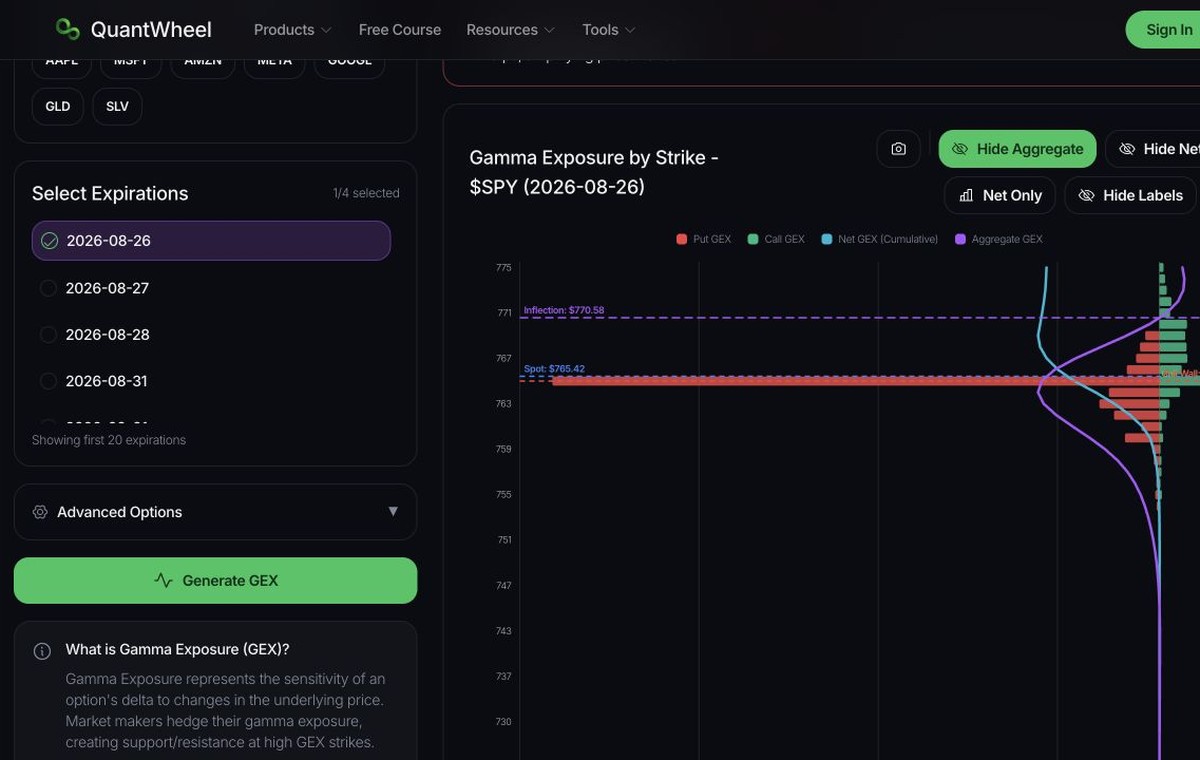
Strike-level gamma by expiration
GEX Intraday PlayTape
Intraday gamma movement & replay
What is Max Pain?
Max Pain is the strike price at which option sellers (market makers) would lose the least amount of money if the stock expired at that price. The theory suggests stocks tend to gravitate toward this price near expiration.
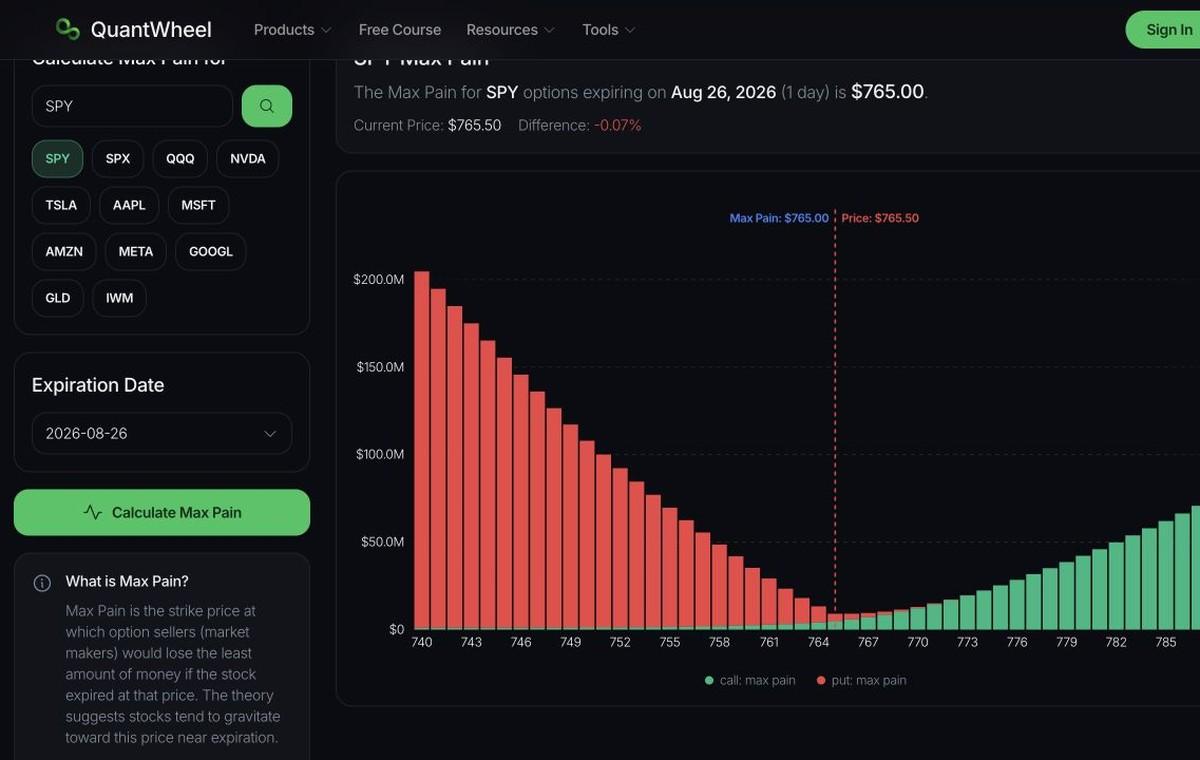
Chart Legend:
- Green bars: Call option pain per strike
- Red bars: Put option pain per strike
- Blue line: Max Pain strike
- Red line: Current underlying price
What is Max Pain in Options Trading?
Max Pain (also called “options pain” or “max option pain”) is a theory in options trading that suggests the price of an underlying stock tends to move toward the strike price where the total dollar value of outstanding options contracts expires worthless - causing the maximum financial loss (“pain”) for option buyers and the minimum loss for option sellers (typically market makers and institutions).
The concept is rooted in the idea that large option sellers and market makers, who take the opposite side of retail trades, have a financial incentive to hedge their positions in a way that pushes the stock price toward the max pain level as expiration approaches. While not guaranteed, many traders observe that stocks with heavy options volume often close near their max pain price on expiration Friday.
How to Read the Max Pain Chart
The max pain chart above displays a stacked bar chart for every available strike price in the selected expiration. Each bar has two components:
- Green bars (call max pain): The total dollar amount call option holders would lose if the stock expired at that strike. This increases as you move to higher strike prices.
- Red bars (put max pain): The total dollar amount put option holders would lose if the stock expired at that strike. This increases as you move to lower strike prices.
The chart forms a characteristic V-shape. The lowest point of the V is the max pain strike - the price at which the combined pain across all options is minimized. Two vertical dashed lines show the max pain price (blue) and the current underlying price (red), making it easy to see how far apart they are.
The greater the distance between the current stock price and the max pain strike, the more “gravitational pull” the max pain theory predicts. However, strong fundamental or technical catalysts can override this effect.
How Max Pain is Calculated
The calculation iterates through every strike price in the options chain. For each possible expiration price:
- Call Pain: For every open call contract with strike K and open interest OI, calculate max(0, Price − K) × OI × 100 (each contract represents 100 shares).
- Put Pain: For every open put contract with strike K and open interest OI, calculate max(0, K − Price) × OI × 100.
- Total Pain: Sum call pain + put pain at that price.
- Max Pain Strike: The price where total pain is the lowest across all possible expiration prices.
This calculator uses real-time open interest data from the options chain, updating as new data becomes available during market hours.
Frequently Asked Questions
Next step
Where to go next
Max Pain is part of the paid GEX plan. Try the GEX tools on sample tickers first.
$1 for 7 days • Cancel anytime • 14-day money-back guarantee