
Max Pain is the strike at which the largest number of open option contracts would expire worthless. The reasoning: option buyers lose the most money if the stock closes at this level, so it's often called "the strike where pain is maximum for option buyers" — hence the name. For most of the trading community, it's an informal reference to the price many traders expect the underlying to "pin" to near expiration.
Before you start
Required:
- QuantWheel GEX or QuantWheel PRO subscription.
Time to complete: 3 minutes
Steps
1. Open the Max Pain tab
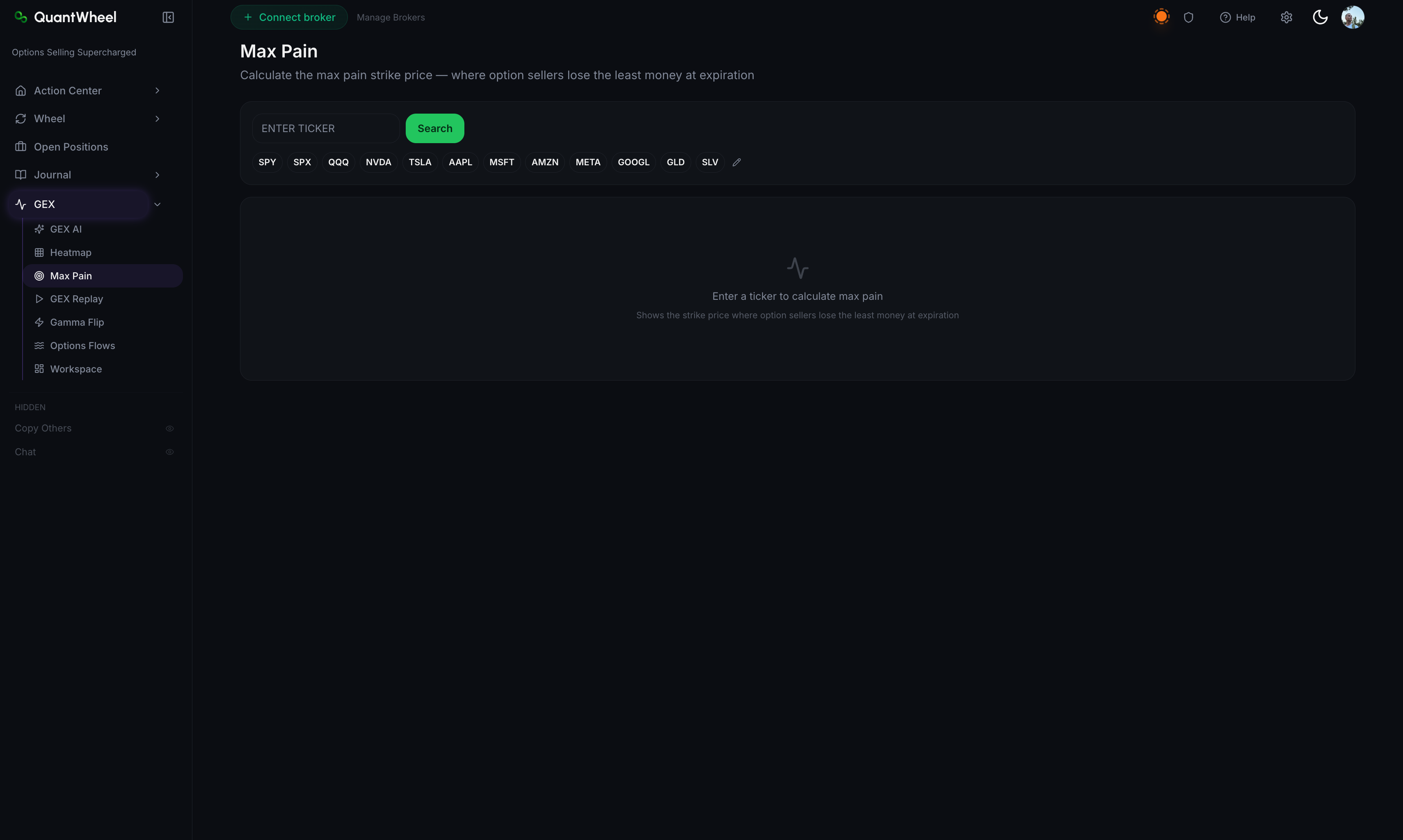
In the sidebar, open GEX → Max Pain.
2. Enter a ticker
Type any ticker with listed options into the ticker input, or click a popular-ticker shortcut (SPY, SPX, QQQ, NVDA, TSLA, AAPL).
3. Select an expiration
Max Pain is calculated per expiration, not aggregated. Pick the expiration you want to analyze:
- Nearest weekly — most commonly used; relevant for end-of-week pin behavior
- Monthly expiration — bigger open interest, potentially stronger magnetism
- Quarterly (OPEX) expiration — highest open interest of all; historically the strongest pin behavior
4. Read the output
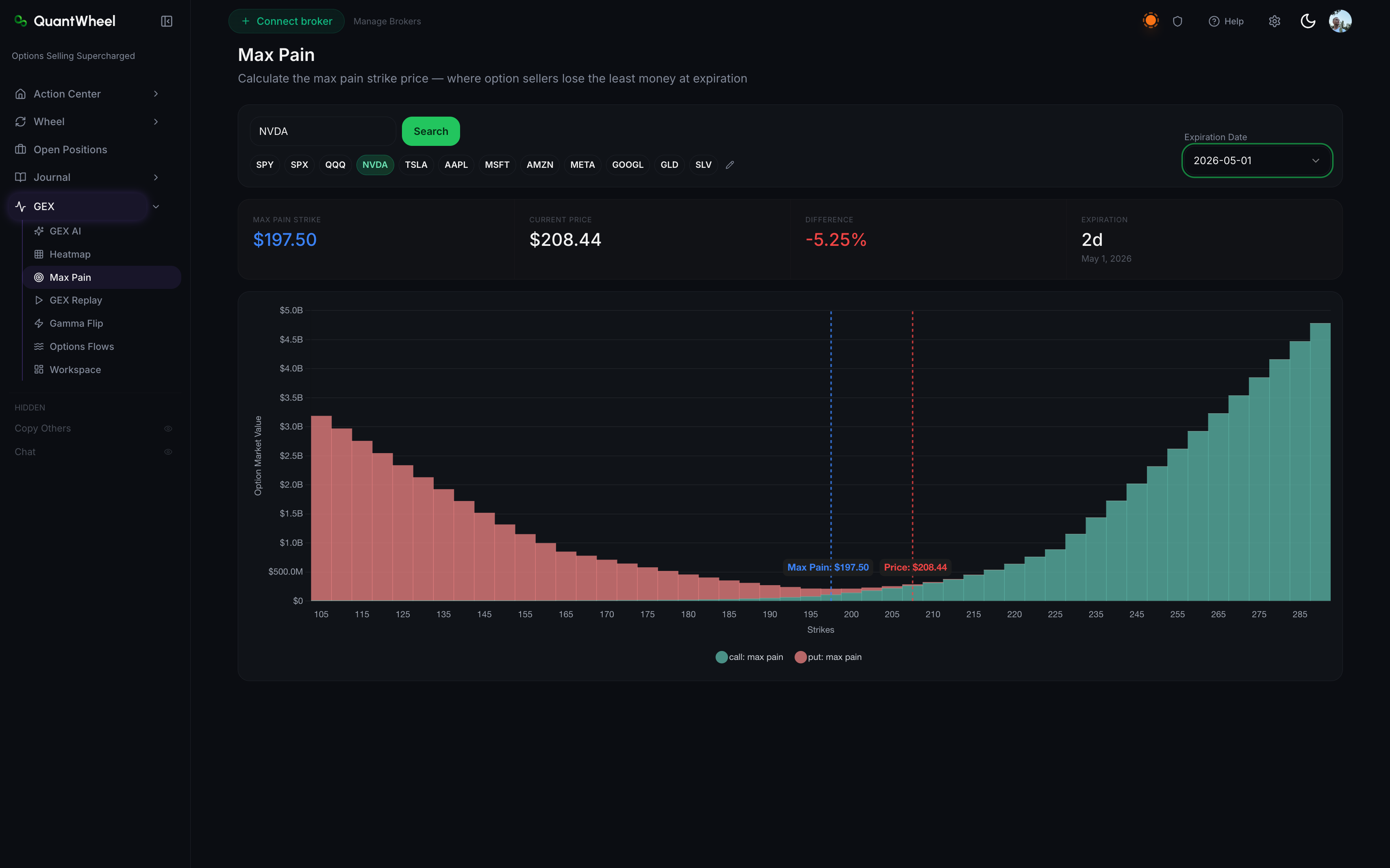
The page shows four pieces of information.
Summary cards:
- Max Pain Strike — the strike where the most open contracts would expire worthless
- Current Price — where the underlying is now
- Difference (%) — gap between Current Price and Max Pain, as a percentage
- Expiration — the date you selected
Bar chart — Option Market Value by strike. Each bar represents the total dollar value of open options (calls plus puts) at that strike. The strike with the lowest combined value — the Max Pain strike — is typically rendered in a highlighted color. Call-side max pain may appear in teal; put-side max pain may appear in red.
Current price indicator line — a vertical line on the chart showing where current price sits relative to the Max Pain strike.
How to use Max Pain
As a magnet price near expiration
The day of or day before expiration, Max Pain can act as a magnet. Price often drifts toward it, especially on quiet sessions without major news. The closer to expiration, the stronger the effect — there's less time for the stock to move away.
Practical application: if you're trading expiration-day action and the stock is near Max Pain, fading small moves has structural tailwind. If it's far from Max Pain, the pin behavior is weaker.
As a distance-from-pin indicator
The Difference (%) card tells you how far from Max Pain the stock currently sits. Small differences (under 1%) suggest the pin may hold; large differences (over 3%) suggest Max Pain is unlikely to exert meaningful magnetism by expiration.
As a read on positioning
Multiple expirations sharing the same Max Pain strike suggests that level matters beyond any single expiration — option activity is systematically concentrated there. Multiple expirations with different Max Pain strikes suggests positioning is varied and no single level dominates.
When Max Pain fails
Max Pain is a statistical tendency, not a trading rule. It fails when:
- News breaks. Earnings, macro data, policy announcements overwhelm the pin dynamic. A stock heading to Max Pain before CPI can reverse sharply after the print.
- The stock is far from Max Pain with little time left. If SPY is at $410 and Max Pain is at $425 with two hours to expiration, the magnetism has little chance to work.
- Implied volatility is elevated. When IV is high, option premium dominates intrinsic value, and the pin calculation (based on where options expire worthless) matters less relative to actual option deltas.
- It's a meme stock or short-squeeze candidate. These move on retail flow and dealer hedging that's different from typical market-making dynamics. Max Pain is statistically less reliable.
Treat Max Pain as context, not signal. A bullish setup at Max Pain is slightly stronger than one mid-range. A bullish setup trying to push price away from Max Pain runs into a headwind.
Common issues
The Max Pain strike doesn't match what I see on other tools.
Different tools compute Max Pain slightly differently — some include weekly and monthly open interest together, some use dealer-assumed hedging ratios, some ignore far-out-of-the-money options. Small differences are normal. If a competing tool shows a wildly different number, they're probably computing something else entirely (a GEX-weighted version, for example).
Max Pain is at a strike with no open interest.
Possible if the calculation uses interpolation across strikes. The "Max Pain strike" is the calculated point where aggregate option value is minimized; it doesn't need to be a specifically-listed strike for the calculation to land there.
Why does Max Pain matter for directional traders when it's mostly about expiration?
Even earlier in the week, Max Pain reveals where option open interest concentrates. Institutional positioning at that strike matters for directional trades even before expiration magnetism kicks in. The levels around Max Pain often coincide with Call Wall / Put Wall clusters.
Can I set an alert on Max Pain?
Not directly through Max Pain today. Use a Smart Alert with a condition referencing the Max Pain strike's distance from current price. See How to create a Smart Alert.
Should I trade against Max Pain?
Fading moves away from Max Pain into expiration has structural tailwind, especially the day of. Fading moves toward Max Pain has structural headwind. Neither is a standalone strategy — combine with your own signal.
Related
- Understanding GEX and what it tells you
- How to read the GEX Heatmap
- Understanding call walls, put walls, and gamma flip
Risk disclaimer: Options trading involves substantial risk of loss and is not suitable for all investors. Past performance does not guarantee future results. This content is for educational purposes only and is not investment advice.