
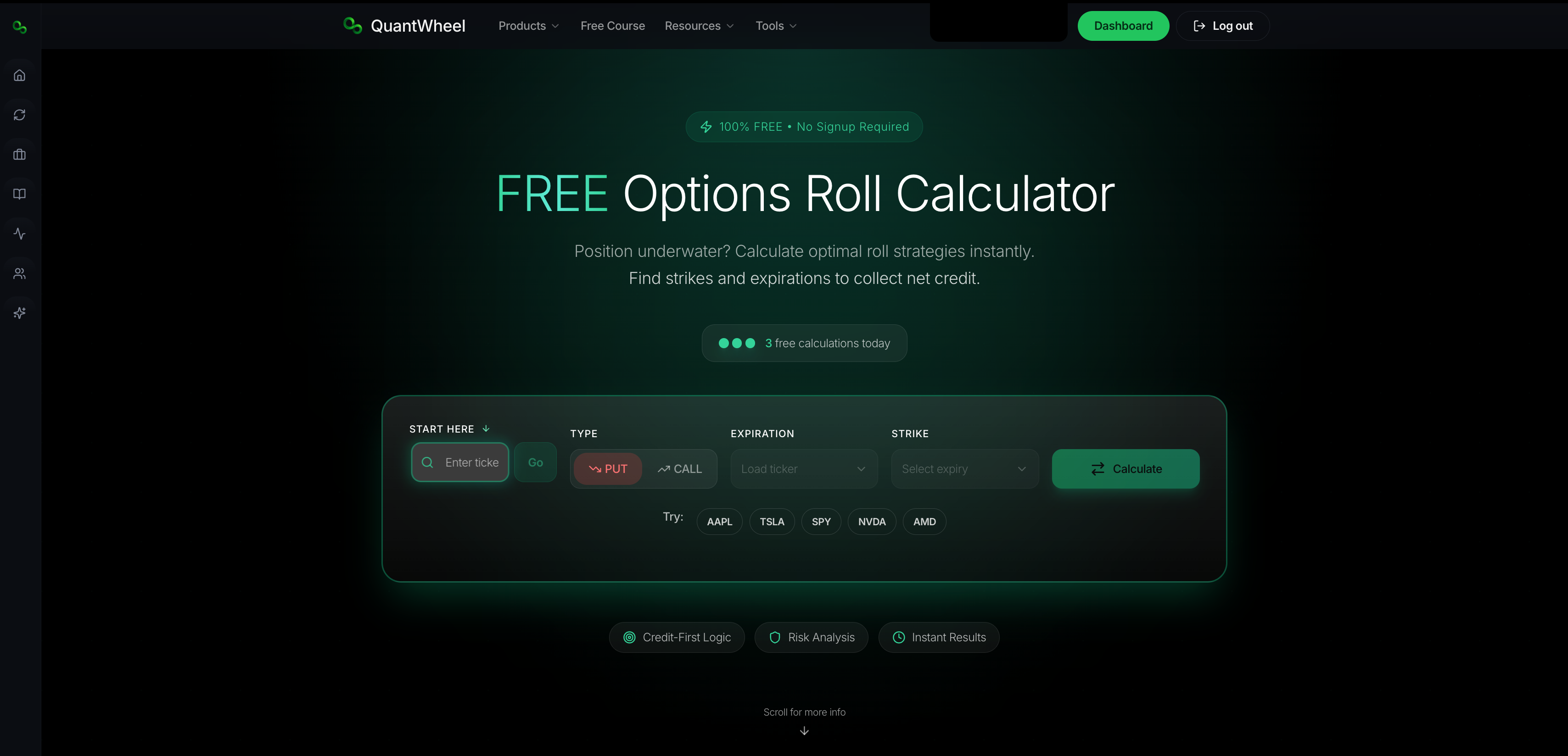
The Free Optimal Roll Finder helps you evaluate rolling decisions on short options positions - cash-secured puts, covered calls, or short options legs. Enter the existing position (ticker, strike, expiration, type) and the tool surfaces candidate rolls ranked by net credit, duration, and risk-adjusted metrics.
Free to use. No account required.
What this tool does
For a given short option position, rolling means closing the current contract and simultaneously opening a new one further out in time, usually at a similar or adjusted strike. The "optimal" roll depends on what you're trying to achieve - maximizing credit, extending time, reducing delta, or repositioning strikes.
The tool evaluates available roll candidates across future expirations and ranks them by:
- Net credit (or debit) - the cash received (or paid) to make the roll
- Duration added - days to expiration on the new position vs. the old
- Strike adjustment - whether rolling same-strike, up, or down
- Greek impact - change in delta, theta, and probability of profit
Who it's for
Options sellers - wheel traders, covered-call writers, premium-sellers in general. Useful when:
- Your short option is approaching expiration and you want to extend duration
- The underlying has moved against your strike and you want to roll out and down (or up)
- You want to take profits on a winning short but don't want to redeploy the cash into cash
- You want to compare several roll candidates quickly before placing the trade
How to use it
- Enter the existing position - ticker, strike, expiration, and type (put or call)
- Set your preferred DTE range for the new position (e.g., 30-45 days)
- Optionally set strike constraints - same strike only, or a range
- Click Find Rolls
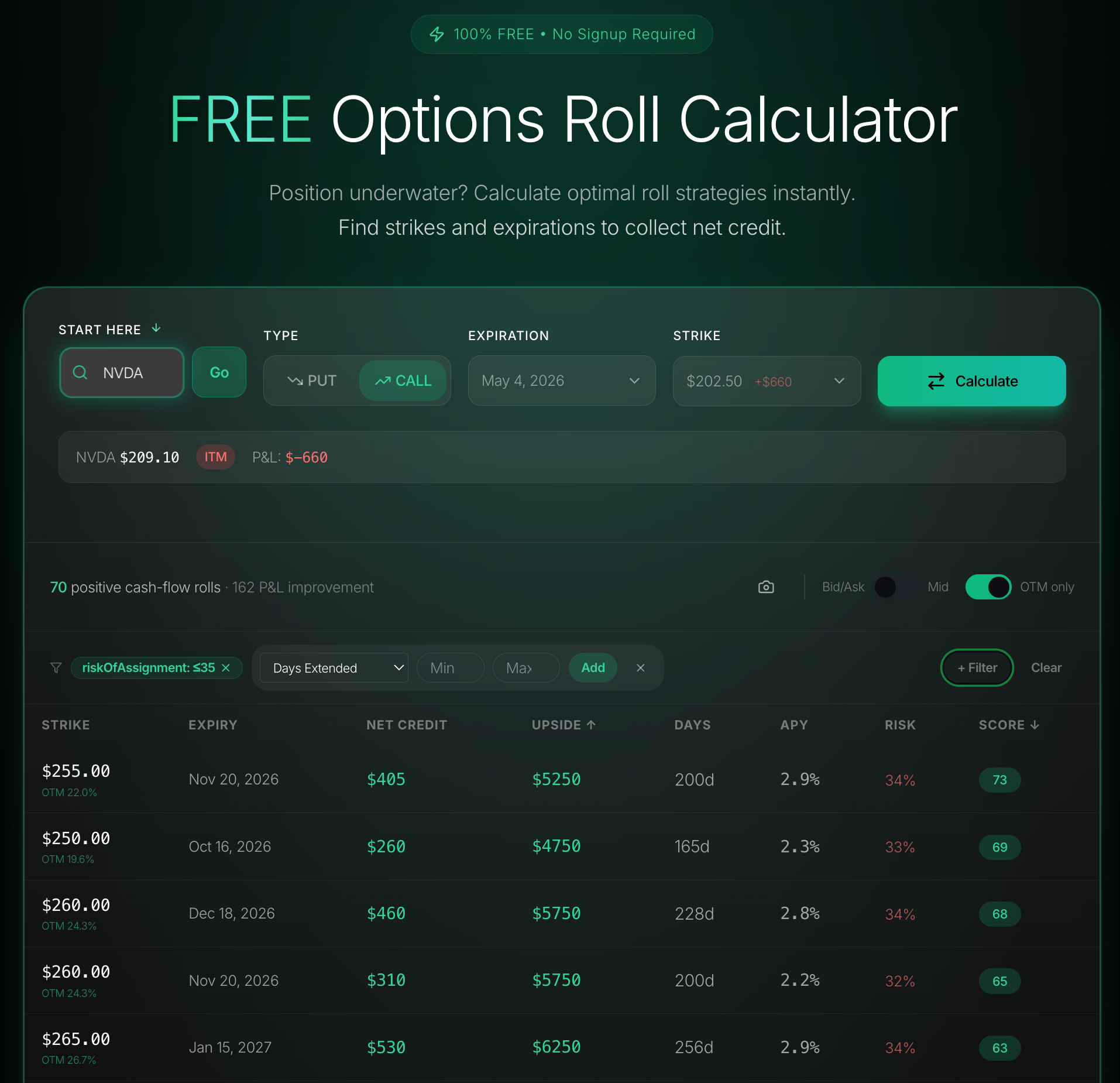
- Review the ranked candidates - each shows the net credit, the new DTE, the strike, and the Greek changes
Reading the output
High-credit rolls are the most common goal - you're rolling to collect more premium. But high credit often comes with higher delta risk on the new position.
Duration-focused rolls prioritize time added, sometimes at the cost of lower credit. Useful when you want to keep the position on without accepting higher risk.
Strike-adjusted rolls can be used to move strikes further out-of-the-money (reducing assignment risk) or further in-the-money (capturing more premium but accepting higher assignment probability).
The "optimal" roll varies by situation. The tool surfaces candidates; the choice is yours.
What this tool doesn't do
- Doesn't place the trade. You still execute the roll in your broker.
- Doesn't account for transaction costs on every candidate - some brokers charge per-contract fees that eat into small credit rolls.
- Doesn't evaluate whether rolling is the right move at all. Sometimes closing the position entirely is better than rolling. The tool assumes you've decided to roll and helps you pick the best candidate.
Limitations of the free version
The free Optimal Roll finder evaluates rolls on any ticker, one position at a time. For a deeper workflow, you typically want:
- Automatic detection of roll candidates on all your open positions - not having to enter each one manually
- Integration with your real cost basis - so credit rolls reflect your actual breakeven, not just the visible strike
- Integration with the authenticated Roll flow - so candidates are generated from your connected broker data
The authenticated Roll workflow inside QuantWheel surfaces candidates from your connected broker data. You still review the candidate and execute the roll in your broker.
Related tools
- Free Options Calculator - model P&L and Greeks on individual options
- Free Strategy Explorer - visualize multi-leg positions and what-ifs
- How to roll a position on QuantWheel - the authenticated workflow with full broker integration