You sold a cash secured put last month. The stock dropped below your strike price. Now you’re staring at an email notification that says “Assignment Notice” in your inbox, and you’re wondering what happens next.
Here’s the truth that most beginner wheel strategy traders discover the hard way: assignment isn’t the problem. The problem is tracking what happens after assignment.
Full transparency: This guide is written by the QuantWheel team.
We built QuantWheel because we ran the wheel strategy ourselves and kept making cost basis errors after assignments — especially when managing multiple positions across rolling cycles. Also, it got tedious.
That frustration is what this article is about, and it’s also what we solved.
We’ve written this guide to be useful whether you use QuantWheel or not. Every concept here applies regardless of how you track your trades — spreadsheet, broker notes, or dedicated software. We’ll tell you where QuantWheel helps, and we’ll be upfront when we do.
Author: David Romic
TL;DR: Everything You Need to Know About Cash Secured Put Assignment
Cash secured put assignment happens when the stock price is below your strike price at expiration, obligating you to buy 100 shares at the strike price. Here’s what you need to know:
- You buy the stock: Your reserved cash is used to purchase 100 shares at the strike price
- Assignment is planned: In the wheel strategy, this is the intended outcome, not a failure
- Your real cost basis is lower: Strike price minus premium collected = your actual cost per share
- Tracking becomes complex: Brokers don’t adjust for premium collected, creating manual tracking nightmares
- Next step is covered calls: Sell calls against your shares to continue the wheel cycle
Simple Example: You sold a $50 cash secured put on ABC stock for $2.00 premium ($200 total). The stock drops to $47 at expiration. You get assigned and buy 100 shares at $50 per share ($5,000). But your real cost basis is $48 per share ($50 strike – $2 premium), not the $50 your broker shows. You immediately sell a $52 covered call for $1.50, lowering your effective cost to $46.50. If the stock stays above $52, you profit $5.50 per share ($550 total) when the shares get called away.
What Is Cash Secured Put Assignment?
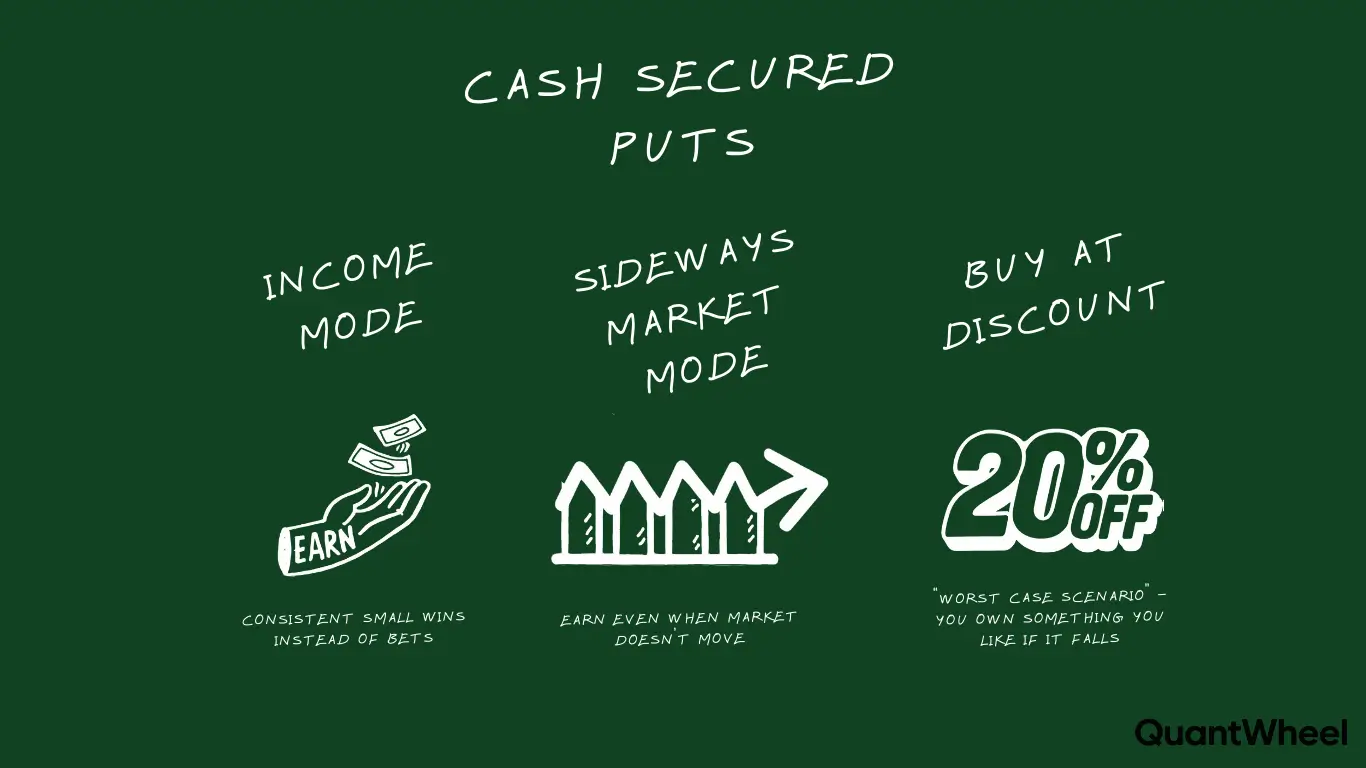
When you sell a cash secured put, you’re making a promise: “I’ll buy 100 shares of this stock at the strike price if it’s below that price at expiration.” In exchange for this promise, you collect premium upfront.
Assignment is what happens when the stock price is below your strike at expiration (or sometimes before expiration for American-style options). The person who owns the put you sold exercises their right to sell shares to you at the strike price.
Here’s the mechanical process:
- Saturday after expiration: The Options Clearing Corporation (OCC) processes all in-the-money options
- Saturday evening/Sunday: Your broker receives the assignment notice
- Monday morning: 100 shares appear in your account at the strike price
- Monday morning: Cash equal to strike price × 100 is debited from your account
For the wheel strategy trader, this is the planned transition from Phase 1 (selling puts) to Phase 2 (owning shares and selling covered calls).
The Cost Basis Problem Nobody Talks About
Here’s where most traders run into trouble. Your broker’s cost basis and your real cost basis are different numbers, and this difference matters.
Here’s a little research we did and what we noticed as a repeating problem
Example 1:
A r/CoveredCalls post (Dec 2024): a user was assigned 300 shares at a $27.50 strike and noted their broker showed $27.50 as cost basis — not the premium-adjusted $27.50 minus the $1.15/share premium he collected.
Multiple commenters had to explain that the premium sits separately in cash, not auto-deducted in the position display.
Example 2:
The “below assignment price CC” trap – the most commonly complained consequence on Reddit.
Users in r/thetagang explicitly describe the “fatal mistake new sellers make” as panicking post-assignment and selling covered calls below their actual assignment price — which can only happen if they don’t know their true breakeven.
Solution: If you collect $2 on a $50 put and get assigned, your net stock cost is $48 — you can sell the shares for $48.01 and still profit overall.
What Your Broker Shows
When you get assigned, your broker records your cost basis as the strike price. If you were assigned on a $50 put, your broker shows your cost basis as $50 per share.
This is technically correct from an accounting standpoint. You paid $50 per share when the shares were delivered to your account.
Your Real Cost Basis
But you didn’t really pay $50 per share. You collected premium when you sold the put. If you collected $2.00 per share in premium, your true economic cost is $48 per share ($50 strike – $2 premium collected).
This $2 difference is critical because:
- Breakeven point: You break even if the stock is at $48, not $50
- Covered call strike selection: You can sell calls at the $49 or $50 strike and still profit
- Tax reporting: You need accurate cost basis for capital gains calculations
- Performance tracking: Your returns are based on your real capital invested
The Manual Tracking Nightmare
Here’s what inevitably happens once you start selling options, both CCs and CSPs:
You get assigned on three different positions in the same week. Two of them were rolled twice before assignment, so you collected premium on three separate transactions before finally getting assigned. One position was from two months ago and you honestly can’t remember if you collected $1.80 or $2.10 in premium.
Your broker shows one number. Your spreadsheet shows a different number. You’re 90% sure you calculated it right, but tax season is coming and you’re starting to doubt yourself.
This is exactly where most wheel traders struggle. The broker doesn’t track your true cost basis. Excel formulas break. Manual calculations introduce errors. After 10+ assignments, you’ve lost track.
Here’s where the tracking gets complex: your broker shows the $50 cost basis for the shares they delivered to you. But you need to manually track that $2 premium you collected weeks or months ago, adjust your cost basis, and remember this through the entire wheel cycle. Then when you sell covered calls for another $1.50, you need to track that too. If the shares get called away, your total profit per share was $3.50 (strike price – adjusted cost basis + covered call premium), but your broker just shows the capital gain from $50 to wherever the shares were called.
Solution:
When you get assigned, QuantWheel can automatically adjust your cost basis by the premium collected. No manual tracking. No spreadsheet formulas.
When Does Assignment Happen?
Assignment typically happens in three scenarios:
1. At Expiration (Most Common)
If your put is in-the-money (ITM) at Friday’s market close, you’ll almost certainly be assigned. The OCC automatically exercises ITM options that are at least $0.01 ITM.
Example: You sold a $50 put. At Friday 4pm ET close, the stock is trading at $49.80. You will be assigned and buy 100 shares at $50 (even though the market price is $49.80).
2. Early Assignment (Dividends)
If the underlying stock pays a dividend, put holders might exercise early to capture the dividend. This is more common when:
- The dividend is large relative to remaining extrinsic value
- Your put is deep in-the-money
- The ex-dividend date is approaching
Example: You sold a $50 put on a stock trading at $47. The stock pays a $0.80 dividend tomorrow. A put holder might exercise today to buy shares and capture that dividend, assigning you early.
3. Early Assignment (Deep ITM)
Occasionally, deep in-the-money puts are exercised early even without dividends. This is rare but happens when there’s no extrinsic value left and the holder wants to deploy capital elsewhere.
In practice, early assignment is uncommon unless dividends are involved. Most assignments happen at expiration.
What to Do After Assignment: The Wheel Continues
You’ve been assigned. You now own 100 shares. Here’s your systematic process:
Step 1: Confirm Your True Cost Basis
Calculate: Strike price – premium collected = real cost per share
Document this number. You’ll need it for strike selection and tax reporting.
Step 2: Sell a Covered Call (Immediately or Next Day)
The wheel strategy continues by selling calls against your shares. Most traders sell covered calls the first trading day after assignment.
Strike selection criteria:
- Strike price should be above your true cost basis (to ensure profit if called away)
- Typically 30-45 days to expiration (DTE)
- Delta around 0.30 (roughly 30% probability of being ITM at expiration)
- Premium should provide acceptable return for the time period
Example: You were assigned at $50 strike after collecting $2 premium, so your cost basis is $48. The stock is trading at $49. You sell a $52 covered call 35 DTE for $1.50 premium.
If the shares get called away at $52, your total profit is:
- Premium from original put: $2.00
- Capital gain from $50 to $52: $2.00
- Premium from covered call: $1.50
- Total profit per share: $5.50 (11.5% return on your $48 real cost basis)
Step 3: Manage the Covered Call
Now you’re in Phase 2 of the wheel. You have three potential outcomes:
Outcome A – Called Away (Best Case): Stock rises above your strike. Shares are called away at expiration. You keep all premiums collected plus capital gain. Return to Phase 1 and sell cash secured puts again.
Outcome B – Expires Worthless (Good Case): Stock stays below your strike. Call expires worthless, you keep the premium. Sell another covered call next cycle. Continue collecting premium while holding shares.
Step 4: Track Everything
This is where complexity multiplies. You need to track:
- Original put premium
- Assignment cost basis adjustment
- Covered call premiums (potentially multiple if you sell several cycles)
- Rolled position adjustments (if you roll calls)
- True cost basis throughout the full cycle
- Total return calculation when you finally close the position
Manual tracking breaks at this point for most traders. After your third or fourth wheel cycle running simultaneously, the spreadsheet becomes a nightmare.
My latest trade as an example – $INTC
| Event | Date | Action | Strike | Premium | Adj. Cost Basis |
|---|---|---|---|---|---|
| Sell CSP | Oct 3 | Sell 1x $47 put (35 DTE) | $47 | $1.85 | — |
| Assignment | Nov 7 | Assigned, buy 100 shares | $47 | — | $45.15 |
| Sell CC #1 | Nov 8 | Sell 1x $49 call (30 DTE) | $49 | $1.20 | $43.95 |
| Expire Worthless | Dec 8 | Call expires, sell CC #2 | $49 | $0.95 | $43.00 |
| Called Away | Jan 10 | Shares called at $49 | $49 | — | — |
Total Return: Oct 3 – Jan 10 (99 days) = $4.00/share, 8.85% on $45.15 basis
Assignment Scenarios: What to Expect
Let’s walk through real scenarios with specific numbers.
The INTC trade above is a real example of Scenario 2 (multiple call cycles). The scenarios below use simplified numbers for clarity — refer to the INTC example for real-world context.
Scenario 1: Clean Assignment and Profitable Close
Setup: Sell $50 cash secured put on XYZ for $2.00 premium (35 DTE)
What happens: Stock drops to $48 at expiration
Assignment: You buy 100 shares at $50. Real cost basis: $48
Covered call: Immediately sell $52 call (35 DTE) for $1.50
Outcome: Stock rises to $53. Shares called away at $52.
Total return:
- Put premium: $2.00
- Covered call premium: $1.50
- Capital gain: $2.00 ($50 purchase to $52 sale)
- Total: $5.50 per share = $550 on $4,800 cost basis = 11.5% return in ~70 days
Scenario 2: Multiple Call Cycles Before Close
Setup: Sell $50 put for $2.00, assigned, cost basis $48
Covered call 1: Sell $52 call for $1.50, expires worthless (stock at $50)
Covered call 2: Sell $51 call for $1.20, expires worthless (stock at $50.50)
Covered call 3: Sell $51 call for $1.10, shares called away (stock at $51.50)
Total return:
- Put premium: $2.00
- Three call premiums: $3.80 total
- Capital gain: $1.00 ($50 purchase to $51 sale)
- Total: $6.80 per share = $680 on $4,800 cost basis = 14.2% return in ~150 days
Note: In this scenario, you made more total profit than Scenario 1, despite shares being called away at a lower price ($51 vs $52), because you collected three cycles of call premium.
Scenario 3: Stock Drops After Assignment
Setup: Sell $50 put for $2.00, assigned, cost basis $48
Situation: Stock drops to $45 after assignment
Covered call: You could sell a $48 call (at your cost basis) for $0.60, or sell a $46 call (below cost basis) for $1.40
Decision framework:
- Selling $48 call: Lower premium ($0.60), but ensures profit if called away. May take multiple cycles.
- Selling $46 call: Higher premium ($1.40), but locks in $2/share loss if called away. Faster cost basis reduction.
- Aggressive approach: Sell $46 call for $1.40. New cost basis: $46.60. If assigned, small loss, but freed capital for new positions.
- Conservative approach: Sell $48 call for $0.60. Keep selling at $48 until called away or cost basis reduced below $48.
There’s no universal “right” answer. It depends on your conviction in the stock, opportunity cost of capital, and risk tolerance.
Common Mistakes After Assignment
Mistake 1: Not Adjusting Cost Basis for Premium
Forgetting that you collected $2 premium and thinking your breakeven is $50 instead of $48. This leads to overly conservative covered call strikes and missed profit opportunities.
Mistake 2: Selling Calls Below Cost Basis Without Realizing It
Selling a $49 call thinking your cost basis is $50, not realizing your real cost basis is $48. You think you’re locking in a loss, but you’re actually still profitable.
Mistake 3: Panic When Stock Drops After Assignment
Assignment happened because the stock dropped below your strike. It might drop more. This is normal. You sold the put knowing this risk. Your plan should include “what if the stock continues dropping.”
Mistake 4: Selling Calls Too Far OTM
After assignment at $50 (real cost $48), the stock recovers to $49, and you sell a $55 call to “be safe.” The premium is tiny ($0.30), and the position ties up capital for 35 days for minimal return. Better to sell closer to current price for meaningful premium.
Mistake 5: Not Having a Management Plan
Getting assigned without a predetermined plan for covered call strike selection, DTE, and what to do if the stock drops further. Emotional decisions replace systematic process.
Tax Implications of Assignment
Assignment creates specific tax reporting requirements:
Cost Basis for IRS
Your cost basis for tax purposes is the strike price, not the adjusted cost basis. The premium from the put is recorded separately as short-term capital gain when the put expired/was assigned.
According to IRS Publication 550, your cost basis for tax purposes is the strike price, not the adjusted cost basis.
Example:
- Sold $50 put for $2, assigned
- Tax basis in shares: $50 (not $48)
- Put premium of $2: Short-term capital gain (reported separately)
- Later sell shares at $52: $2 short-term capital gain from stock ($52 – $50 cost basis)
- Total taxable gain: $4 ($2 from put + $2 from stock)
This is why your broker shows $50 as the cost basis – it’s technically correct for tax reporting. But for your trading decisions and performance tracking, you need to know your real economic cost of $48.
Wash Sale Considerations
If you were assigned on a stock you recently sold at a loss, wash sale rules might apply. The IRS disallows the loss deduction if you acquire substantially identical securities within 30 days before or after the sale.
Example scenario:
- Day 1: Sell 100 shares of ABC at a loss
- Day 15: Sell cash secured put on ABC
- Day 45: Get assigned on the put, buying 100 shares
This triggers a wash sale. Your loss from Day 1 is disallowed and added to the cost basis of the shares you acquired on Day 45.
This is complex and beyond the scope of this article. Consult a tax professional for your specific situation, especially if you trade the same underlying frequently.
Advanced Assignment Considerations
Assignment Risk Before Expiration
American-style options can be exercised any time. Deep in-the-money puts with no extrinsic value and approaching dividends are most at risk.
Monitor for:
- Dividend ex-dates (most common cause of early assignment)
- Deep ITM puts with <$0.05 extrinsic value
- Hard-to-borrow stocks (put holders might exercise to short)
If you don’t want assignment before expiration, close or roll the position before the ex-dividend date.
Rolling to Avoid Assignment
If you don’t want to own the stock, you can roll the put before expiration:
Roll out: Same strike, later expiration (collects more time premium)
Roll down and out: Lower strike, later expiration (reduces basis if eventually assigned)
Example: $50 put expiring this Friday, stock at $48. Roll to $50 put expiring next month for additional $0.80 credit. Or roll to $47 put next month for additional $0.50 credit.
Rolling defers assignment and collects more premium, but extends your obligation and capital commitment.
Position Sizing for Assignments
If you’re running multiple wheel positions, you need sufficient capital for potential simultaneous assignments.
Conservative sizing: Assume all puts get assigned simultaneously. Have 100% of assignment value in cash.
Moderate sizing: Assume 50% of puts get assigned simultaneously. Have 50% in cash, use margin if needed.
Aggressive sizing: Use margin for assignments, maintaining required margin levels.
Most wheel traders operate in the conservative to moderate range, especially after experiencing a volatility spike that assigns multiple positions at once.
Tools and Tracking
| Method | Best For | Limitations |
|---|---|---|
| Broker notes | 1–2 positions | No cost basis adjustment |
| Spreadsheet (Excel/Sheets) | Up to ~5 positions | Manual errors at scale |
| Trade journal | Any volume | No automation |
| Dedicated tools (e.g., QuantWheel, Tradervue, etc.) | 10+ positions | Paid – but makes life easier and no mistakes |
Here’s what you really need:
Must-Have Tracking
- Original put premium collected (for cost basis)
- Assignment date and strike (for tax basis)
- All covered call premiums collected (for total return)
- Adjusted cost basis (for decision making)
- Days in position (for return calculation)
Manual Tracking Methods
Spreadsheet: Works for 1-2 positions. Breaks down at 5+ simultaneous positions. Manual updates introduce errors. Difficult to maintain across multiple assignments and covered call cycles.
Broker notes: Some brokers let you add notes to positions. Better than nothing but limited functionality.
Journal: Physical or digital trade journal. Reliable but requires discipline and manual calculations.
What Automated Tracking Does?
Manual tracking isn’t sustainable at scale.
That’s why QuantWheel automatically tracks cost basis through complete wheel cycles. When you get assigned, your cost basis adjusts instantly.
When you sell covered calls, premium is tracked automatically.
When shares are called away, total return is calculated across the full cycle.
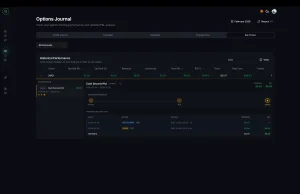
No spreadsheets. No manual formulas. No remembering premiums collected three months ago. The moment any event happens in your wheel position, the tracking updates automatically and accurately.
Track automatically inside QuantWheel →
Conclusion: Assignment Is Part of the Plan
If you’re running the wheel strategy, assignment isn’t a failure – it’s the planned transition to the covered call phase. The challenge isn’t assignment itself. The challenge is tracking your real cost basis through assignment, multiple covered call cycles, potential rolls, and eventual position close.
Your broker shows one number. Your real cost is different.
Assignment is boring. Tracking assignment shouldn’t drive you crazy.
Risk Disclosure
Options trading involves substantial risk and is not suitable for all investors. Past performance does not guarantee future results. This content is for educational purposes only and should not be considered investment advice. Always do your own research and consider consulting with a financial advisor before making investment decisions.
The examples used in this article are for educational purposes only and are not recommendations to buy or sell any security. All investment decisions should be based on your own analysis and risk tolerance.