
You've heard traders talk about generating "passive income" by selling options, but most explanations sound like they're written in another language. Cash secured puts are actually one of the most straightforward options strategies - once someone explains them in plain English.
Here's what you need to know: A cash secured put lets you get paid for agreeing to buy a stock you're interested in, at a price you're comfortable with. That's it. The catch? You have to actually buy that stock if the price drops to your agreed level.
Let's break down exactly how this works, when it makes sense, and what the real risks are.
Need help finding quality Cash - Secured Puts? Remove the noise with QuantWheel →
Inside you can also track your cash secured put positions automatically, with cost basis calculations and roll alerts.
TLDR: Cash Secured Puts Explained Simply
What is a cash secured put? A cash secured put is when you sell someone else the right to sell you 100 shares of a stock at a specific price (the strike price) before a certain date (expiration). You collect money upfront (the premium) and must have enough cash in your account to buy those shares if required.
Simple example: You sell a $50 cash secured put on Apple (AAPL) and collect $200 premium. If AAPL stays above $50, you keep the $200. If AAPL drops to $45, you must buy 100 shares at $50 ($5,000 total), but your real cost is $48 per share ($5,000 - $200 premium = $4,800 / 100 shares).
Key benefit: You earn income upfront and potentially buy stocks you want at a discount.
Main risk: You could be forced to buy stocks that continue falling, creating unrealized losses.
Who it's for: Investors who want to own specific stocks anyway and are comfortable buying them at lower prices than today's market value.
How Cash Secured Puts Work: Step by Step
Let's walk through the mechanics of selling a cash secured put with a real example.
Step 1: Choose a Stock You Want to Own
Cash secured puts work best when used on stocks you'd genuinely be happy to own. Don't sell puts on random stocks just because the premium looks attractive.
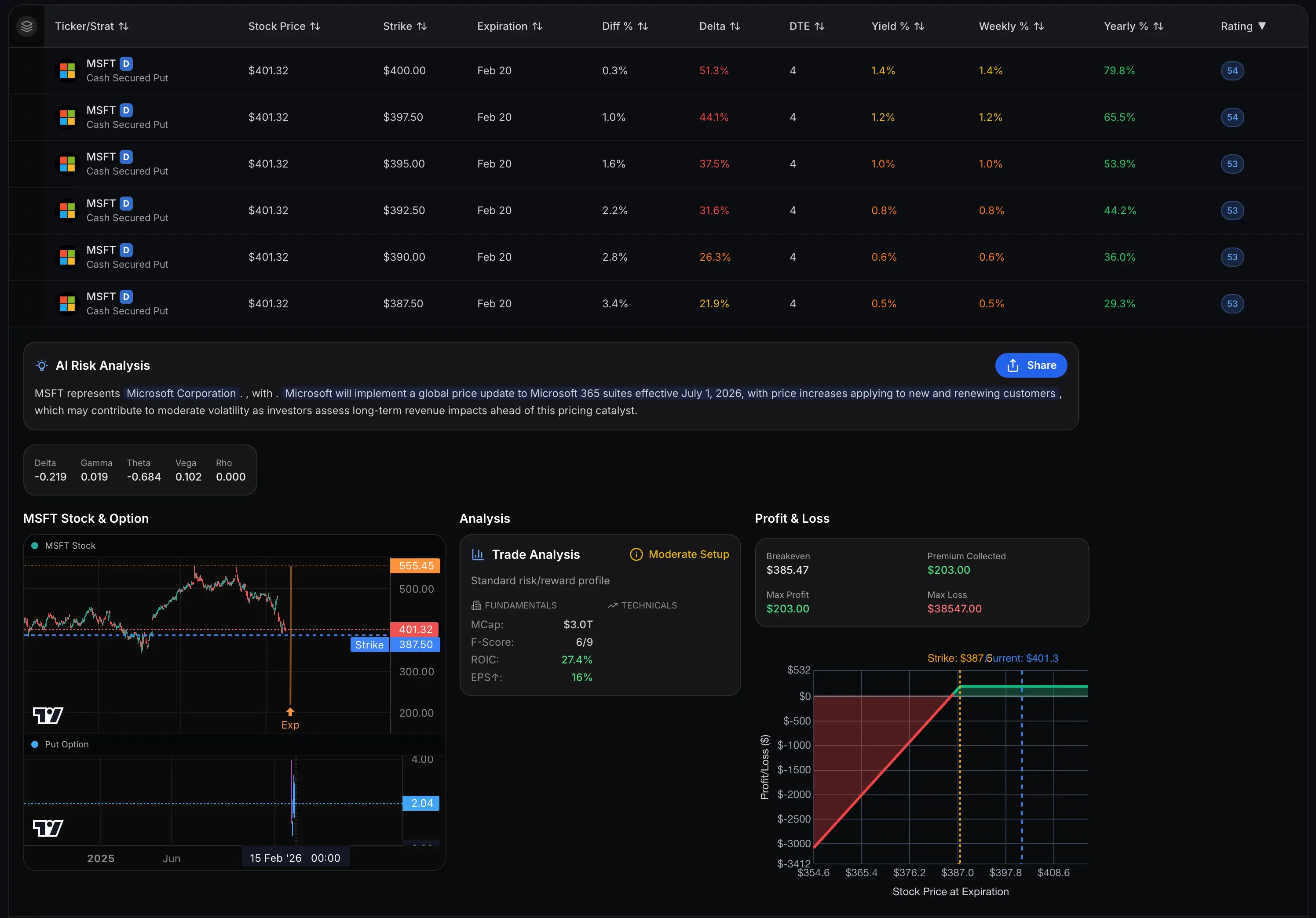
Example: You like Microsoft (MSFT) as a long-term investment. It's currently trading at around $400 per share, but you'd prefer to buy it at lower, $370-$390.
Here are top deals you could find, due to current market conditions, these would be most beneficial:
Step 2: Sell a Put Option at Your Desired Price
Let's say you want to sell a put option expiring in 30 days, which has a less than 20% chance of assignment.
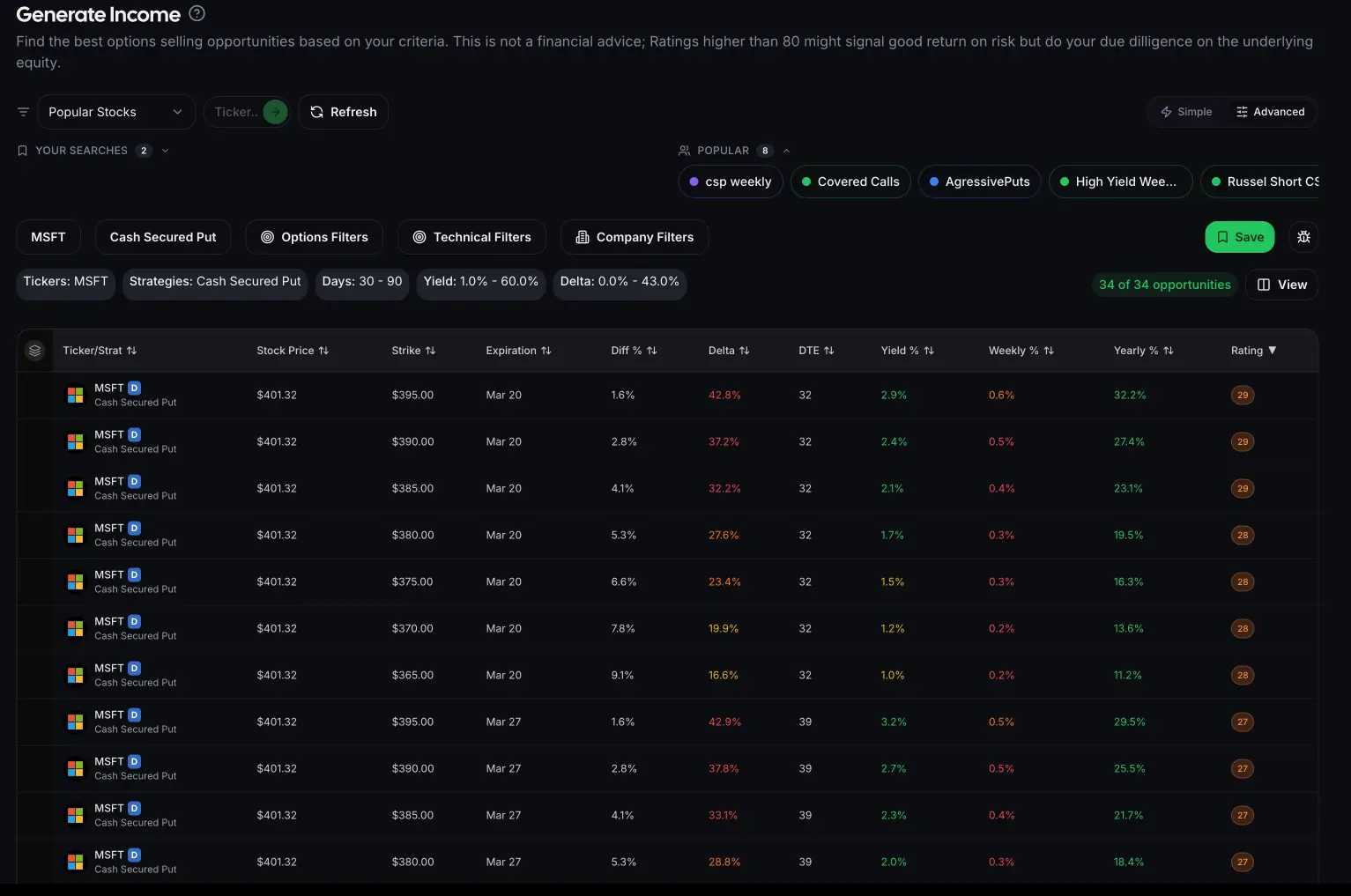
You notice a $370 strike price supports your trade idea.
Here's your best pick:
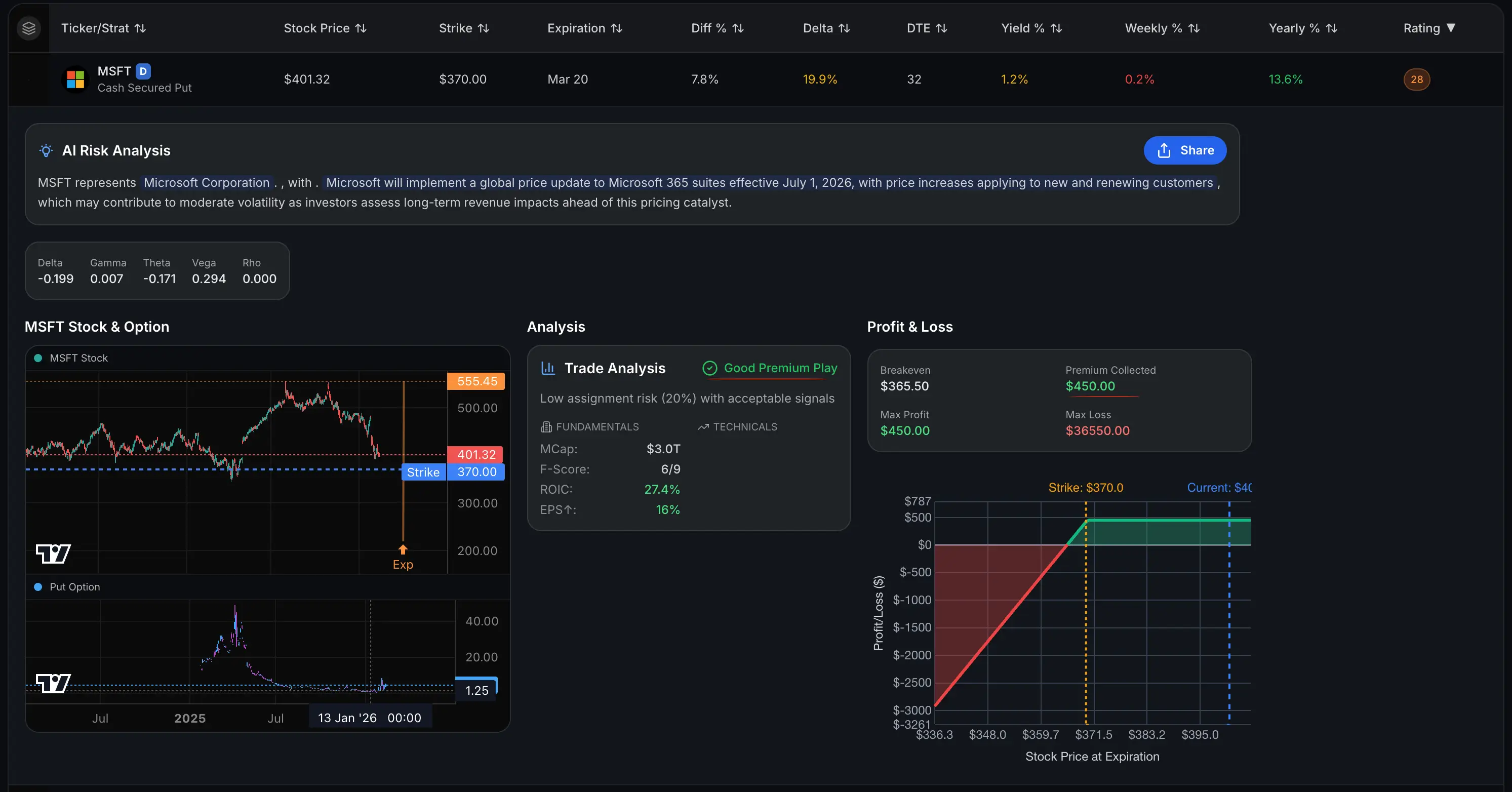
Let's say you collect $450 in premium for this contract, like it's shown in the example trade.
What you've done: You've agreed to buy 100 shares of MSFT at $370 per share ($37,000 total) if the stock drops below $370 before expiration. In exchange, you immediately receive $450.
Here's what you would be able to choose if you filter for 30 days of expiration:
Step 3: Your Broker Holds Cash as Collateral
Your broker requires you to have $37,000 in cash available. This ensures you can fulfill your obligation to buy the shares if assigned. This is why it's called a "cash secured" put - the cash secures your obligation.
Step 4: Wait for Expiration
Over the next 30 days, one of two things will happen:
Scenario A - Stock stays above $370: The put expires worthless. You keep the full $350 premium as profit, and you're free to sell another put if you want.
Scenario B - Stock drops below $370: You're "assigned" and must buy 100 shares at $400 per share. Your cash is used to purchase the shares. Your effective cost basis is actually $396.50 per share ($37,000 - $450 premium = $36,550 / 100 shares).
Understanding Assignment
Assignment is when the put buyer exercises their right to sell you shares at the strike price. This typically happens automatically at expiration when the stock is below the strike price.
Important: Assignment is not a bad outcome if you picked a stock you wanted to own. You're buying it at the price you agreed to, and you collected premium income along the way. Many wheel strategy traders intentionally seek assignment as part of their strategy.
Create a system for finding Cash - Secured puts inside QuantWheel →
Real Example: Cash Secured Put on AMD
Let's look at a complete real-world example with specific numbers.
Stock: AMD (Advanced Micro Devices) Current price: $165 Your target buy price: $155 Strategy: Sell cash secured puts at $155 strike
The Trade:
- Sell 1 AMD put contract: $155 strike, 30 days to expiration
- Premium collected: $285 (this goes into your account immediately)
- Cash required: $15,500 (100 shares × $155)
- Your account: Must have $15,500 available
Outcome 1 - AMD stays above $155 (expires worthless):
- Result: Keep $285 premium as profit
- Return: 1.84% in 30 days ($285 / $15,500)
- Annualized: ~22% (though returns aren't guaranteed to compound)
- Time invested: Maybe 5 minutes to enter the trade
Outcome 2 - AMD drops to $150 (you get assigned):
- Result: Buy 100 shares at $155 = $15,500
- Premium kept: $285
- Effective cost basis: $152.15 per share ($15,500 - $285 = $15,215 / 100)
- Current value: $15,000 (100 shares × $150)
- Unrealized loss: $215 (but you own AMD at $152.15 vs market price of $165 when you started)
Key insight: Even though AMD dropped to $150, your effective purchase price of $152.15 is still better than the $165 it was trading at when you sold the put.
The Math Behind Cash Secured Puts
Understanding the calculations helps you evaluate if a trade makes sense.
Premium Calculation
Premium return = (Premium collected / Cash required) × 100
Using our AMD example:
- Return = ($285 / $15,500) × 100 = 1.84%
Effective Cost Basis
Effective cost basis = Strike price - (Premium collected / 100)
AMD example:
- Cost basis = $155 - ($285 / 100) = $152.15 per share
Maximum Loss
Maximum loss = (Strike price × 100) - Premium collected
AMD example if stock goes to zero:
- Max loss = ($155 × 100) - $285 = $15,215
Though realistically, quality stocks don't go to zero. Your practical risk is the stock declining significantly, leaving you with underwater shares.
Breakeven Point
Breakeven = Strike price - (Premium collected / 100)
This is the same as your effective cost basis: $152.15 in our example.
When to Use Cash Secured Puts
Cash secured puts work particularly well in specific situations:
1. You Want to Buy a Stock Anyway
This is the ideal use case. You're planning to buy shares, so you might as well get paid to wait for your target price.
Example: You want to buy Disney at $95, but it's currently $102. Sell a $95 put, collect premium, and either buy Disney at your target or keep the premium if it doesn't drop.
2. You Want to Generate Conservative Income
If you have cash sitting idle, selling cash secured puts on quality stocks can generate 1-3% monthly returns. This is more active than dividend stocks but more conservative than speculation.
3. You Believe a Stock Has Temporary Weakness
When you think a quality stock is temporarily oversold, selling puts at support levels lets you profit from mean reversion or acquire shares at a discount.
4. You're Starting the Wheel Strategy
Cash secured puts are the first step in the wheel strategy, a systematic income approach. When assigned, you transition to covered calls on the shares. QuantWheel's journal automatically tracks these transitions from cash secured puts through assignment to covered calls.
When NOT to Use Cash Secured Puts
Avoid cash secured puts in these scenarios:
1. You Don't Want to Own the Stock
Never sell puts on stocks you wouldn't want to own. If you're just chasing premium on risky stocks, you're speculating, not strategically generating income.
2. You Need the Cash Soon
The cash securing your put is tied up until expiration or assignment. If you need that money in the next few weeks, don't lock it up in put collateral.
3. You Can't Handle Stock Volatility
If a 20-30% unrealized loss would cause you to panic sell, cash secured puts aren't for you. You need the temperament to hold quality stocks through downturns.
4. The Stock Is Extremely Volatile
High implied volatility might offer attractive premiums, but it also signals higher risk. Selling puts on meme stocks or unstable companies can lead to painful assignments.
Cash Secured Puts vs Other Strategies
Cash Secured Puts vs Covered Calls
Cash secured puts:
- Sell puts using cash collateral
- Generate income while waiting to buy
- Benefit if stock stays flat or rises
- Risk: Buying stock if it drops
Covered calls:
- Sell calls on shares you own
- Generate income on existing holdings
- Benefit if stock stays flat or declines slightly
- Risk: Shares called away if stock rallies
Many traders use both in the wheel strategy: cash secured puts to acquire shares, then covered calls to generate income on those shares.
Cash Secured Puts vs Buying Shares Outright
Cash secured puts:
- Collect premium immediately
- Buy at lower effective price (if assigned)
- Miss upside if stock rallies strongly
- More active management
Buying shares:
- Immediate ownership and upside participation
- No premium income
- Pay current market price
- Simpler, more passive
When to choose cash secured puts: When you want income now and are patient about entry price.
When to buy shares directly: When you expect near-term upside and want immediate exposure.
Cash Secured Puts vs Naked Puts
Cash secured puts:
- Cash collateral required (safer, approved for most accounts)
- Maximum risk is clearly defined
- Suitable for smaller accounts
- Lower margin efficiency
Naked puts (not recommended for beginners):
- No cash collateral (uses margin)
- Requires higher trading approval
- Higher risk if assigned without capital
- Better margin efficiency
Always use cash secured puts until you deeply understand options mechanics and risk management.
Risks and Downsides of Cash Secured Puts
Let's be honest about what can go wrong:
Risk 1: Assignment on Declining Stocks
If you're assigned on a stock that continues falling, you'll have unrealized losses. You own shares worth less than you paid, even accounting for the premium collected.
Example: You sold a $50 put, collected $150, got assigned. Stock drops to $40. Your effective cost is $48.50, but current value is $40. Unrealized loss: $850 per contract.
Mitigation: Only sell puts on stocks you believe in long-term. If fundamentals remain strong, you can hold through the decline or sell covered calls to reduce your cost basis further.
Risk 2: Opportunity Cost
If you sell a $100 put and the stock rallies to $120, you only made the premium (maybe $200). If you'd bought shares, you'd have made $2,000. The premium is nice, but you missed the bigger gain.
Reality check: You can't time the market perfectly. The premium is compensation for potentially missing upside.
Risk 3: Capital is Tied Up
Your cash collateral sits idle earning no interest (in most cases) while the put is active. If expiration is 45 days away and the stock stays well above your strike, that capital could have been deployed elsewhere.
Risk 4: Early Assignment (Rare but Possible)
Though rare, you can be assigned before expiration if the put goes deep in-the-money. This happens most often around dividends or earnings events.
Impact: Usually minimal. You were willing to buy the shares anyway.
Risk 5: Tracking Complexity
If you're running 10+ cash secured put positions, tracking expirations, assignments, and cost basis becomes challenging without proper tools. This is exactly why many traders use QuantWheel - it automatically tracks when you're assigned, adjusts your cost basis to include the premium collected, and alerts you to upcoming expirations.
How to Choose Strike Prices and Expirations
Your strike selection dramatically impacts your results.
Strike Price Selection
At-the-money (ATM) puts:
- Strike ≈ current stock price
- Highest premium
- Higher assignment probability
- Use when: You want maximum income and don't mind owning shares at current prices
Out-of-the-money (OTM) puts:
- Strike < current stock price (typically 5-15% below)
- Lower premium
- Lower assignment probability
- Use when: You want to buy at a discount and are okay with occasional expired puts
Common approach: Sell puts 10-15% out-of-the-money (around 30-delta) for a balance of income and assignment probability.
Expiration Selection
Weekly options (7 days):
- Fast theta decay
- More frequent trading (more commissions)
- Quicker capital recycling
- Requires more active management
Monthly options (30-45 days):
- Most liquid
- Good balance of premium and time
- Standard approach for most traders
- Sweet spot for theta decay
Quarterly options (60+ days):
- Higher absolute premium
- Lower annualized returns
- More capital tied up longer
- Better for very patient traders
Most popular: 30-45 day expirations provide optimal balance of premium collection and capital efficiency.
Managing Your Cash Secured Puts
What do you do after you sell a cash secured put?
Strategy 1: Let It Expire
The simplest approach is to do nothing and let expiration determine the outcome. If the stock stays above your strike, you keep the premium. If not, you own the shares.
Best for: Traders who genuinely want to own the stock at the strike price.
Strategy 2: Buy to Close at 50% Profit
Many experienced traders close their puts when they've captured 50-70% of the maximum profit. This frees up capital faster to sell another put.
Example: You collected $200 premium. When the put's value drops to $100 or less, you buy it back for $100, keeping $100 profit. You can immediately sell another put with the freed capital.
Best for: Active traders optimizing capital efficiency.
Strategy 3: Roll Down and Out
If the stock drops toward your strike and you want to avoid assignment, you can "roll" the put by:
- Buying back your current put
- Selling a new put with a lower strike and/or later expiration
This collects additional premium and potentially avoids assignment, though it also locks in some loss.
Example: You sold a $50 put, stock drops to $48. You buy back the $50 put (at a loss) and sell a $45 put for next month, collecting more premium overall.
Strategy 4: Accept Assignment and Run the Wheel
If assigned, you can start selling covered calls on the shares you now own. This is the "wheel strategy" that many income-focused traders use systematically.
Full cycle:
- Sell cash secured put → collect premium
- Get assigned → own shares at lower effective price
- Sell covered calls → collect more premium
- Shares called away OR repeat covered calls
This systematic approach can generate consistent income, though it requires tracking multiple positions. QuantWheel was built specifically for traders running this strategy, automating the position tracking as you cycle from cash secured puts through assignment to covered calls and back.
Step-by-Step: Your First Cash Secured Put
Ready to try this yourself? Here's a practical guide.
Step 1: Verify Your Account Approval
Contact your broker to ensure you have approval for "selling cash secured puts." Most brokers require:
- Account application for options trading
- Level 1 or 2 options approval
- Acknowledgment of options risks
Popular brokers for cash secured puts: Fidelity, Schwab, E*Trade, TD Ameritrade, Robinhood, tastytrade
Step 2: Choose Your First Stock
Pick a stock meeting these criteria:
- Market cap > $10 billion (liquidity)
- You'd genuinely want to own it
- Stable business (avoid meme stocks)
- Decent option volume (check bid-ask spreads)
- Price range that fits your account size
Beginner-friendly examples: SPY (S&P 500 ETF), AAPL, MSFT, GOOGL, DIS
Step 3: Determine Your Strike Price
Decide where you'd be happy to buy the stock. Generally:
- Conservative: 10-15% below current price (30-delta area)
- Moderate: 5-10% below current price
- Aggressive: At or near current price
Step 4: Choose Your Expiration
For your first trade: 30-45 days is ideal. This gives you:
- Reasonable premium
- Not too much time for things to go wrong
- Standard expiration cycle (monthly)
Step 5: Check the Premium
Look at the bid price for your chosen put option. Calculate:
- Return: (Premium / Strike × 100) × 100 = X%
- Annualized: X% × (365 / days to expiration)
Target: 1-2% per month (12-24% annualized) is reasonable for quality stocks.
Step 6: Enter the Trade
In your broker platform:
- Select the stock
- Choose "Options" or "Option Chain"
- Select your expiration date
- Find your strike price on the PUT side
- Select "Sell to Open" (not buy)
- Enter quantity: 1 contract
- Choose order type: Limit order at or above current bid
- Review: Cash requirement should show strike × 100
- Submit
Step 7: Set Reminders
Mark your calendar:
- Expiration date (don't forget!)
- Midpoint check (15 days) to evaluate
- Profit target alert if closing early
Or use QuantWheel to get automatic alerts when your positions hit profit targets or need attention.
Step 8: Monitor and Manage
Check your position periodically:
- Is the stock moving toward your strike?
- Have you hit 50% profit? (consider closing)
- Any major news affecting the stock?
- Do you still want to own it?
Common Mistakes When Selling Cash Secured Puts
Learn from others' errors:
Mistake 1: Selling Puts on Stocks You Don't Want to Own
Why it's wrong: If assigned, you're stuck holding a stock you don't believe in. Panic selling at the worst time usually follows.
Fix: Only sell puts on stocks you'd happily buy at the strike price.
Mistake 2: Chasing High Premiums
Why it's wrong: Extremely high premiums signal high risk. That juicy premium on a volatile stock can turn into a painful assignment.
Fix: Target reasonable returns (1-2% monthly) on quality stocks rather than 5%+ on risky names.
Mistake 3: Selling Too Many Contracts
Why it's wrong: Over-allocating to cash secured puts ties up all your capital. If assigned on multiple positions, you're suddenly very concentrated.
Fix: Don't commit more than 50-60% of your capital to cash secured puts at once. Keep dry powder for opportunities.
Mistake 4: Ignoring Earnings Dates
Why it's wrong: Earnings reports cause volatility. Selling puts right before earnings can lead to gap-down assignments at much worse prices than you anticipated.
Fix: Check earnings dates before selling puts. Either avoid earnings entirely or sell puts expiring after earnings with appropriate strike selection.
Mistake 5: Not Having a Plan for Assignment
Why it's wrong: Getting assigned and immediately panic-selling locks in losses. You collected premium specifically to be willing to buy - don't waste it.
Fix: Before selling the put, decide: If assigned, will I hold the shares? Sell covered calls? Have a plan.
Mistake 6: Poor Record Keeping
Why it's wrong: When assigned, your broker shows a cost basis equal to the strike price. But your real cost basis is lower (strike minus premium). Forgetting this leads to bad decisions.
Fix: Track your actual cost basis including all premium collected. QuantWheel automates this calculation, showing your real breakeven on assigned positions.
Tax Implications of Cash Secured Puts
Understand the tax treatment before trading actively.
Premium Income Taxation
The premium you collect is not taxed when received. Instead, tax treatment depends on what happens to the put:
If the put expires worthless:
- Premium is a short-term capital gain
- Taxed at ordinary income rates
- Recognized in the year the put expires
If the put is assigned:
- Premium reduces your cost basis in the stock
- No gain or loss until you sell the shares
- When you eventually sell shares, your cost basis is: (strike price × 100) - premium collected
Example:
- Sell $50 put, collect $200 premium
- Get assigned: Buy 100 shares
- Your cost basis: $5,000 - $200 = $4,800 ($48 per share)
- Later sell shares at $55: Gain is $55 - $48 = $7 per share × 100 = $700 capital gain
Holding Periods
Short-term vs long-term: The holding period for shares purchased via assignment begins on the assignment date, not when you sold the put. To get long-term capital gains treatment, hold the shares for >1 year from assignment.
Wash Sale Rules
If you sell puts, get assigned, and then sell the shares at a loss within 30 days, wash sale rules may apply. This disallows the loss and adds it to your cost basis on a replacement security.
Tax Efficiency Tips
- Track everything: Keep detailed records of premiums collected, assignment dates, and cost basis adjustments
- Consider year-end timing: Closing profitable positions in January vs December can defer taxes
- Long-term holds: If assigned, consider holding shares 1+ year for long-term treatment
- Consult a professional: Tax rules are complex; consider working with a CPA familiar with options
Tools and Resources for Cash Secured Puts
Broker Platforms
Best for beginners:
- Robinhood: Simplest interface, commission-free
- Fidelity: Great education, easy options approval
- Schwab: Strong research tools, quality platform
Best for active traders:
- tastytrade: Options-focused, excellent tools
- TD Ameritrade (thinkorswim): Powerful analysis platform
- Interactive Brokers: Lowest commissions, professional grade
Screening and Analysis
Finding opportunities:
- QuantWheel: Scans 570K+ contracts in seconds, filters for delta, IV rank, and yield
- Barchart: Free options screener with basic filtering
- CBOE: Options analytics and implied volatility tools
Position Tracking
Managing trades:
- QuantWheel: Automatically tracks cash secured puts through assignment, adjusts cost basis, and alerts on profit targets
- Spreadsheets: Free but manual, prone to errors
- Your broker: Shows positions but doesn't track cycles or adjusted cost basis
Education
Learning resources:
- CBOE Options Institute: Free courses on options fundamentals
- tastytrade: Free videos on options strategies and management
- r/thetagang: Reddit community focused on premium selling strategies
- QuantWheel blog: Strategy guides and wheel trading education
Frequently Asked Questions (Expanded)
Can I sell cash secured puts in an IRA?
Yes, most brokers allow cash secured puts in IRAs since they're considered a conservative strategy. You'll need options approval for your IRA account. Note that margin isn't available in IRAs, so you must have cash equal to the full strike price × 100.
What happens if I don't have enough cash?
Your broker won't let you sell a cash secured put without sufficient cash in your account. The trade will be rejected. Some brokers may offer portfolio margin or allow you to sell naked puts (using margin instead of cash), but these require higher approval levels and carry more risk.
Can I sell multiple cash secured puts on the same stock?
Yes, you can sell multiple contracts on the same stock (each contract represents 100 shares). Just ensure you have enough cash to cover all contracts if assigned. If you sell 5 contracts on a $50 stock, you need $25,000 in cash available.
How do I calculate if a cash secured put is worth it?
Compare the return to alternatives:
- Calculate: (Premium / Cash required) = X%
- Annualize: X% × (365 / days to expiration)
- Compare to: bonds, dividend stocks, high-yield savings
Rule of thumb: 12-24% annualized on quality stocks is reasonable. Higher returns usually mean higher risk.
What if the stock gaps down overnight?
If the stock gaps down past your strike price due to overnight news, you'll likely be assigned at the strike price. Your effective cost is still strike minus premium, but the unrealized loss will be larger. This is why choosing quality stocks matters - they typically recover from temporary news-driven drops.
Should I sell puts on stocks I already own?
Generally no - that ties up cash that could be earning elsewhere. If you already own shares, selling covered calls makes more sense than cash secured puts. Exception: If you want to add to your position at lower prices.
Can I sell cash secured puts on ETFs?
Absolutely. ETFs like SPY, QQQ, and IWM are popular for cash secured puts because they're diversified, liquid, and have consistent option activity. ETF puts often have lower premiums than individual stocks but also lower volatility.
Final Thoughts: Is Selling Cash Secured Puts Right for You?
Cash secured puts work best for investors who:
✅ Have cash they're willing to invest ✅ Want to own specific stocks anyway ✅ Are comfortable with stock volatility ✅ Prefer active involvement over passive investing ✅ Want to generate income while waiting for buy opportunities ✅ Can handle unrealized losses without panic selling
Cash secured puts may not be ideal if you:
❌ Need your cash available on short notice ❌ Can't tolerate seeing red in your account ❌ Don't want to own stocks at lower prices ❌ Prefer completely passive investing ❌ Are chasing quick profits rather than steady income
The bottom line: Cash secured puts are a conservative, income-focused strategy that works well as part of a broader investment approach. They're not a get-rich-quick scheme, but they can systematically generate 1-2% monthly returns while potentially acquiring quality stocks at discounted prices.
If you decide to trade cash secured puts actively - especially as part of the wheel strategy - position tracking becomes critical after you're managing 5+ positions. This is exactly why QuantWheel was built: to automate the tedious tracking of cash secured puts through assignment, adjust your cost basis automatically, and alert you when positions hit profit targets or need attention.
Start your free trial of QuantWheel and let it handle position tracking while you focus on finding the best opportunities.
$1 for 7 days • Cancel anytime • 14-day money-back guarantee
Risk Disclosure
Options trading involves substantial risk and is not suitable for all investors. Past performance does not guarantee future results. This content is for educational purposes only and should not be considered investment advice. Always do your own research and consider consulting with a financial advisor before making investment decisions.
The examples used in this article are for educational purposes only and are not recommendations to buy or sell any security. All investment decisions should be based on your own analysis and risk tolerance.