

Selling a cash-secured put means you pocket a premium upfront, then either keep it when the put expires or use it to buy stock at a price you already agreed was fair.
Here's how to execute that trade step by step.
What is a Cash Secured Put? (TLDR Summary)
My straightforward explanation
A cash secured put is a strategy of "wanting to buy a stock if it falls". You make a trade (contract) while having enough cash in your account to buy 100 shares of the stock if it actually drops and you get assigned at the price you picked.
How it works:
- You sell someone the right to sell you 100 shares of a stock at a specific price (the strike price)
- They pay you money upfront (the premium) for this right
- You keep this cash in your account as collateral
- If the stock stays above your strike price at expiration, you keep the premium and you're done
- If the stock falls below your strike, you buy 100 shares at the strike price using your reserved cash
Simple Example:
- Apple (AAPL) is trading at $180
- You sell a $170 strike put expiring in 30 days
- You collect $300 premium ($3.00 per share × 100 shares)
- You have $17,000 cash reserved in your account
Outcome 1: AAPL stays above $170. Your put expires worthless, you keep the $300 premium, and your $17,000 is freed up to use again.
Outcome 2: AAPL drops to $165. You're assigned and buy 100 shares at $170 per share ($17,000), but you keep the $300 premium. Your real cost is $167 per share ($170 - $3 premium).
Why it's good: You either keep the premium for doing nothing and if the stock doesn't fall and stay under the price you picked at the expiration day, or you buy stock you wanted anyway at a discount.
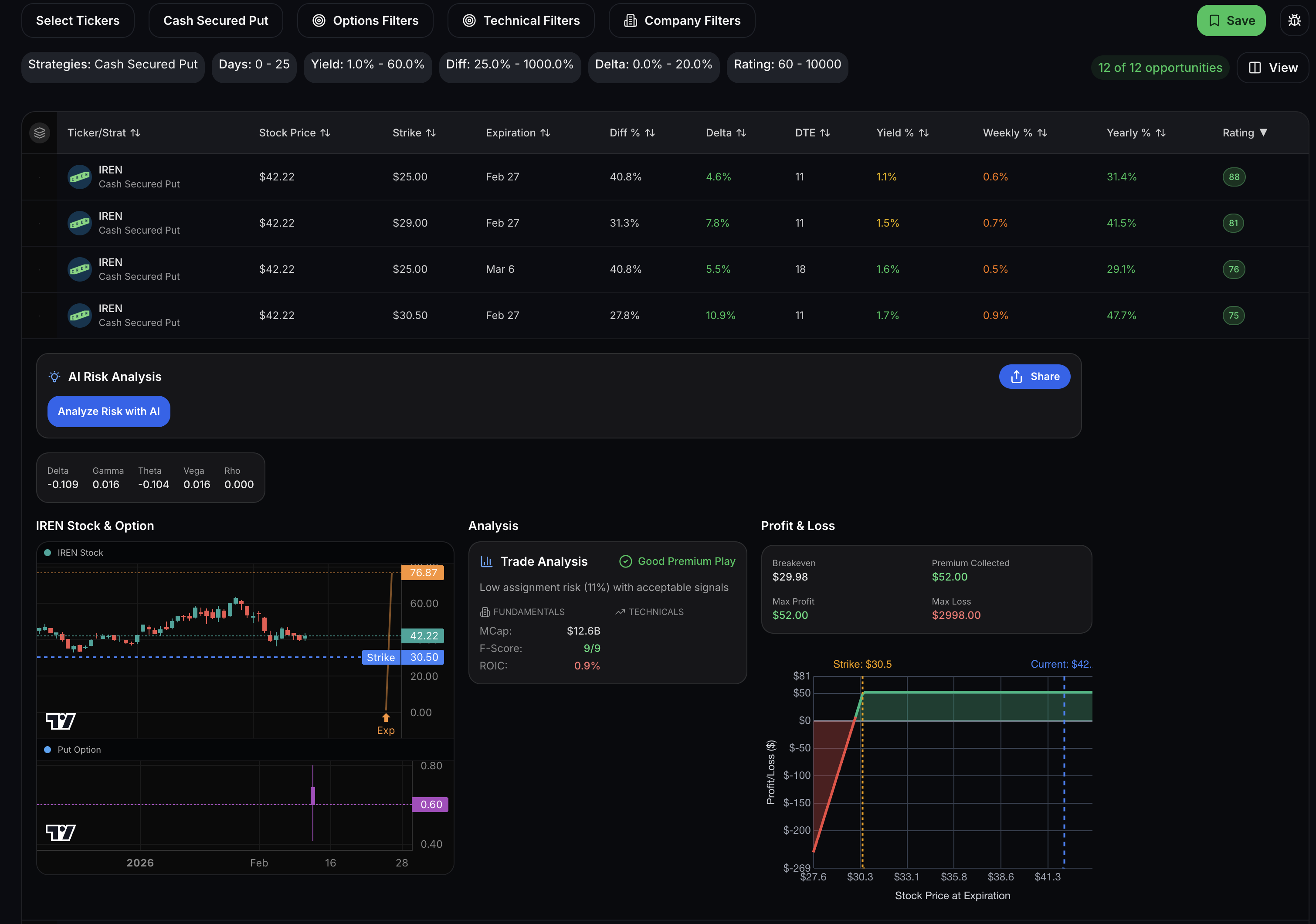
Why Sell Cash Secured Puts?
Income generation on stocks you'd own anyway. Instead of placing a limit buy order and hoping the stock dips to your price, you get paid to wait. If the stock never reaches your target price, you still keep the premium.
Lower effective cost basis. When you do get assigned, the premium you collected reduces your actual cost per share.
Capital efficiency compared to buying stock outright. You only tie up capital when and if you're assigned. Until then, your cash sits in your account earning interest (in many brokers) while you collect premiums.
Foundation of the wheel strategy. Cash secured puts are the first step in the wheel strategy, where you sell puts until assigned, then sell covered calls on your shares.
This creates a systematic income-generating approach that QuantWheel was specifically built to track and optimize.
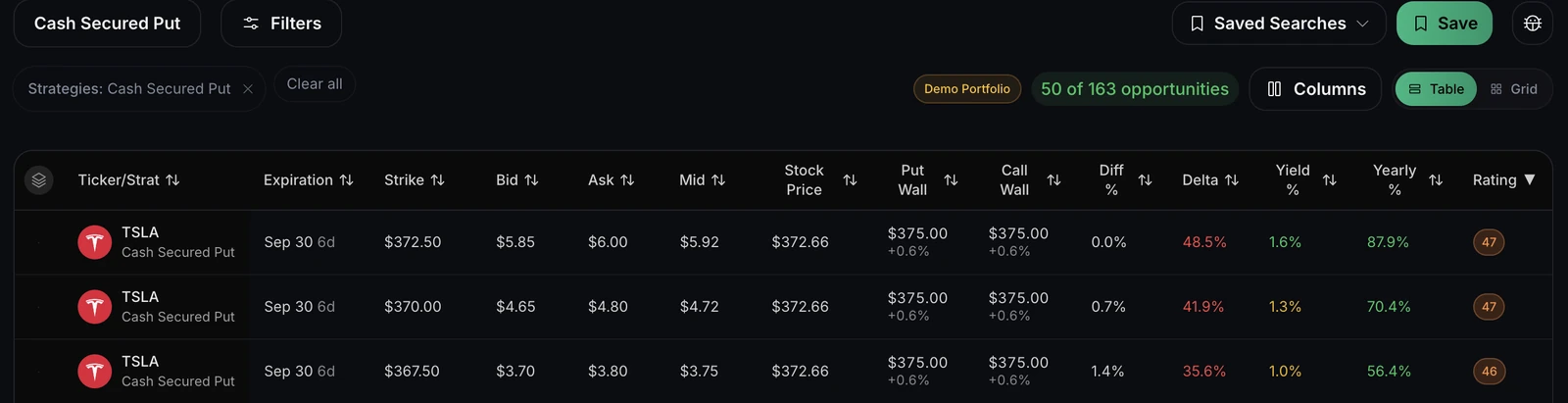
Simplify trading Cash - Secured puts with QuantWheel →
What You Need Before Selling Your First Cash Secured Put
1. Brokerage Account with Options Approval
You need a brokerage account approved for options trading. Most brokers classify cash secured puts as "Level 1" or "Level 2" options approval - the easiest levels to qualify for.
Popular brokers for selling cash secured puts:
- Interactive Brokers (low commissions, professional tools)
- ThinkorSwim (excellent platform for options)
- E*TRADE (user-friendly interface)
- Fidelity (good for beginners)
- Robinhood (simple interface, but limited tools)
Apply for options approval in your account settings. You'll answer questions about your trading experience, financial situation, and investment objectives. Most traders qualify for cash secured puts even with limited experience since it's considered a conservative strategy.
2. Sufficient Cash in Your Account
You need cash equal to the strike price multiplied by 100 shares. This cash will be held as collateral for the entire trade duration.
Cash requirement formula: Strike Price × 100 = Cash Needed
Examples:
- $30 strike = $3,000 required
- $50 strike = $5,000 required
- $100 strike = $10,000 required
- $200 strike = $20,000 required
Most brokers won't let you sell a cash secured put without this full amount available. The "cash secured" part literally means you're securing the obligation with cash.
3. Basic Understanding of Options Mechanics
You should understand these fundamental concepts:
- Put option: A contract giving the buyer the right to sell 100 shares at a specific price
- Strike price: The price at which you'd buy the stock if assigned
- Expiration date: When the contract expires
- Premium: The money you collect for selling the option
- Assignment: When you're obligated to buy the shares
If any of these terms are unfamiliar, spend time learning options basics before risking capital. The strategy itself is simple, but you need to understand what you're agreeing to when you sell a put.
How to sell Cash-Secured puts?
Step 1: Choose the Right Stock for Your Cash Secured Put
Not all stocks are suitable for cash secured puts. You want quality companies you'd genuinely be comfortable owning at the strike price.
Stock Selection Criteria:
Look for fundamentally sound companies. Strong balance sheets, consistent revenue, competitive advantages, and good management. If you'd hate owning the stock even at a discount, don't sell puts on it.
Avoid value traps and declining businesses. Just because a stock has fallen 50% doesn't make it a good candidate. Selling puts on struggling companies because "the premium is huge" often leads to owning deteriorating assets.
Consider stocks with decent implied volatility. Higher IV means higher premiums. Look for IV rank above 30-40 if you want meaningful premium relative to risk. Stocks with IV rank below 20 often offer premiums too small to be worthwhile.
Prefer liquid options. Check that the bid-ask spread is tight (ideally $0.05 or less) and there's sufficient open interest (at least 100 contracts). Wide spreads eat into your profits and make it harder to exit positions if needed.
Think about assignment. Would you want to own 100 shares of this company? At this price? For potentially months? If the answer is "no," look at different stocks or strikes. Here are examples of stock characteristics that work well (not recommendations):
- Large-cap tech companies with strong fundamentals
- Dividend-paying blue chips with stable businesses
- ETFs like SPY, QQQ, or IWM for diversification
- Established companies with temporary volatility spikes
Step 2: Select Your Strike Price and Expiration Date
This is where your strategy and risk tolerance come into play. Your strike and expiration determine your premium, probability of assignment, and how long your capital is tied up.
Choosing the Strike Price
Out-of-the-money (OTM) strikes are most common. Select a strike below the current stock price - typically 5-15% below. This gives you a buffer and lowers assignment probability while still collecting reasonable premium.
Delta is your probability guide. The delta of an option roughly approximates the probability of finishing in-the-money:
- 0.30 delta ≈ 30% chance of assignment
- 0.20 delta ≈ 20% chance of assignment
- 0.10 delta ≈ 10% chance of assignment
Many wheel strategy traders target the 0.20-0.30 delta range for a balance between premium and safety.
Calculate your effective entry price. Strike price minus premium is your real cost if assigned. Make sure you'd be happy buying at that net price.
Example strike selection:
- Stock trading at $100
- You sell the $95 strike (5% OTM)
- Premium received: $2.50
- Effective cost if assigned: $92.50
- You'd be buying at a 7.5% discount to current price
Choosing the Expiration Date
30-45 days to expiration (DTE) is the sweet spot.
This timeframe offers the best balance of premium collection and theta decay. Options decay faster as they approach expiration, and the steepest decay occurs in the final 30 days.
Weekly options offer more frequent premium collection. If you prefer more active management and smaller premium amounts, weekly expirations (7-14 DTE) work well. You can reinvest more quickly but need to monitor positions more closely.
Avoid going too far out. Selling puts 60-90 days out ties up capital longer and exposes you to more potential price movement. The premium looks better initially but offers worse annualized returns in many cases.
Step 3: Calculate Your Potential Premium and Return
Before entering the trade, understand what you're making and whether it's worth the risk.
Understanding Premium
The premium you see is quoted per share, but you receive it times 100 since each contract represents 100 shares.
Premium calculation:
- Quote shows: $2.50
- You receive: $2.50 × 100 = $250
- This is credited to your account immediately when the trade fills
Calculate Your Return on Capital
Your return should be evaluated as a percentage of the capital at risk (the cash held as collateral).
Return on Capital Formula: (Premium Received ÷ Strike Price × 100) × 100 = Return %
Example:
- Strike: $50
- Premium: $1.50
- Cash required: $5,000
- Premium received: $150
- Return: ($150 ÷ $5,000) × 100 = 3% for the duration
Annualize Your Return
To compare different trades fairly, calculate the annualized return.
Annualized Return Formula: (Return % ÷ Days Until Expiration) × 365 = Annualized Return %
Example:
- 3% return over 30 days
- (3% ÷ 30) × 365 = 36.5% annualized
This doesn't mean you'll actually earn 36.5% per year - it's a theoretical comparison assuming you could repeat this exact trade monthly. Real returns vary based on market conditions, assignment, and reinvestment.
What's a Good Return?
Target ranges for cash secured puts:
- Conservative: 1-2% per month (12-24% annualized)
- Moderate: 2-3% per month (24-36% annualized)
- Aggressive: 3-5% per month (36-60% annualized)
Higher returns come with higher assignment probability and often require selling puts on more volatile stocks. Know your risk tolerance.
Step 4: Enter Your Sell-to-Open Order
Now you're ready to execute the trade. This is where you'll work with your broker's options trading interface.
Locate the Options Chain
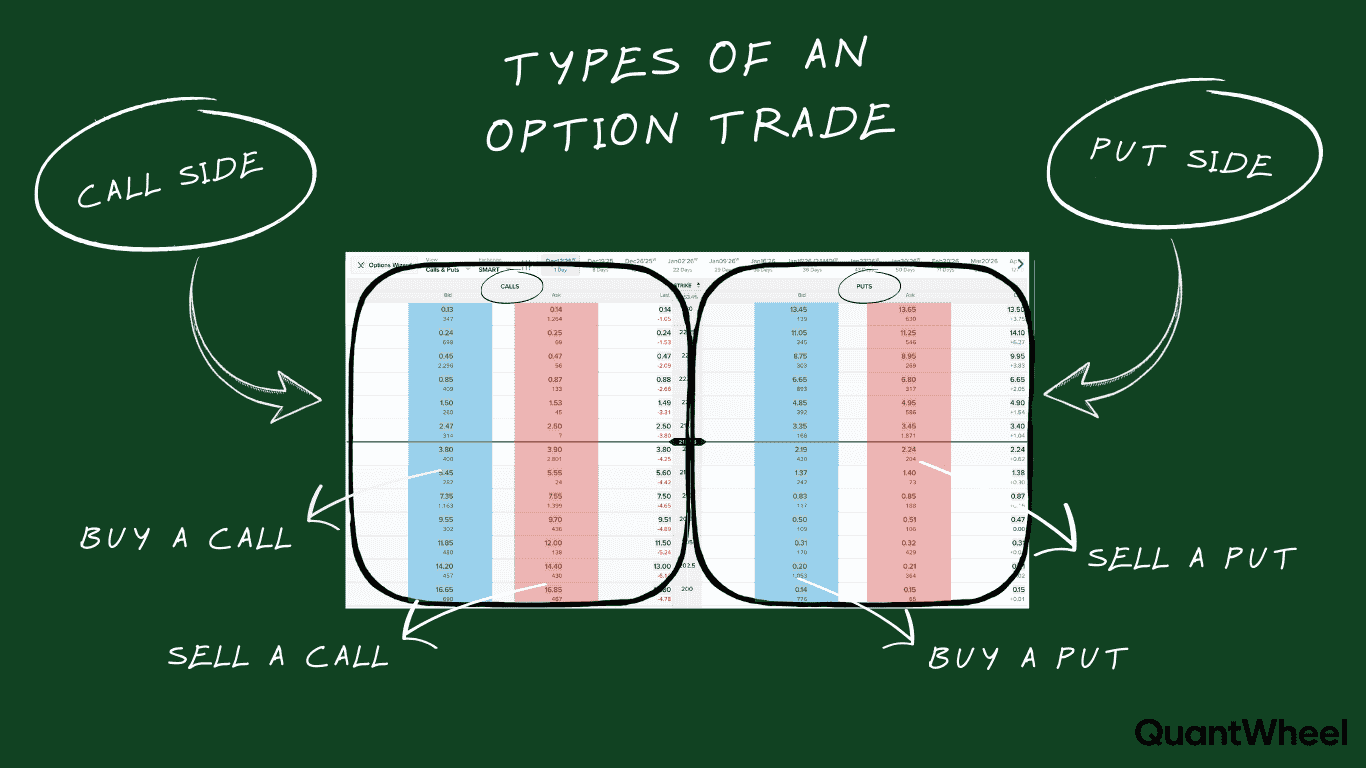
In your broker's platform:
- Search for your chosen stock ticker
- Navigate to the options chain (usually a tab or button)
- Select your expiration date
- Look at the "Put" side of the chain
- Find your chosen strike price
The options chain displays all available strikes and expirations with real-time bid/ask prices.
Understanding Bid vs Ask
Bid: What buyers are willing to pay (lower price)
Ask: What sellers are asking (higher price)
Mid: The middle point (often where fair value is)
When you sell a put, you want to get filled at or near the bid price since you're taking the buyer's side. Don't panic if your order doesn't fill instantly at the ask - you're selling, not buying.
Place Your Sell-to-Open Order
Critical: Make sure you select "Sell to Open" (STO), not "Buy to Open." You're selling a put to open a new position.
Order types:
- Limit Order (recommended): Specify the minimum premium you'll accept. Use the mid-price or slightly below as your starting point.
- Market Order (not recommended): Takes whatever price is available. You'll likely get a worse fill, especially on less liquid options.
Order Entry Checklist
Before hitting submit, verify:
- ✓ Correct stock ticker
- ✓ Correct expiration date
- ✓ Correct strike price
- ✓ PUT (not call)
- ✓ SELL to open (not buy)
- ✓ Quantity (usually 1 contract = 100 shares)
- ✓ Limit price set at acceptable premium
- ✓ Sufficient cash in account
Example order:
- Action: SELL TO OPEN
- Ticker: AAPL
- Expiration: 30 days out
- Strike: $170
- Type: PUT
- Quantity: 1 contract
- Limit Price: $3.00 (you want at least $300)
Getting Filled
Submit your order and wait. If it doesn't fill quickly:
- Lower your limit price slightly (in $0.05 increments)
- Check if the stock price has moved significantly
- Consider if the premium is still acceptable at lower prices
- Be patient - don't chase by lowering too aggressively
Once filled, the premium is immediately credited to your account, and your cash collateral is held until the position closes or expires.
Step 5: Monitor Your Cash Secured Put Position
Now that you're in a trade, here's how to track it and when it's good to take action.
What to Monitor Daily
Stock price movement. Is the stock moving toward or away from your strike? The further it stays above your strike, the better.
Days to expiration. As time passes, your put loses value (theta decay working in your favor). Track how many days remain.
Current option value. Check what your put is trading at. If it's declined significantly, you might have an opportunity to close early for profit.
Unrealized P&L. Your broker shows this, but remember: if the put value decreases, that's GOOD for you since you sold it. A $3.00 put now worth $1.00 means you have a $200 unrealized gain.
Understanding Position Status
Deep out-of-the-money: Stock is well above your strike. Low assignment risk. You'll likely keep the full premium.
Near-the-money: Stock is close to your strike. Watch carefully. Assignment becomes more likely.
In-the-money: Stock is below your strike. High assignment risk. Decide if you want to take assignment or roll the position.
When to Close Early (Buy to Close)
You don't have to hold until expiration. Many traders close positions early when they've captured most of the profit.
The 50% profit rule and the 30-45 DTE rule.
If your put has declined 50% in value, consider buying it back to close the position and free up capital.
Why? Among retail options traders, a common rule of thumb is:
- Sell 30-45 DTE
- Sell at .30 delta
- Close a trade at 50% of max profit
How did this 50% number come about - is there mathematics behind it or just a conservative benchmark?
- the first half of the premium decays faster, it’s the point where you now have more to lose than to gain so you should take profit at 50% or by ~21 DTE
- it reduces the chance that a single bad move or early assignment in the last few days of expiry nukes a week’s worth of work, which is especially important in wheel / CSP‑CC style strategies
Bottom line
The popular 30-45 DTE rule is not a magic “sweet spot” proven by exchange data; it is a compromise. Starting further out in time lets you sell safer strikes for similar credit, gives you more room to roll and manage, and keeps you out of the worst of gamma and early‑assignment risk, at the cost of lower annualized yield and higher vega exposure compared with weeklies. For many conservative wheel and short‑premium traders that trade‑off is attractive, but it is a preference, not a universal optimum. The best advice is to see what can happen in terms of news in the period of your trade and then adjust based on that.
Example:
- You sold a put for $3.00 ($300 credit)
- It's now worth $1.50 ($150)
- You can buy to close for $150
- Your profit: $300 - $150 = $150 (50% of max profit)
- Your capital is freed up 10-20 days early to redeploy
This strategy often beats holding to expiration because you can redeploy capital into new trades and reduce risk.
Managing Positions with QuantWheel
Here's where manual tracking becomes challenging. You need to track:
- Original premium received
- Current option value
- Unrealized P&L
- Days to expiration
- Profit percentage
- When to close based on your rules
If you want to make your life easier, you can automatically track all your cash secured puts with real-time alerts when positions hit your profit targets or need attention. QuantWheel handles the math and tracking so you can focus on trading decisions.
$1 for 7 days • Cancel anytime • 14-day money-back guarantee
When NOT to sell CSPs?
Simple, don't sell Cash-secured puts in low IV environments, trending/momentum markets and at earnings. Once you gather experience, selling Cash-secured puts around earnings can sometimes be a good idea. What does "low IV" mean? It means that the stock doesn't have too much option traders interested in it. Hence, the volatility is lower - less people are betting on it. High IV comes from companies that are under a spotlight from the current market cycle narrative, for example Ai or energy currently in 2026. High enough IV for selling options is anything above 50%. If you want to screen for stocks that fit this "Higher IV environment" you can do so in QuantWheel too - it has a special "IV filter".
Step 6: Handle Expiration - Keep Premium or Get Assigned
As expiration approaches, one of two things happens.
Scenario 1: Option Expires Worthless (You Win the Full Premium)
If the stock closes above your strike price on expiration day:
- The put expires worthless
- You keep the entire premium
- Your cash collateral is released
- No further action needed
- You're free to sell another put or use the capital elsewhere
Example:
- You sold a $95 strike put
- Stock closes at $97 on expiration
- Your put expires worthless
- You keep the full $250 premium
- Your $9,500 cash is freed up
This is the ideal outcome for cash secured puts. You collected income without being assigned.
Scenario 2: You Get Assigned (You Buy the Stock)
If the stock closes below your strike price on expiration day:
- You're assigned automatically (usually over the weekend)
- Your cash is used to purchase 100 shares at the strike price
- You keep the premium you collected
- Monday morning, you own 100 shares
Example:
- You sold a $95 strike put for $2.50 premium
- Stock closes at $92 on expiration Friday
- Over the weekend, you're assigned
- Monday: You own 100 shares at $95 per share ($9,500 total)
- You also kept the $250 premium
- Your real cost basis: $92.50 per share ($95 - $2.50)
Important: Assignment is not a loss or failure. You've acquired stock at a price you predetermined was acceptable, and at an effective discount due to the premium.
Cost Basis Tracking After Assignment
From my experience, this is among top 3 most asked questions on Reddit.
Your broker will show: 100 shares purchased at $95 (the strike price)
Your actual cost basis should be: $92.50 (strike minus premium)
You need to track this manually for tax purposes and to know your true breakeven - unless you use software like QuantWheel that automatically adjusts your cost basis when assignments happen. Getting this wrong means you'll miscalculate profits/losses and potentially overpay taxes.
Step 7: What to Do After Assignment (If It Happens)
You now own 100 shares. You have several options.
Option 1: Hold the Shares
Keep the stock as a long-term investment if you believe in the company and have the capital to hold. You bought at a discount, so you're in a better position than someone who bought at the higher market price.
Option 2: Sell Covered Calls (Continue the Wheel)
This is the natural next step in the wheel strategy. You own 100 shares, so now you can sell covered calls to generate additional income.
How it works:
- You own 100 shares at $92.50 real cost (using our example)
- Sell a covered call at $95 or $97 strike
- Collect more premium
- If called away, you sell at a profit
- If not called away, keep the premium and repeat
Selling covered calls after assignment is how you turn cash secured puts into a complete income-generating system.
Option 3: Sell the Shares Immediately
If you've changed your mind about owning the stock or need the capital, you can sell immediately at market price.
Keep in mind:
- You might realize a loss if the stock dropped significantly
- But the premium you collected cushioned the loss
- You also have flexibility to wait for a recovery
The Complete Wheel Cycle
Many traders use cash secured puts as part of a larger strategy:
- Sell cash secured put (collect premium)
- Get assigned if stock drops (buy shares at strike)
- Sell covered call (collect more premium)
- Shares called away if stock rises (sell shares at strike)
- Return to step 1 with freed capital
This is the wheel strategy - and tracking it properly across multiple positions and stocks is exactly why QuantWheel exists. Each cycle requires tracking premiums, assignments, cost basis adjustments, and call profits.
Common Cash Secured Put Mistakes to Avoid
Mistake 1: Selling Puts on Stocks You Don't Want to Own
The biggest mistake is selling puts purely for the premium on stocks you'd hate to own. Assignment will happen eventually, and you'll be stuck with shares of a company you don't believe in.
Solution: Only sell puts on stocks you'd genuinely be comfortable holding.
Mistake 2: Ignoring the Effective Cost Basis
Many traders forget to account for the premium when calculating their real cost. If you sold a $50 strike put for $2 premium and got assigned, your real cost is $48, not $50. This matters for tax reporting and profit calculations.
Solution: Track your net cost basis properly.
Mistake 3: Chasing Premium on Low-Quality Stocks
High premiums often signal high risk. Stocks offering 5-10% monthly premiums are usually volatile, declining, or facing serious business problems.
Solution: Focus on quality companies with reasonable premiums (1-3% per month) rather than chasing outsized premiums.
Mistake 4: Overleveraging Your Account
Tying up all your capital in cash secured puts leaves no room for new opportunities or emergencies. If everything gets assigned simultaneously, you could be overexposed to market risk.
Solution: Use only 50-70% of your capital for cash secured puts, keeping reserves for opportunities and safety.
Mistake 5: Not Having a Plan for Assignment
Many traders sell puts without thinking through what happens if assigned. They panic, sell immediately at a loss, and turn a manageable situation into a realized loss.
Solution: Before selling any put, decide: if assigned, will I hold or sell covered calls? Having a plan eliminates emotional decisions.
Mistake 6: Ignoring Tax Implications
Short-term trading generates short-term capital gains taxed at your ordinary income rate. Premium received is taxed as short-term gains even if held less than a year.
Solution: Keep accurate records and consult a tax professional about your situation.
The solution that eliminates some of the problems from above
To solve problems like wrong cost basis calculations and keeping track of taxes, you can get both cost basis and tax calculations done automatically inside QuantWheel.
Cash Secured Put Example: Complete Trade Walkthrough
Here's a recent trade I made, I'll walk you through it now.
In late January I sold a $360 MSFT put when IV had spiked after the earnings. The stock dipped to $370 in a few days - here's how I thought through the whole process.
The Setup (Day 0)
Stock: Microsoft (MSFT) Current price: $380 My analysis: Good company, wouldn't mind owning even at $360, got a bright future, especially with ai. If it falls even more, in the next 2-5 years will definitely be above current prices. Account cash available: $40,000
Selecting the Trade (Day 0)
I look at the options chain for 30 days out:
- $360 strike put (5.3% OTM)
- Premium: $6.50 ($650 total)
- Delta: 0.25 (25% assignment probability)
- Cash required: $36,000
- Return if kept: 1.8% in 30 days (22% annualized)
Entering the Order (Day 0)
Order details:
- Find a "Sell to Open" in options chain
- Find MSFT 30-day DTE $360 Put
- Quantity: 1 contract
- Limit Price: $6.50
- Cash held: $36,000
Order filled at $6.50. I receive $650 credit.
Week 1 Monitoring (Days 1-7)
MSFT stays around $380-$385. This put declines to $5.00 in value (due to time decay and positive price movement).
Unrealized P&L: $150 profit ($650 received minus $500 current value)
Week 2-3 Monitoring (Days 8-21)
MSFT dips to $370 on market volatility. This put trade increases to $7.00 in value.
Unrealized P&L: -$50 loss ($650 received minus $700 current value)
You're not worried in this situation because:
- Stock is still above your $360 strike
- You have 9 days left for recovery
- You'd be fine owning MSFT at $353.50 net cost ($360 strike minus $6.50 premium)
Final Week (Days 22-30)
MSFT recovers to $378 by expiration Friday. This put is clearly out-of-the-money.
Expiration Day Result
Stock closes at $378. Your $360 put expires worthless.
Final outcome:
- Premium kept: $650
- Return: 1.8% in 30 days
- Capital freed: $36,000 (available for next trade)
- Shares owned: 0
This is how it looks - complete cash secured put trade with it's ups and downs. I kept the full premium with this trade at the end which is the goal of this strategy or The Wheel strategy in general.
Alternative Scenario: Assignment
What if MSFT had closed at $355?
- You're assigned 100 shares over the weekend
- Monday: You own 100 shares at $360 ($36,000)
- You kept the $650 premium
- Real cost basis: $353.50 per share
- Current value: $355 per share
- Unrealized position: +$150 (break-even with premium)
I'd then sell covered calls on shares to generate additional income while waiting for recovery.
Advanced Tips for Cash Secured Put Sellers
Tip 1: Layer Your Positions
Instead of deploying all capital into one expiration, layer trades across multiple dates. Sell puts expiring in 2 weeks, 4 weeks, and 6 weeks. This staggers capital deployment and gives flexibility.
Tip 2: Use Technical Support Levels
Sell puts at strikes that align with technical support levels. If a stock has strong support at $50, selling the $50 or $48 put has additional safety from technical buying.
Tip 3: Target Volatility Spikes
Watch for temporary IV spikes from earnings, news, or market selloffs. These create opportunities for elevated premiums on otherwise stable stocks. Strike quickly when IV spikes above historical norms.
Tip 4: Consider Earnings Dates
Selling puts through earnings is higher risk but offers higher premiums due to elevated IV. Only do this on stocks where you're truly comfortable with assignment at your strike.
Tip 5: Scale Position Sizing
Don't use the same position size for every trade. High-conviction, low-risk trades can be larger. Speculative or volatile stocks should be smaller positions.
Tip 6: Track Everything
As you scale to multiple positions across different stocks and expirations, tracking becomes critical. Missing a profit-taking opportunity or forgetting about an approaching expiration costs money.
QuantWheel was built specifically for this problem. It tracks all your cash secured puts, shows you which positions need attention, calculates real-time profit percentages, and alerts you when positions hit your target thresholds. No spreadsheets, no manual calculations, just automated tracking so you can focus on finding good trades.
Cash-Secured put VS Naked put VS Covered call comparison
Definitions
Cash-Secured Put (CSP): Sell a put option and hold the full cash needed to buy the shares if assigned. You don't own the stock yet - you're getting paid to potentially buy it at your strike price if the stock closes below that strike at expiration. Naked Put: Same as a CSP mechanically - sell a put - but backed by margin instead of full cash. You're using leverage.
Covered Call (CC): You already own 100 shares, then sell a call against them to collect premium. Your stock is the "cover". It's like collecting rent for example.
How does the PnL look like?
All three arebullish-to-neutral strategies.
A naked put and a CSP have identical P&L graphs - the only difference is capital used. A covered call and a short put at the same strike also share the same P&L profile.
- Max profit: Premium collected (all three)
- Max loss: CSP/Naked put - strike price minus premium; Covered call - stock drops to zero minus premium received
- Profit cap: All three are capped at the premium collected
When to Use Which?
CSP - You want to acquire a stock at a lower price and are happy to wait, no margin risk.
Naked Put - You want the same exposure as a CSP but with 4-5× capital efficiency and you can actively manage margin. This is very risky.
Covered Call - You already hold the stock and want to generate income while you wait; you accept capping your upside.
Conclusion
CSP and naked put are similar - the naked put is just the more capital-efficient, higher-risk version. The covered call starts from a different position (stock already owned (CC) instead cash held(CSP)).
Frequently Asked Questions (Additional)
What brokers allow cash secured puts?
Nearly all major brokers allow cash secured puts with Level 1 or Level 2 options approval: Interactive Brokers, E*TRADE, Fidelity, Schwab, Robinhood, and Webull all support this strategy.
Do I need margin to sell cash secured puts?
No, cash secured puts don't require margin since you're holding 100% cash collateral. However, having a margin account can give you flexibility for other strategies and may reduce some restrictions.
How many cash secured puts should I sell?
This depends on your account size and risk tolerance. A conservative approach is to use 50-60% of your capital across 5-10 different positions, leaving 40-50% in reserve. Never deploy 100% of capital into options positions.
Can I close my cash secured put before expiration?
Yes, absolutely. You can buy to close at any time. Many traders close when they've captured 50-70% of the maximum profit to free up capital for new trades.
What's the difference between cash secured puts and naked puts?
Cash secured puts require holding full cash collateral ($100 × strike price). Naked puts use margin and don't require full cash, but carry much higher risk and require higher approval levels. Cash secured puts are the conservative, beginner-friendly version.
Should I sell cash secured puts on index ETFs or individual stocks?
Both work well. Index ETFs (SPY, QQQ, IWM) offer diversification and generally lower volatility. Individual stocks offer higher premiums but concentrate risk. Many traders do both - ETFs for core positions, stocks for opportunistic trades.
How do taxes work on cash secured puts?
Premium received from sold puts is taxed as short-term capital gains when the position closes (expiration or buy-to-close). If assigned, the premium reduces your cost basis in the acquired stock. Consult a tax professional for your specific situation.
What happens if the stock gaps down after hours?
If a stock gaps significantly down after market close but before expiration, you can still be assigned at your strike price. This is why stock selection and position sizing matter - never sell puts on stocks where bankruptcy or massive gaps are realistic.
Conclusion: Cash Secured Puts are a good way to exploit the stock market and earn from it
The good part: Sell a put on a quality stock at a strike you'd accept, collect premium, and either keep the premium or buy shares at a discount.
The risk: You're only doing what you'd do anyway (buying stocks), but getting paid for it.
Problem: As you scale to multiple positions, tracking expirations becomes a challenge and that's where you start loosing your focus and even leaving profits on the table. How? You start missing opportunities to close at 50% profit or forgetting to adjust cost basis after assignment directly impacts your returns or even miss that you're about to get assigned.
Solution: To automatically track your cash secured puts, receive alerts when positions hit profit targets, and see accurate cost basis calculations when assignments happen you should create a system. A system is aN important part when trading as it reduces errors and improves decision making.
Create a system for trading The Wheel inside QuantWheel →
Risk Disclosure
Options trading involves substantial risk and is not suitable for all investors. Past performance does not guarantee future results. This content is for educational purposes only and should not be considered investment advice. Always do your own research and consider consulting with a financial advisor before making investment decisions.
The examples used in this article are for educational purposes only and are not recommendations to buy or sell any security. All investment decisions should be based on your own analysis and risk tolerance. You can lose money selling cash secured puts, including the potential for significant losses if the underlying stock declines substantially.