
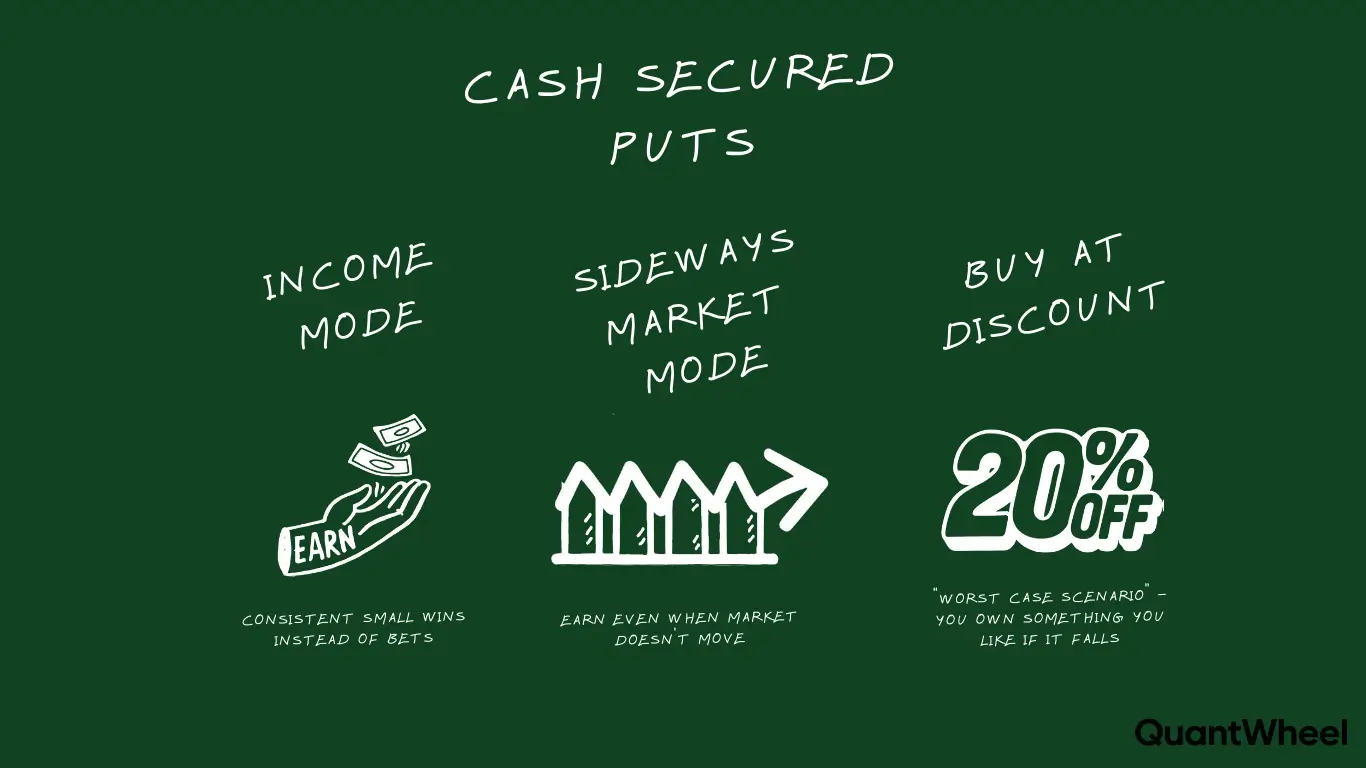
You're looking at a stock trading at $50, and you'd happily buy it at $45. What if someone paid you to set that limit order - and you could keep the payment even if you never buy the stock?
That's exactly what the cash secured put strategy does. It's one of the most conservative options strategies available, yet most traders either don't understand it or overcomplicate it. Here's everything you need to know to start selling cash secured puts with confidence.
Find Cash-Secured Puts with QuantWheel →
What Is a Cash Secured Put?
A cash secured put (CSP) is an options strategy where you sell a put option on a stock you're willing to own, while holding enough cash in your account to purchase 100 shares at the strike price if assigned.
Here's the transaction breakdown:
- You sell a put option contract (representing 100 shares)
- You collect premium upfront (yours to keep regardless of outcome)
- You reserve enough cash to buy 100 shares at the strike price
- You wait until expiration or assignment
The buyer of your put option is purchasing insurance - they're paying you to guarantee you'll buy their stock at the strike price if it falls. Most of the time, the stock stays above the strike, the option expires worthless, and you keep the premium without ever buying the stock.
When the stock does fall below your strike price, you get assigned - meaning you're obligated to purchase 100 shares at the strike price using your reserved cash. But remember, this was a price you were willing to pay anyway, and you collected premium upfront to reduce your actual cost basis.
TLDR: Cash Secured Put Strategy Essentials
The cash secured put strategy is a conservative options approach for generating income while potentially acquiring stocks at a discount.
How It Works (Simple Example)
Stock XYZ trades at $50. You sell a 30-day put option with a $45 strike price and collect $200 premium ($2 per share × 100 shares). You set aside $4,500 cash as collateral.
Outcome 1 (Most Common - 70-80% of the time): Stock stays above $45. Option expires worthless. You keep the $200 premium and your $4,500 cash. That's a 4.4% return in 30 days.
Outcome 2: Stock drops to $43. You get assigned and buy 100 shares for $4,500. But since you collected $200 premium, your real cost basis is $43 per share ($45 strike - $2 premium = $43 effective cost). The stock is currently at $43, so you broke even at market price while owning a stock you wanted anyway.
Key Points
- Capital Required: Full strike price × 100 (e.g., $45 strike = $4,500 reserved)
- Income Potential: Typically 1-5% monthly returns on reserved capital
- Risk Level: Moderate - less risky than buying stock outright, but capital-intensive
- Best For: Traders who want to own quality stocks at a discount while collecting premium
- Win Rate: Generally 70-85% of trades expire worthless (you keep premium without assignment)
Why This Strategy Works
Cash secured puts give you three advantages: you collect immediate premium income, you only buy stocks at prices you predetermined are attractive, and you have a built-in discount through the premium collected. It's essentially getting paid to place limit buy orders on stocks you like.
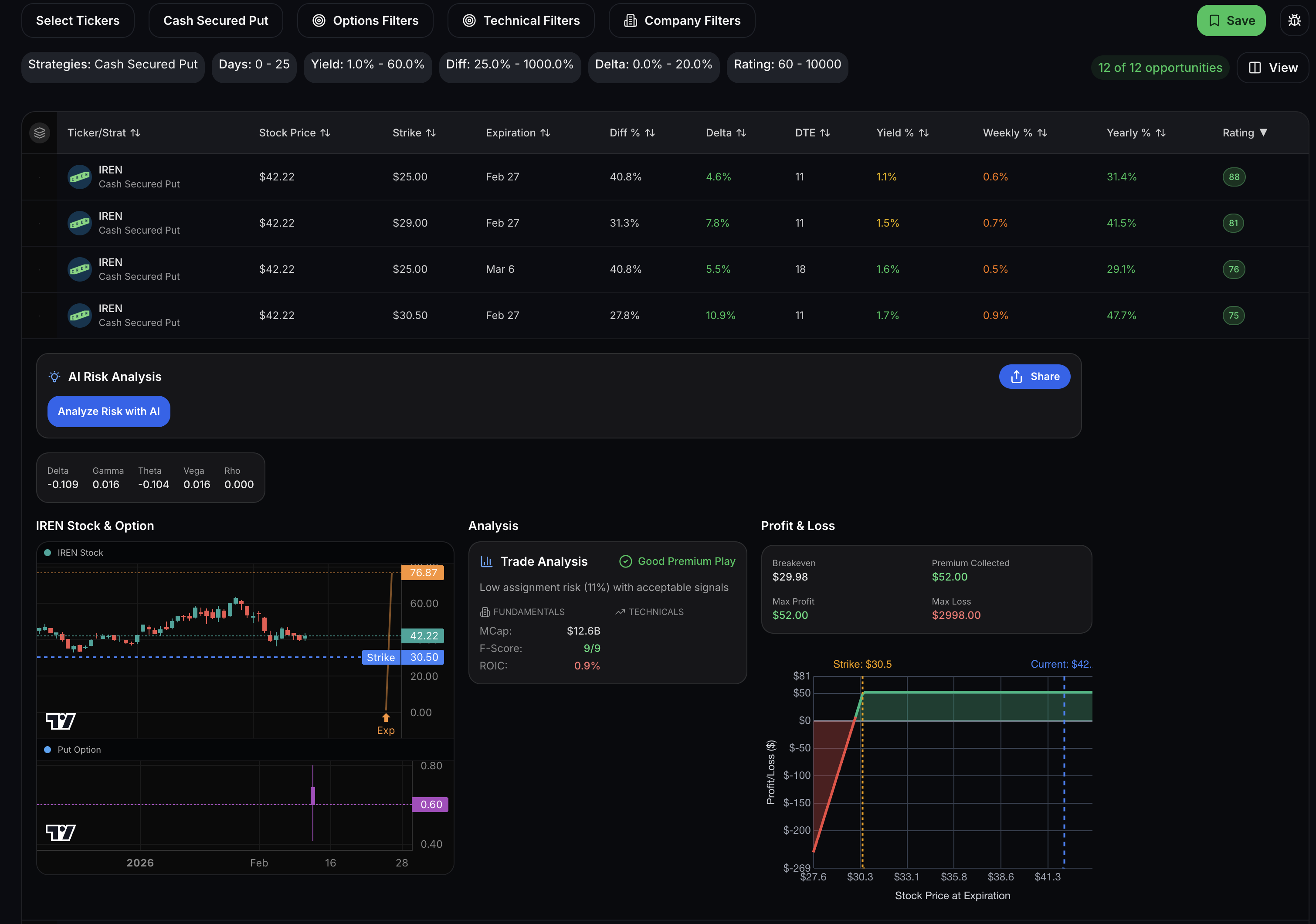
QuantWheel makes this process of finding Cash-Secured puts easier, take a look below of a few trades it has found and ranked for you by quality (1-100).
Find Cash-Secured Puts with QuantWheel →
Why Sell Cash Secured Puts?
The cash secured put strategy offers several compelling advantages for conservative traders:
1. Generate Income While Waiting
Instead of placing a limit buy order and waiting (earning nothing), you collect premium immediately. If the stock never drops to your target price, you keep the premium and move on to the next opportunity.
2. Buy Stocks at a Discount
When you do get assigned, your effective cost basis is the strike price minus the premium collected. This creates an instant discount compared to buying shares at market price.
3. High Probability of Profit
By selecting out-of-the-money strikes (below current stock price), you create a cushion. The stock can drop moderately and your put can still expire worthless, letting you keep the full premium.
4. Defined Risk
Unlike many options strategies, your risk is clearly defined from the start. You know exactly how much capital you're committing and what your maximum loss scenario looks like (though unlikely with quality stocks).
5. Perfect Entry Point for the Wheel Strategy
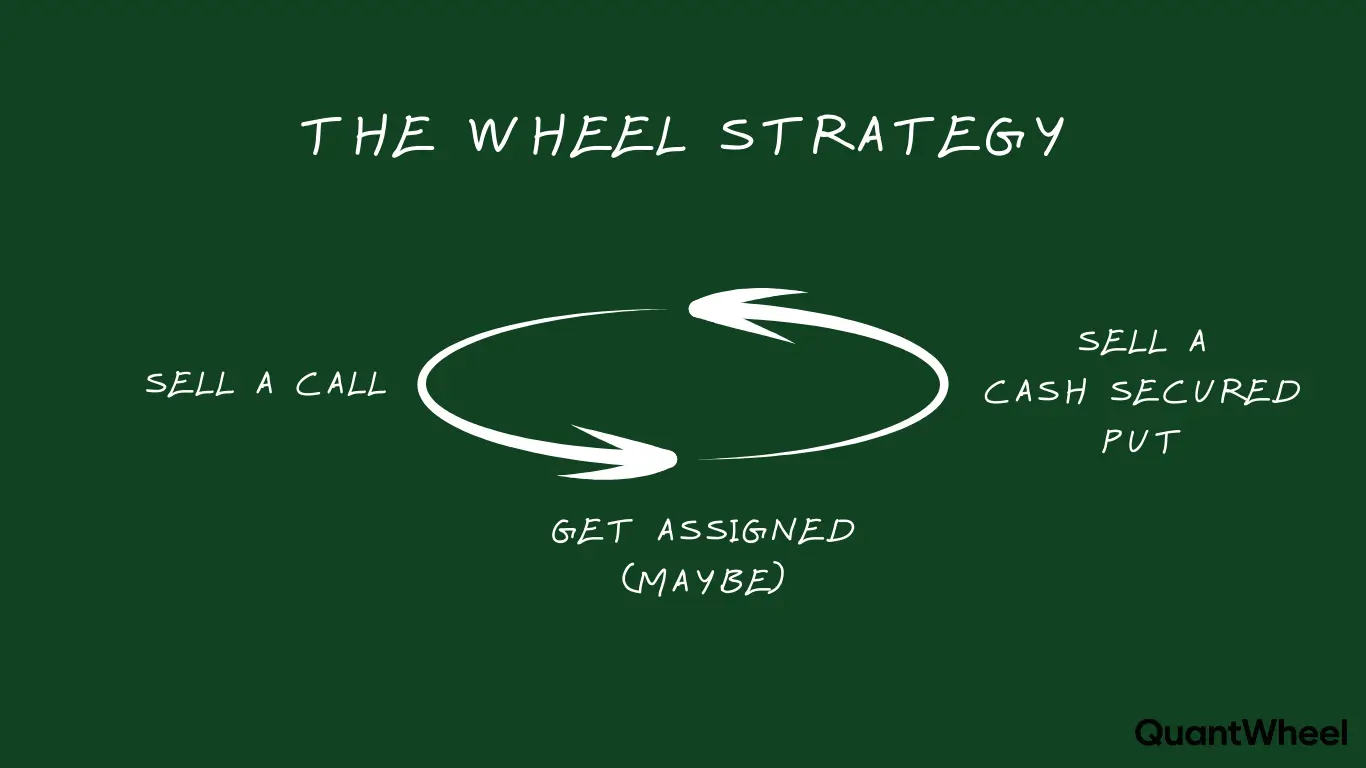
Cash secured puts are the first step in the wheel strategy - one of the most popular income-generating approaches for options traders. After assignment, you transition to selling covered calls on the shares you now own.
The strategy isn't about getting rich quick. It's about consistent, boring, profitable income generation. Conservative traders who run cash secured puts systematically often achieve 15-30% annual returns on deployed capital - not spectacular, but highly consistent.
How to Sell a Cash Secured Put: Step-by-Step
Here's the exact process for executing your first cash secured put trade:
Step 1: Select Your Underlying Stock
Choose stocks you genuinely want to own at the strike price you'll be selling. Focus on:
- Quality companies with strong fundamentals
- Adequate liquidity (daily volume over 500K shares)
- Moderate to high implied volatility (generates better premium)
- Stable or bullish long-term outlook
- Stock price you can afford (remember: strike × 100 × number of contracts)
Avoid stocks you'd never want to own just because the premium looks attractive. Assignment is always possible, and you don't want to own garbage companies.
Step 2: Choose Your Strike Price
Select a strike price below the current stock price where you'd be happy to own the stock. Most wheel strategy traders use one of these approaches:
- Conservative: 5-10% below current price (high win rate, lower premium)
- Moderate: 10-15% below current price (balanced approach)
- Aggressive: 15-20% below current price (higher premium, but higher assignment risk)
In options terminology, traders often reference delta:
- 0.10-0.20 delta: Very conservative (10-20% probability of assignment)
- 0.20-0.30 delta: Moderate (20-30% probability of assignment)
- 0.30-0.40 delta: Aggressive (30-40% probability of assignment)
Step 3: Select Your Expiration Date
Choose how long you want the trade to run:
- Weekly options (7-14 DTE): Higher annualized returns, but requires active management
- Monthly options (30-45 DTE): Most popular, balances return and time commitment
- 60-90 DTE: More premium collected upfront, but capital tied up longer
Most cash secured put traders prefer 30-45 days to expiration. This timeframe offers good premium while avoiding excessive time commitment.
Step 4: Calculate Your Expected Return
Before entering the trade, calculate your return on capital:
Premium Return = (Premium Collected / Capital Reserved) × 100
Example: Sell $50 strike put for $2.00 premium
- Premium collected: $200 ($2 × 100)
- Capital reserved: $5,000 ($50 × 100)
- Return: ($200 / $5,000) × 100 = 4% for 30 days
Annualized, this is roughly 48% - but remember, you can't deploy capital constantly with zero downtime.
Step 5: Place the Order
In your broker's options trading platform:
- Navigate to the options chain for your chosen stock
- Select the expiration date you've chosen
- Find your target strike price in the PUT column
- Click "Sell to Open" (or just "Sell")
- Enter the number of contracts (start with 1 as a beginner)
- Choose order type (limit order recommended)
- Enter your minimum acceptable premium (based on your research)
- Review the buying power requirement
- Submit the order
Your broker will immediately reserve the required cash ($strike × 100 × contracts) as collateral. Once filled, you'll receive the premium in your account as available buying power.
Step 6: Manage the Position
Once your cash secured put is active, you have several management approaches:
Hold Until Expiration: The simplest approach. Do nothing and let the option expire worthless (keeping full premium) or accept assignment.
Close Early at Target Profit: Many traders close positions when they've captured 50-75% of the maximum premium, especially if significant time remains. This frees up capital for new trades.
Roll the Position: If assignment is imminent but you want to avoid it, you can "roll" by buying back your current put and simultaneously selling a new put at a different strike or expiration.
Here's where tracking becomes critical. When you're managing multiple cash secured puts across different stocks and expirations, manual tracking in spreadsheets gets messy fast. You need to know: Which positions are approaching expiration? Which are at 50% profit? What's your total capital deployed?
This is exactly why software like QuantWheel exists - to automatically track your cash secured put positions, calculate real-time P&L, and alert you when positions hit your management rules. It eliminates the tedious spreadsheet management that breaks down once you're running more than 5-10 positions.
$1 for 7 days • Cancel anytime • 14-day money-back guarantee
What Happens When You Get Assigned
Assignment is not a failure - it's part of the plan in the cash secured put strategy. Here's exactly what happens:
The Assignment Process
- Trigger: The stock closes below your strike price at expiration (or you're assigned early, though rare)
- Notification: Your broker notifies you of assignment (usually overnight after expiration Friday)
- Execution: Monday morning, you own 100 shares per contract at the strike price
- Cash Deduction: Your reserved cash is used to purchase the shares
- Position Change: Your sold put disappears, replaced by long stock position
Your Real Cost Basis After Assignment
This is where most brokers fail traders. Your broker will show your cost basis as the strike price - but that's not your real cost.
Real Cost Basis = Strike Price - Premium Collected
Example:
- Sold $50 strike put
- Collected $2.00 premium ($200)
- Got assigned → bought 100 shares at $50 = $5,000
- Broker shows cost basis: $50/share
- Real cost basis: $48/share ($50 strike - $2 premium)
That $2 difference matters enormously for your P&L calculations, tax reporting, and decision-making on when to exit the position. You need to track this manually in a spreadsheet... or use software that automatically adjusts your cost basis on assignment.
QuantWheel is the wheel strategy software that automatically calculates and tracks your adjusted cost basis when you get assigned. The moment assignment happens, your cost basis reflects the premium you collected - giving you accurate breakeven prices and P&L without manual spreadsheet work.
$1 for 7 days • Cancel anytime • 14-day money-back guarantee
What to Do After Assignment
Once you own the shares, you have several options:
Option 1: Sell Covered Calls The most common approach. Start selling covered calls on your shares to generate additional premium. This is the second phase of the wheel strategy.
Option 2: Hold and Wait If you believe the stock will recover, simply hold the shares. You've already reduced your cost basis through the premium collected.
Option 3: Sell at Market If your analysis has changed or you need the capital, sell the shares immediately. Your loss is limited to the difference between your adjusted cost basis and the current market price.
Option 4: Sell More Cash Secured Puts If you want to add to your position, you can sell additional cash secured puts at lower strikes, averaging down your cost basis if assigned again.
Strike Selection Strategy: Finding the Sweet Spot
Choosing the right strike price is the most important decision in cash secured put trading. Here's how to optimize your selection:
The Delta Method
Delta represents the approximate probability that the option will expire in-the-money (resulting in assignment).
Delta Ranges and Characteristics:
0.10-0.15 Delta (Conservative)
- Probability of assignment: ~10-15%
- Typical distance from current price: 15-20% below
- Premium: Lower (0.5-1.5% of strike)
- Best for: Risk-averse traders, volatile markets, stocks you're less confident about
0.20-0.30 Delta (Moderate - Most Popular)
- Probability of assignment: ~20-30%
- Typical distance from current price: 10-15% below
- Premium: Moderate (1.5-3% of strike)
- Best for: Balanced approach, most wheel strategy traders, quality stocks
0.30-0.40 Delta (Aggressive)
- Probability of assignment: ~30-40%
- Typical distance from current price: 5-10% below
- Premium: Higher (2.5-5% of strike)
- Best for: Stocks you strongly want to own, bullish on near-term outlook, experienced traders
The Percentage Method
Some traders prefer thinking in terms of percentage below current price:
- Stock at $100, sell $95 strike = 5% cushion
- Stock at $100, sell $90 strike = 10% cushion
- Stock at $100, sell $85 strike = 15% cushion
The larger the cushion, the lower your assignment probability and premium collected.
The Support Level Method
Use technical analysis to identify support levels, then sell puts at or slightly above those levels. This gives you technical confirmation that the stock is unlikely to fall below your strike.
Premium Yield Targets
Many traders work backward from a minimum premium yield target:
- Minimum 1% monthly yield: ($strike × 100 × 0.01) = minimum acceptable premium
- Target 2% monthly yield: More aggressive but achievable in higher IV environments
- Stretch 3%+ monthly yield: Usually requires higher risk (closer strikes or volatile stocks)
Example: $50 strike targeting 2% monthly yield
- Minimum premium: $50 × 100 × 0.02 = $100 (or $1.00 per share)
Cash Secured Put Risk Management
Every strategy has risks. Here's how to manage them effectively:
Risk 1: Stock Declines Significantly After Assignment
The Risk: You get assigned at $50, stock drops to $40. You're down $1,000 (minus the premium you collected).
Management Strategies:
- Only sell puts on quality stocks you'd hold through downturns
- Use technical support levels to identify better strikes
- Position size appropriately (never more than 5-10% of portfolio in any single underlying)
- Start selling covered calls after assignment to collect additional premium and reduce cost basis
- Have a predetermined exit price if your thesis changes
Risk 2: Capital Tied Up for Extended Periods
The Risk: You reserve $5,000 to sell a put, then the stock trades sideways and you can't deploy that capital elsewhere.
Management Strategies:
- Don't deploy 100% of your capital at once
- Stagger expirations so capital becomes available at different times
- Close positions early when you've captured most of the profit (50-75% max gain)
- Use shorter-dated options (weekly or bi-weekly) for faster capital rotation
Risk 3: Early Assignment
The Risk: You get assigned before expiration, usually due to dividends or deep in-the-money positions.
Management Strategies:
- Avoid selling puts through ex-dividend dates (especially high-yield stocks)
- Monitor deeply in-the-money positions and consider closing or rolling
- Keep required cash available (don't spend your reserved capital)
- Remember: early assignment is rare, usually less than 5% of positions
Risk 4: Opportunity Cost
The Risk: The stock rallies strongly, you miss gains because you only collected fixed premium.
Management Reality:
- This isn't really a "risk" - it's the nature of the strategy
- You captured the premium you targeted; be satisfied with your return
- Don't suffer FOMO; there are always new opportunities
- Consider this scenario a win (you made money and the stock didn't decline)
Position Sizing Guidelines
Proper position sizing is critical for risk management:
Conservative Approach:
- Maximum 5-10% of portfolio in any single underlying
- No more than 50% of total portfolio in active cash secured puts
- Keep 25%+ in reserve cash for new opportunities
Moderate Approach:
- Maximum 10-15% in any single underlying
- Up to 70% of portfolio in active positions
- Diversify across sectors and market caps
Aggressive Approach:
- Up to 20% in strong conviction underlyings
- 80%+ deployed in active positions
- Accept higher concentration risk for higher returns
Start conservative and increase position sizes as you gain experience and understanding of how stocks move.
Cash Secured Puts vs Other Strategies
Understanding how cash secured puts compare to alternative approaches:
Cash Secured Puts vs Buying Stock Outright
Cash Secured Puts Advantages:
- Collect premium immediately (income while waiting)
- Lower effective cost basis if assigned
- Can generate returns without ever owning stock
- Define your entry price in advance
Buying Stock Advantages:
- Immediate exposure to upside
- Dividend rights from purchase date
- No expiration pressure
- Simpler execution
Best Choice: Cash secured puts if you're patient and want to optimize entry price. Buy stock outright if you believe strong upward momentum is starting.
Cash Secured Puts vs Covered Calls
These strategies are complementary, not competitive:
Cash Secured Puts:
- Used when you don't own the stock yet
- Bullish to neutral bias
- Generate income while waiting to buy
- No dividend collection
Covered Calls:
- Requires stock ownership
- Neutral to slightly bullish bias
- Generate income on stocks you own
- Keep dividend payments
The Connection: The wheel strategy combines both. Start with cash secured puts (trying to get assigned), then switch to covered calls (trying to get called away), then repeat. It's a continuous cycle.
Cash Secured Puts vs Cash Secured Put Spreads
Cash Secured Put (Naked Put):
- Sell put only
- Collect full premium
- Require full strike × 100 in cash
- Unlimited downside to zero
Put Credit Spread:
- Sell higher strike put, buy lower strike put
- Collect net premium (less than naked put)
- Require only the spread width as collateral
- Defined maximum loss (spread width - premium)
Best Choice: Naked cash secured puts if you want to own the stock and have sufficient capital. Put spreads if you only want income and want to limit capital deployment or risk.
Best Stocks for Cash Secured Puts
Not all stocks are equally suitable for cash secured puts. Here's what to look for:
Ideal Characteristics
1. Strong Fundamentals
- Profitable companies with solid balance sheets
- Competitive advantages and market position
- Reasonable valuation metrics
- You'd want to own them long-term
2. Adequate Liquidity
- Daily volume over 500K shares minimum
- Tight bid-ask spreads on options (ideally $0.05 or less on ATM options)
- Open interest on your target strike over 100 contracts
3. Moderate to High Implied Volatility
- IV Rank or IV Percentile above 30 preferred
- Generates enough premium to make the trade worthwhile
- But not so volatile that the business is unstable
4. Stable to Bullish Price Action
- Avoid stocks in clear downtrends
- Look for stocks consolidating after pullbacks
- Prefer stocks with identifiable support levels
5. Manageable Stock Price
- Strike × 100 should be manageable for your account size
- Lower-priced stocks ($20-$100) are more accessible for smaller accounts
- Higher-priced stocks often have better liquidity and spreads
Popular Cash Secured Put Candidates
Tier 1: Blue Chip Tech (Higher capital requirement, more stability)
- AAPL (Apple)
- MSFT (Microsoft)
- NVDA (NVIDIA)
- AMD (Advanced Micro Devices)
Tier 2: Established Growth (Moderate capital, solid premium)
- PLTR (Palantir)
- COIN (Coinbase)
- SOFI (SoFi Technologies)
- DKNG (DraftKings)
Tier 3: ETFs (Lower volatility, consistent returns)
- SPY (S&P 500 ETF)
- QQQ (Nasdaq 100 ETF)
- IWM (Russell 2000 ETF)
- TLT (Treasury Bond ETF)
Tier 4: Dividend Aristocrats (Lower premium, but dividend capture potential)
- KO (Coca-Cola)
- PG (Procter & Gamble)
- JNJ (Johnson & Johnson)
- O (Realty Income)
The best stocks for you depend on your account size, risk tolerance, and investment time horizon. Start with stocks you already research and understand.
Stocks to Avoid for Cash Secured Puts
Red Flags:
- Penny stocks or low-priced stocks under $5: Extreme volatility, often poor liquidity
- Stocks with pending binary events: FDA approvals, merger votes, bankruptcy proceedings
- Companies with deteriorating fundamentals: Declining revenue, mounting debt, competitive threats
- Stocks you know nothing about: Don't sell puts on companies you haven't researched
- Illiquid options: Wide bid-ask spreads, low open interest, poor fills
Remember: high premium usually signals high risk. If a stock is offering extraordinarily high premium relative to others, investigate why before selling puts.
Advanced Cash Secured Put Tactics
Once you've mastered the basics, these advanced techniques can optimize your results:
Rolling Cash Secured Puts
Rolling means closing your current put position and simultaneously opening a new put position at a different strike and/or expiration. You roll to avoid assignment or extend time.
When to Roll:
- Stock approaching your strike with expiration imminent
- You want to avoid assignment and collect more premium
- You need more time for the stock to recover
How to Roll:
- Buy to close your current put (at a loss if stock dropped)
- Simultaneously sell to open a new put at lower strike and/or later expiration
- Net credit or debit depending on roll parameters
Example Roll for Credit:
- Stock at $48, sold $50 strike put expiring Friday
- Roll: Buy to close $50 put for $2.50 loss
- Sell to open $45 put expiring next month for $3.00
- Net credit: $0.50 ($3.00 - $2.50)
- Result: Avoided assignment, collected additional premium, lowered strike
Rolling Strategy: Rolling is controversial. Some traders roll indefinitely to avoid assignment. Others accept assignment as part of the plan. Develop your philosophy based on your goals.
Staggering Expirations
Instead of selling all your cash secured puts with the same expiration, stagger them across multiple dates:
Benefits:
- Capital becomes available at different intervals
- Reduces timing risk (not all positions exposed to same market event)
- Provides regular income streams
- Allows for more consistent portfolio management
Example Ladder:
- Week 1: Sell 1 contract expiring in 1 week
- Week 2: Sell 1 contract expiring in 2 weeks
- Week 3: Sell 1 contract expiring in 3 weeks
- Week 4: Sell 1 contract expiring in 4 weeks
- Result: Every week, one contract expires and frees capital for new trade
The Earnings Play
Some aggressive traders sell cash secured puts right before earnings, capitalizing on elevated implied volatility:
The Opportunity:
- IV spikes before earnings (higher premium)
- IV crushes after earnings (option value drops fast)
- Can close position for quick profit if stock doesn't tank
The Risk:
- Earnings misses can cause sharp drops
- Assignment probability increases
- Requires strong conviction in the company
Best Practice: Only run earnings plays on companies you're very confident about and genuinely want to own. The premium boost isn't worth the added risk unless you'd be happy with assignment.
Scaling Into Positions
Instead of selling your maximum desired contracts at once, scale in gradually:
The Approach:
- Week 1: Sell 1 contract at current levels
- Week 2: If stock drops, sell another contract at lower strike
- Week 3: If still dropping, sell another contract
- Result: Average down your effective entry price, collect more total premium
Benefits:
- Reduces timing risk
- Better average cost basis if assigned
- Collects more total premium across multiple contracts
Drawback:
- Requires more capital in reserve
- More complex to track
- May miss the opportunity if stock rebounds
Tracking and Managing Multiple Cash Secured Put Positions
Once you're running more than 3-5 cash secured put positions simultaneously, tracking becomes a real challenge.
What You Need to Track
Position Details:
- Underlying stock and current price
- Strike price and expiration date
- Premium collected and date opened
- Current P&L (unrealized)
- Days remaining to expiration
- Assignment probability (delta)
Portfolio-Level Metrics:
- Total capital deployed
- Available buying power
- Aggregate return on capital
- Upcoming expirations (next 7 days)
- Positions approaching 50% max profit
- Total premium collected (month, year)
Risk Metrics:
- Concentration by underlying (% of portfolio)
- Sector exposure
- Total assignments if all stocks fall
- Margin usage (if applicable)
The Spreadsheet Problem
Most traders start with Excel or Google Sheets. This works fine for 1-3 positions but breaks down quickly because:
- Manual data entry is time-consuming and error-prone
- Stock prices update constantly, spreadsheet doesn't
- No automatic alerts when positions hit profit targets
- Calculating cost basis after assignment requires manual tracking
- No visibility into portfolio-level risk
After managing 15+ positions in a spreadsheet that broke constantly, I realized wheel strategy traders needed something better. That's why I built QuantWheel - to automate the tedious tracking so you can focus on finding good trades instead of updating spreadsheets.
QuantWheel connects to your broker, automatically tracks all your cash secured put positions in real-time, calculates accurate P&L including your adjusted cost basis after assignment, and alerts you when positions hit your management rules. It's built specifically for wheel strategy traders who are serious about scaling beyond a few positions.
$1 for 7 days • Cancel anytime • 14-day money-back guarantee
Common Cash Secured Put Mistakes to Avoid
Learn from others' mistakes rather than making them yourself:
Mistake 1: Selling Puts on Stocks You Don't Want to Own
The Error: Chasing high premium on low-quality stocks just for the income.
The Consequence: You get assigned on a garbage company that keeps declining, losing far more than the premium you collected.
The Fix: Only sell puts on stocks that meet your quality standards. If you wouldn't buy the stock outright at the strike price, don't sell the put.
Mistake 2: Ignoring Earnings Dates
The Error: Selling puts without checking the earnings calendar.
The Consequence: Earnings miss causes sharp drop, instant assignment at unfavorable prices, or forced roll at a loss.
The Fix: Always check earnings dates before selling. Decide deliberately whether to close before earnings or hold through based on your conviction.
Mistake 3: Over-Concentrating in Single Stocks or Sectors
The Error: Selling 5 contracts on the same stock or all tech stocks because that's what you know.
The Consequence: Sector rotation or company-specific news creates correlated losses across all positions simultaneously.
The Fix: Diversify across at least 5-10 different underlyings and multiple sectors. No single position should represent more than 10-15% of your portfolio.
Mistake 4: Not Having a Management Plan
The Error: Selling the put without deciding in advance when you'll close or what you'll do if assigned.
The Consequence: Emotional decision-making when positions move against you, holding losers too long, closing winners too early.
The Fix: Before entering any trade, decide: At what profit % will I close early? What's my assignment plan? What would make me exit the trade at a loss?
Mistake 5: Selling Puts With Insufficient Cash
The Error: Using margin to "leverage up" your cash secured put positions.
The Consequence: Margin calls if positions move against you, forced liquidations at the worst times, magnified losses.
The Fix: True cash secured puts require 100% cash backing. If you're using margin, you're trading naked puts (different risk profile). Start conservative with full cash coverage.
Mistake 6: Ignoring the Bid-Ask Spread
The Error: Accepting market orders or wide spreads, losing 10-20% of potential premium to poor execution.
The Consequence: Your 2% expected return becomes 1.6% after poor fills - death by a thousand cuts.
The Fix: Always use limit orders. Target fills at or near the midpoint of the bid-ask spread. On wider spreads, be patient and work your order.
Mistake 7: Not Tracking Cost Basis Accurately After Assignment
The Error: Accepting broker's displayed cost basis instead of calculating adjusted cost basis including premium.
The Consequence: Incorrect P&L calculations, poor exit decisions, tax reporting errors.
The Fix: Track your real cost basis (strike - premium collected). Use software like QuantWheel that calculates this automatically, or maintain meticulous spreadsheet records.
Tax Implications of Cash Secured Puts
Understanding the tax treatment helps you make better decisions and avoid surprises:
Taxation When Options Expire Worthless
Scenario: You sold a cash secured put, collected $200 premium, option expired worthless.
Tax Treatment:
- Premium is short-term capital gain
- Reported in the year the option expired (not when you sold it)
- Taxed at your ordinary income rate (short-term capital gains rate)
Taxation When You're Assigned
Scenario: You sold a $50 strike put for $2 premium, got assigned.
Tax Treatment:
- The $200 premium REDUCES your cost basis in the stock
- Your official cost basis becomes $48/share ($50 strike - $2 premium)
- No immediate tax consequence (you haven't sold the stock)
- Future tax consequences determined when you eventually sell the stock
This is why accurate cost basis tracking is critical - it affects your future tax liability.
Wash Sale Rules and Cash Secured Puts
The Rule: If you sell stock at a loss and buy "substantially identical" securities within 30 days before or after, the loss is disallowed (deferred).
How It Affects Cash Secured Puts:
- Selling puts on a stock you recently sold at a loss could trigger wash sale rules
- Getting assigned on a put could affect previous stock losses
- Complicated rules that vary by situation
The Fix: Track carefully and consult a tax professional if you're actively trading the same stocks frequently.
Record Keeping Requirements
The IRS requires you to maintain records of:
- Trade confirmations (date, price, quantity)
- Premium collected
- Assignment notifications
- Adjusted cost basis calculations
- Broker statements
Most brokers provide year-end tax reports, but these often don't correctly calculate adjusted cost basis for options strategies. Keep your own detailed records or use software like QuantWheel that generates tax-ready reports.
Tax Disclaimer: This is educational information, not tax advice. Options taxation is complex and situation-dependent. Consult with a qualified tax professional about your specific circumstances.
Is the Cash Secured Put Strategy Right for You?
The cash secured put strategy isn't for everyone. Here's how to know if it fits your situation:
Ideal Candidate Profile
You're a good fit if:
- You have at least $5,000-$10,000 in investable capital
- You want to own quality stocks but prefer buying at a discount
- You're comfortable with moderate volatility and unrealized losses
- You have time to monitor positions at least 2-3 times per week
- You understand options basics (strikes, expirations, premium)
- You're patient and process-oriented (not seeking quick riches)
- You're willing to actually own stocks if assigned
Maybe Not the Right Strategy If:
Consider alternatives if:
- Your account is under $5,000 (not enough capital for proper diversification)
- You need guaranteed returns or can't handle volatility
- You don't want to own individual stocks under any circumstances
- You can't commit time to position monitoring
- You're completely unfamiliar with options (learn basics first)
- You're emotionally reactive to market moves
- You want aggressive growth (cash secured puts are conservative income)
Getting Started Recommendations
Month 1: Paper trade or start with 1 contract on a single stock you know well. Focus on learning the mechanics without risking significant capital.
Month 2-3: Expand to 2-3 different underlyings, still keeping position sizes small. Start tracking your returns and learning what works.
Month 4-6: Scale up to your target allocation, diversify across 5-8 stocks, optimize your strike selection process based on what you've learned.
Beyond 6 Months: Consider implementing systematic approaches, using tracking software like QuantWheel to manage multiple positions, and potentially expanding to the full wheel strategy.
Start small, be patient, focus on learning. The cash secured put strategy rewards consistency and discipline, not aggressive position sizing.
Final Thoughts: Conservative, Consistent, Profitable
The cash secured put strategy won't make you rich overnight. It won't generate the dramatic returns you see in social media screenshots (which are usually cherry-picked or fabricated anyway).
What it will do is generate consistent, moderate returns while potentially acquiring stocks you want to own at prices you predetermined were attractive. It's a strategy that rewards patience, discipline, and systematic execution.
Typical realistic results: 15-30% annual returns on deployed capital, with 70-85% of positions expiring worthless (pure premium income) and occasional assignments that lead to stock ownership at discounted cost basis.
It's boring. It's conservative. It works.
The cash secured put strategy is often the first step into the wheel strategy - one of the most popular income-generating approaches for options traders. Once you're comfortable with cash secured puts, the natural progression is learning covered calls (for when you get assigned and own the stock), and then combining both into a continuous wheel cycle.
If you're ready to track your cash secured put positions automatically, calculate accurate cost basis after assignment, and scale beyond spreadsheet management, QuantWheel was built specifically for wheel strategy traders like you.
$1 for 7 days • Cancel anytime • 14-day money-back guarantee
Risk Disclosure
Options trading involves substantial risk and is not suitable for all investors. Past performance does not guarantee future results. This content is for educational purposes only and should not be considered investment advice. Always do your own research and consider consulting with a financial advisor before making investment decisions.
The examples used in this article are for educational purposes only and are not recommendations to buy or sell any security. All investment decisions should be based on your own analysis and risk tolerance.