
You've decided to start selling cash secured puts to generate income, but now you're staring at thousands of potential stocks wondering which ones actually make sense. Scrolling through your broker's option chains, everything looks tempting until you realize most stocks either have terrible premiums, sketchy fundamentals, or liquidity so thin you might never exit the position.
Finding the best stocks for cash secured puts isn't about chasing the highest premiums. It's about identifying quality businesses at the right moment when implied volatility gives you attractive compensation for an obligation you'd be comfortable fulfilling anyway.
$1 for 7 days • Cancel anytime • 14-day money-back guarantee
TLDR: Best Stocks for Cash Secured Puts
The best stocks for cash secured puts combine five key factors: high implied volatility (IV rank 50%+) to generate meaningful premiums, strong business fundamentals you'd actually want to own if assigned, sufficient liquidity (1M+ daily share volume and 1,000+ daily options volume) for clean entry and exit, appropriate share price ($20-$200) for capital efficiency, and premium yields of 1-3% monthly that balance income with reasonable risk.
Simple example: You find AAPL trading at $180 with IV rank at 60% (elevated volatility). You sell a 30-day put at the $170 strike for $3.00 premium. This gives you a 1.8% yield in one month ($300 collected on $17,000 cash secured). If AAPL stays above $170, you keep the $300 premium. If assigned, you buy 100 shares at $170 but your real cost basis is $167 per share ($170 strike minus $3 premium collected), and you're owning a quality business you wanted anyway. That's a winning cash secured put on a quality stock.
Understanding Cash Secured Puts Basics
Before diving into specific stock selection criteria, let's quickly cover what makes cash secured puts work. A cash secured put involves selling a put option while holding enough cash in your account to buy 100 shares of the stock if you get assigned.
When you sell a cash secured put, you're essentially telling the market: "I'll buy 100 shares of this stock at this strike price, and I want to be paid this premium for making that commitment." If the stock stays above your strike at expiration, the option expires worthless and you keep the premium. If the stock falls below your strike, you're obligated to buy 100 shares at the strike price.
The cash secured put strategy works best when you combine it with quality stock selection. You're not just collecting premiums blindly. You're getting paid to potentially buy stocks you actually want to own at prices you consider attractive.
The Five Criteria for Best Cash Secured Put Stocks
1. Implied Volatility Rank Above 50%
Implied volatility rank (IV rank) measures where current implied volatility sits relative to its 52-week range. An IV rank of 50% means current IV is at the midpoint of the past year's range. Above 50% means volatility (and thus premiums) are elevated compared to recent history.
Why does IV rank matter for cash secured puts? Higher implied volatility translates directly to higher option premiums. When IV rank spikes above 50%, you collect more premium for the same strike distance and time frame. This improves your risk-reward ratio significantly.
Target stocks with IV rank above 50% when initiating cash secured puts. At IV rank 60-80%, you're getting compensated well for your obligation. Below 30% IV rank, premiums become anemic unless the stock has exceptional fundamental reasons to justify the trade.
During market selloffs, you'll often find quality stocks temporarily spiking to 70-90% IV rank. These present outstanding cash secured put opportunities, assuming the underlying business remains solid. The market's fear becomes your premium collection advantage.
2. Strong Business Fundamentals You'd Own
This criterion cannot be emphasized enough: only sell cash secured puts on stocks you genuinely want to own at your strike price. Assignment happens. When it does, you'll be locked into that position, and no amount of premium compensates for owning a deteriorating business.
What defines strong fundamentals for cash secured put candidates? Look for companies with consistent revenue growth, reasonable profit margins, manageable debt levels, and competitive moats. These businesses can weather temporary volatility without fundamental impairment.
Established blue-chip stocks often make excellent cash secured put candidates. Think companies that have survived multiple economic cycles, maintain market leadership, and generate consistent cash flow. When these stocks experience temporary volatility spikes, you get elevated premiums on quality businesses.
Avoid selling puts on speculative stocks, money-losing growth companies, or businesses facing existential threats regardless of how attractive the premium looks. That 5% monthly premium on a dying retailer isn't attractive when you're assigned shares that fall another 40% with no recovery in sight.
3. Sufficient Liquidity for Clean Execution
Liquidity matters tremendously for cash secured puts. Poor liquidity manifests as wide bid-ask spreads, inconsistent pricing, and difficulty exiting positions when needed. You want stocks where you can enter and exit positions at fair prices without significant slippage.
For the underlying stock, target daily volume above 1 million shares. This ensures the stock itself trades actively enough that price movements are genuine rather than manipulation or illiquidity artifacts. High share volume also typically correlates with more active options markets.
For options specifically, look for daily options volume above 1,000 contracts and open interest above 500 contracts at your target strike. The bid-ask spread should be under $0.10 for reasonably liquid options. Wider spreads eat into your premium collection and make closing positions expensive.
Check the option chain before committing capital. If the bid-ask spread is $0.30 on a $2.00 option, you're giving up 15% of your value just in transaction costs. That's unacceptable for a systematic income strategy. Move to more liquid alternatives.
4. Appropriate Share Price ($20-$200)
The share price determines how much capital you need per contract. Remember, cash secured puts require 100 times the strike price in cash. A $300 strike requires $30,000 in reserved capital per contract, limiting diversification for most traders.
Stocks between $20-$50 work well for smaller accounts ($10,000-$25,000). You can deploy multiple positions without over-concentrating in single names. Stocks between $50-$100 suit medium accounts ($25,000-$100,000). Stocks between $100-$200 work for larger accounts.
Avoid extremely cheap stocks (under $10) for cash secured puts. These often have fundamental problems, terrible liquidity, and wider bid-ask spreads percentage-wise. The premium might look attractive nominally, but the risk-adjusted return and execution quality suffer.
Very expensive stocks (above $250) concentrate too much capital per position unless you're managing substantial accounts. Even then, consider multiple positions in $50-$150 stocks rather than single positions in $300+ stocks for better diversification.
5. Premium Yield of 1-3% Monthly
Premium yield measures the cash premium you collect as a percentage of the cash you're securing. If you sell a $50 strike put for $1.50 premium, you're collecting $150 on $5,000 secured capital, or 3% for that expiration cycle.
Target premium yields between 1-3% monthly (12-36% annualized) for sustainable cash secured put strategies. Below 1% monthly often isn't worth the capital commitment and obligation risk. You can achieve better risk-adjusted returns in other strategies or simply buying and holding quality stocks.
Above 4% monthly premium yield typically signals excessive risk. Either the stock faces serious fundamental challenges, or the market is pricing in significant downside probability. That tempting 5% monthly premium on a struggling tech company isn't attractive when assignment likelihood is 40% and the stock could fall 30% more.
Calculate yield consistently: (Premium Collected / Strike Price) / Days to Expiration × 30 days. This normalizes to a monthly equivalent for easier comparison. A 45-day option collecting 4% total yields 2.7% monthly, while a 15-day option collecting 1.5% yields 3% monthly.
Top Stock Categories for Cash Secured Puts
Blue-Chip Technology During Volatility
Large-cap technology stocks like AAPL, MSFT, GOOGL, and NVDA make excellent cash secured put candidates during market volatility. These businesses have strong fundamentals, consistent growth, and typically recover from temporary selloffs.
The key is timing. During market-wide corrections or sector rotation, these stocks often spike to 60-80% IV rank while the underlying businesses remain fundamentally sound. This creates attractive premium collection opportunities on stocks you'd be happy owning anyway.
Example scenario: AAPL trades at $175 during a broad market selloff, with IV rank spiking to 70%. The 30-day $165 put trades for $3.50. You collect 2.1% premium in one month on a stock that's down temporarily but fundamentally strong. If assigned, you're buying AAPL at an effective $161.50 cost basis ($165 strike minus $3.50 premium).
Dividend Aristocrats for Conservative Income
Dividend aristocrats (companies with 25+ years of consecutive dividend increases) provide stable cash secured put opportunities for conservative traders. These businesses have proven resilience, consistent cash flow, and shareholder-friendly management.
Look for dividend aristocrats during temporary weakness or sector rotation. When a quality dividend payer sells off 10-15% for non-fundamental reasons, IV rank often spikes to 55-70% range. You collect elevated premiums on businesses with long track records of stability.
Companies like JNJ, PG, KO, and MMM typically don't offer the highest premiums due to lower volatility. However, during market stress, their IV ranks rise enough to generate 1.5-2.5% monthly yields while providing exceptional safety. The dividend income adds additional yield if assigned.
High-Quality Growth at Reasonable Prices
Established growth companies with reasonable valuations make attractive cash secured put candidates when IV rank elevates. Think companies past the speculative startup phase but still growing consistently.
AMD, COST, HD, and UNH often present opportunities during sector rotation or earnings-related volatility. These companies grow earnings consistently, maintain strong competitive positions, and trade at reasonable multiples. When temporary volatility spikes their IV rank, you collect attractive premiums.
Avoid pure growth stocks with no profitability or unsustainable valuations. That 4% monthly premium on an unprofitable SaaS company trading at 20x revenue isn't attractive when the business model hasn't proven itself. Stick to established growth with demonstrated profitability.
Financial Sector Stocks During Rate Stability
Banks and financial stocks provide interesting cash secured put opportunities during periods of interest rate stability. Companies like JPM, BAC, GS, and MS combine reasonable valuations with consistent profitability and periodic volatility spikes.
Financial stocks tend to spike in IV rank during broader market stress, regulatory concerns, or interest rate policy uncertainty. These volatility spikes often aren't company-specific but sector-wide, creating opportunities on fundamentally sound businesses.
The 2023 regional bank crisis, for example, spiked IV ranks across major money-center banks despite these institutions being fundamentally sound. Selective cash secured puts on JPM or BAC during that period captured elevated premiums with limited fundamental risk.
Stocks to Avoid for Cash Secured Puts
Meme Stocks and Extreme Volatility
Stocks with sustained IV ranks above 90% or meme stock characteristics should be avoided despite tempting premiums. GME, AMC, and similar names offer premiums that look incredible until you realize assignment often means catching a falling knife.
These stocks exhibit disconnection between fundamental value and market price. High premiums reflect genuine risk, not opportunity. When you're assigned at $20 and the stock collapses to $8, that 5% premium you collected doesn't compensate for 60% losses.
Pre-Revenue Biotech and Speculative Plays
Small biotech companies awaiting FDA approval or other binary events offer massive premiums for good reason. These businesses face existential risk from single trial results or regulatory decisions. Cash secured puts on these names aren't income generation, they're binary gambles.
If the trial fails or FDA rejects the drug, the stock can drop 80-90% overnight. Your 8% monthly premium means nothing when you're assigned at $15 and the stock opens at $3. Stick to established companies with diversified revenue streams.
Overleveraged Companies in Declining Industries
Companies with heavy debt loads in structurally declining industries occasionally offer attractive premiums due to elevated IV rank. Retail companies struggling with e-commerce competition, traditional media facing cord-cutting, or energy companies in transition often fit this profile.
The premium reflects real business risk. Being assigned these stocks often means owning deteriorating assets in sunset industries. No amount of premium collection compensates for permanent capital impairment in businesses facing existential challenges.
Extreme Low-Volume Options
Some stocks appear attractive fundamentally but have terrible options liquidity. If daily options volume is under 100 contracts or bid-ask spreads exceed $0.30, avoid these names regardless of other attributes.
Poor liquidity locks you into positions. When you need to close or roll, you'll face massive slippage that erases months of premium collection. Stick to liquid options markets where you can execute at fair prices consistently.
How to Screen for Best Cash Secured Put Stocks
Finding quality cash secured put opportunities requires systematic screening. Most traders waste 90 minutes manually checking stocks one by one in ThinkorSwim or their broker platform. This inefficiency causes you to miss time-sensitive opportunities when IV spikes temporarily.
Start by filtering the stock universe for appropriate share price ($20-$200) and minimum daily volume (1M+ shares). This eliminates illiquid penny stocks and over-concentrated positions immediately. You're left with a manageable universe of liquid, appropriately priced stocks.
Next, layer in IV rank filtering for stocks above 50%. During normal market conditions, you'll find 50-100 stocks meeting this criterion. During market stress, this list expands to 200-300 stocks. This is where manual checking becomes impossible and automated screening becomes essential.
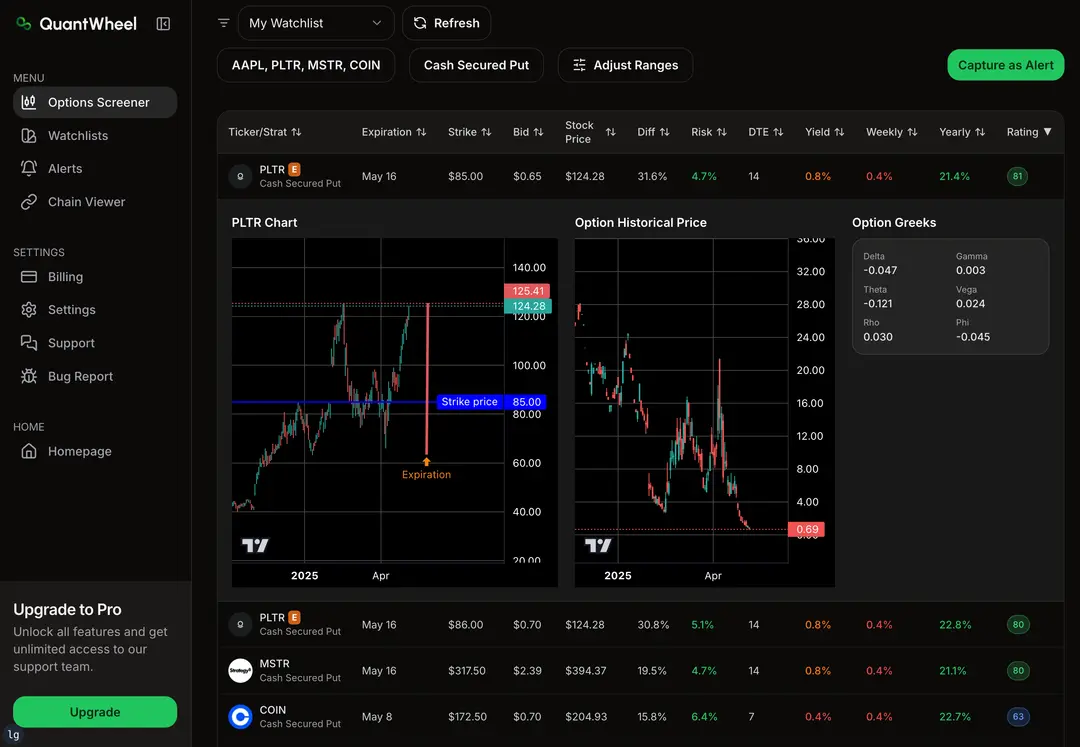
Many wheel strategy traders use QuantWheel's real-time options screener for this exact process. It filters across 570,000+ contracts in minutes rather than hours, showing you exactly which stocks meet your cash secured put criteria right now. The screener calculates premium yields, IV ranks, and liquidity metrics automatically, letting you identify opportunities before they disappear.
After identifying candidates meeting your technical criteria, evaluate fundamental quality. Check recent earnings, review revenue trends, and assess competitive positioning. You're looking for reasons you'd want to own this business, not reasons to avoid it.
Managing Your Cash Secured Put Positions
Selecting good stocks is half the battle. Managing positions properly ensures you capture premium without unnecessary risk. Set clear exit rules before entering any cash secured put position.
Close winning positions at 50% profit with 21+ days to expiration. If you collected $2.00 premium and can buy back the option for $1.00 with three weeks remaining, close the position. You've captured half the maximum profit in one-quarter of the time, freeing capital for new opportunities.
Roll positions down and out when the stock falls toward your strike with 7-14 days remaining. Instead of accepting assignment at current prices, roll to next month's expiration at a lower strike, collecting additional premium. This gives the stock more time to recover while improving your cost basis if eventually assigned.
Accept assignment on stocks you actually want to own. If you're assigned at $50 strike after collecting $2 premium, your real cost basis is $48. If you believe the stock is worth $55-60, assignment isn't failure - it's buying a quality business at a discount. Start selling covered calls to continue generating income.
Here's where tracking becomes critical. After assignment, your broker shows a $50 cost basis, but your real cost basis is $48 after the premium you collected. You need to track this manually in spreadsheets, or use software like QuantWheel that automatically adjusts your cost basis when assignments happen. Without accurate cost basis tracking, you can't make informed decisions about when to sell assigned shares or which covered call strikes to use.
Common Cash Secured Put Mistakes
Chasing Premium Without Fundamental Analysis
The biggest mistake in cash secured put selection is prioritizing premium over quality. That 5% monthly premium looks incredible until you realize you're selling puts on a company losing market share, burning cash, and facing potential bankruptcy.
Always reverse the question: "Would I buy 100 shares of this stock at this strike price tomorrow?" If the answer is no, don't sell the put regardless of premium attractiveness. Premium is compensation for obligation, not magic income disconnected from risk.
Ignoring IV Rank and Selling During Low Volatility
Many traders sell cash secured puts when IV rank sits at 20-30% because they're impatient to deploy capital. This means collecting 0.5-1% monthly instead of waiting for IV rank to spike to 60%+ where you'd collect 2-3% monthly.
The difference compounds dramatically. Waiting for elevated IV rank might mean fewer trades, but each trade captures significantly better risk-adjusted returns. You're not paid to be constantly active, you're paid to act when conditions favor premium collection.
Over-Concentrating in Single Sectors
Selling cash secured puts exclusively in one sector creates correlated risk. If all your puts are on tech stocks and tech sells off sector-wide, multiple positions go ITM simultaneously. Your diversification fails exactly when you need it most.
Spread cash secured puts across multiple sectors: technology, healthcare, financials, consumer, industrials. Sector-specific selloffs affect only a portion of your portfolio rather than creating correlated losses across all positions.
Not Having an Assignment Plan
Many traders sell cash secured puts without considering assignment implications. When assigned, they panic and immediately sell the shares, often at the worst possible time. This transforms assignment from a manageable outcome into a forced loss.
Before selling any cash secured put, know your assignment plan. How will you manage assigned shares? Will you sell covered calls to generate additional income? At what price will you exit the position? Having this plan ready prevents emotional decisions during assignment.
$1 for 7 days • Cancel anytime • 14-day money-back guarantee
Risk Disclosure
Risk Disclosure: Options trading involves substantial risk and is not suitable for all investors. Past performance does not guarantee future results. This content is for educational purposes only and should not be considered investment advice. Always do your own research and consider consulting with a financial advisor before making investment decisions.
The examples used in this article are for educational purposes only and are not recommendations to buy or sell any security. All investment decisions should be based on your own analysis and risk tolerance.