
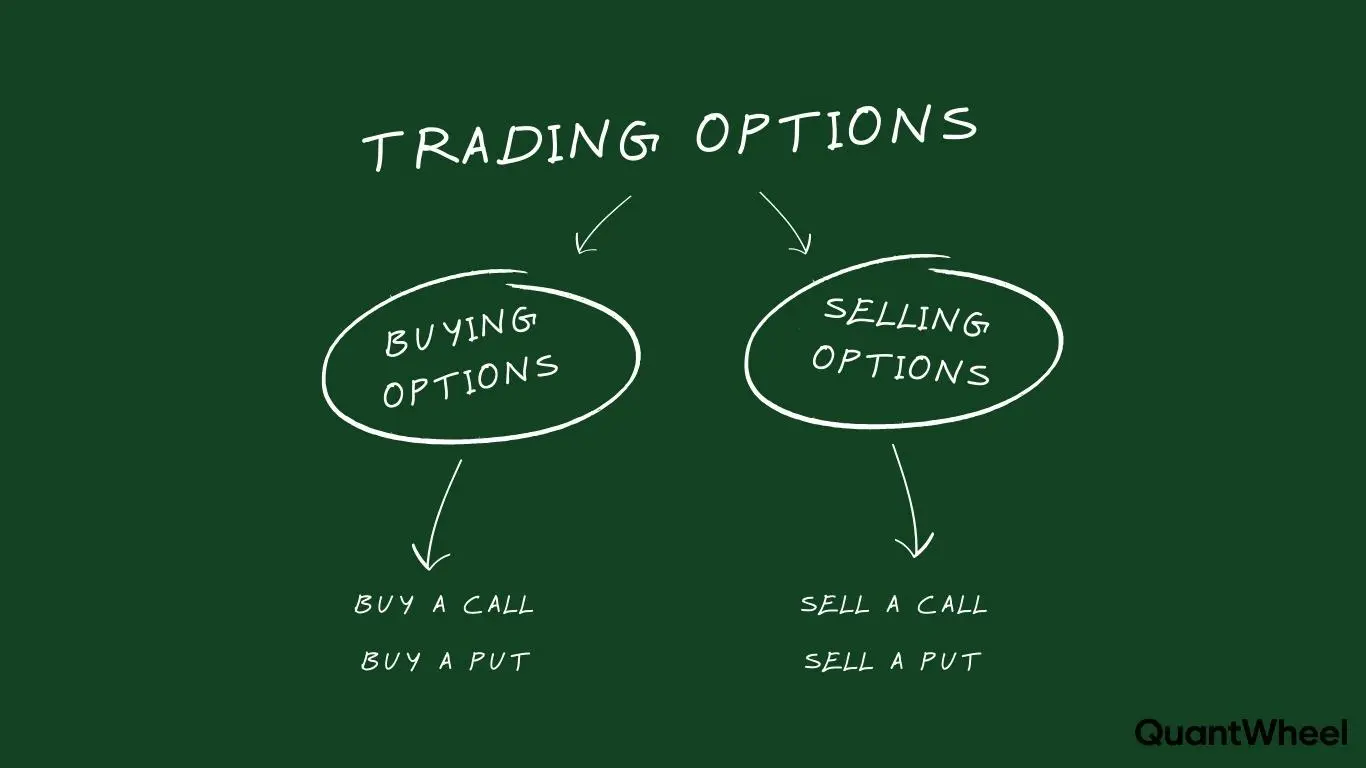
You're deciding between two fundamentally different approaches to building wealth in the stock market.
One requires almost no time and has worked for decades. The other demands active management but promises higher returns through premium collection.
The question isn't which strategy is objectively "better" - it's which one fits your goals, time availability, and personality as a trader or investor.
After running both strategies for years, here's what the data actually shows about wheel strategy versus buy and hold, including when each approach wins and which one might work for your specific situation.
TLDR: Wheel Strategy vs Buy and Hold - The Quick Answer
The Core Difference: Buy and hold means buying stocks and keeping them for years, earning returns through equity appreciation and dividends. The wheel strategy means selling cash-secured puts to acquire stocks at a discount, then selling covered calls while holding them, generating income through options premium on top of equity gains.
Who Wins on Returns?
- Buy and hold: 8-10% annually (historical S&P 500 average)
- Wheel strategy: 12-20% annually when executed well in suitable conditions
- The wheel's advantage comes from premium collection, which adds 5-10% extra income on top of stock appreciation
Who Wins on Time?
- Buy and hold: 1-2 hours per year (set it and forget it)
- Wheel strategy: 5-10 hours per week managing positions, selecting strikes, rolling options
Simple Example: Imagine you have $10,000 and want to own Apple stock (trading at $100).
Buy and hold approach: You buy 100 shares for $10,000 and hold them. If Apple rises to $110 in one year, you made $1,000 (10% return).
Wheel strategy approach: You sell a cash-secured put at $95 strike for $2.00 premium ($200 income). If Apple stays above $95, you keep the $200 and repeat. If Apple drops below $95, you get assigned and buy 100 shares at an effective cost of $93 (the $95 strike minus $2 premium collected). Then you sell covered calls on your shares for even more premium. Over the same year, you might collect $1,200 in total premium plus benefit from stock appreciation.
The Verdict: If you have 5-10 hours weekly and enjoy active trading, the wheel strategy can outperform. If you want truly passive income with zero time commitment, buy and hold is superior. Most investors should start with buy and hold until they've learned options thoroughly.
Find good deals for the wheel with QuantWheel →
What Is Buy and Hold (And Why It Works)
Buy and hold is the strategy of purchasing quality stocks or index funds and holding them for years or decades, regardless of short-term market fluctuations.
How buy and hold works:
- Research companies or buy broad index funds (like SPY or VOO)
- Purchase shares with investable capital
- Hold through market ups and downs
- Collect dividends if the stock pays them
- Sell after many years when you need the capital
Why buy and hold works: The stock market has historically trended upward over long periods. The S&P 500 has returned approximately 10% annually since 1928, despite crashes, recessions, and bear markets. Time in the market beats timing the market.
Buy and hold benefits from:
- Compound growth: Your returns generate their own returns over time
- Tax efficiency: No capital gains taxes until you sell
- Dividend reinvestment: Quarterly dividends buy more shares automatically
- Simplicity: No decisions needed after initial purchase
- Lower stress: Daily market movements don't require action
The biggest advantage of buy and hold is that it requires almost zero ongoing effort. You can work your job, live your life, and check your portfolio once per quarter. Your wealth builds passively in the background.
What Is the Wheel Strategy (And How It Generates Income)
The wheel strategy is an active options trading approach that generates income by systematically selling cash-secured puts and covered calls on stocks you're willing to own.
How the wheel strategy works:
Phase 1: Sell Cash-Secured Puts You sell put options on quality stocks you'd be happy to own at a lower price. You collect premium upfront. If the stock stays above your strike price, the option expires worthless and you keep the premium. If the stock falls below your strike, you get "assigned" and must buy 100 shares at that strike price.
Phase 2: Get Assigned (When It Happens) When assigned, you now own 100 shares of the stock at your strike price, minus the premium you already collected. This reduces your effective cost basis below the strike price.
Phase 3: Sell Covered Calls Now that you own the shares, you sell call options against them. You collect more premium. If the stock stays below your call strike, you keep both the shares and the premium. If the stock rises above your strike, your shares get "called away" and you sell them at the strike price for a profit.
Phase 4: Repeat Once your shares are called away, you return to Phase 1 and start selling puts again on the same or different stocks.
Why the wheel strategy generates higher returns: You're collecting option premium at every stage (selling puts, selling calls), which adds 5-10% annual income on top of any stock appreciation. Your effective cost basis is lowered by all the premium collected, giving you a margin of safety that buy and hold doesn't have.
The wheel strategy works best on quality stocks with moderate volatility - stable enough that you're happy owning them long-term, but volatile enough that options premium is worthwhile.
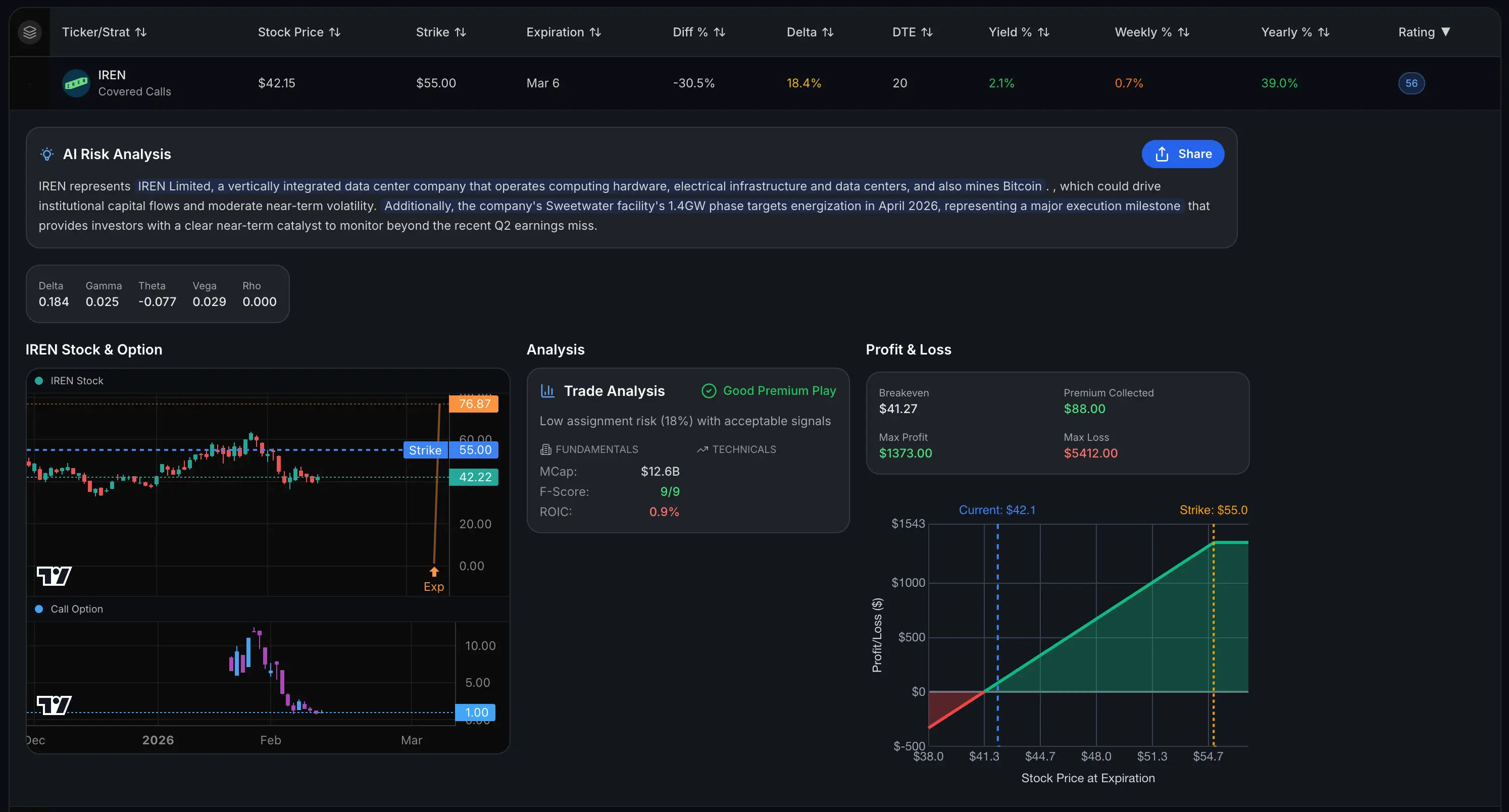
Here's a few example trades for you to get the idea on what's possible: Cash secured put trade example:
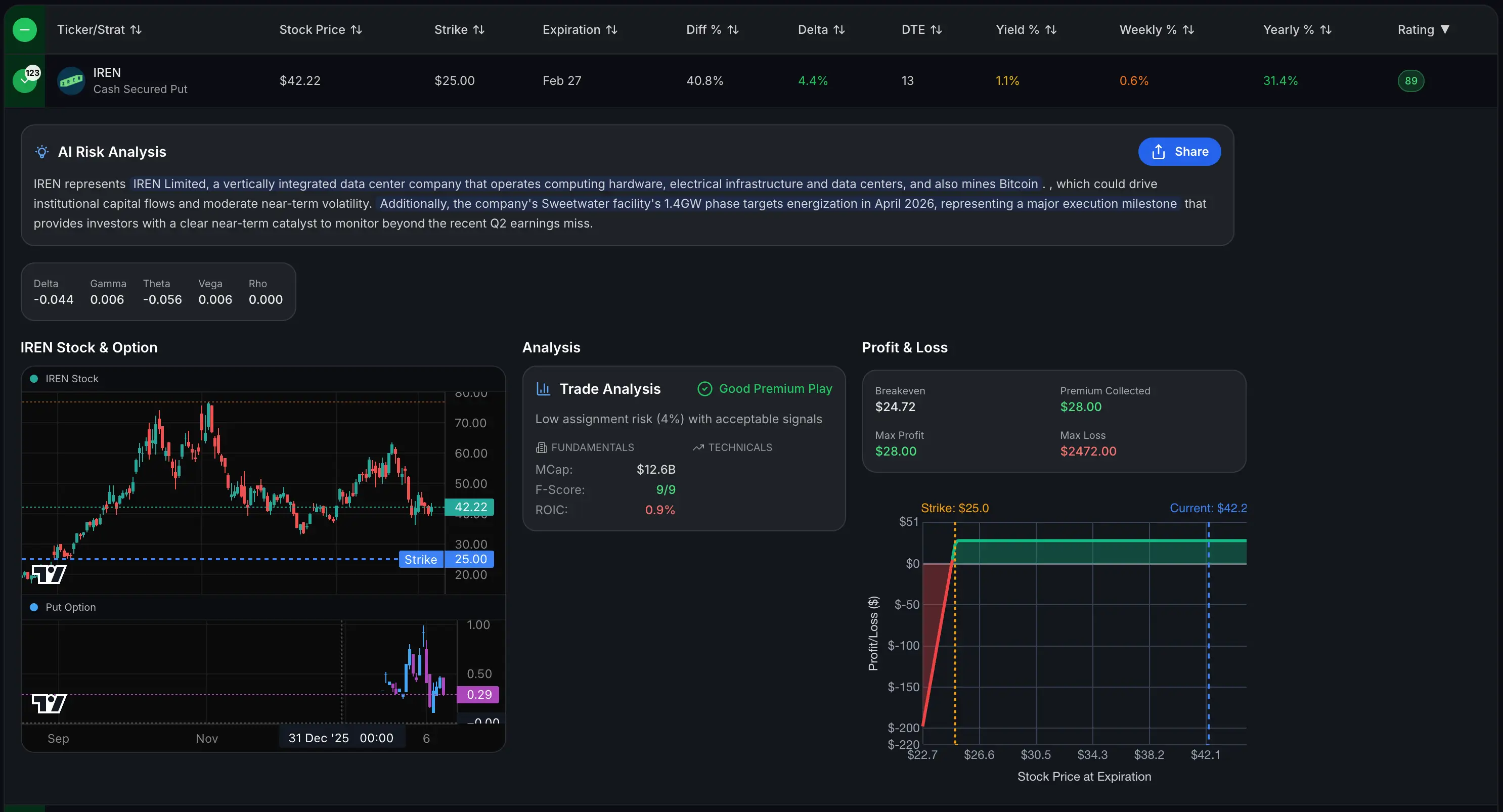
Covered Call trade example:
Run the wheel strategy inside QuantWheel →
Returns Comparison: What the Data Shows
Let's compare actual return potential for both strategies using realistic scenarios.
Buy and Hold Returns:
- S&P 500 historical average: 10% annually (1928-2024)
- Individual quality stocks: 8-15% annually depending on selection
- Dividends: Additional 1-2% for dividend-paying stocks
- Total realistic expectation: 8-10% annually
Wheel Strategy Returns:
- Stock appreciation: Same as buy and hold (8-10% if assigned)
- Put premium: 2-4% annually from cash-secured puts
- Call premium: 3-6% annually from covered calls
- Total realistic expectation: 12-20% annually when managed well
Where the wheel strategy outperforms:
- Sideways markets where stocks trade in ranges
- Moderately bullish markets with normal volatility
- High implied volatility environments where premium is elevated
- Individual stocks versus broad indexes
Where buy and hold outperforms:
- Strong bull markets where stocks rise rapidly (calls cap your upside)
- Low volatility environments where option premium is minimal
- Stocks that make unexpected large moves upward
- Tax-advantaged accounts (fewer taxable events)
Real example comparison: Let's use $50,000 invested in a quality stock over 12 months:
Buy and hold: Stock rises from $50 to $55 (10% gain) = $5,000 profit
Wheel strategy:
- Sold puts: Collected $1,200 in premium before assignment
- Got assigned at $48 effective cost basis (after premium)
- Stock rose to $55, sold for $7 profit per share = $7,000
- Sold covered calls: Collected additional $1,800 premium
- Total profit: $3,000 (assignment profit + premium) = 16% return
The wheel strategy added 6% extra returns through premium collection in this scenario.
Important caveat: Wheel strategy returns require active management, good strike selection, and favorable market conditions. Poor execution can result in returns worse than buy and hold.
Time Commitment: The Real Cost of Active Trading
The biggest practical difference between these strategies is how much of your life they consume.
Buy and Hold Time Commitment:
- Initial research: 5-10 hours (one time)
- Ongoing management: 1-2 hours per year
- Annual portfolio review: 1 hour
- Rebalancing: 30 minutes annually
- Total: Nearly zero ongoing time
You can literally buy index funds, set up automatic investments, and not look at your portfolio for years. This is the ultimate passive income strategy.
Wheel Strategy Time Commitment:
- Learning options basics: 40-60 hours (one time)
- Weekly position management: 3-5 hours
- Daily monitoring: 20-30 minutes
- Rolling positions: 1-2 hours weekly
- Research and screening: 2-3 hours weekly
- Total: 5-10 hours per week ongoing
The wheel strategy is not passive. You're actively managing positions, monitoring expirations, making roll decisions, and selecting new strikes every week.
The hidden time costs:
- Mental energy spent thinking about positions
- Stress during market volatility
- Decision fatigue from constant choices
- Learning curve for options mechanics
- Tax preparation complexity
For busy professionals with demanding careers, the wheel strategy's time requirements often make it impractical. You need consistent availability to monitor positions and make adjustments during market hours.
For those who enjoy trading, want market involvement, or have flexible schedules, the wheel strategy's time commitment is a feature, not a bug. You're actively engaged with your money.
Risk Profile: Understanding What Can Go Wrong
Both strategies involve owning stocks, so both face similar fundamental risks. The key differences lie in complexity and tail risks.
Buy and Hold Risks:
- Market risk: Stocks can decline 20-50% in bear markets
- Individual stock risk: Company-specific issues (earnings misses, management problems)
- Opportunity cost: Capital tied up in losing positions for years
- Behavioral risk: Panic selling during crashes
Buy and hold risk is straightforward: if the stock goes down, you lose money. The advantage is that you own the shares outright with no additional complexity.
Wheel Strategy Risks:
- All the same stock risks: You're still exposed to declines
- Assignment risk: Forced to buy stocks at inopportune times
- Capped upside: Covered calls limit profits on big upward moves
- Complexity risk: Mistakes from poor strike selection or timing
- Margin risk: If using margin instead of cash-secured puts
- Concentration risk: Capital locked in assigned positions
The wheel strategy doesn't eliminate stock risk - it slightly reduces your effective cost basis through premium collection. If a stock crashes 40%, you're still losing money (just 3-5% less due to collected premium).
What about "the wheel is safer" claims? Some traders claim the wheel strategy is safer because premium reduces cost basis. This is partially true but misleading. Your downside protection is limited to the premium collected (typically 2-4% per trade). If the stock crashes 30%, your premium collected provides minimal cushion.
Black swan events: Both strategies suffer during market crashes. In March 2020, buy and hold investors saw 30-35% portfolio declines. Wheel traders saw similar declines on assigned positions, plus faced challenges with elevated volatility and difficult roll decisions.
The honest assessment: The wheel strategy has similar downside risk to buy and hold, with added complexity risk from options management.
Capital Requirements: How Much Money You Actually Need
One often-overlooked factor is the significant difference in starting capital requirements.
Buy and Hold Capital Requirements:
- Minimum: $100 (can buy fractional shares)
- Comfortable start: $1,000-$5,000
- Ideal for diversification: $10,000+
- No account minimums for cash accounts
You can start buy and hold investing with nearly any amount. Fractional shares mean even expensive stocks like Amazon or Google are accessible with $50. This makes buy and hold the only realistic option for beginning investors.
Wheel Strategy Capital Requirements:
- Absolute minimum: $2,000-$3,000 (for very cheap stocks)
- Realistic minimum: $5,000-$10,000
- Comfortable start: $25,000+
- Ideal for multiple positions: $50,000+
Why so much more? Cash-secured puts require enough capital to buy 100 shares of the underlying stock. For a $50 stock, that's $5,000 in cash sitting in your account for each put you sell.
Example capital requirements:
- $30 stock: $3,000 required per position
- $50 stock: $5,000 required per position
- $100 stock: $10,000 required per position
- $200 stock: $20,000 required per position
To run the wheel strategy on multiple stocks (recommended for diversification), you need capital for multiple positions. Most successful wheel traders operate with $50,000+ to maintain 5-10 positions simultaneously.
Using margin changes the equation: Some brokers allow you to sell puts using margin instead of cash-secured. This reduces capital requirements but adds significant risk and margin interest costs. For most traders, cash-secured puts are the safer approach.
The capital requirement difference makes buy and hold the only viable option for investors starting with less than $10,000.
Tax Implications: The Often-Overlooked Difference
Taxes can significantly impact your real returns, and these strategies face very different tax treatments.
Buy and Hold Tax Advantages:
- No taxes until you sell (could be decades away)
- Long-term capital gains rates (0%, 15%, or 20% depending on income)
- Qualified dividends taxed at favorable rates
- Tax-loss harvesting opportunities
- Step-up basis for heirs (no capital gains tax)
- Tax-deferred growth compounds over time
Buy and hold is remarkably tax-efficient. Your wealth compounds without annual tax drag. If you hold quality stocks for 20 years, you pay zero taxes for 19 years and only pay favorable long-term rates in year 20.
Wheel Strategy Tax Complications:
- Option premium taxed as short-term capital gains (ordinary income rates)
- Frequent trades generate taxable events
- Complicated cost basis tracking through assignments
- Wash sale rules can disallow losses
- More complex tax preparation
- Higher effective tax rate reduces net returns
Every option premium you collect is a taxable event. If you're selling puts and calls every month, you're generating 12-24 taxable events per position per year. This administrative burden is real.
Tax rate impact on returns: Assume you're in the 24% tax bracket:
Buy and hold: 10% return - 1.5% long-term cap gains tax = 8.5% after-tax return
Wheel strategy: 16% return - 3.8% short-term tax = 12.2% after-tax return
The wheel strategy still wins in this example, but the gap narrows significantly after taxes. In lower return environments or higher tax brackets, taxes could erase the wheel strategy's advantage entirely.
Account type matters: These tax differences disappear in retirement accounts (IRA, 401k, Roth IRA). If you're trading in a tax-advantaged account, the wheel strategy's tax burden becomes irrelevant, making it significantly more attractive.
Market Conditions: When Each Strategy Excels
Neither strategy is universally better - performance depends heavily on market environment.
Best Markets for Buy and Hold:
Strong bull markets - When stocks rise consistently and rapidly, buy and hold captures all the upside while wheel strategy calls cap your gains. During 2019-2021, many wheel traders underperformed simply holding tech stocks.
Low volatility environments - When implied volatility is low, option premiums are minimal and barely worth collecting. Buy and hold wins by default since there's little premium advantage to justify the wheel's complexity.
Mega-cap growth stocks - Stocks like NVDA, TSLA, or AAPL during explosive growth phases often make 100-300% moves. Covered calls would have capped your gains at 10-20% while buy and hold captured the full move.
Best Markets for Wheel Strategy:
Sideways markets - When stocks trade in ranges for months, premium collection adds significant returns while buy and hold makes zero progress. 2015-2016 and 2022 were excellent environments for the wheel strategy.
High volatility markets - When implied volatility spikes above 30-40%, option premiums become substantial enough to meaningfully enhance returns. The wheel strategy shines during elevated VIX environments.
Moderately bullish markets - When stocks grind slowly higher with normal volatility, the wheel strategy captures both stock appreciation AND premium income, outperforming pure buy and hold.
Dividend aristocrats and blue chips - Stable, mature companies with predictable trading ranges are ideal wheel candidates. Think stocks like KO, PG, JNJ, or DIS during normal times.
The 2020-2024 example:
- 2020: Extreme volatility favored wheel strategy (huge premiums)
- 2021: Strong bull market favored buy and hold (uncapped upside)
- 2022: Bear market slightly favored wheel (premium cushioned losses)
- 2023: Strong rally favored buy and hold again
- 2024: Moderate markets favored wheel strategy
No single strategy dominates all environments. Many traders use buy and hold for core holdings and wheel strategy for tactical positions.
Skill Requirements: What You Need to Know
The learning curves for these strategies differ dramatically.
Buy and Hold Skill Requirements:
- Basic understanding of stocks and ownership
- Company fundamental analysis (optional but helpful)
- Patience and emotional discipline
- Ability to ignore short-term noise
- Understanding of diversification
- Total learning time: 10-20 hours
Buy and hold is remarkably accessible. You can start with index funds (SPY, VOO, QQQ) and immediately have a diversified, professional-quality portfolio with zero stock selection skills needed.
The hardest skill for buy and hold is psychological: not panicking during market crashes. But this is behavioral, not technical.
Wheel Strategy Skill Requirements:
- Everything from buy and hold, plus:
- Options mechanics (puts, calls, strike selection, expiration)
- Implied volatility and the Greeks (delta, theta, vega)
- Cost basis calculation through assignments
- Rolling strategies and decision frameworks
- Position sizing and risk management
- Stock screening for suitable candidates
- Broker platform proficiency
- Total learning time: 50-100 hours minimum
The wheel strategy has a legitimate learning curve. You need to understand:
- What happens when you sell a put
- How assignment works mechanically
- How to calculate your real cost basis after collecting premium
- When to roll versus accept assignment
- How to select appropriate strikes for your risk tolerance
- How to manage multiple positions simultaneously
Most traders spend 2-3 months paper trading (practicing with fake money) before running the wheel strategy with real capital. Jumping in without education often leads to expensive mistakes.
Common beginner mistakes:
- Selling puts on stocks they don't actually want to own
- Choosing strikes too aggressively (high premium but high risk)
- Getting assigned and panicking
- Selling covered calls at strikes that don't allow profit
- Misunderstanding cost basis after assignment
- Violating pattern day trading rules accidentally
These mistakes rarely happen with buy and hold since the strategy is straightforward: buy, hold, don't sell.
This is exactly where most wheel traders struggle: tracking your actual cost basis after assignment. Your broker shows the strike price, but your real cost is the strike minus all premium collected. Many traders manually track this in spreadsheets - which breaks down after multiple assignments and rolled positions. This is why QuantWheel exists - built specifically to track full wheel cycles automatically, adjusting your cost basis on assignment so you always know your real breakeven.
If you're a beginner, QuantWheel rating can help you in distinguishing good trades from bad ones. You can further optimize by making adjustments in the filters.
Learn faster with QuantWheel →
Which Strategy Should You Choose?
The answer depends entirely on your specific situation, goals, and personality.
Choose Buy and Hold If:
- You have limited time (less than 5 hours weekly for trading)
- You're starting with under $10,000
- You want truly passive income
- You're investing in tax-advantaged retirement accounts
- You prefer simplicity over optimization
- You don't want to learn options mechanics
- You're investing for goals 10+ years away
- You have a demanding job with little flexibility
- You get anxious making frequent decisions
Choose Wheel Strategy If:
- You have 5-10 hours weekly for active management
- You have $25,000+ in investable capital
- You genuinely enjoy trading and market involvement
- You're willing to invest 50-100 hours learning options
- You want higher potential returns and accept complexity trade-off
- You have consistent availability during market hours
- You're comfortable with position management responsibility
- You're trading in tax-advantaged accounts (negates tax disadvantage)
- You want to generate income from existing capital
Consider Combining Both If:
- You have sufficient capital for diversification ($50,000+)
- You want to "test" the wheel strategy without going all-in
- You enjoy tactical trading but want passive core holdings
- You're willing to allocate time to active management on portion of portfolio
A common hybrid approach: 70% of capital in buy and hold index funds (SPY, VOO) for passive growth, 30% of capital in wheel strategy on individual stocks for income generation. This balances simplicity with return enhancement.
The honest truth most won't tell you: For 95% of investors, buy and hold will deliver better risk-adjusted returns simply because they won't consistently execute the wheel strategy well enough to justify its complexity. The wheel strategy CAN outperform, but only if you're disciplined, educated, and willing to treat it like a part-time job.
If you're not genuinely interested in options trading as a skill to develop, stick with buy and hold. Your time is valuable, and spending 10 hours weekly on wheel strategy management might generate less total wealth than spending those 10 hours advancing your career.
But if you're fascinated by options, enjoy active trading, and have the capital to support it properly, the wheel strategy can be a powerful tool for income generation and return enhancement.
Getting Started: First Steps for Each Strategy
Starting with Buy and Hold:
- Open a brokerage account (Fidelity, Schwab, Vanguard)
- Decide between index funds (simple) or individual stocks (more research)
- For index funds: Buy SPY, VOO, or VTI and hold forever
- For stocks: Research 3-5 quality companies you understand
- Invest a fixed amount monthly (dollar-cost averaging)
- Set up automatic dividend reinvestment
- Check portfolio quarterly, rebalance annually
- Ignore daily market noise
Time to implement: 2-3 hours total
Starting with Wheel Strategy:
- Learn options basics thoroughly (50-100 hours of education)
- Read options textbooks or take courses
- Understand cash-secured puts and covered calls
- Learn the Greeks (delta, theta, gamma, vega)
- Study implied volatility and IV rank
- Paper trade for 2-3 months
- Practice on thinkorswim paperMoney or similar
- Execute full wheel cycles with fake money
- Learn your broker's options interface
- Make mistakes with no financial consequences
- Create a watchlist of suitable wheel stocks
- Quality companies you'd hold long-term
- Stock price $25-$100 (capital efficiency)
- Adequate options volume and liquidity
- Moderate volatility (not too low, not meme-stock high)
- Start small with real money
- Begin with 1-2 positions maximum
- Use only 20-30% of capital initially
- Choose familiar, stable stocks (avoid earnings plays initially)
- Sell conservative strikes (0.20-0.30 delta)
- Track everything meticulously
- Record all premium collected
- Calculate cost basis after assignments
- Monitor position performance
- Learn from both wins and losses
- Scale up gradually
- Add positions only after mastering current ones
- Increase position size as confidence grows
- Maintain diversification (5-10 positions eventually)
- Continue education throughout
Time to implement: 3-6 months before trading confidently with size
The stark difference in implementation time explains why buy and hold is dramatically more popular despite the wheel strategy's higher return potential.
Final Verdict: Which Strategy Wins?
There is no universal winner - the best strategy depends on your specific situation.
Buy and hold wins for:
- Passive investors who value time over maximizing returns
- Beginners with limited capital
- Long-term retirement investing
- Those who want simplicity and low maintenance
- Investors who prefer low-stress approaches
Wheel strategy wins for:
- Active traders who enjoy market involvement
- Those with substantial capital ($25,000+)
- Investors willing to develop options expertise
- Those seeking higher returns and accepting complexity
- Traders with consistent time availability
The reality most ignore: Investment success depends more on consistency and discipline than strategy selection. A perfectly executed buy and hold strategy will outperform a poorly executed wheel strategy every single time.
Many traders switch to the wheel strategy seeking higher returns, only to underperform their previous buy and hold results due to poor execution, emotional decisions, and time inconsistency.
Before abandoning buy and hold for the wheel strategy, honestly assess:
- Will you consistently dedicate 5-10 hours weekly?
- Will you study options for 50-100 hours before starting?
- Do you have $25,000+ to properly diversify wheel positions?
- Are you comfortable with the added complexity?
- Will you remain disciplined during losses?
If you answered "no" to any of these, buy and hold is probably your better choice.
If you answered "yes" to all of them AND you genuinely enjoy trading, the wheel strategy can deliver enhanced returns worth the effort investment.
The unsexy truth: Most investors would achieve better results putting 100% into buy and hold index funds and spending their time advancing their careers than attempting to optimize returns through active wheel strategy management.
But for the minority who love trading, have the capital, and commit to mastering the strategy, the wheel can be a powerful income generation tool.
Choose based on who you are, not based on which strategy sounds more appealing.
Start your free trial of QuantWheel - If you've decided the wheel strategy fits your goals, QuantWheel automates the tedious position tracking, cost basis calculations, and alert management so you can focus on strike selection and strategy execution instead of spreadsheet maintenance.
$1 for 7 days • Cancel anytime • 14-day money-back guarantee
Risk Disclosure
Options trading involves substantial risk and is not suitable for all investors. Past performance does not guarantee future results. This content is for educational purposes only and should not be considered investment advice. Always do your own research and consider consulting with a financial advisor before making investment decisions.
The examples used in this article are for educational purposes only and are not recommendations to buy or sell any security. All investment decisions should be based on your own analysis and risk tolerance.