

You've heard about the wheel strategy - the "boring but profitable" options approach that generates consistent income. Maybe you've seen traders on Reddit's r/thetagang discussing their monthly premium collection, or perhaps you're tired of the stress that comes with directional trading.
The wheel strategy offers a systematic way to generate income from options while managing risk through actual stock ownership. It's not glamorous, won't make you rich overnight, and requires patience. But for traders who want a repeatable, rule-based system for generating returns, it's worth understanding deeply.
Try wheeling with QuantWheel →
In this complete guide, I'll walk you through exactly how the wheel strategy works, when to use it, how to manage positions, which stocks to choose, and the mistakes that trip up most beginners. By the end, you'll understand whether this strategy fits your goals and how to execute it properly.
TLDR: Wheel Strategy Explained (Read This First)
The wheel strategy is a three-phase options income strategy that combines cash-secured puts and covered calls to generate consistent returns. Think of it as getting paid to set limit orders, then getting paid again while you wait for your shares to get called away.
Here's how it works in simple terms:
- Phase 1 - Sell Cash-Secured Puts: You sell a put option on a stock you'd be happy to own, collecting premium upfront. You set aside enough cash to buy 100 shares if assigned. If the stock stays above your strike price, the put expires worthless and you keep the premium. If it drops below your strike, you buy the shares at your strike price (but your real cost is lower because of the premium you collected).
- Phase 2 - Get Assigned (Maybe): If the stock price is below your strike at expiration, you're "assigned" and must buy 100 shares. This isn't a bad thing - it's part of the plan. You now own shares at a discount.
- Phase 3 - Sell Covered Calls: Now that you own shares, you sell call options against them, collecting more premium. If the stock rises above your call strike, your shares get "called away" (sold) at that price for a profit. The wheel cycle then starts again.
Simple Example:
- You sell a $50 put on Stock XYZ and collect $2 in premium ($200 per contract)
- Stock drops to $48, you get assigned and buy 100 shares at $50
- Your real cost basis is $48 ($50 strike - $2 premium collected)
- You sell a $52 covered call and collect another $1.50 ($150)
- Stock rises to $53, your shares get called away at $52
- Total profit: $2 (put premium) + $1.50 (call premium) + $2 (stock appreciation from $50 to $52) = $5.50 per share or $550 total on your $5,000 investment
That's a 11% return in one complete wheel cycle, which might take 4-8 weeks. Even a 14-year-old could understand this: you get paid to potentially buy stocks cheaper, own them, then get paid again to sell them at a profit.
The beauty is in the repetition - you keep running this cycle over and over on quality stocks, compounding your returns while managing risk through actual stock ownership rather than pure options exposure.
What Is the Wheel Strategy?
The wheel strategy is a systematic options trading approach that generates income through two core mechanics: selling cash-secured puts (CSPs) to potentially acquire stock at a discount, and selling covered calls (CCs) on shares you own to generate premium while potentially selling those shares at a profit.
Unlike directional trading strategies that bet on price movement, the wheel strategy is a premium collection strategy. You're essentially acting as an insurance seller - collecting small, consistent premiums from buyers willing to pay for the right to buy or sell at specific prices.
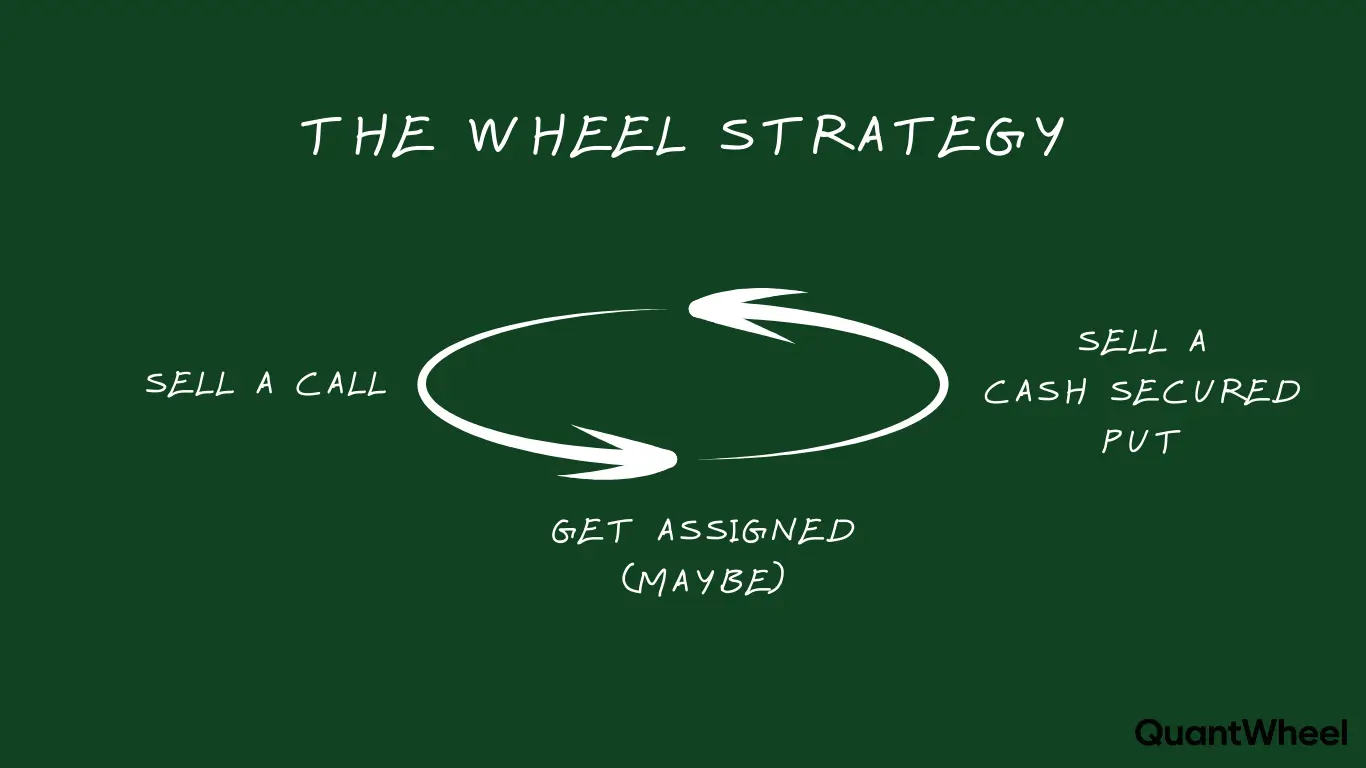
The "wheel" name comes from the cyclical nature of the strategy:
- Sell cash-secured put → 2. Get assigned shares → 3. Sell covered calls → 4. Shares get called away → 5. Return to step 1
This cycle repeats continuously, generating income at each phase. You collect premium when you sell the put, collect premium when you sell the call, and potentially profit from stock appreciation if your shares are called away above your cost basis.
The Three Phases Explained
Phase 1: Selling Cash-Secured Puts
You identify a quality stock you'd be comfortable owning long-term. Instead of just buying shares at market price, you sell a put option at a strike price below the current market price. This gives someone else the right to "put" the stock to you (force you to buy it) at that strike price.
For taking on this obligation, you collect premium upfront. You must have enough cash in your account to purchase 100 shares at the strike price - this is what makes it "cash-secured."
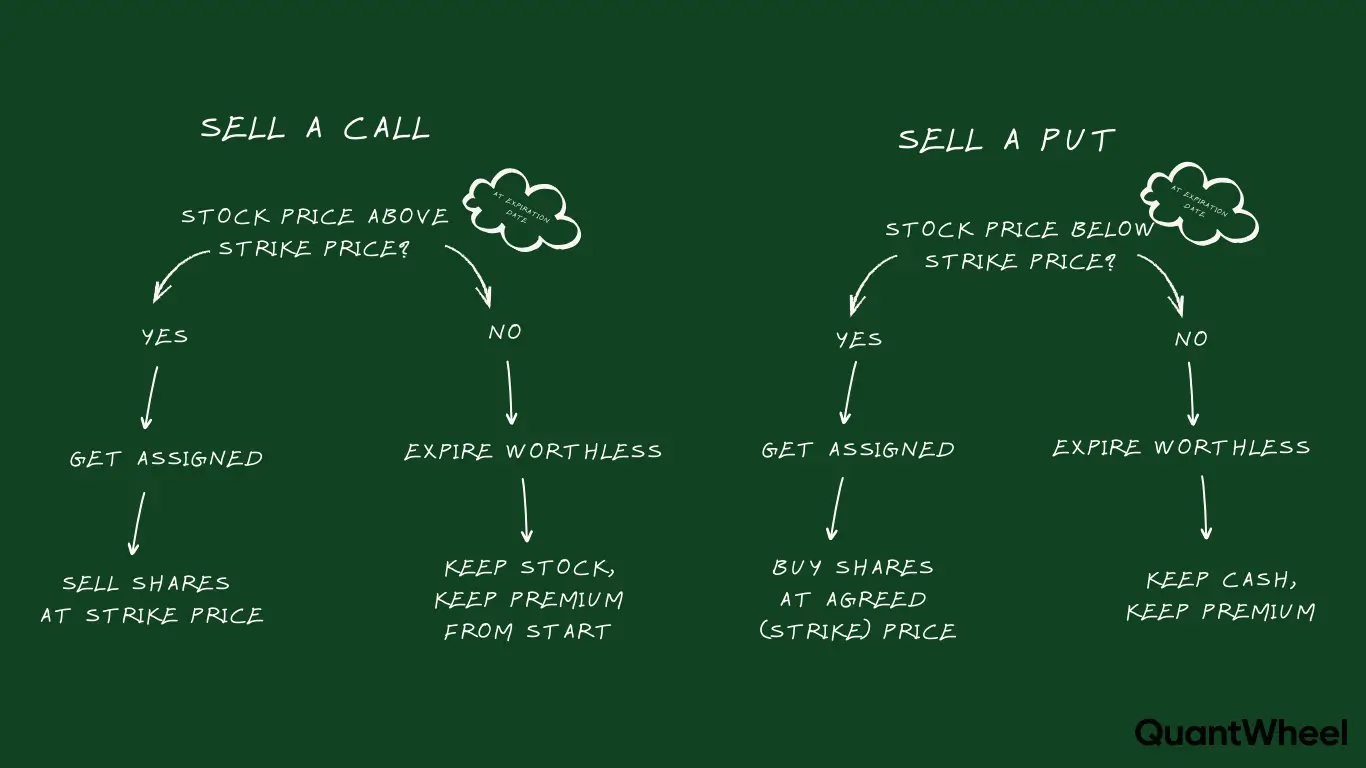
Scenario A: If the stock stays above your strike price through expiration, the put expires worthless. You keep the premium as profit and can immediately sell another put to repeat the process.
Scenario B: If the stock drops below your strike price, you're assigned and purchase 100 shares at the strike price. Your effective cost basis is the strike price minus the premium you collected.
Phase 2: Stock Ownership (After Assignment)
You now own 100 shares of the stock. This is not a failure - assignment is part of the strategy. You acquired the stock at your chosen strike price, and your real cost basis is lower due to the premium collected.
During this phase, you're holding shares and can potentially collect dividends if the stock pays them. But you won't just sit idle - you'll move to Phase 3.
Phase 3: Selling Covered Calls
With 100 shares in your account, you now sell a call option at a strike price above your purchase price. This gives someone else the right to "call away" your shares (buy them from you) at that strike price.
Again, you collect premium upfront for taking on this obligation.
Scenario A: If the stock stays below your call strike through expiration, the call expires worthless. You keep the premium and still own your shares. You can immediately sell another covered call.
Scenario B: If the stock rises above your call strike, your shares get called away at the strike price. You pocket the premium collected plus any appreciation in stock price above your cost basis. The wheel cycle completes, and you return to Phase 1 with increased capital.
Why Traders Choose the Wheel
Conservative Risk Profile: Unlike naked options selling, the wheel strategy always has cash backing your puts and shares backing your calls. You're never exposed to unlimited risk. And also unlike buying options, it's a much safer.
Systematic Approach: The wheel provides clear rules for what to do in every situation. Assignment happens? Sell covered calls. Calls expire worthless? Sell more calls. Shares get called away? Start the wheel again.
Income Generation: Each phase generates premium income. Even in flat markets, you can profit from time decay as options lose value approaching expiration.
Stock Ownership Benefits: During the covered call phase, you own actual shares. You collect dividends (if any) and benefit from stock appreciation up to your call strike price.
Lower Capital Requirements Than Alternatives: While strategies like iron condors or strangles might seem complex, the wheel strategy is straightforward and requires only the capital to buy shares - no special approval or margin requirements for naked options.
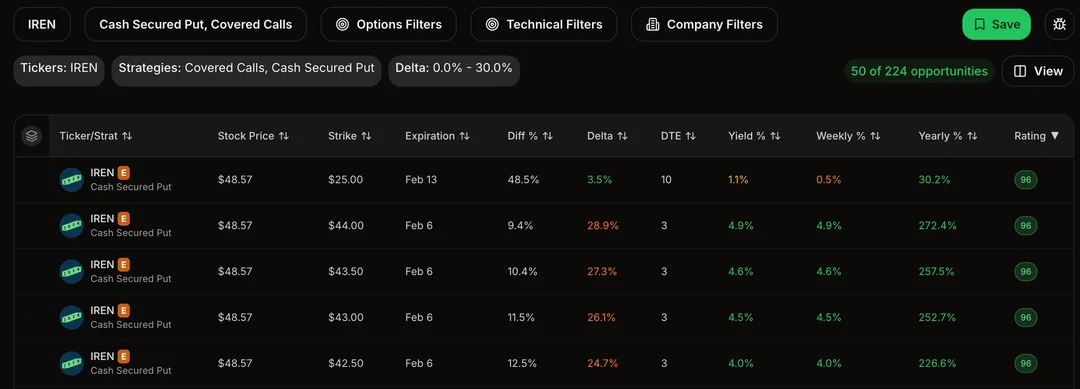
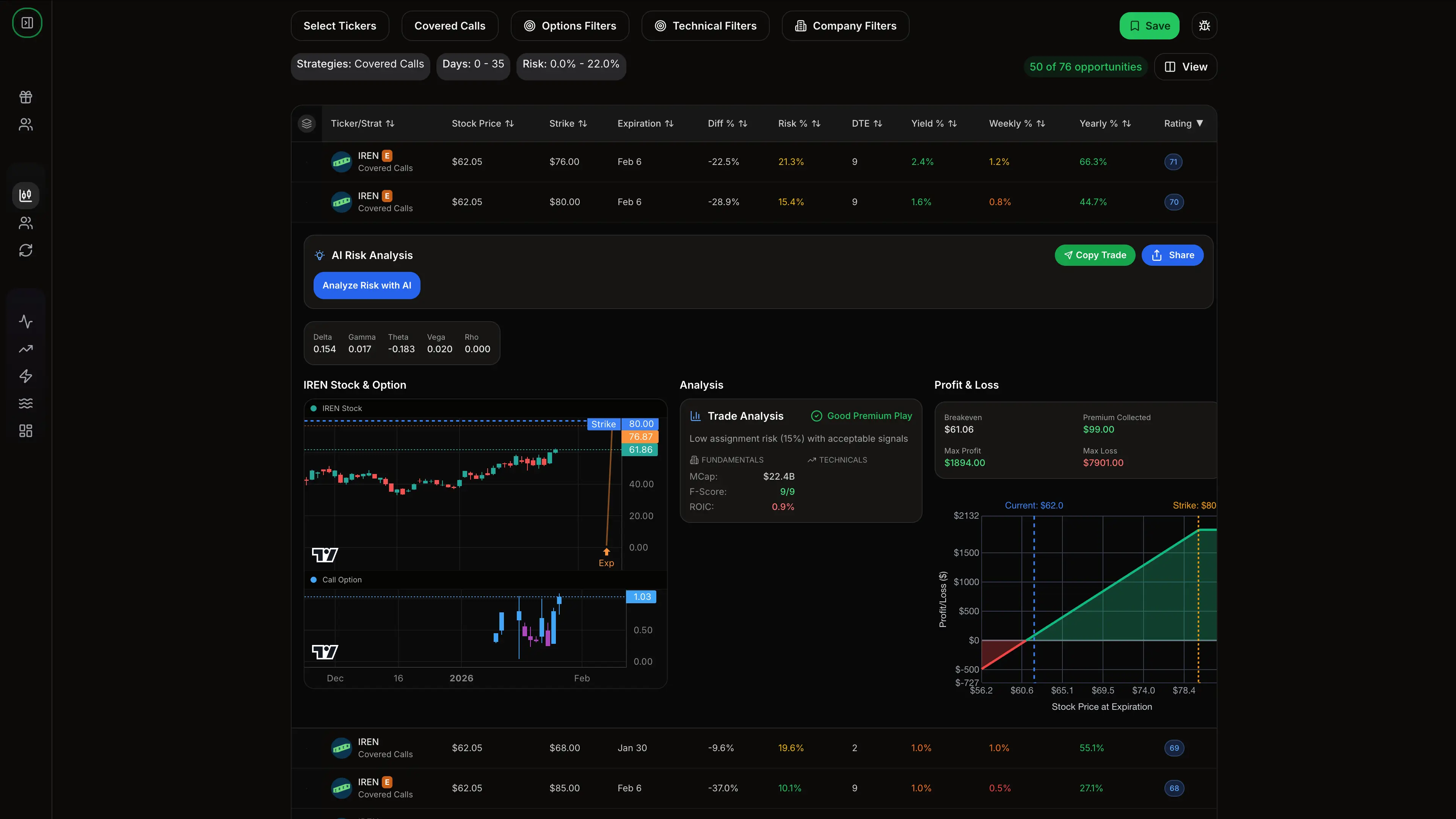
QuantWheel is a tool designed to: 1. Find the best option selling opportunities 2. Help you with rolling trades 3. Help you with journaling trades It's a one place for selling options and creating a system - from finding trades and filtering based on your preferences to fixing mistakes and ultimately keeping track of your cost basis and trade history.
Create your wheel system inside QuantWheel →
What the Wheel Strategy Is NOT
Before going further, let's clarify what the wheel isn't:
Not a "Get Rich Quick" Strategy: The wheel generates consistent, moderate returns. You're collecting small premiums repeatedly, not hitting home runs. Expecting 12-30% annual returns is reasonable; expecting 300% is not.
Not Risk-Free: You can lose money with the wheel if stocks decline significantly. The premium you collect lowers your cost basis but doesn't eliminate loss potential.
Not Suitable for All Stocks: The wheel works on quality stocks with sufficient liquidity and options volume. Running the wheel on penny stocks or meme stocks with unstable fundamentals is asking for trouble.
Not Passive Income: While the strategy is systematic, it requires active management, position monitoring, and decision-making about rolls, strikes, and expirations.
Not a Market-Beating Strategy Guaranteed: In strong bull markets, simple buy-and-hold often outperforms the wheel because your upside is capped by the call strikes you sell. The wheel shines in flat-to-moderately-bullish markets.
How the Wheel Strategy Works: Step-by-Step Walkthrough
Let's walk through a complete wheel cycle with real numbers so you can see exactly how each phase works.
Example Setup
- Stock: Microsoft (MSFT)
- Current Price: $420
- Capital Available: $40,000
- Strategy: Run the wheel on MSFT
Step 1: Sell a Cash-Secured Put
You want to potentially buy MSFT shares, but instead of paying $420 per share right now, you'll use the wheel to potentially acquire them cheaper.
Action: Sell one $400 put option expiring in 30 days
You collect $8.00 in premium per share ($800 per contract). This premium is immediately credited to your account and is yours to keep regardless of what happens.
You set aside $40,000 in cash to secure this put (enough to buy 100 shares at $400).
Possible Outcomes After 30 Days:
Outcome A - MSFT stays above $400: The put expires worthless. You keep the $800 premium as profit. That's a 2% return on your $40,000 in 30 days (24% annualized if you could repeat this monthly). You immediately sell another cash-secured put to repeat the cycle.
Outcome B - MSFT drops below $400 (let's say to $385): You're assigned and must purchase 100 shares at $400 per share, spending your $40,000 cash. Your 100 shares are now worth $38,500 at current market price - you're showing an unrealized loss of $1,500. However, your true cost basis is $392 per share ($400 strike - $8 premium collected), not $400. You move to Step 2.
Step 2: You're Assigned - Now You Own Shares
You now own 100 shares of MSFT with a cost basis of $392 per share ($39,200 total). The current price is $385, so you're underwater by $700 on paper ($39,200 cost basis - $38,500 current value).
Don't Panic. Assignment is part of the plan. You chose MSFT because it's a quality company you're comfortable owning. Now you'll use these shares to generate more income.
Step 3: Sell a Covered Call
Now that you own 100 shares, you can sell covered calls against them.
Action: Sell one $405 call option expiring in 30 days
You collect $5.50 in premium per share ($550 per contract). This premium is immediately yours.
Your total premium collected so far: $800 (from the put) + $550 (from this call) = $1,350.
Possible Outcomes After 30 Days:
Outcome A - MSFT stays below $405: The call expires worthless. You keep the $550 premium and still own your 100 shares. You can sell another covered call next month. Keep repeating this until Outcome B happens.
Outcome B - MSFT rises above $405 (let's say to $420): Your shares get called away. You must sell them at $405 per share, receiving $40,500.
Final Accounting:
- Initial Cash: $40,000
- Premium Collected (Put): $800
- Premium Collected (Call): $550
- Stock Sale Proceeds: $40,500 (sold at $405 per share)
- Total Return: $40,500 + $800 + $550 - $40,000 = $1,850
- ROI: 4.625% in 60 days (~28% annualized)
You've completed one full wheel cycle. You now have $41,850 in cash and can start the wheel again by selling another cash-secured put, perhaps at a higher strike now that you have more capital.
What If the Stock Keeps Dropping?
Let's say MSFT doesn't recover and keeps dropping to $370, then $360, then $350.
You're still holding your 100 shares (cost basis $392). On paper, you're down significantly. You keep selling covered calls to collect premium, lowering your cost basis with each call:
- Month 1: Sell $385 call, collect $400 → new cost basis $391.60
- Month 2: Sell $380 call, collect $350 → new cost basis $391.10
- Month 3: Sell $375 call, collect $300 → new cost basis $390.80
Each month, you're chipping away at your cost basis with premium. Eventually, either:
- The stock rebounds and your shares get called away
- Your cost basis drops below the current price, putting you back in profit
- You decide to take the loss and move on (sometimes the right choice if fundamentals deteriorate)
This is the risk of the wheel - you can get "stuck" in a position that declines. This is why stock selection is critical, which we'll cover later.
Strike Selection: Choosing the Right Prices
Strike selection is where the art meets the science in the wheel strategy. Choose strikes too aggressive and you'll get assigned on poor entries or have shares called away too early. Choose strikes too conservative and you'll collect minimal premium.
Understanding Delta as Your Assignment Probability
Delta is an options Greek that approximates the probability of an option finishing in-the-money (ITM) at expiration. A put with 0.30 delta has roughly a 30% chance of being ITM (and you getting assigned).
Common Delta Targets for the Wheel:
0.20 - 0.30 Delta (Conservative): This is the sweet spot for most wheel traders. You're selling puts below current price with a ~20-30% chance of assignment, collecting moderate premium while keeping assignment risk controlled.
- Pros: Lower assignment risk, better sleep at night, works well for volatile stocks
- Cons: Lower premium collected, slower capital growth
- Best for: Beginners, volatile stocks, larger accounts
0.30 - 0.40 Delta (Moderate): Increased premium with increased assignment risk. A balanced approach.
- Pros: Higher premium collection, faster returns
- Cons: Higher assignment frequency, need to be comfortable owning at these levels
- Best for: Intermediate traders, quality stocks, normal volatility
0.40 - 0.50 Delta (Aggressive): Selling puts close to at-the-money with high assignment probability.
- Pros: Maximum premium collection
- Cons: Very high assignment risk, can result in poor entry prices
- Best for: When you really want to own the stock, strong conviction stocks, experience traders
Strike Selection for Cash-Secured Puts
Step 1: Identify the lowest price you'd be happy to own the stock at. This should be a price where, even if assigned, you're comfortable holding long-term.
Step 2: Look at support levels, previous lows, and logical price points. Round numbers ($50, $100, $150) often have psychological support.
Step 3: Check the options chain and find the strike with your target delta that's closest to your desired price.
Example: MSFT trading at $420
- You'd be happy to own MSFT at $400 or below
- The $400 put shows 0.28 delta and $8.00 premium
- The $395 put shows 0.22 delta and $6.00 premium
- The $405 put shows 0.35 delta and $10.50 premium
For conservative positioning, you might choose the $400 strike (0.28 delta). For more premium, the $405 strike (0.35 delta). Your choice depends on how badly you want to own MSFT and your risk tolerance.
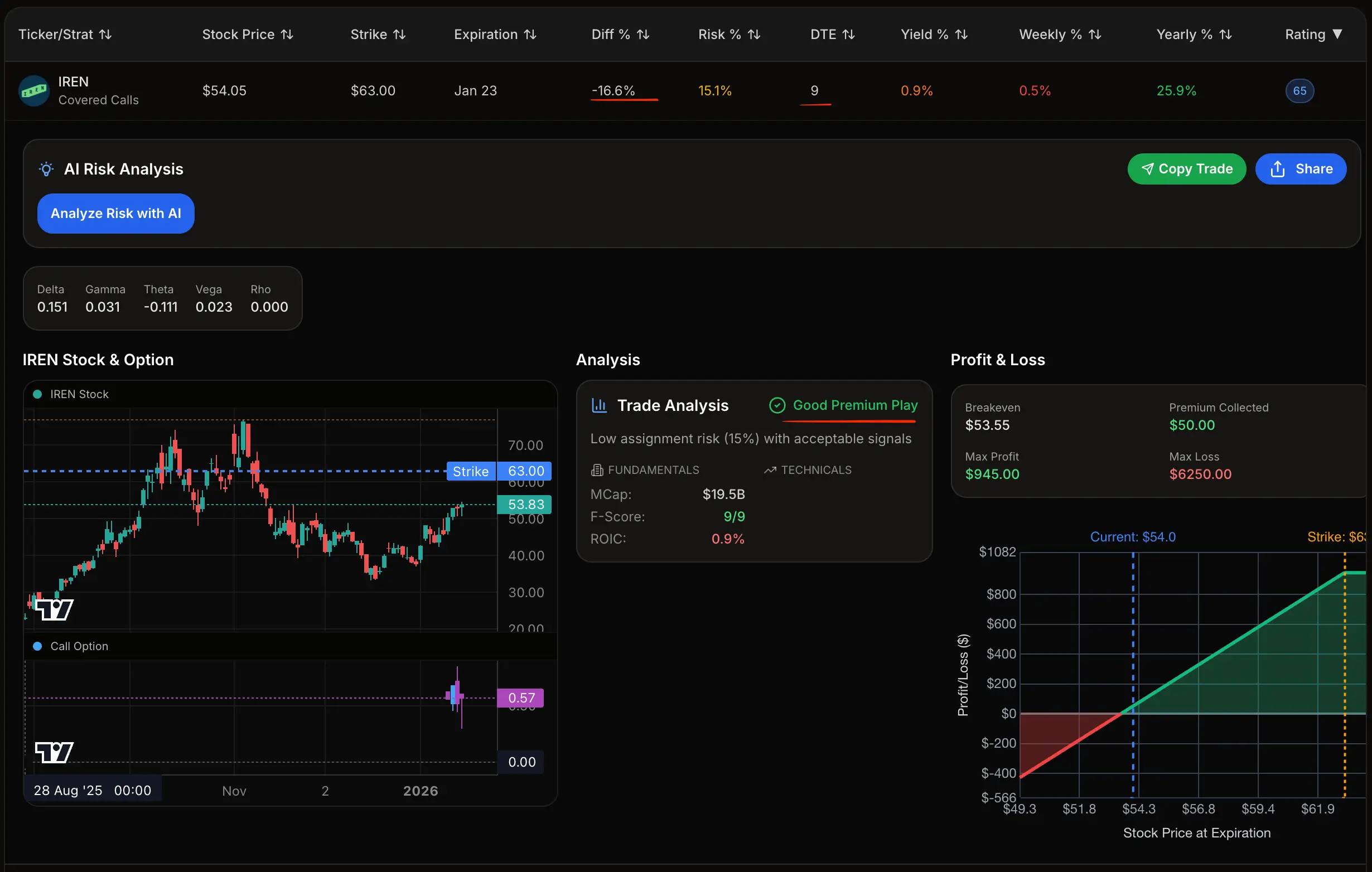
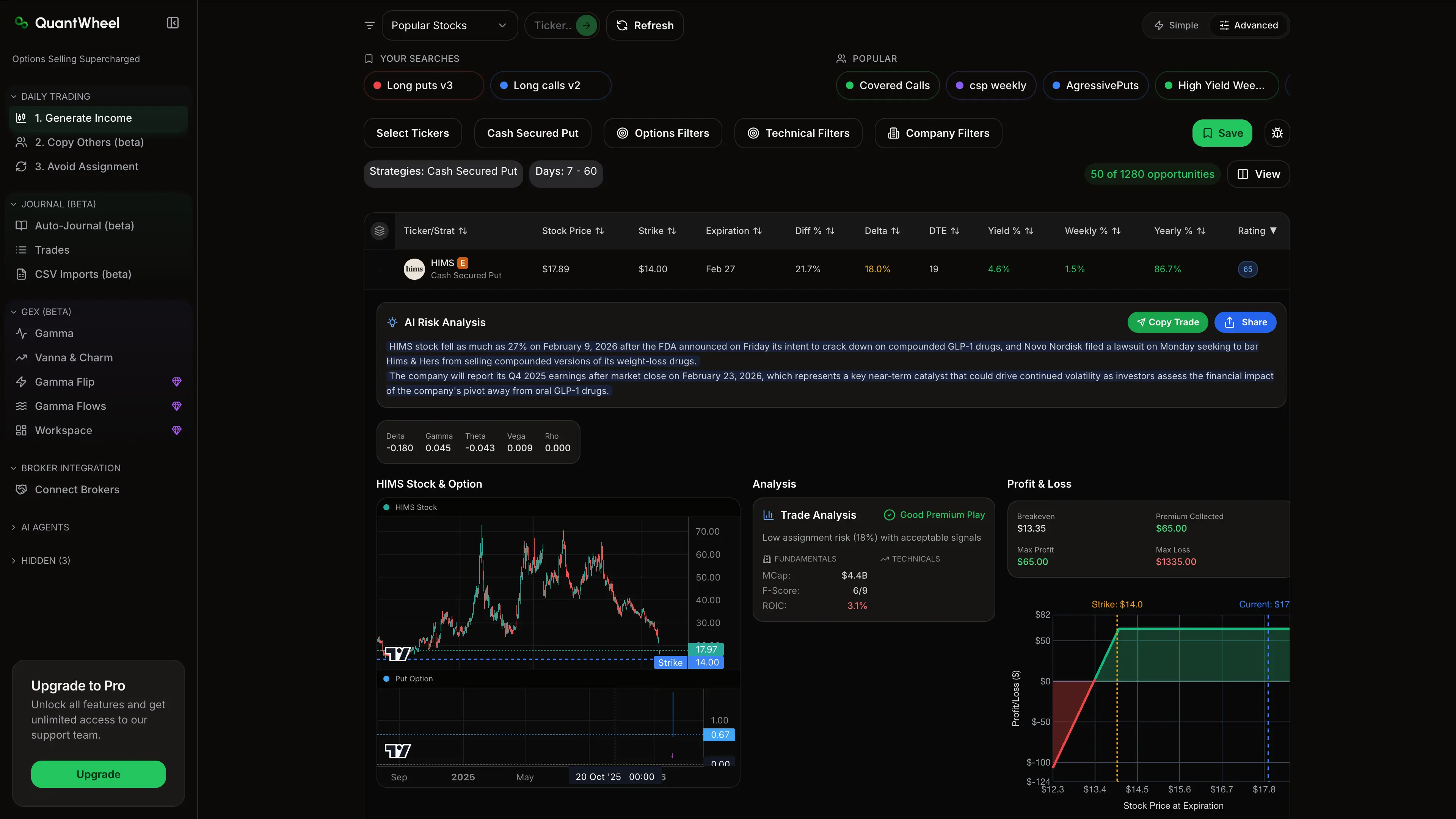
At QuantWheel you get a rating for every trade to help you pick the best trade opportunity, the rating favors avoiding assignment while maximizing the yield or a profit of a trade.
Create your wheel system inside QuantWheel →
Strike Selection for Covered Calls
After assignment, you're selling covered calls on your shares. Your goal is to collect premium while giving yourself room for stock appreciation.
Conservative Approach: Sell calls above your cost basis by 5-10%. This ensures if called away, you profit on both the stock appreciation and the premium collected.
Aggressive Approach: Sell calls at or even below your cost basis if the stock has dropped significantly. You're prioritizing premium collection to lower your cost basis even if it means potential loss on the shares.
Example: Assigned MSFT shares at $400, cost basis $392 after premium
- Conservative: Sell $410 call (5% above cost basis)
- Moderate: Sell $400 call (at original strike)
- Aggressive: Sell $395 call (below cost basis, high premium, stock recovering)
Most traders sell calls at strikes where they'd be happy to sell the shares. If you think MSFT is worth holding above $410, don't sell $410 calls - sell $415 or $420 calls instead.
Days to Expiration (DTE) Considerations
Weekly Options (7-14 DTE):
- Pros: Fast theta decay, quick premium collection, more trading opportunities
- Cons: Requires constant monitoring, more transaction costs, higher IV needed for decent premium
- Best for: Active traders, high-IV stocks, experienced wheel traders
Monthly Options (30-45 DTE):
- Pros: Better premium for time spent, less management required, smoother equity curve
- Cons: Slower premium collection, longer hold times if assigned
- Best for: Most traders, balanced approach, multiple position management
Extended Options (45-60 DTE):
- Pros: Maximum extrinsic value, set it and forget it approach
- Cons: Very slow, capital tied up longer, less compounding
- Best for: Patient traders, lower volatility stocks, large accounts
The most common approach is selling 30-45 DTE options. This offers a balance between premium collection and time efficiency. Many traders close positions at 50% profit with 21+ days remaining rather than holding to expiration, which improves return on time.
Managing Assignments: What Actually Happens
Assignment is where the wheel strategy differs most from other options approaches. In the wheel, assignment isn't a failure - it's an expected part of the cycle. But understanding the mechanics and implications is crucial.
The Assignment Process
When Assignment Happens: If your short put is in-the-money (stock price below strike price) at expiration, you'll likely be assigned. Assignment can also happen early if the option has no extrinsic value and the holder wants to exercise, though this is rare for puts.
Notification: Your broker will notify you (usually after market close on expiration Friday) that you've been assigned. Sometimes the notification comes Saturday or Monday morning.
Share Delivery: Monday morning (or next trading day), 100 shares per contract will appear in your account. The cash used to purchase them ($strike price × 100 shares per contract) is deducted from your account. This is the cash you had set aside when you sold the cash-secured put.
Cost Basis Reality vs Broker Display
Here's where most beginners get confused: your broker will show your cost basis as the strike price, but your real cost basis is lower.
Example:
- You sold a $50 put and collected $2.00 premium ($200)
- You get assigned and buy 100 shares at $50
- Broker shows: Cost basis $50.00 per share
- Reality: Cost basis $48.00 per share ($50 strike - $2 premium collected)
This is where most traders struggle: calculating your actual cost basis after assignment. Your broker shows the price you paid for the shares ($50) but doesn't automatically account for the premium you collected earlier ($2). You need to track this manually - unless you're using software like QuantWheel that automatically adjusts your cost basis when assignments happen. It's one less spreadsheet to maintain and ensures you always know your real breakeven.
What to Do Immediately After Assignment
Step 1: Calculate Your True Cost Basis
Add up all premium collected on the position:
- Premium from the put that was assigned
- Any premium from rolls leading up to assignment
Subtract this from your strike price to get your real cost per share.
Step 2: Assess the Stock's Current Price
Is the stock above or below your cost basis?
- Above cost basis: You're already profitable on paper. Sell a covered call to lock in gains and collect more premium.
- Below cost basis: You're underwater but not panicking. Sell a covered call to start lowering your cost basis.
Step 3: Sell Your First Covered Call
Within 1-3 trading days of assignment, sell a covered call. Common approaches:
- Conservative: Sell a call 5-10% above your cost basis at 30-45 DTE
- Aggressive: Sell a call at your original strike price or slightly below if the stock has dropped significantly
Don't wait weeks to sell your first covered call. The sooner you start collecting premium on your shares, the better.
Managing Losing Positions After Assignment
The hardest scenario: you're assigned shares, and the stock continues to decline. You're sitting on an unrealized loss that keeps growing.
Option 1: Keep Selling Calls (Standard Approach)
Continue selling covered calls every 30-45 days, lowering your cost basis with each premium collected. Eventually either:
- The stock recovers and you exit profitably
- Your cost basis drops below the current price
- You decide it's time to cut the loss
Option 2: Roll Down Your Cost Basis
If the stock has dropped significantly, you might sell calls at lower strikes (even below your cost basis) to collect higher premium. Yes, this means you could be called away at a loss, but:
- You collect much more premium (maybe $3-4 per share vs $0.50)
- You lower your cost basis significantly
- You exit the position faster if the stock rebounds
Example: Assigned at $50, cost basis $48 after premium. Stock drops to $42.
- Selling a $50 call might collect $0.30 (low because it's far OTM)
- Selling a $45 call collects $2.00 (ATM, higher premium)
- If called away at $45: You lose $3 per share on the stock but collected $2 from the call, so net loss is $1 per share on your $48 cost basis. Not ideal but better than being stuck indefinitely.
Option 3: Take the Loss
Sometimes the right move is admitting the trade didn't work and moving on. If:
- The stock's fundamentals have deteriorated (earnings miss, leadership change, competitive threat)
- The capital is better deployed elsewhere
- You're taking significant opportunity cost by staying in the trade
Then sell the shares, realize the loss (useful for tax purposes), and move on.
The key is: Don't let ego keep you in a losing position on a deteriorating stock. The wheel works best on quality companies, not hopeful turnarounds.
Rolling Options: When and How to Adjust
Rolling is the process of closing your current option and simultaneously opening a new option at a different strike price and/or expiration date. It's one of the most powerful techniques in the wheel strategy.
Why Roll Instead of Taking Assignment or Letting Expire?
Scenario 1: You Don't Want Assignment
Your cash-secured put is now in-the-money, and you'll be assigned if you do nothing. But maybe:
- The stock dropped due to temporary market panic, not fundamental issues
- You'd rather wait for a better entry price
- You want to collect more premium before assignment
Solution: Roll the put down and/or out (to a later expiration).
Scenario 2: Your Covered Call Is Likely to Be Exercised, But You Want to Keep Your Shares
Your covered call is in-the-money, and your shares will likely be called away. But maybe:
- You believe the stock has more upside
- You haven't held the shares long enough for long-term capital gains
- The stock pays a dividend soon and you want to collect it
Solution: Roll the call up and/or out.
Scenario 3: You Can Extract More Value
Your option is near expiration with little value remaining. Instead of:
- Waiting for expiration and selling a new option (two transactions)
- Letting the option expire and doing nothing until next cycle
Solution: Close early and roll to a new expiration immediately, keeping capital continuously working.
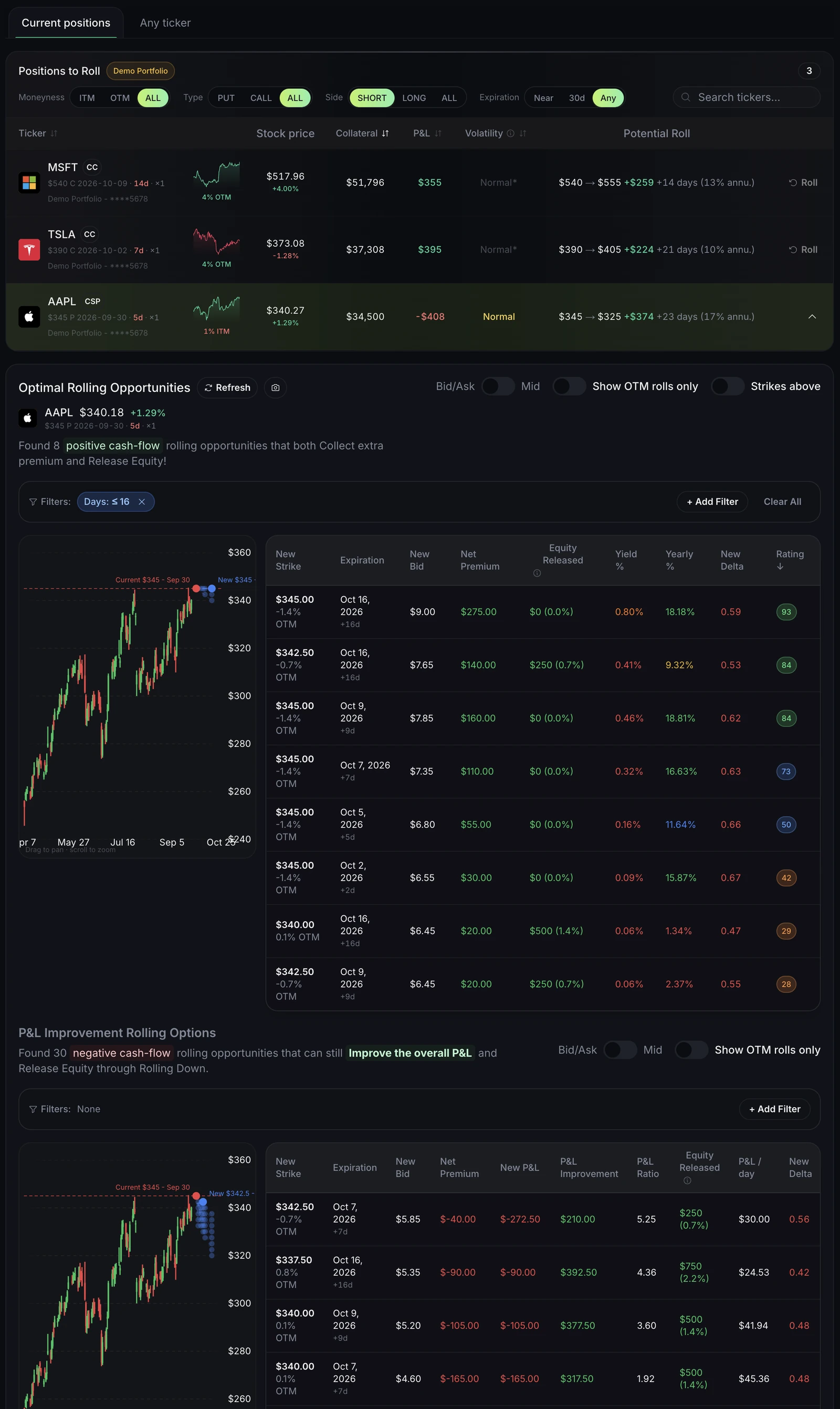
QuantWheel can help you avoid assignment, it recommends the best rolling opportunities for you to fix your mistake.
Create your wheel system inside QuantWheel →
How to Roll: The Mechanics
A roll is executed as a single order (not two separate orders):
For a Put Roll:
- Buy to close your current put (spend money)
- Sell to open a new put at different strike/date (collect money)
- Net credit or debit determines if the roll "pays you" or "costs you"
For a Call Roll:
- Buy to close your current call
- Sell to open a new call at different strike/date
- Same net credit/debit analysis
Example Roll:
- You sold a $50 put expiring this Friday for $2.00
- Stock is now at $48, put is now worth $2.50
- You buy to close at $2.50 (spend $250)
- Simultaneously sell a $47 put expiring next month for $3.00 (collect $300)
- Net credit: $50 ($300 - $250)
You've successfully rolled for a credit, extending your time and lowering your strike (reducing assignment risk).
Rolling Decision Framework
When to Roll:
1. The 21-Day, 50% Profit Rule: If your option has reached 50% of max profit with 21+ days remaining, close it and roll to the next expiration. This improves your return on time deployed.
Example: Sold a put for $2.00. It's now worth $1.00 (50% profit) with 25 days left until expiration. Close it for $1.00 profit and sell a new put for the next cycle.
2. Avoiding Poor Assignments: If your put is ITM and you don't want assignment at the current price, roll down and out for a credit if possible.
3. Keeping Shares Longer: If your covered call is ITM but you want to keep shares, roll up and out to a higher strike and later date.
When NOT to Roll:
1. Impossible to Roll for a Credit: If rolling would cost you money (net debit) and you don't have strong conviction, it's often better to accept assignment or have shares called away.
2. Fundamentals Have Deteriorated: If the stock's thesis has changed (poor earnings, scandal, competitive threat), don't roll just to avoid assignment. Accept assignment and reassess, or close the position entirely.
3. Better Opportunities Exist: Opportunity cost matters. If rolling keeps your capital tied up in a mediocre position when better opportunities exist elsewhere, don't roll just to avoid a small loss.
Rolling Mechanics: Strikes and Dates
Rolling Out (Same Strike, Later Expiration):
- Extends time to avoid assignment
- Collects more premium
- Maintains same price obligation
- Example: Roll from May $50 put to June $50 put
Rolling Down (Lower Strike, Same or Later Expiration):
- Reduces assignment risk
- Lowers your potential cost basis
- Collects less premium (or requires later expiration to get credit)
- Example: Roll from $50 put to $47 put
Rolling Up (Higher Strike, Later Expiration - For Calls):
- Allows shares to appreciate further before called away
- Extends time holding shares
- Requires later expiration to collect credit
- Example: Roll from May $52 call to June $55 call
Rolling Down and Out (Lower Strike, Later Expiration):
- Most common for puts
- Reduces assignment risk and extends time
- Example: Roll from May $50 put to June $45 put
Rolling Up and Out (Higher Strike, Later Expiration):
- Most common for calls
- Keeps shares and allows more appreciation
- Example: Roll from May $52 call to June $58 call
Advanced Rolling: Comparing Options
When deciding whether to roll, calculate the annualized return of each option:
Current position: 15 days left, $0.50 profit remaining
- Annualized return = ($0.50 / original premium) / (15/365) ≈ ?
Potential roll: Roll to next month, collect $0.80 credit
- Annualized return = ($0.80 / original premium) / (35/365) ≈ ?
Choose the option with better annualized return, assuming you're comfortable with the risk.
When deciding whether to roll, I use QuantWheel's Roll Assistant. It compares every possible strike and expiration, calculates the return for each, and recommends the optimal roll in seconds. Instead of spending 45 minutes analyzing 12 different roll options, I see them all ranked instantly.
Stock Selection: Choosing the Right Underlying
Stock selection is arguably the most important decision in the wheel strategy. Choose quality stocks and the wheel generates consistent income. Choose poor stocks and you'll get assigned on declining companies that may never recover.
The Core Principle: Only Wheel Stocks You Want to Own
Ask yourself: "If I were assigned this stock tomorrow and it dropped 30%, would I be comfortable holding it for 1-2 years?"
If the answer is no, don't run the wheel on that stock. Period.
The wheel strategy requires you to potentially own shares for extended periods. If you're not comfortable with long-term ownership, you're gambling, not investing systematically.
Characteristics of Good Wheel Stocks
1. Solid Fundamentals
Look for:
- Profitable companies (positive earnings)
- Reasonable debt levels
- Consistent revenue
- Competitive advantages or moats
- Established businesses (not pre-revenue startups)
Why it matters: Fundamentally sound companies are more likely to recover from temporary drops, which is when you get assigned.
2. Adequate Liquidity
Requirements:
- Average daily volume > 1 million shares
- Tight bid-ask spreads on options (< $0.10 for ATM options)
- Open interest > 100 contracts per strike
- Multiple strike prices available
Why it matters: Liquid stocks and options mean you can enter and exit positions efficiently without paying large spreads.
3. Sufficient Implied Volatility
Target:
- IV Rank above 30 (ideally 40-60)
- Higher IV = higher premium collected
- But not so high that it signals fundamental problems
Why it matters: Higher volatility means higher options premiums, which directly increases your returns. But extreme volatility (80+ IV) often signals serious problems with the company.
4. Reasonable Valuation
Be cautious of:
- Stocks trading at 100x earnings with no path to profitability
- Meme stocks driven by speculation rather than fundamentals
- Companies with deteriorating business models
Why it matters: Overvalued stocks can drop 50-70% during corrections, and the premium you collected won't save you.
5. Stock Price Sweet Spot
Ideal range:
- $20-$300 per share
- Too cheap (under $10): Often questionable quality, lower premium
- Too expensive (over $500): Requires huge capital per position, limits diversification
Why it matters: A $50 stock requires $5,000 per position. A $500 stock requires $50,000 per position. Most traders find the $30-$150 range optimal for building a diversified wheel portfolio.
Stock Categories That Work Well
Large-Cap Tech (Blue Chips):
- Examples: Microsoft (MSFT), Apple (AAPL), Adobe (ADBE), Salesforce (CRM)
- Pros: Stable, liquid, reasonable IV, comfortable to hold
- Cons: Lower IV means lower premium, high share prices require more capital
Established Growth:
- Examples: AMD, NVDA, PLTR, SNOW
- Pros: Higher IV than blue chips, good liquidity, growth potential
- Cons: More volatile, can drop sharply on bad news
Dividend Aristocrats:
- Examples: Johnson & Johnson (JNJ), Coca-Cola (KO), Procter & Gamble (PG)
- Pros: Very stable, dividends add to returns, comfortable to own
- Cons: Lower IV means lower premium, less exciting
High-Quality ETFs:
- Examples: SPY, QQQ, IWM
- Pros: Maximum diversification, very liquid, can't go to zero
- Cons: Lower IV than individual stocks, less premium
Stocks to Avoid in the Wheel Strategy
Penny Stocks (Under $5):
- Reason: Low quality, low liquidity, high risk of permanent capital loss
- Exception: None. Just don't.
Meme Stocks:
- Examples: Stocks driven by Reddit hype, no fundamental basis
- Reason: Extreme volatility cuts both ways; fundamental deterioration risk
- Exception: Only if you truly believe in the long-term thesis and have high risk tolerance
Biotech (Pre-Revenue):
- Reason: Binary events (FDA approval/rejection) can cause 70% swings
- Exception: Established biotech with diversified drug pipelines (like GILD, AMGN) can work
Chinese ADRs:
- Reason: Delisting risk, accounting concerns, regulatory uncertainty
- Exception: Well-established companies like BABA or JD might work, but understand the risks
Declining Industries:
- Examples: Struggling retail, dying tech, disrupted business models
- Reason: Premium doesn't compensate for secular decline
- Exception: Turnaround stories with new management/strategy, but be very selective
Building Your Wheel Watchlist
Step 1: Start with 20-30 stocks you'd be comfortable owning long-term. Think of companies whose products/services you understand and believe in.
Step 2: Filter for:
- Market cap > $10 billion
- Average volume > 1 million shares
- Options available with liquid strike prices
- IV Rank > 30
Step 3: Research fundamentals:
- Read recent earnings reports
- Understand the business model
- Check P/E ratio vs sector average
- Look at debt levels
Step 4: Monitor the watchlist for high-IV opportunities:
- IV spike due to earnings → opportunity
- Market-wide selloff → opportunity
- Stock-specific bad news that's temporary → opportunity
Step 5: Only trade 3-5 stocks at a time to maintain position focus. As positions close, rotate in new stocks from your watchlist.
Using Screeners to Find Opportunities
Most traders use options screeners to find wheel candidates. Look for:
Screener Criteria:
- Stock price: $30-$200
- IV Rank: > 40
- Volume: > 1 million shares
- Market cap: > $5 billion
- Put options with 30-45 DTE
- Delta: 0.25-0.35
- Premium yield: > 1.5% per month
This gives you a list of stocks offering good premium with reasonable assignment risk.
Instead of spending 90 minutes on ThinkorSwim scanning 50 tickers one by one, I use QuantWheel's screener to scan 500+ tickers in under 5 minutes. It filters for DTE, delta, IV rank, and yield all at once - with fundamentals like P/E and debt ratios built in. The AI ranking highlights the best risk-adjusted opportunities, saving hours of manual analysis.
Risk Management: What Can Go Wrong
The wheel strategy is conservative compared to naked options selling or directional trading, but it's not risk-free. Understanding the risks helps you manage them properly.
Risk #1: Significant Stock Decline
Scenario: You sell a $50 put, collect $2 premium (cost basis $48), get assigned, and the stock drops to $35 over the next six months.
Reality: You're down $13 per share ($1,300 per contract). Selling covered calls might generate $1-2 per month, but you're looking at months or years to break even if the stock doesn't recover.
Mitigation:
- Only wheel quality stocks with sound fundamentals
- Diversify across 3-5 positions, not all-in on one
- Set a maximum loss threshold (e.g., "If down 30%, I'll reassess and potentially exit")
- Avoid companies in declining industries or with questionable financials
Risk #2: Opportunity Cost (Shares Called Away Too Soon)
Scenario: You sell a $50 call on shares with cost basis $48. Stock rises to $65, but your shares get called away at $50.
Reality: You made $4 per share (your planned profit) but "missed" the additional $15 per share move. Your returns are capped by the strikes you sell.
Mitigation:
- Accept that capped upside is the trade-off for premium income
- Don't sell covered calls on stocks you believe are about to have major breakouts
- Sell calls at strikes you're genuinely happy to sell at
- Remember: a profit is a profit, and consistency matters more than home runs
Risk #3: Premature Assignment (Dividends)
Scenario: You sell a covered call on a dividend-paying stock. The ex-dividend date approaches, and your call is deep ITM. You get assigned early and miss the dividend.
Reality: You lose the dividend you were expecting. This typically happens when:
- The dividend amount > the extrinsic value remaining in your call
- Rational call holders exercise early to capture the dividend
Mitigation:
- Know ex-dividend dates for stocks you're wheeling
- Avoid selling calls that expire just after ex-dividend dates
- Accept that sometimes you'll be assigned early; factor this into position planning
Risk #4: Margin Calls (If Using Margin)
Scenario: You're running the wheel using margin (not cash-secured) to increase position size. The market drops sharply, your positions are underwater, and your broker issues a margin call.
Reality: You must deposit cash immediately or the broker will close positions (often at the worst possible time).
Mitigation:
- Use cash-secured positions, not margin, especially when starting
- If using margin, maintain at least 30-50% cash cushion
- Never use more than 50% of your buying power on wheel positions
- Understand your broker's margin requirements and liquidation policies
Risk #5: Black Swan Events
Scenario: Market crash, pandemic, war, banking crisis - events that cause broad market declines of 30-50% in weeks.
Reality: All your positions are suddenly deeply underwater. Premiums spike (good for new positions), but you're sitting on large unrealized losses.
Mitigation:
- Size positions appropriately (no single position > 20% of portfolio)
- Keep 20-30% cash reserve for opportunities
- Accept that crashes happen; your quality stocks will likely recover
- Consider protective strategies (buying puts) if you see systemic risk building
- Remember: premium collection continues even in bear markets, lowering your cost basis
Risk #6: Concentration Risk (Sector or Stock)
Scenario: You wheel 5 tech stocks (MSFT, AAPL, NVDA, AMD, PLTR). Tech sector has a correction, and all 5 positions drop simultaneously.
Reality: Your portfolio correlation is 1.0 - everything moves together. No diversification benefit.
Mitigation:
- Diversify across sectors (tech, consumer, finance, healthcare, etc.)
- Use ETFs like SPY or QQQ for broad exposure
- Limit any single sector to 40% of wheel positions
- Rotate sectors based on market conditions
Risk #7: Tax Implications
Scenario: You're generating lots of short-term capital gains from options premiums and called-away shares held under one year.
Reality: Short-term capital gains are taxed as ordinary income (up to 37% in 2026 for high earners). This significantly reduces your after-tax returns.
Mitigation:
- Understand that options premium is taxed as short-term gains (or income, depending on structure)
- Consider holding assigned shares for 12+ months before calling them away for long-term capital gains treatment
- Track all trades meticulously for accurate tax reporting
- Consult with a tax professional who understands options strategies
- Consider running the wheel in tax-advantaged accounts (IRA, Roth IRA) to avoid annual tax drag
Position Sizing Guidelines
To manage risk effectively:
Rule 1: No single position should exceed 20% of your portfolio.
- Example: $50,000 portfolio → maximum $10,000 per position
Rule 2: Run 3-5 positions simultaneously when possible.
- Provides diversification while remaining manageable
Rule 3: Keep 20-30% in cash at all times.
- For opportunities, margin cushion, and peace of mind
Rule 4: Limit total exposure to 70-80% of capital.
- Never be fully deployed; always have dry powder
Example Portfolio (50,000 account):
- Position 1: $8,000 (MSFT wheel)
- Position 2: $7,500 (SPY wheel)
- Position 3: $7,000 (AMD wheel)
- Position 4: $8,500 (AAPL wheel)
- Position 5: $6,000 (QQQ wheel)
- Cash Reserve: $13,000 (26%)
Common Mistakes and How to Avoid Them
After trading the wheel for years and helping hundreds of traders learn the strategy, these are the mistakes I see repeatedly.
Mistake #1: Running the Wheel on Poor-Quality Stocks
What happens: You sell a put on a meme stock or speculative company because the IV is 150% and the premium is huge. You get assigned as the stock collapses 60%. You're stuck in a terrible position that may never recover.
Why it happens: Greed. High premium is seductive. "Just one trade on this high-IV stock" becomes a disaster.
Solution: Stick to your watchlist of quality stocks you'd own for 2+ years. If you wouldn't buy and hold the stock without options, don't wheel it. Ever.
Mistake #2: Selling Calls Below Cost Basis Prematurely
What happens: You're assigned shares at $50, cost basis $48. The stock immediately drops to $45. You panic and sell a $44 call to collect premium, locking in a loss if assigned.
Why it happens: Desperation to "do something" and collect premium. Impatience.
Solution: Give the position time to work. Sell calls at or above your cost basis unless you've decided to exit the position entirely. A few weeks of patience often pays off as stocks mean-revert.
Mistake #3: Over-Leveraging with Margin
What happens: You have $30,000 cash but use margin to sell $100,000 worth of cash-secured puts. Market drops 15%, you get margin called, and your broker liquidates your positions at the bottom.
Why it happens: Wanting to "maximize returns" and deploy capital aggressively.
Solution: Use cash-secured positions only until you deeply understand the strategy and risk management. If you use margin, never exceed 50% of buying power on wheel positions, and maintain a 30%+ cash cushion.
Mistake #4: Chasing Premium Instead of Strategy
What happens: You see a 10% monthly return opportunity on a sketchy biotech stock with FDA approval coming up. You sell the put for the huge premium. The FDA rejects the drug, stock drops 80%, and you own shares of a nearly worthless company.
Why it happens: Focusing on premium percentage instead of risk-adjusted returns.
Solution: Premium should be adequate but secondary to stock quality. A 1.5% monthly return on Microsoft is better than 10% monthly on a penny stock. Boring is profitable.
Mistake #5: Not Taking Profits at 50%
What happens: You sold a put for $2.00. It's now worth $0.80 (60% profit) with 30 days left. You hold to expiration to "maximize profit." In the last week, the stock drops sharply, and your put goes back to $2.50. Instead of realizing $1.20 profit, you get assigned on a worse entry.
Why it happens: Wanting to extract every penny of profit; not understanding return on time.
Solution: Close positions at 50% profit if 21+ days remain until expiration. Redeploy capital into a new position. This maximizes your return per day and reduces late-cycle risk.
Mistake #6: Ignoring Position Management
What happens: You sell a covered call and forget about it. The stock runs up 30%, your shares get called away, and you realize you could have rolled the call to capture more upside.
Why it happens: "Set it and forget it" mentality. Not monitoring positions.
Solution: Check positions at least weekly. Set alerts for key price levels. Know when earnings and dividends are coming. Active management dramatically improves wheel returns.
Mistake #7: Not Calculating True Cost Basis
What happens: You get assigned at $50 after collecting $2 premium. Your broker shows $50 cost basis. You sell a $50 call thinking you're at breakeven, but you're actually giving away $2 per share in profit.
Why it happens: Not tracking premium collected; relying on broker's displayed cost basis.
Solution: Maintain a separate tracking sheet (or use software) that calculates your true cost basis including all premiums collected. This is where most traders struggle: calculating your actual cost basis after assignment. Your broker shows the price you paid for the shares but doesn't automatically account for the premium you collected earlier. You need to track this manually - unless you're using software like QuantWheel that automatically adjusts your cost basis when assignments happen.
Mistake #8: Running Too Many Positions
What happens: You're running the wheel on 15 different stocks simultaneously. You can't keep track of expirations, earnings dates, roll opportunities, or which positions need attention. You miss rolls, forget to sell calls after assignment, and make errors.
Why it happens: Thinking more positions = more profit. Overestimating your ability to manage complexity.
Solution: Start with 1-2 positions. Once comfortable, expand to 3-5. Even experienced traders rarely exceed 10 simultaneous wheel positions. Quality management beats quantity.
Mistake #9: Emotional Decision-Making
What happens: Stock drops 20%, and you panic-sell your shares for a loss instead of working the wheel strategy. Or the stock rallies, and you buy back your covered call at a loss because you're afraid of missing more upside.
Why it happens: Letting fear and greed override your systematic process.
Solution: Have written rules for your wheel strategy. When to enter, when to roll, when to exit. Follow the rules even when emotions are screaming at you. Systematic trading beats emotional trading.
Mistake #10: Not Having an Exit Plan
What happens: You're assigned on a stock that drops 40%. You keep selling calls month after month, hoping for recovery. Two years later, you're still in the position, and the stock has continued declining. You've experienced huge opportunity cost.
Why it happens: No predefined exit criteria. Hoping instead of planning.
Solution: Before entering any wheel position, decide: "If this stock drops X% from my cost basis, I will exit the position." Common thresholds are 20-30%. Sometimes taking a loss and moving on is the right decision.
Is the Wheel Strategy Profitable? Real Expectations
Let's discuss realistic returns, because there's a lot of unrealistic hype around the wheel strategy.
Expected Returns (Realistic)
Conservative Wheel (Quality Stocks, 0.25-0.30 Delta):
- Annual Return: 10-15%
- Monthly Premium: 1-1.5% of capital deployed
- Characteristics: Lower assignment frequency, very boring, consistent
- Best for: Risk-averse traders, retirement accounts, large portfolios
Moderate Wheel (Good Stocks, 0.30-0.40 Delta):
- Annual Return: 15-25%
- Monthly Premium: 1.5-2.5% of capital deployed
- Characteristics: Moderate assignment frequency, some volatility
- Best for: Most traders, balanced risk/reward
Aggressive Wheel (Higher Volatility Stocks, 0.35-0.50 Delta):
- Annual Return: 25-35%+ (but higher variance)
- Monthly Premium: 2.5-4% of capital deployed
- Characteristics: Frequent assignments, requires active management, higher drawdowns
- Best for: Experienced traders, smaller accounts needing growth
What Affects Your Returns
1. Market Environment:
- Bull markets: Lower IV = lower premium, but stocks recover quickly from assignments. Wheel tends to underperform simple buy-and-hold.
- Flat markets: Sweet spot for the wheel. Theta decay and ranging prices favor premium collection.
- Bear markets: Higher IV = higher premium, but assignments more frequent and painful. Skilled traders can thrive; novices get crushed.
2. Stock Selection:
- Quality stocks generate lower premium but consistent returns
- Volatile stocks generate higher premium but higher risk
- Your returns are capped by the quality of your watchlist
3. Management Skill:
- Taking 50% profits early improves returns
- Smart rolling decisions capture value
- Position sizing prevents blowups
- Experience matters significantly
4. Compounding:
- Year 1: 20% return on $50,000 = $10,000 profit → $60,000
- Year 2: 20% return on $60,000 = $12,000 profit → $72,000
- Year 3: 20% return on $72,000 = $14,400 profit → $86,400
- Over time, compounding creates significant wealth
Wheel Strategy vs Buy-and-Hold
When the Wheel Wins:
- Flat or choppy markets (2015-2016, 2018, 2022)
- High volatility environments (2020 pandemic, 2022 bear market)
- When you actively manage positions well
When Buy-and-Hold Wins:
- Strong bull markets (2017, 2019, 2021)
- When stocks make massive runs (e.g., NVDA 2023)
- When you're lazy and don't actively manage
Real Comparison (2020-2024):
- S&P 500 buy-and-hold: ~65% total return
- Well-managed wheel on QQQ/tech stocks: ~80-100% total return
- Poorly-managed wheel on bad stocks: -20% to +40%
The wheel can outperform buy-and-hold, but it requires skill, discipline, and work. It's not passive income.
Time Investment Required
Weekly Time Commitment:
- Position monitoring: 30-60 minutes
- Entering new positions: 15-30 minutes
- Rolling decisions: 30-45 minutes
- Research/watchlist updates: 30-60 minutes
- Total: 2-3 hours per week
The wheel is not passive. You're actively managing positions, making decisions, and monitoring markets. If you want truly passive investing, buy index funds.
Tax Considerations
Short-term capital gains and options income are taxed as ordinary income:
- 37% tax bracket → 37% of your wheel profits go to taxes (2026 federal, plus state)
- 24% tax bracket → 24% of your wheel profits go to taxes
- This significantly reduces your after-tax returns
Example:
- 20% gross return on $50,000 = $10,000 profit
- At 37% tax rate: $3,700 to taxes
- After-tax return: $6,300 or 12.6%
Running the wheel in a Roth IRA (if eligible) eliminates this tax drag entirely, potentially adding 5-10% to your effective annual return.
Advanced Wheel Variations
Once you've mastered the basic wheel, these variations can optimize returns or manage specific scenarios.
The Poor Man's Covered Call (PMCC) Wheel
Instead of owning shares, you own LEAPS (long-term call options) and sell shorter-term calls against them. This creates a similar position to the covered call phase of the wheel but with less capital.
How it works:
- Buy a deep ITM LEAPS call (0.80+ delta) expiring 12-24 months out
- Sell shorter-term OTM calls against it (just like covered calls)
- Collect premium monthly while your LEAPS appreciates with the stock
Advantages:
- Requires less capital (e.g., $3,000 for LEAPS vs $10,000 for shares)
- Leveraged returns
- Defined risk (max loss = cost of LEAPS)
Disadvantages:
- LEAPS decay over time (unlike shares)
- No dividends
- More complex to manage
- Requires good timing to avoid theta decay on your LEAPS
Best for: Smaller accounts wanting exposure to expensive stocks, traders who understand LEAPS.
The Dividend Wheel
Running the wheel specifically on dividend-paying stocks to combine premium income with dividend income.
How it works:
- Choose quality dividend stocks (JNJ, KO, PG, etc.)
- Run the standard wheel
- Collect dividends while holding shares during covered call phase
- Never sell calls expiring just after ex-dividend dates
Advantages:
- Dual income streams (premium + dividends)
- Forces you into high-quality, stable stocks
- Dividends lower your effective cost basis
- More comfortable to hold during assignments
Disadvantages:
- Lower IV on stable dividend stocks = lower premium
- Slower overall returns
- Can be boring for growth-oriented traders
Best for: Conservative traders, retirees, IRAs.
The Aggressive Wheel (Earnings Plays)
Selling puts right before earnings announcements to capture IV spike, then managing the aftermath.
How it works:
- Identify earnings dates
- Sell puts 3-7 days before earnings (IV is elevated)
- Collect large premium due to high IV
- Accept higher assignment risk
- If assigned, immediately start selling calls
Advantages:
- Significantly higher premium (2-3x normal)
- Fast capital deployment
- Opportunities every week (different stocks)
Disadvantages:
- Much higher risk (earnings can gap stocks 15-30%)
- Requires strong conviction in fundamentals
- More stressful
- Can result in poor entries
Best for: Experienced traders, smaller position sizes (5-10% of portfolio), stocks you're very bullish on long-term.
The Cash-Flow Wheel
Optimizing for maximum cash generation rather than total return, useful for traders who need regular withdrawals.
How it works:
- Focus on weekly options (faster premium collection)
- Close at 50% profit consistently (lock in cash)
- Target higher-IV stocks (more premium)
- Withdraw a portion of profits monthly
- Prioritize consistency over home runs
Advantages:
- Predictable cash flow
- More frequent "wins"
- Can budget around expected income
- Less capital appreciation needed
Disadvantages:
- More transaction costs (weekly trading)
- Requires more active management
- Potentially higher taxes (more short-term gains)
Best for: Traders who need income from their trading, semi-retired individuals, those who want frequent feedback loops.
Tools and Resources for Wheel Traders
Position Tracking
The Problem: After managing 10+ positions in spreadsheets, tracking becomes a nightmare. Which puts are still open? What's your cost basis after multiple rolls and assignment? How much total premium have you collected?
Solution Options:
1. Spreadsheets (Free, Manual):
- Google Sheets or Excel
- Track: Entry date, strike, premium collected, cost basis, expiration, status
- Pros: Free, customizable, you control the data
- Cons: Manual updates, error-prone, time-consuming, doesn't sync with broker
2. Professional Software: After managing 20+ positions in spreadsheets, I built QuantWheel's Wheel Native Journal to automate the tracking. It syncs with your broker and automatically adjusts cost basis when you get assigned - no manual spreadsheet updates needed. Tracks complete wheel cycles from cash-secured put → assignment → covered calls → exit, with real-time P&L and roll analysis built in.
Options Screeners
Finding wheel opportunities requires screening hundreds of stocks for the right combination of price, IV, delta, and premium.
1. Broker Platforms (Free but Slow):
- ThinkorSwim (TDAmeritrade)
- Power E*TRADE
- Fidelity Active Trader Pro
- Pros: Free with broker account, decent data
- Cons: Slow (5-10 minutes per scan), clunky interfaces, limited filtering
2. Specialized Screeners: Instead of spending 90 minutes on ThinkorSwim scanning 50 tickers one by one, I use QuantWheel's screener to scan 500+ tickers in under 5 minutes. It filters for DTE, delta, IV rank, and yield all at once - with fundamentals like P/E and debt ratios built in.
Options Calculators
For analyzing positions, calculating break-even, and modeling scenarios:
Free Options:
- OptionStrat (free, excellent visualization)
- CBOE Options Calculator
- Options Profit Calculator
What to calculate:
- Break-even price
- Max profit/loss
- P&L at different stock prices
- Effect of IV changes
- Theta decay per day
Educational Resources
Reddit Communities:
- r/thetagang - Dedicated to premium selling strategies like the wheel
- r/options - General options discussion, more technical
- Filter advice carefully; verify everything independently
Books:
- "The Wheel Strategy" by Scott Welsh
- "Option Volatility & Pricing" by Sheldon Natenberg (advanced)
- "Options as a Strategic Investment" by Lawrence McMillan
YouTube Channels:
- InTheMoney (beginner-friendly, clear explanations)
- Tastytrade (advanced, research-backed)
- ProjectFinance (technical but thorough)
Conclusion: Is the Wheel Strategy Right for You?
The wheel strategy isn't for everyone. It's boring, requires patience, demands active management, and won't make you wealthy overnight. But for traders who value:
- Systematic approaches over gut-feel trading
- Consistent returns over home-run swings
- Defined risk over unlimited upside
- Income generation alongside capital appreciation
- Rule-based decisions that remove emotion
Then the wheel strategy might be exactly what you need.
The Ideal Wheel Trader Profile
You're a good fit for the wheel if:
- You have $10,000+ to deploy (ideally $25,000+)
- You can commit 2-3 hours per week to management
- You're comfortable with options basics (puts, calls, assignment)
- You can follow rules even when emotions run high
- You prefer consistency over excitement
- You have a 2+ year time horizon
- You're okay with capped upside in exchange for premium income
The Bottom Line
The wheel strategy works. Not because it's magic, but because it's systematic, manages risk through stock ownership, collects premium from time decay, and forces discipline through defined rules.
Your success depends on:
- Stock selection - Only wheel quality companies
- Position sizing - Never over-leverage
- Management - Take profits at 50%, roll intelligently
- Patience - Let the strategy work over time
- Discipline - Follow your rules even when it's hard
If you're ready to implement the wheel strategy with proper tracking, automated cost basis calculation, and intelligent position management, try QuantWheel free for 14 days. Built specifically for wheel traders who want to focus on trading, not spreadsheet maintenance.
$1 for 7 days • Cancel anytime • 14-day money-back guarantee
Risk Disclosure
Risk Disclosure: Options trading involves substantial risk and is not suitable for all investors. Past performance does not guarantee future results. This content is for educational purposes only and should not be considered investment advice. Always do your own research and consider consulting with a financial advisor before making investment decisions.
Examples Disclosure: The examples used in this article are for educational purposes only and are not recommendations to buy or sell any security. All investment decisions should be based on your own analysis and risk tolerance.