
Author: David Romic - retail options trader and active member in the options trading communities on Reddit (u/thedavidromic). I share wheel strategy setups, trade management, and lessons learned from real positions.
In this guide I go through different rolling options scenarios. If you're looking for advice on your specific situation, feel free to scroll down and find a scenario you need help with.
I start with some basic frameworks on how rolling works, when to do it, how to calculate whether it makes sense and how to avoid the common mistakes that I made and also saw others make.
TLDR: What is Rolling Options?
Rolling an option means closing your current position and immediately opening a new one with a different expiration date, strike price, or both. There are different types of rolling - rolling to avoid getting assigned on a Cash - Secured put trade, rolling to avoid letting go of your shares in a Covered Call strategy or simply rolling a trade to harvest more premium in the Wheel strategy.
In short: Rolling options gives yo ua chance to make corrections in your trade.
When wheel traders roll:
- Roll out (time): Extend to later expiration to collect more premium on winning positions
- Roll out and up/down (changing time + strike price): Adjust strike when stock moved against you, giving yourself more room
- Roll for credit: Always try to collect money when rolling, not pay money (debit)
Key point: Rolling doesn't eliminate risk - it extends it. You're adding time to your position, which means more opportunity for things to go right OR wrong.
What Does Rolling Options Actually Mean?
Rolling an option is the process of closing your existing option position and simultaneously opening a new one with a different expiration date, strike price, or both. It's done as a single transaction through your broker, typically for a net credit (you receive money for a roll) or net debit (you pay money for a roll).
The mechanics work like this:
- Buy to close your current option (closes existing position)
- Sell to open a new option with different parameters (opens new position)
- Your broker executes both legs as one trade
Example with real numbers:
Rolling a Cash - Secured put: You hold a previously sold AAPL $170 put expiring this Friday for $2.00 premium ($200 per contract). The stock is at $175, and your put is now worth $0.80. You are currently $1.20 in profit (60% of max).
You could:
- Close for $120 profit and be done
- Let it expire worthless for full $200 profit
- Roll it out one week to next Friday's $170 put
If you choose to roll:
- Buy to close Friday's $170 put: Pay $0.80 ($80)
- Sell to open next Friday's $170 put: Collect $1.50 ($150)
- Net credit: $0.70 ($70 per contract)
You extended your position by one week and collected an additional $0.70 in premium. Your total potential profit is now $2.70 instead of $2.00 - but you also added 7 more days of risk.
*The example above shows how to keep milking your position for more money - a most often approach in the wheel strategy.*This is beneficial because opening a new position to sell at the same new strike price and expiration date of those 7 days would tie up more of your capital. Another example: IREN $46 strike with 5 DTE remaining, current stock price = $44. This example shows one of the most often types of rolls - defensive roll. Since the stock price is below the CSP trade strike price and we are out of time in this trade - a good idea would be to roll the trade and avoid assignment. The screenshot below shows you rolling opportunities that should help you decide on the best roll for you if you're at the risk of getting assigned on your CSP and have very little time remaining in your trade.
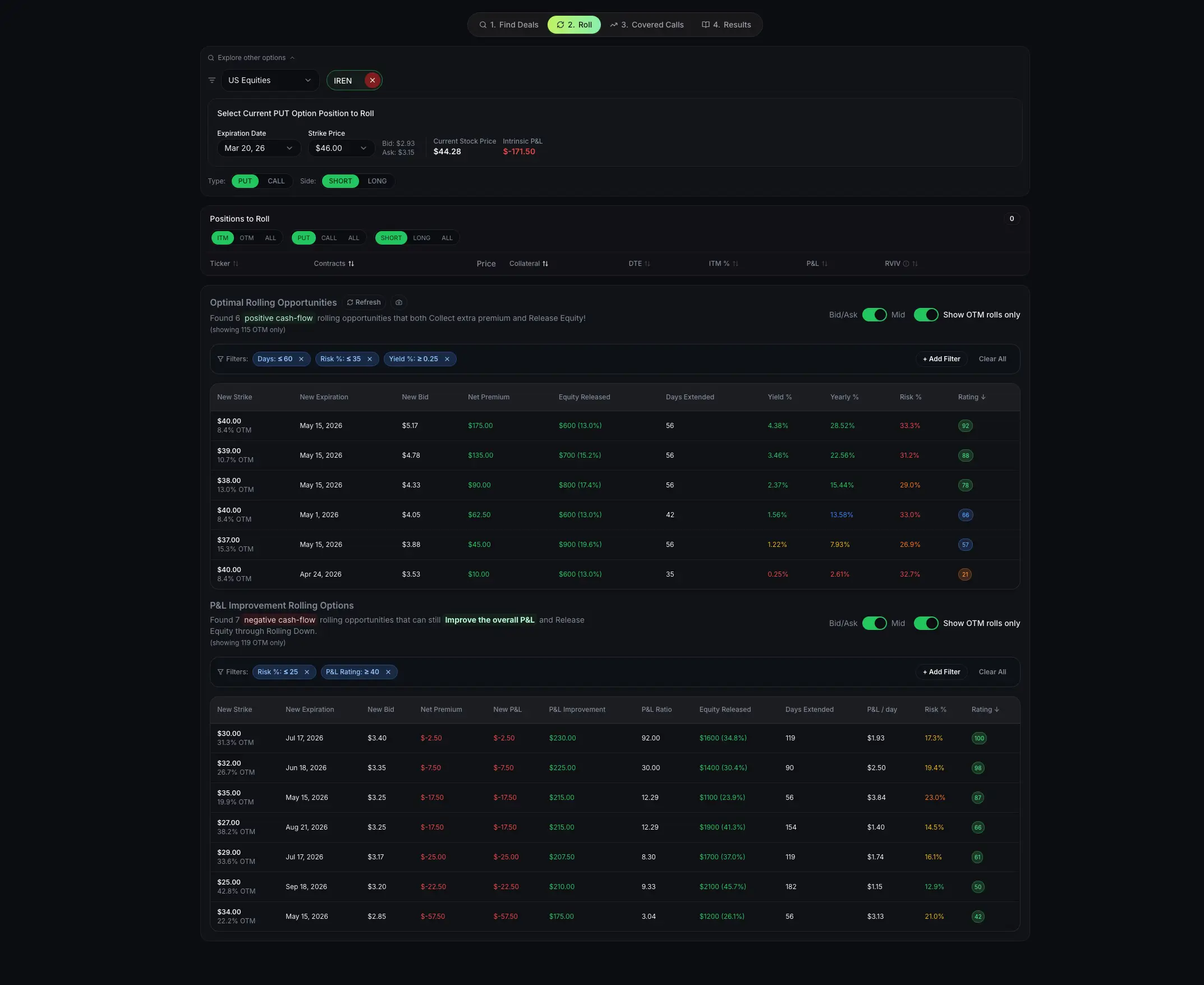
If you're bullish on the stock - you pick the first option in the upper table showing "positive cash-flow opportunities". If you're uncertain - you pick the first option under "negative cash-flow opportunities" that still improve PnL and release equity through rolling down. I personally ended up picking the first one from the positive cash-flow table. You can try it out for yourself.. See best rolls for your situation →
The Different Types of Option Rolls
Rolling Out (Time Only)
What it is: Extending to a later expiration date while keeping the same strike price.
When to use: When your position is winning and you want to collect more premium without changing your strike.
Example:
- Currently have: PLTR $45 put expiring in 2 days
- Roll to: PLTR $45 put expiring in 30 days
- Same strike, more time
Typical scenario: You've captured 50% of max profit with 21+ days left. Instead of closing, you roll out to the next monthly expiration and collect another $0.50-$1.00 in premium.
Rolling Out and Up (Time + Strike)
What it is: Extending expiration AND moving to a higher strike price.
When to use: When the stock rallied and you're selling covered calls, or when your put is in trouble and you need to give yourself more room.
Example with covered calls:
- Currently have: TSLA $250 call expiring this week
- Stock is at $255 (in the money)
- Roll to: TSLA $260 call expiring next month
- More time + higher strike = less likely to be assigned
Example with puts:
- Currently have: SPY $450 put expiring in 2 weeks
- Stock dropped to $445 (losing position)
- Roll to: SPY $445 put expiring in 45 days
- Lower commitment + more time = better chance of recovery
Rolling Out and Down (Time + Strike)
What it is: Extending expiration AND moving to a lower strike price.
When to use: When selling puts and the stock rallied significantly, or when you want to be more aggressive and collect more premium.
Example:
- Currently have: NVDA $500 put expiring in 5 days
- Stock rallied to $520
- Roll to: NVDA $505 put expiring next month
- You're collecting more premium by moving closer to the money
Rolling Just the Strike (Less Common)
What it is: Keeping the same expiration but changing strike price.
When to use: Rarely used in wheel strategy. More common in active trading when making quick adjustments.
When Should You Roll Options?
The decision to roll comes down to: Can I collect enough premium to justify the additional time and risk?
Here are the most common situations when rolling makes sense for wheel traders:
Situation 1: Hit 50% Profit Target with 21+ Days Left
The scenario: Your cash-secured put hit 50% max profit, but there are still 3+ weeks until expiration.
The math:
- You sold a $50 put for $2.00 ($200 premium)
- It's now worth $1.00 (50% profit locked in)
- 24 days still remaining
Should you roll? Probably yes. Closing now captures $100 profit in ~6 days (if you sold a 30-day option). But rolling to the next month for an additional $1.00-$1.50 gives you $100-$150 more profit for 30 more days of time.
Rule of thumb: If you can collect at least $0.05-$0.10 per day of added time, rolling is usually worth it.
Situation 2: Position Going Against You, But Thesis Intact
The scenario: You sold a put and the stock dropped, but you still believe in the company long-term and wouldn't mind being assigned at a lower price.
The math:
- Sold PLTR $40 put for $1.50
- Stock dropped to $38
- Put is now worth $2.50 (down $1.00)
- 5 days until expiration (likely assignment)
Should you roll? Depends. If you still want to own PLTR at $40 (minus premium), take assignment. If you want to avoid it, roll out and down:
- Buy to close $40 put: Pay $2.50
- Sell to open $38 put (45 days out): Collect $2.00
- Net debit: $0.50
You paid $0.50 to avoid assignment and adjusted your strike down to $38. Now you need the stock above $38 in 45 days - more achievable than $40 in 5 days.
Situation 3: Covered Call Approaching Assignment (But You Want to Keep Shares)
The scenario: Your covered call went in the money and expiration is approaching. You want to keep the shares.
The math:
- Own 100 shares of AAPL at $170 cost basis
- Sold $175 call for $2.00
- Stock is now $178 (call is ITM)
- 3 days until expiration
Should you roll? If you want to keep shares, roll out and up:
- Buy to close $175 call: Pay $3.50
- Sell to open $180 call (30 days out): Collect $4.00
- Net credit: $0.50
You collected $0.50 to extend the position and moved the strike to $180, giving you more room before assignment.
Situation 4: Approaching Expiration with Little Premium Left
The scenario: Your put is nearly worthless with a few days left, but closing it still costs $0.05-$0.10.
Should you roll? Usually no. Just let it expire worthless. The risk of the stock suddenly dropping is low, and rolling for small amounts of additional premium isn't worth the complexity.
Exception: If the stock has high volatility (earnings coming up, news expected), you might roll out to capture higher IV premiums.
How to Calculate if a Roll is Worth It
Most wheel traders roll by gut feel - but the math matters. Here's how to evaluate rolls systematically.
The Roll Value Formula
Net Credit / Additional Days = Daily Premium Rate
What you want: At least $0.05-$0.10 per day in additional premium.
Example 1 (Good Roll):
- Roll credit: $0.80
- Additional time: 7 days
- Daily rate: $0.80 / 7 = $0.11/day ✅ Good roll
Example 2 (Marginal Roll):
- Roll credit: $0.40
- Additional time: 14 days
- Daily rate: $0.40 / 14 = $0.03/day ⚠️ Borderline
Example 3 (Bad Roll):
- Roll cost: -$0.50 (debit)
- Additional time: 30 days
- Daily rate: -$0.50 / 30 = -$0.02/day ❌ Losing money
Factor in Strike Adjustments
When you roll strikes (up or down), consider how much room you're giving yourself versus premium collected.
Rolling up a call:
- Current: $50 call, stock at $52
- Roll to: $55 call for $0.80 credit
- Analysis: You're $2 ITM now, but moving $3 higher gives you $5 room total. If you believe stock won't hit $55, the $0.80 is worth it.
Rolling down a put:
- Current: $45 put, stock at $43
- Roll to: $43 put for $0.60 debit
- Analysis: You're paying $0.60 to avoid assignment at $45 and reset at $43 (where stock is now). Only worth it if you don't want shares at $45.
Compare to Alternatives
Always compare rolling to your other options:
- Close and move on: Take the profit or loss and redeploy capital elsewhere
- Take assignment: Let shares get assigned and start selling calls (if puts)
- Roll to different underlying: Close this position and start fresh on a better stock
Rolling isn't always the best choice - sometimes cutting your losses or taking assignment is smarter.
Common Rolling Mistakes (And How to Avoid Them)
Mistake 1: Rolling to Avoid Admitting You're Wrong
The trap: Your put is losing money, so you keep rolling it out to avoid taking the loss. Each roll adds time, but the stock keeps dropping.
Why it's costly: You're compounding losses and tying up capital in a losing position. After 3-4 rolls, you've extended a position 4 months and your loss is now 2x the original.
The fix: Only roll if your thesis is still intact. If the stock fundamentals changed or you no longer want to own it, close the position and move on. A small loss today is better than a huge loss in 4 months.
Mistake 2: Rolling Too Early
The trap: You hit 50% profit after 3 days and immediately roll. But you had 27 days left - you gave up free money by rolling early.
Why it's costly: The last few weeks of an option have the fastest theta decay. By rolling at 50% with 27 days left, you didn't give the position time to decay further to 70-80% profit.
The fix: Don't roll until you have 21 days or less remaining (for 45-day options) or 7 days or less (for weeklies). Let theta work for you.
Mistake 3: Rolling for Tiny Credits
The trap: You roll for $0.10-$0.20 of additional premium but add 30 days of time. The risk/reward is terrible.
Why it's costly: You're taking 30 more days of market risk for $10-$20. Not worth it.
The fix: Set a minimum roll credit threshold-$0.50 minimum for monthlies, $0.30 for weeklies. Below that, just close the position.
Mistake 4: Death by a Thousand Rolls
The trap: Your put is underwater, so you roll once. Stock keeps dropping, you roll again. And again. And again. Now you're in a position that you've been managing for 9 months with a massive loss.
Why it's costly: Each roll extends your pain and prevents you from deploying capital to better opportunities. Opportunity cost compounds.
The fix: Set a "max rolls" rule - typically 2-3 rolls maximum per position. After that, take the loss or assignment and move on.
Mistake 5: Not Calculating the Roll (Just Guessing)
The trap: You roll because "it feels right" without calculating if the credit justifies the time.
Why it's costly: You're making decisions blind. Some rolls are great, others are terrible - you won't know without math.
The fix: Use a roll calculator or, better yet, QuantWheel's Roll Assistant analyzes every possible roll option, calculates the return for each, and recommends the optimal roll in seconds. No more guessing or spending 30 minutes with a calculator.
How to Execute a Roll (Step-by-Step)
On Most Brokers (Manual Process)
Step 1: Open your position and note the current strike, expiration, and option type.
Step 2: Navigate to the options chain for your underlying.
Step 3: Find your desired new strike and expiration.
Step 4: Select "Buy to Close" for current position and "Sell to Open" for new position.
Step 5: Execute as a single order (combination order / multi-leg order). This ensures you get the net credit/debit you want and both legs fill together.
Step 6: Review the net credit/debit before confirming. Make sure you're collecting money (credit) or paying an acceptable debit.
On QuantWheel (Automated Analysis)
When you're managing wheel positions in QuantWheel, it tracks all your open options and alerts you when rolls might make sense. The Roll Assistant shows you:
- All possible roll options (every strike and expiration combination)
- Net credit/debit for each roll
- Additional time added
- Return per day of time value
- Optimal recommendation based on your preferences (max premium, min time, etc.)
Instead of manually calculating 12+ possible rolls, you see them ranked and can execute the optimal one.
This is exactly why QuantWheel exists - to automate the tedious analysis so you can make better decisions faster.
$1 for 7 days • Cancel anytime • 14-day money-back guarantee
Rolling Options: Key Takeaways
Rolling is a tool, not a requirement. Don't feel pressured to roll every position. Sometimes closing, taking assignment, or moving to a different stock is smarter.
Always roll for credit when possible. Paying to roll (debit) should be rare and only when you're fixing a losing position you still believe in.
Calculate the math. Aim for at least $0.05-$0.10 per day of additional time value. Less than that and rolling probably isn't worth the risk.
Set rules and follow them. "Roll when 50% profit with 21+ DTE remaining" or "Roll losing positions max 2 times." Rules prevent emotional decisions.
Avoid the roll-forever trap. If you've rolled a position 3+ times and it's still losing, cut the loss. Don't let rolling become procrastination.
Track your rolls carefully. Each roll changes your cost basis, time commitment, and breakeven point. Manual spreadsheets break fast when you're rolling 10+ positions - that's where systematic tracking (like QuantWheel) becomes essential.
Rolling options is one of the most powerful tools in the wheel strategy when used correctly. Master when to roll, how to calculate value, and when to walk away - and you'll collect significantly more premium over time while avoiding the costly mistakes that trap most beginners.
Risk Disclosure
Options trading involves substantial risk and is not suitable for all investors. Past performance does not guarantee future results. This content is for educational purposes only and should not be considered investment advice. Always do your own research and consider consulting with a financial advisor before making investment decisions.
The examples used in this article are for educational purposes only and are not recommendations to buy or sell any security. All investment decisions should be based on your own analysis and risk tolerance.