
You've heard options can generate income. You've seen traders collecting "premium" every week. But when you try to understand what options actually are, you hit a wall of jargon: Greeks, strikes, expirations, assignments.
Let's fix that. This guide explains exactly what options are, how they work, and why thousands of traders use them to generate income - without the confusing terminology.
TLDR: What Are Options (Simple Explanation)
Options are financial contracts that give you the right - but not the obligation - to buy or sell a stock at a specific price (strike price) before a certain date (expiration). You pay a small fee (called premium) for this right.
Simple Example: Apple stock is trading at $150. You think it might go up, so you buy a call option with a $155 strike price expiring in 30 days. You pay $2 per share (x100 shares = $200 total). If Apple rises to $165, your option is now worth about $10 per share ($1,000 value). You've turned $200 into $1,000. If Apple stays below $155, your option expires worthless and you lose the $200 you paid.
The other side: Someone sold you that option and collected your $200. They keep that money if Apple stays below $155. This is how traders generate income - by selling options and collecting premium from buyers.
Key Differences from Stocks:
- Expiration: Options have expiration dates (stocks don't)
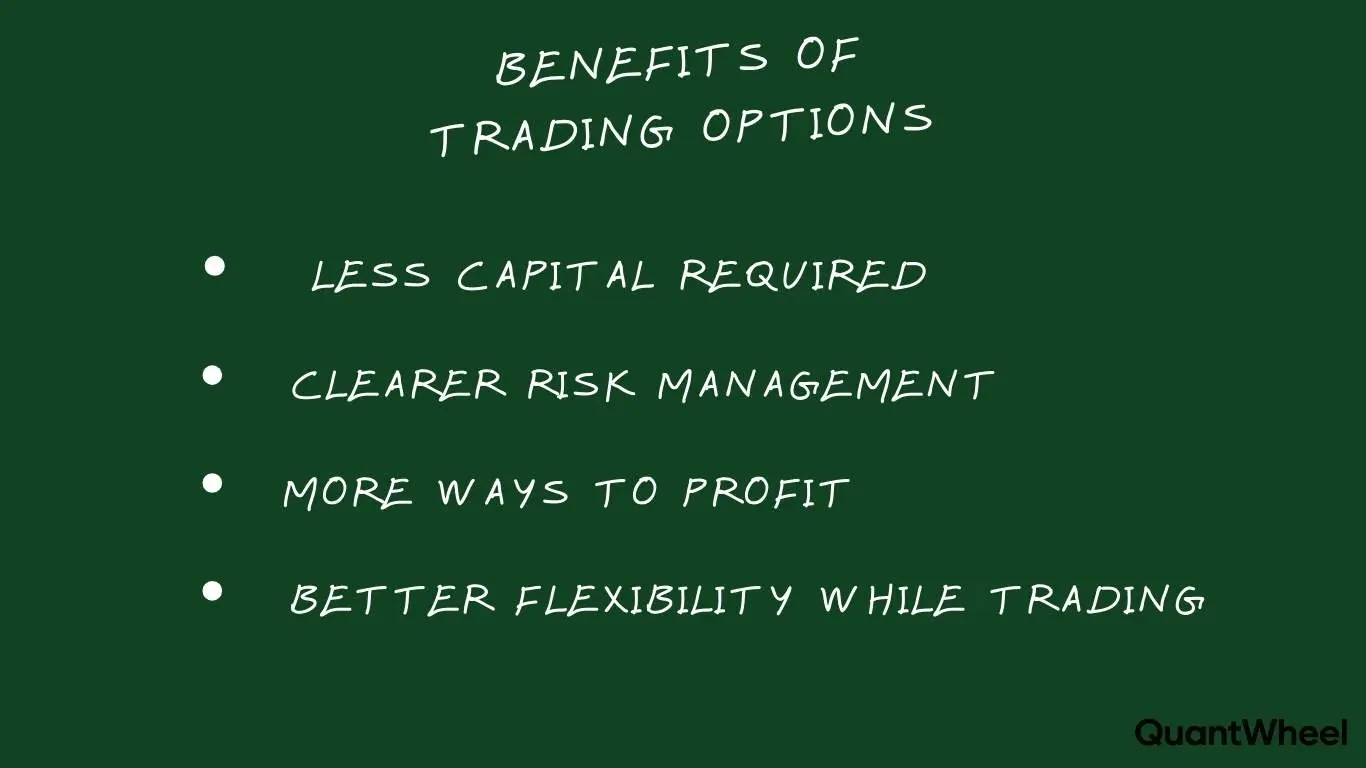
- Leverage: Control 100 shares for a fraction of the cost
- Income: You can sell options to collect premium (can't do this with stocks)
Defined Risk: Maximum losses are known upfront when structured properly
$1 for 7 days • Cancel anytime • 14-day money-back guarantee
What Are Options Contracts?
An options contract is an agreement between two parties: a buyer and a seller.
The buyer pays a fee (premium) for the right to buy or sell 100 shares of stock at a predetermined price.
The seller collects that fee in exchange for taking on the obligation to buy or sell 100 shares if the buyer exercises their right.
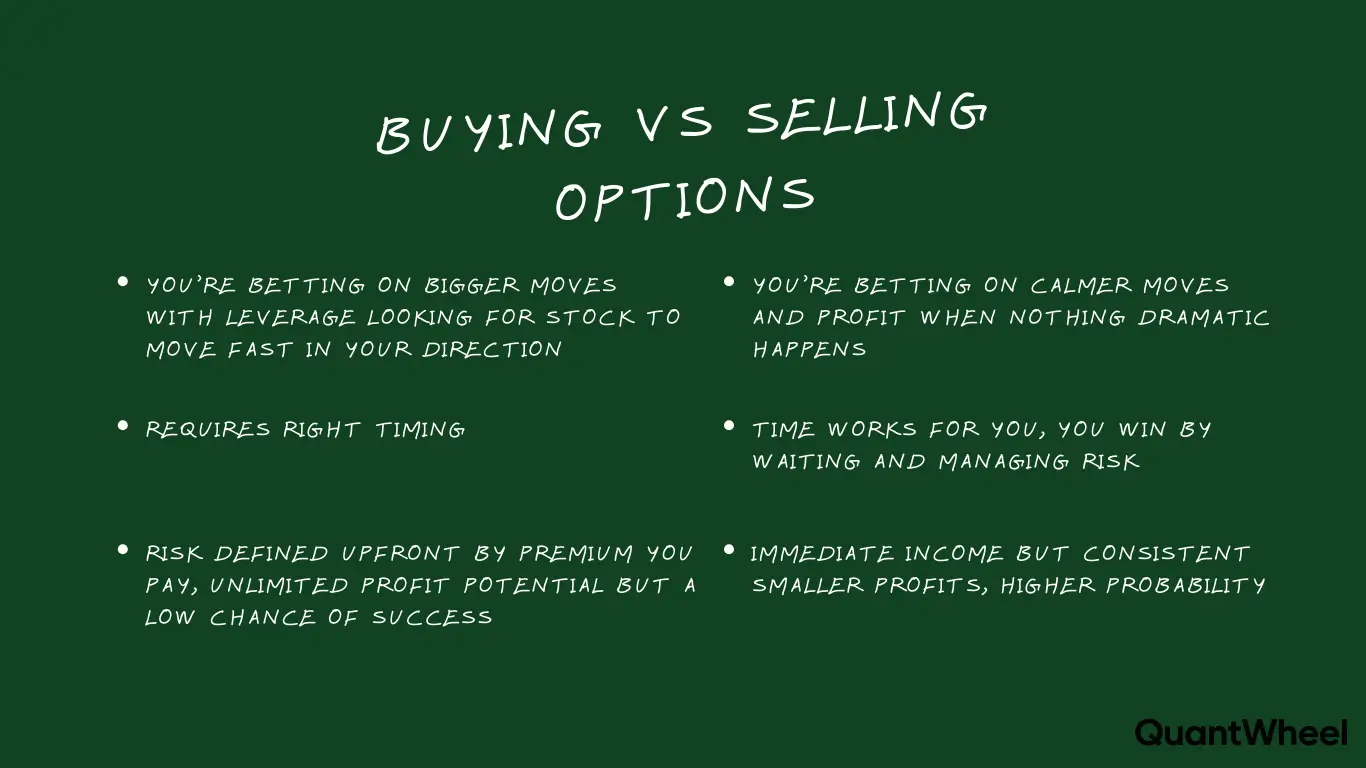
Each options contract represents 100 shares of the underlying stock. This is called the "contract multiplier."
Example breakdown:
- Premium quoted: $2.50 per share
- Actual cost: $2.50 × 100 shares = $250 per contract
- If you buy 3 contracts: $250 × 3 = $750 total
The premium is paid by the buyer to the seller immediately when the contract is created. The buyer pays this cost upfront regardless of what happens to the stock. The seller keeps this money no matter what.
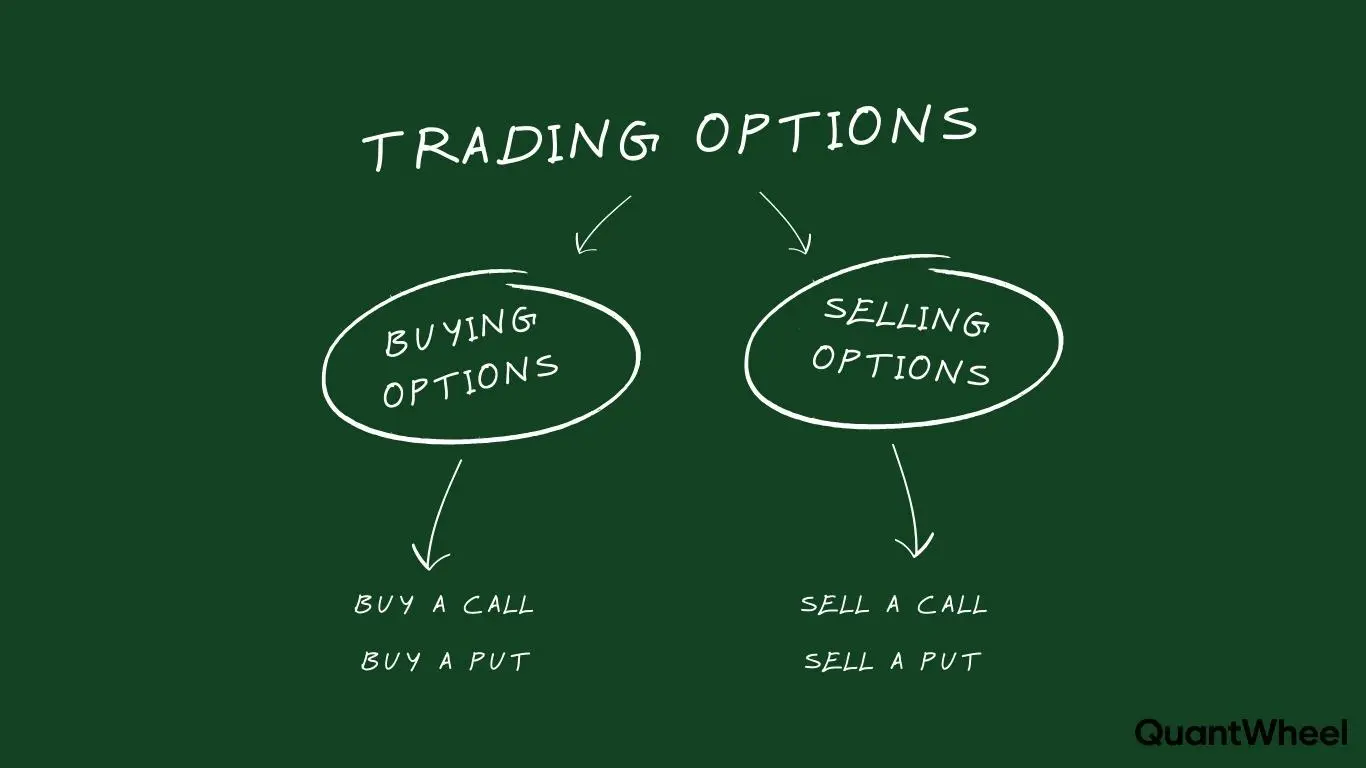
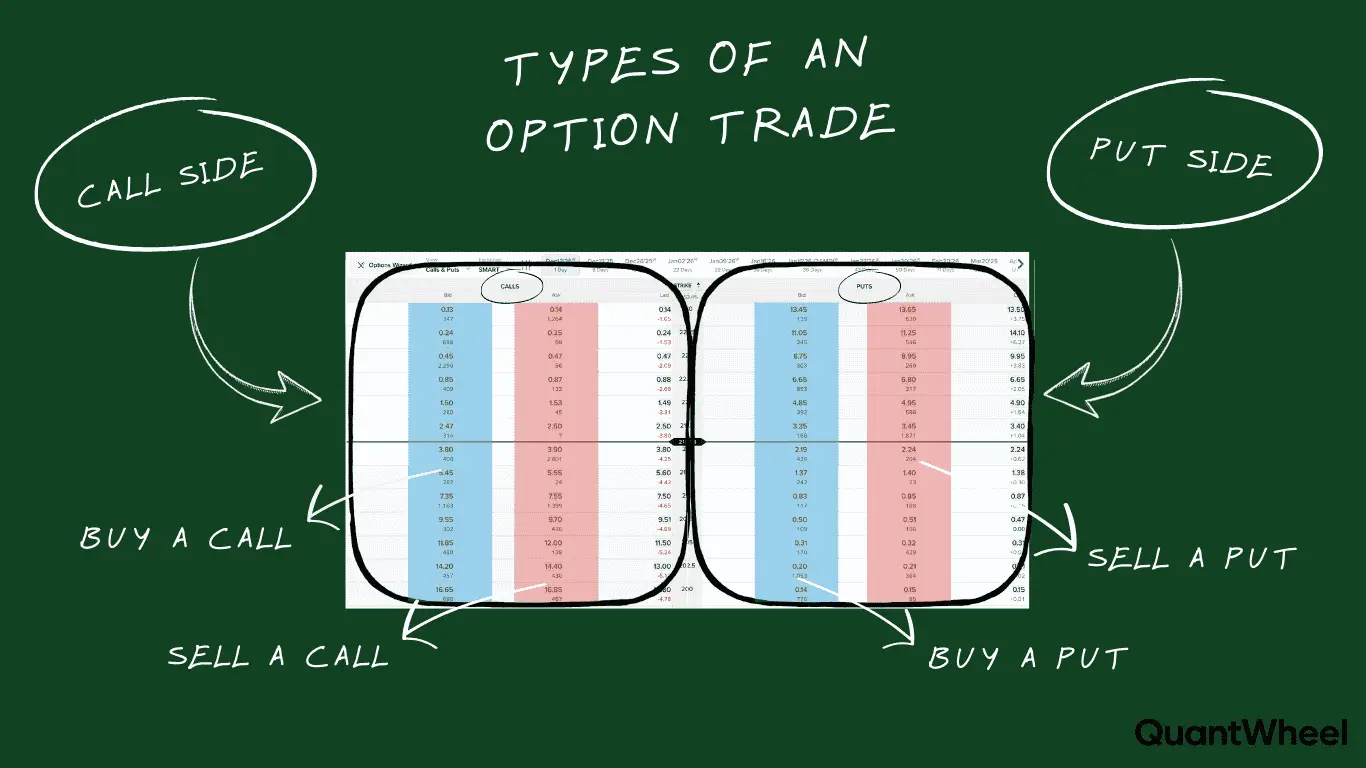
The Two Types of Options: Calls and Puts
There are only two types of options contracts: calls and puts. Everything else in options trading is built from these two building blocks. With those two it's your choice if you're going to sell them or buy them.
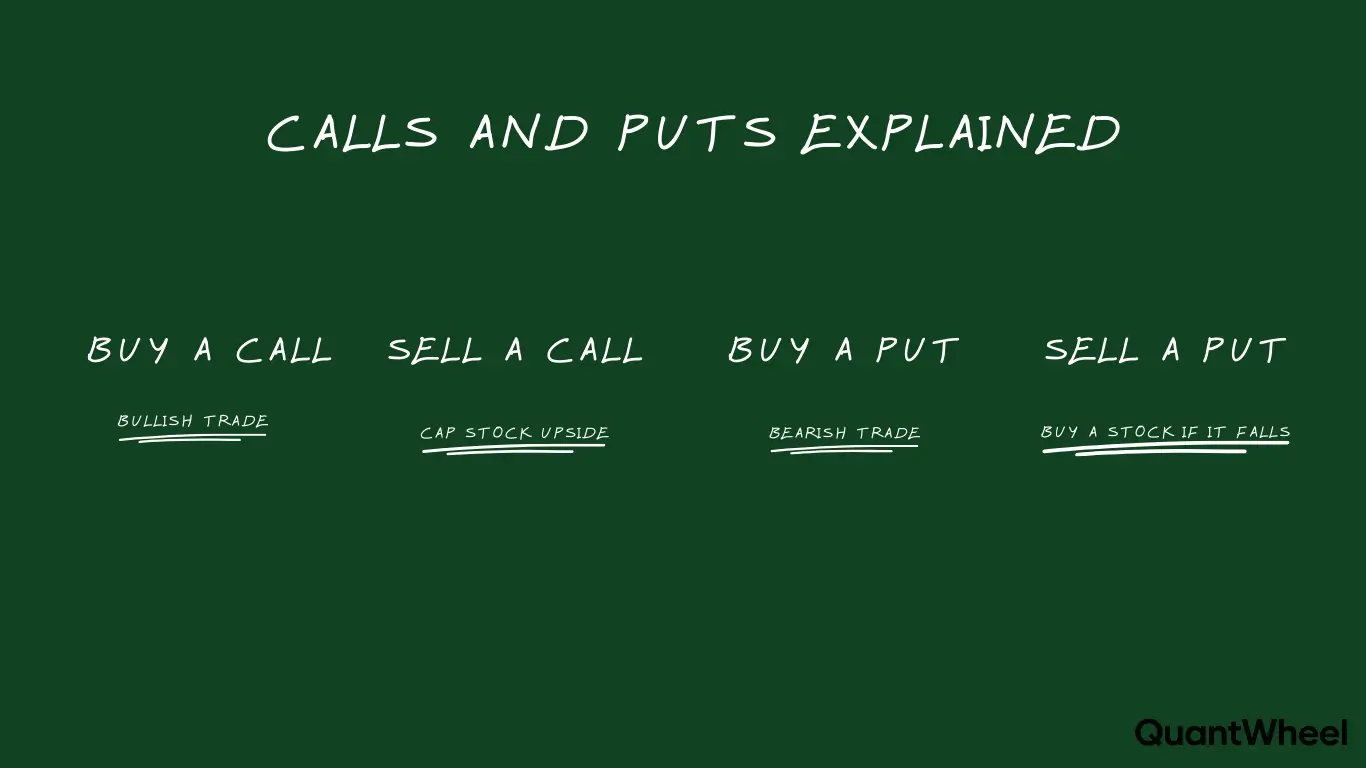
Call Options Explained
A call option gives the buyer the right to buy 100 shares at the strike price before expiration.
Who buys calls: Traders who think the stock price will go up.
Who sells calls: Traders who think the stock will stay flat or go down, or who already own the stock and want to generate income (this is called a "covered call").
Call Option Example:
- Stock XYZ is trading at $50
- You buy a $55 call expiring in 30 days
- Premium: $1.50 per share ($150 total)
- If XYZ rises to $60: Your call is worth approximately $5 per share ($500). You profited $350 after subtracting the $150 you paid.
- If XYZ stays at $50: Your call expires worthless. You lose the $150 premium.
The seller of this call collected $150 and keeps it if the stock stays below $55.
Put Options Explained
A put option gives the buyer the right to sell 100 shares at the strike price before expiration.
Who buys puts: Traders who think the stock price will go down, or who want to protect stock they already own.
Who sells puts: Traders who want to buy stock at a lower price and get paid to wait, or who believe the stock will stay flat or rise. This is called a "cash-secured put" when you have enough money to buy the shares.
Put Option Example:
- Stock ABC is trading at $100
- You buy a $95 put expiring in 30 days
- Premium: $2.00 per share ($200 total)
- If ABC drops to $85: Your put is worth approximately $10 per share ($1,000). You profited $800 after subtracting the $200 you paid.
- If ABC stays at $100: Your put expires worthless. You lose the $200 premium.
The seller of this put collected $200. If ABC drops below $95, they must buy 100 shares at $95 each (total cost: $9,500), even though the stock is trading lower.
Key Options Terms You Need to Know
Understanding options requires knowing just a few essential terms. Here are the most important:
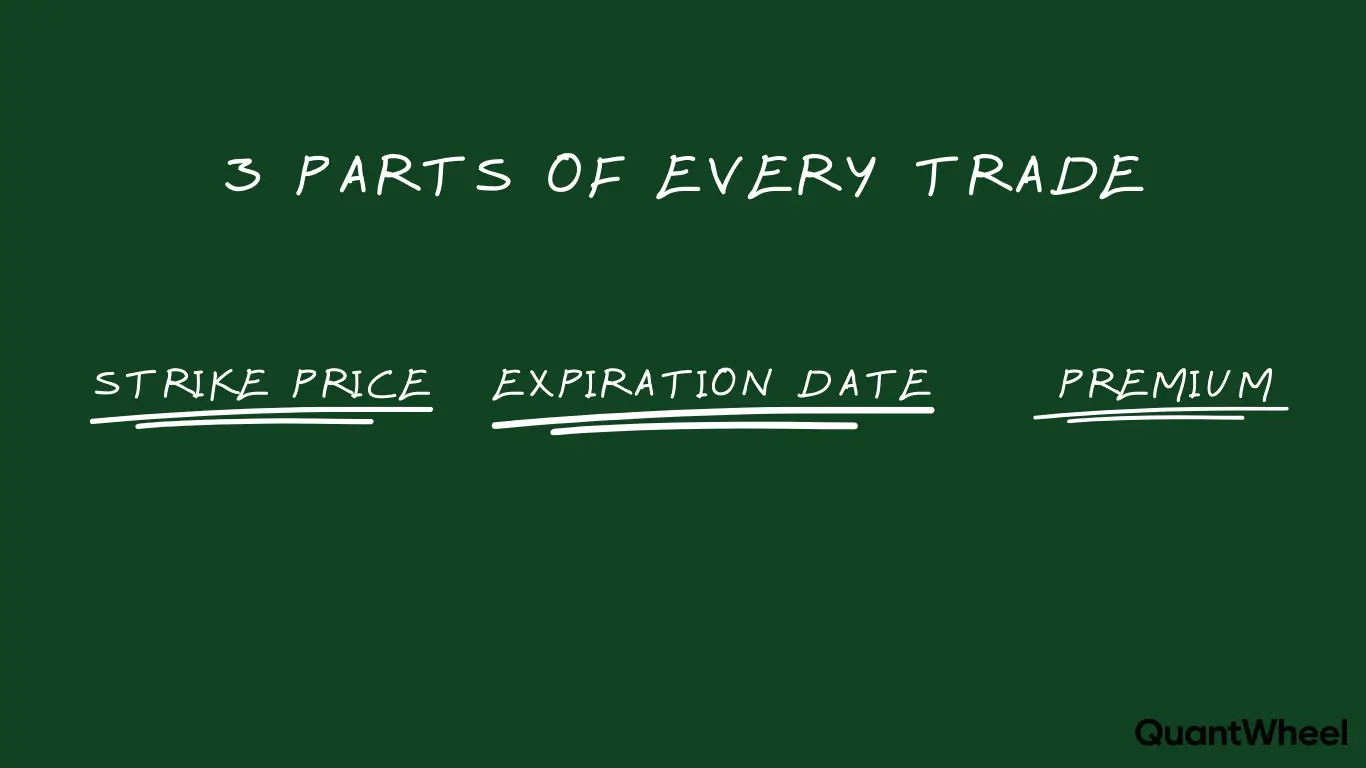
Strike Price
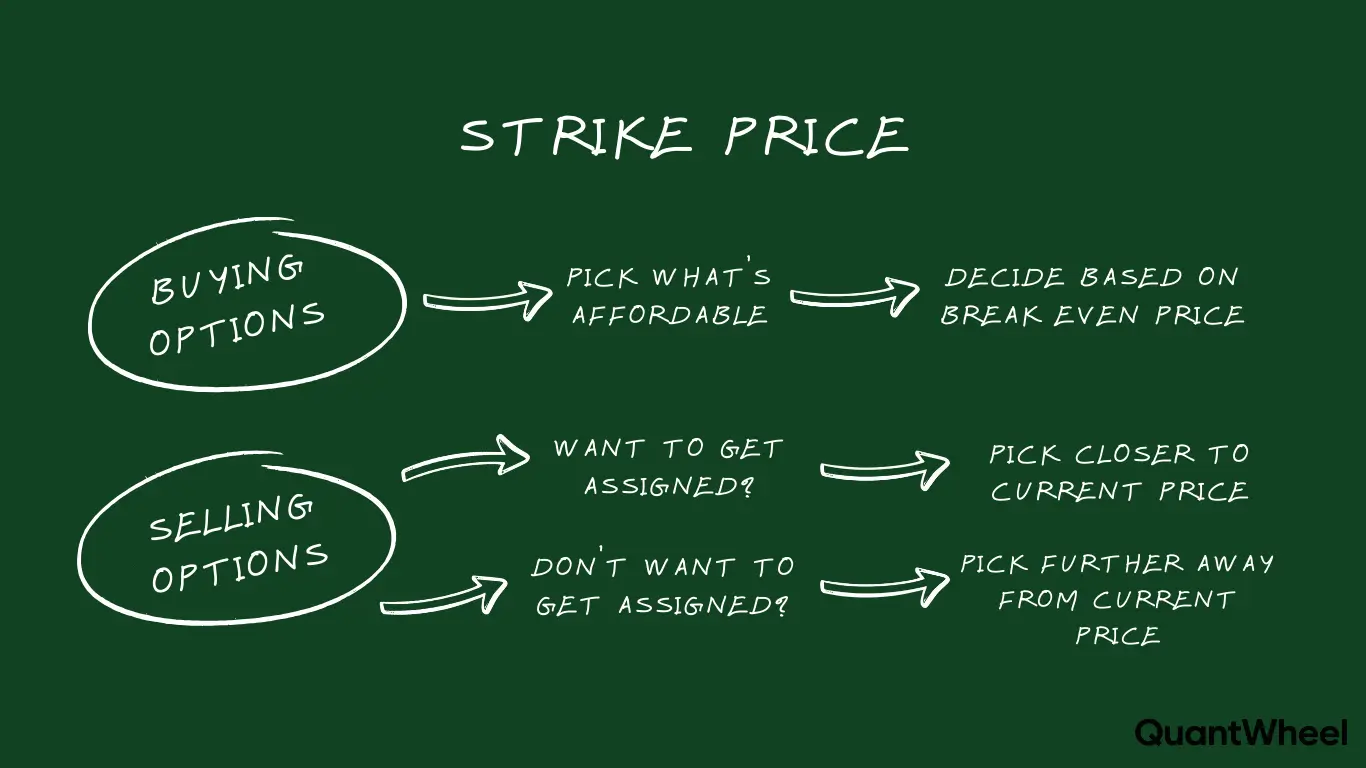
The predetermined price at which the option can be exercised. If you have a $50 call, you can buy shares at $50 no matter what the current stock price is.
Expiration Date
The last day the option is valid. Options expire on specific dates (usually Fridays). After expiration, the option is worthless or automatically exercised.
Premium
The price paid by the option buyer to the option seller. This is the "income" that options sellers collect. Premium is paid upfront and kept by the seller regardless of outcome.
In the Money (ITM)
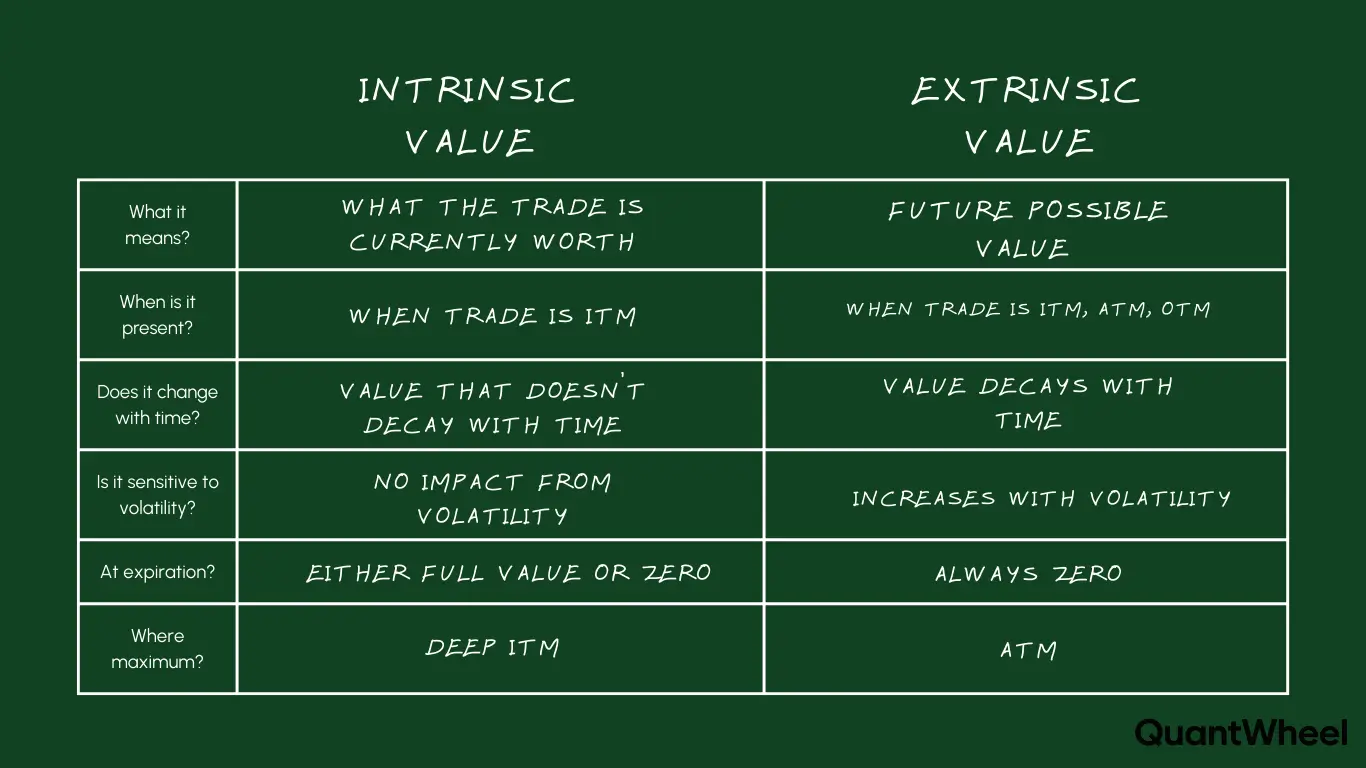
An option with intrinsic value. For calls, this means the stock price is above the strike price. For puts, the stock price is below the strike price.
Out of the Money (OTM)
An option with no intrinsic value. For calls, the stock price is below the strike price. For puts, the stock price is above the strike price.
At the Money (ATM)
The stock price is equal (or very close) to the strike price.
Assignment
When an option seller is required to fulfill their obligation. If you sold a put and it expires in the money, you'll be "assigned" and must buy 100 shares at the strike price.
Intrinsic Value
The real, tangible value of an option. For a $50 call when the stock is at $55, the intrinsic value is $5.
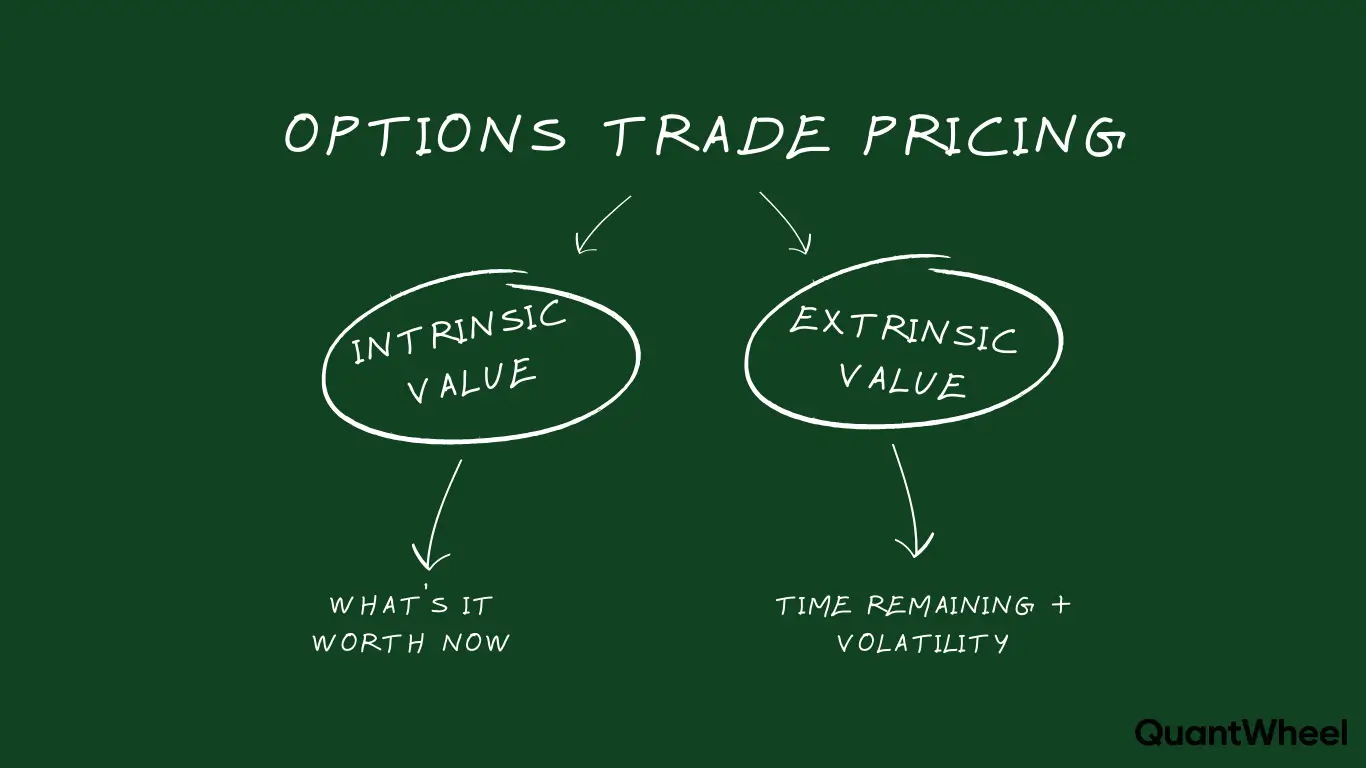
Extrinsic Value (Time Value)
The extra value beyond intrinsic value. This represents the probability of the option becoming more valuable before expiration. Extrinsic value decays over time.
How Options Work: The Complete Mechanics
Let's walk through exactly what happens when you trade options, from opening a position to closing it.
Opening an Options Position
Step 1: Choose your strategy
- Buying a call (bullish on stock)
- Buying a put (bearish on stock)
- Selling a cash-secured put (want to buy stock at discount, generate income)
- Selling a covered call (own stock, want to generate income)
Step 2: Select the strike price The strike determines your risk and reward. Strikes further from the current stock price have lower premiums but lower probability of profit.
Step 3: Choose the expiration date Longer expirations cost more but give more time for your prediction to be correct. Common timeframes: weekly (7 days), monthly (30-45 days), quarterly (60-90 days).
Step 4: Enter the order Options orders have several types:
- Market order: Execute immediately at current price
- Limit order: Only execute at your specified price or better
- Stop order: Trigger an order when price reaches a certain level
During the Trade: What Happens?
Once your option position is open, several things affect its value:
Stock price movement: The primary driver of option value.
Time decay (Theta): Options lose value as expiration approaches, all else equal. This benefits sellers and hurts buyers.
Volatility changes: Higher volatility increases option premiums. Lower volatility decreases them.
Dividends: Upcoming dividends can affect option pricing, especially for calls.
Closing an Options Position
You have four ways to exit an options position:
1. Sell to close (for buyers) You sell your option contract to someone else before expiration. Most buyers do this to realize profits or limit losses.
2. Buy to close (for sellers) You buy back the option contract you sold. Sellers do this to lock in profits early or limit losses.
3. Let it expire worthless If the option is out of the money at expiration, it expires worthless. Buyers lose the premium paid. Sellers keep the full premium collected.
4. Assignment/Exercise If the option is in the money at expiration, it will typically be automatically exercised. Buyers receive or deliver shares. Sellers are assigned and must fulfill their obligation.
Options vs. Stocks: Key Differences
Understanding how options differ from stocks helps clarify when to use each instrument.
| Feature | Stocks | Options |
|---|---|---|
| Expiration | None (hold forever) | Yes (days to years) |
| Cost | Full share price | Fraction of share price |
| Leverage | 1:1 (buy 1 share, own 1 share) | 100:1 (1 contract = 100 shares) |
| Income generation | Dividends only | Sell for premium income |
| Maximum loss (buying) | Entire investment | Limited to premium paid |
| Maximum loss (selling) | Entire investment | Depends on strategy |
| Time decay | No effect | Loses value over time |
| Volatility impact | Direct 1:1 | Amplified effect |
When to choose stocks:
- Long-term investing (5+ years)
- No time pressure
- Want simplicity
- Building wealth gradually
When to choose options:
- Generate income from existing holdings
- Want defined risk with leverage
- Shorter-term trading (days to months)
- Strategic positioning (hedging, acquisition)
Why Traders Use Options
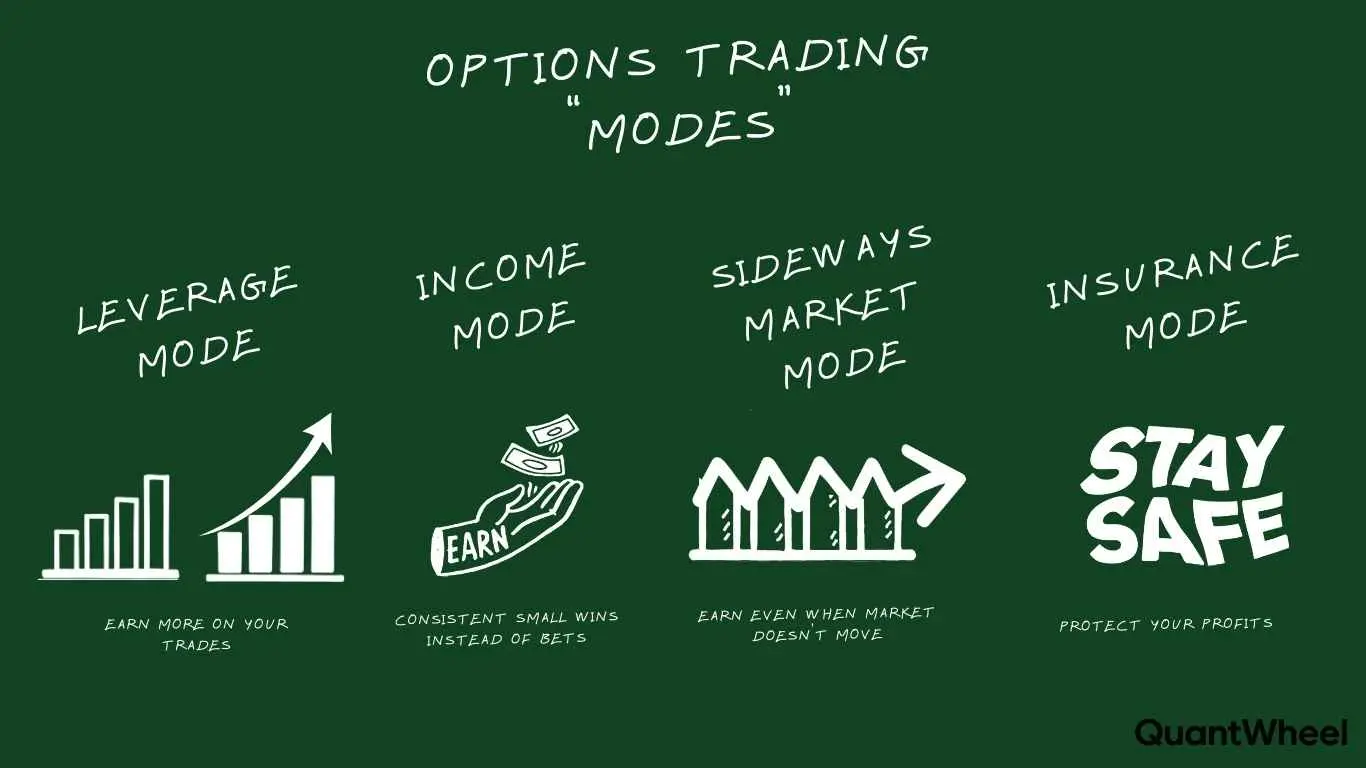
Options serve three primary purposes in trading and investing: income generation, hedging, and speculation. Understanding these use cases helps you determine if options fit your goals.
1. Income Generation (Most Conservative Use)
This is the most popular use of options among long-term traders. You sell options to collect premium income regularly.
Cash-secured puts: You get paid to place a limit order to buy stock. If the stock drops below your strike, you buy it at a discount (minus the premium collected). If it doesn't, you keep the premium and your cash.
Example: You want to buy AAPL at $140, but it's currently $150. You sell a $140 put expiring in 30 days for $3 premium. You collect $300 immediately. If AAPL drops below $140, you buy 100 shares at $140 (your real cost basis is $137 after the $3 premium). If AAPL stays above $140, you keep the $300 and your cash.
Covered calls: You own stock and sell calls against it to generate income. If the stock rises above your strike, your shares are called away at a profit. If not, you keep the premium and your shares.
Example: You own 100 shares of TSLA at $200. You sell a $220 call for $4 premium, collecting $400. If TSLA rises above $220, your shares are sold at $220 (you profit $20 per share on stock + $4 premium = $24 total). If TSLA stays below $220, you keep your shares and the $400 premium.
The Wheel Strategy: Combines cash-secured puts and covered calls into a systematic income generation system. You sell puts until assigned, then sell calls on the assigned shares. This is one of the most popular conservative options strategies.
2. Hedging (Portfolio Protection)
Options can protect stock positions from downside risk, similar to insurance for your home.
Protective puts: Buy puts on stocks you own. If the stock crashes, the puts increase in value to offset losses.
Example: You own 100 shares of NVDA at $500. You're worried about a potential drop. You buy a $480 put for $5 premium ($500 cost). If NVDA drops to $400, your put is worth approximately $80 per share ($8,000), offsetting most of your stock loss. Your maximum loss is capped at $2,500 (the $20 per share drop to $480, plus the $5 premium paid).
Collars: Combine a protective put with a covered call to reduce hedging costs. You sacrifice upside potential to pay for downside protection.
3. Speculation (Highest Risk/Reward)
Traders use options to amplify returns on price predictions with limited capital.
Buying calls or puts: Control 100 shares for a fraction of the cost. If your prediction is correct, returns can be substantial. If wrong, you lose only the premium paid (but that's 100% of your investment in that position).
Example: You think MSFT will rise from $300 to $330 in the next month. Instead of buying 100 shares for $30,000, you buy 1 call option with a $310 strike for $5 premium ($500 cost). If MSFT reaches $330, your option is worth approximately $20 per share ($2,000), a 300% return on your $500 investment. If MSFT stays flat, you lose the entire $500.
Most experienced traders avoid pure speculation with options, preferring income generation strategies with statistical edges.
The Most Popular Options Strategies for Beginners
Starting with options can be overwhelming given hundreds of possible strategies. These four strategies are beginner-friendly, have defined risk, and are most commonly used by retail traders.
Cash-Secured Puts: Get Paid to Buy Stock
How it works: Sell a put option at a strike price where you'd be happy to own the stock. Set aside enough cash to buy 100 shares if assigned.
Best for: Acquiring stock at a discount while generating income.
Risk: You must buy 100 shares at the strike price if the stock drops below it, even if it continues falling.
Example trade:
- AAPL trading at $170
- Sell $160 put expiring in 30 days
- Collect $3.50 premium ($350)
- Outcome 1: AAPL stays above $160. You keep $350 and your cash. Repeat next month.
- Outcome 2: AAPL drops to $155. You buy 100 shares at $160. Your real cost basis is $156.50 after the $3.50 premium. You now own AAPL at a discount and can sell covered calls.
Covered Calls: Generate Income on Stock You Own
How it works: Own 100 shares of stock. Sell a call option above the current price. Collect premium. If the stock rises above your strike, your shares are called away at a profit. If not, keep the premium and your shares.
Best for: Generating income on stocks you already own and don't mind selling if they appreciate.
Risk: You cap your upside at the strike price. If the stock skyrockets, you miss those gains.
Example trade:
- Own 100 MSFT shares at $350
- Sell $370 call expiring in 30 days
- Collect $5 premium ($500)
- Outcome 1: MSFT stays below $370. You keep $500 premium and your shares. Repeat next month.
- Outcome 2: MSFT rises to $385. Your shares are called away at $370. You profit $20 per share on stock + $5 premium = $2,500 total.
The Wheel Strategy: Systematic Income Generation
How it works: Combine cash-secured puts and covered calls into a continuous system:
- Sell cash-secured puts on quality stocks
- If assigned, sell covered calls on those shares
- If called away, return to step 1
- "The wheel keeps turning"
Best for: Traders who want systematic, repeatable income with controlled risk.
Risk: You're exposed to downside in the underlying stock. Not a market-neutral strategy.
Example full cycle:
- Week 1-4: Sell $100 put on XYZ, collect $2 premium
- XYZ drops to $98, you're assigned 100 shares at $100
- Your cost basis: $98 per share (after $2 premium)
- Week 5-8: Sell $105 covered call, collect $2.50 premium
- XYZ rises to $106, shares called away at $105
- Total profit: $2 (put premium) + $7 (stock appreciation from $98 cost basis to $105 sale) + $2.50 (call premium) = $11.50 per share = $1,150 profit
- Return to step 1 with your cash plus profits
Long Calls and Puts: Directional Speculation
How it works: Buy a call if you think the stock will rise, or buy a put if you think it will fall. Risk is limited to the premium paid. Potential profit is substantial if you're correct.
Best for: Traders with strong directional conviction and high risk tolerance.
Risk: You can lose 100% of the premium paid. Time works against you (time decay).
Example trade:
- NVDA at $800, you think it'll hit $900 before earnings
- Buy $830 call expiring in 45 days
- Pay $15 premium ($1,500)
- Outcome 1: NVDA rises to $920. Your call is worth approximately $90 per share ($9,000). Profit: $7,500 (500% return).
- Outcome 2: NVDA stays at $800. Your call expires worthless. Loss: $1,500 (100% of investment).
Most conservative traders avoid buying options as a primary strategy due to the time decay disadvantage. Selling options gives you the statistical edge.
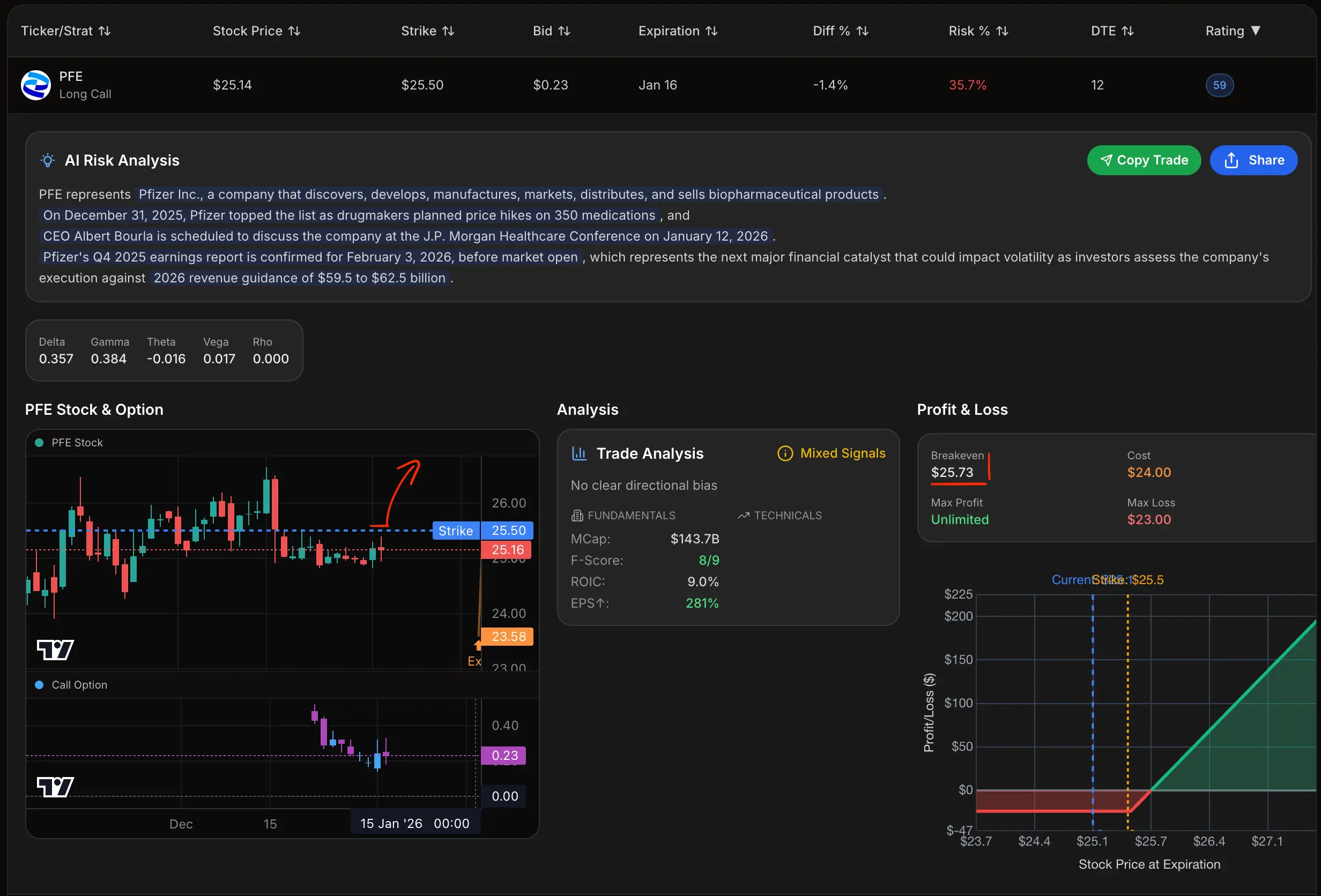
Long call (bullish) examples: Example 1; Cheaper but riskier trade.
Example 2; Safer trade.
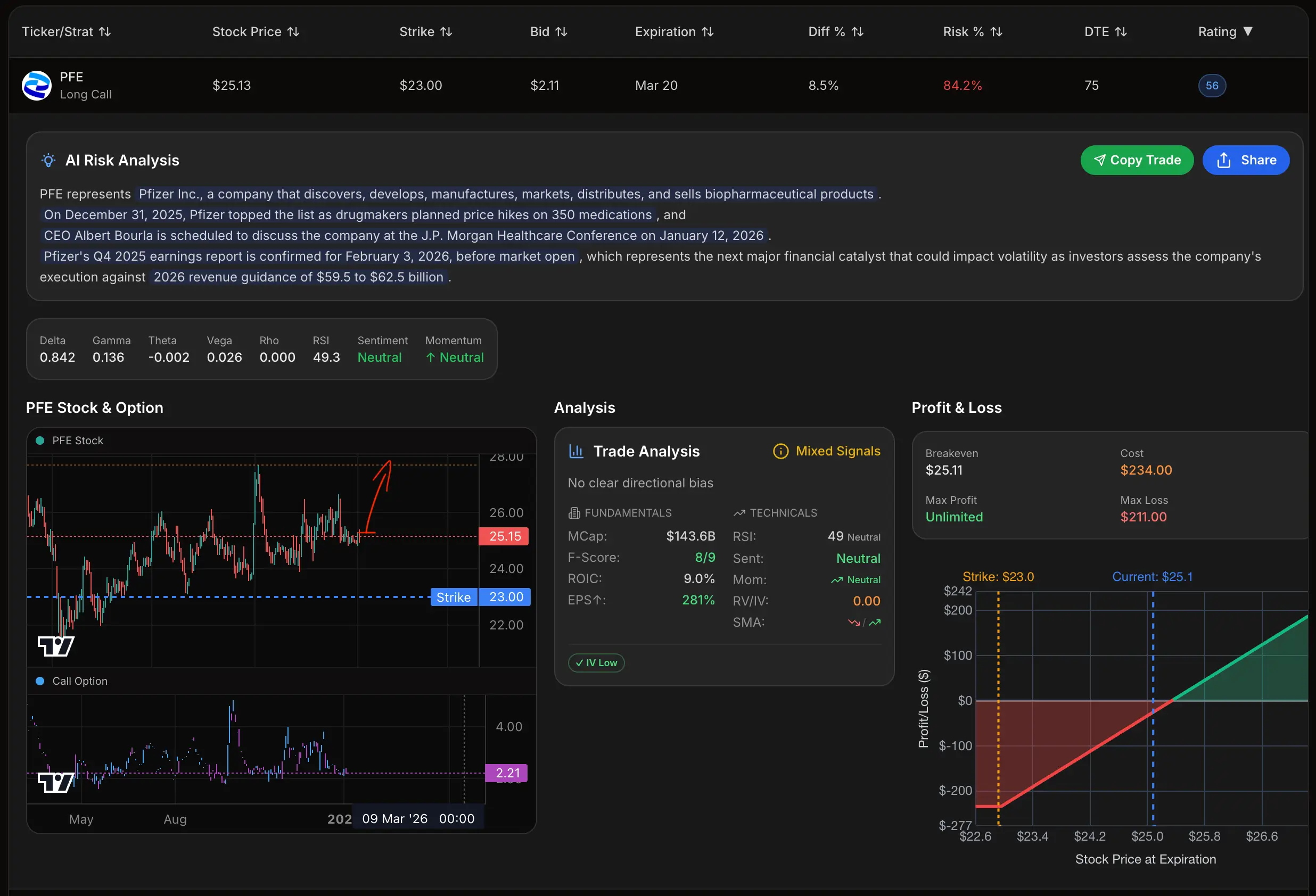
Main difference: Picture 1 has a strike price above stock price and picture 2 has a strike price below stock price.
Long put (bearish) examples: Example 1; Riskier but cheaper trade.
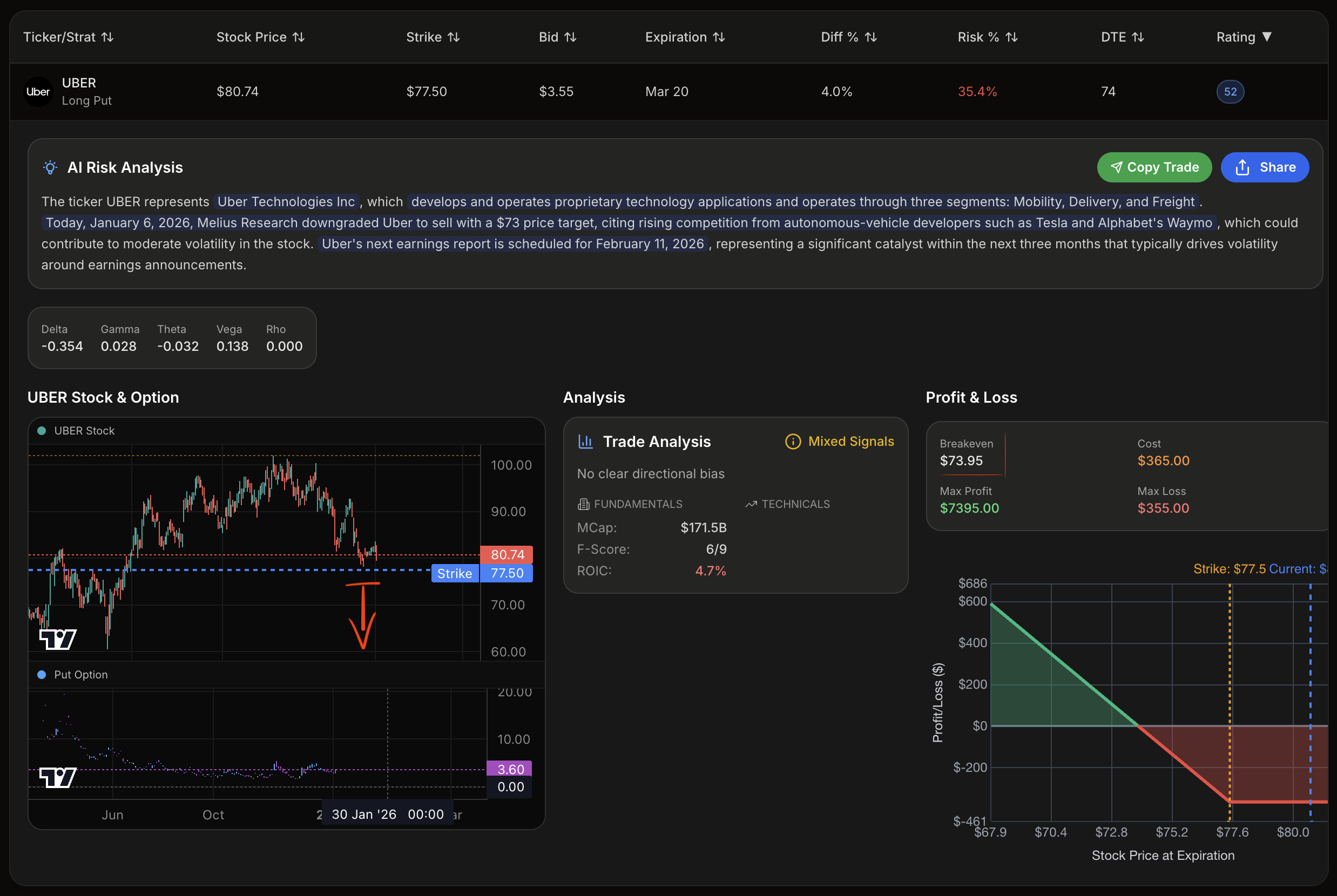
Example 2; Safer trade.
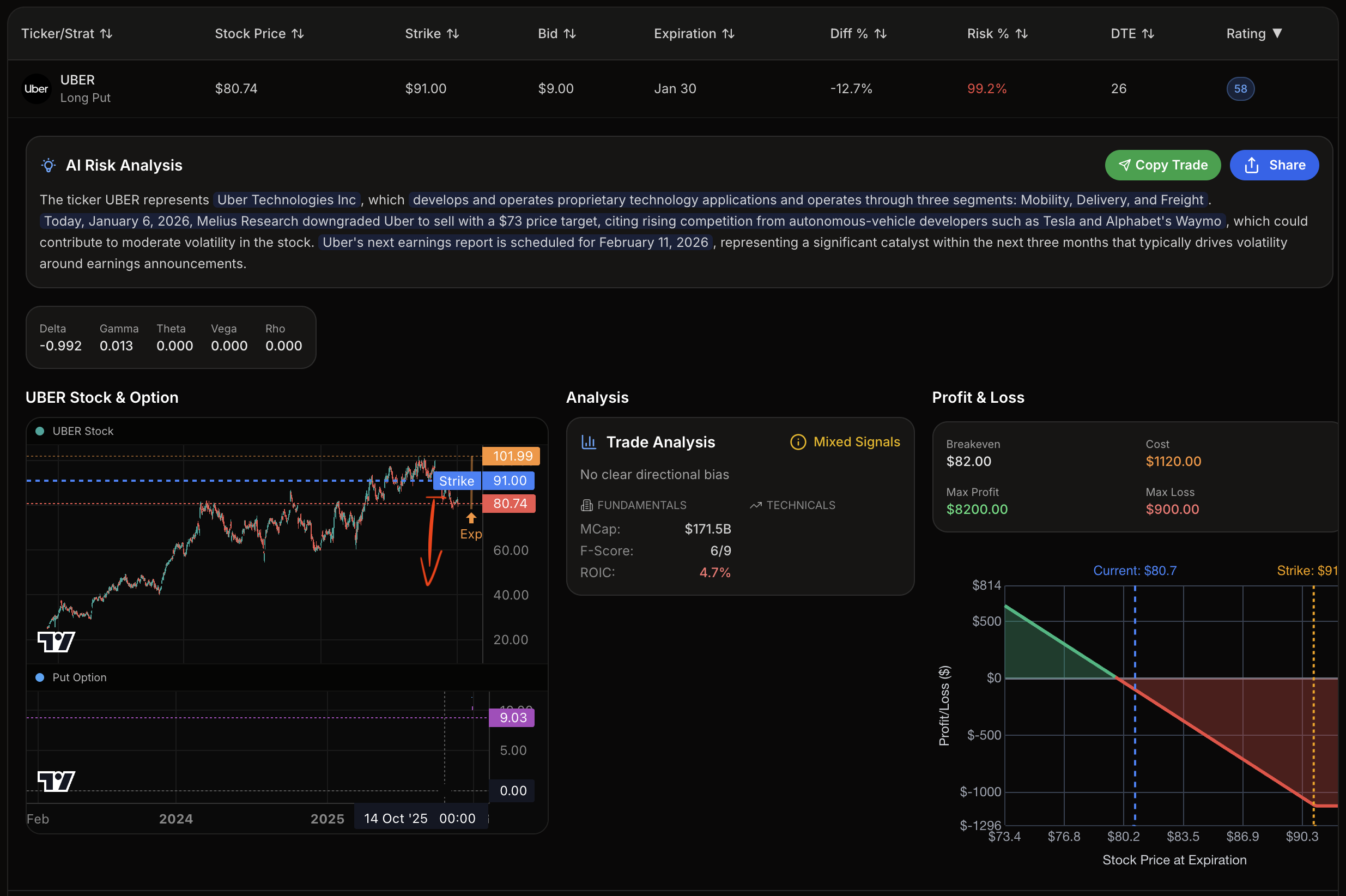
If you're learning about options, you can learn faster with QuantWheel. It can help you by identifying good opportunities so you can immediately see what's worth your time and money.
$1 for 7 days • Cancel anytime • 14-day money-back guarantee
Understanding Options Assignment
Assignment is one of the most misunderstood aspects of options trading. Let's clarify exactly what it is and when it happens.
What Is Assignment?
Assignment is when the stock price reaches your strike price of your trade. If stock price is under strike price at the end of the last day of your trade = you have to buy shares at that price. If stock price is above strike price at the end of the last day of your trade = you have to sell shares at that price. Assignment occurs when an option seller is required to fulfill their obligation (the trade they made).
If you sold a put, you must buy 100 shares at the strike price. If you sold a call, you must sell 100 shares at the strike price.
Assignment typically happens in two scenarios:
1. At expiration (automatic): If your option expires in the money, you'll typically be automatically assigned.
2. Early assignment (rare): The option buyer can exercise their right before expiration. This is uncommon but can happen, especially for in-the-money calls on stocks about to pay dividends.
What Happens When You Get Assigned?
The process happens automatically through your broker overnight or over the weekend. You'll wake up to find shares in your account (if you sold puts) or shares removed from your account (if you sold calls).
Example - Put assignment:
- You sold a $50 put on XYZ for $2 premium
- XYZ drops to $45 by expiration
- You're assigned: 100 shares of XYZ appear in your account
- $5,000 is deducted from your cash balance
- Your real cost basis: $48 per share (the $50 strike minus the $2 premium you collected)
This is where most traders struggle: calculating cost basis after assignment. Your broker shows $50 per share, but your actual cost is $48 after the premium. You need to track this manually for accurate profit calculations and tax reporting.
Unless you're using software like QuantWheel that automatically adjusts your cost basis when assignments happen. It's one of the key features that wheel strategy traders need but most tools don't provide.
Example - Call assignment:
- You own 100 shares of ABC at $80
- You sold a $90 covered call for $3 premium
- ABC rises to $95 by expiration
- You're assigned: 100 shares are removed from your account
- $9,000 is deposited to your cash balance
- Your total profit: $10 per share (from $80 to $90) + $3 premium = $1,300
How to Avoid Assignment
If you don't want to be assigned, you can "close" your position before expiration by buying back the option you sold. This is called "buying to close."
When to close early:
- You've captured most of the profit (common rule: close at 50% profit)
- The stock is moving against you and assignment seems likely
- You no longer want the obligation
- Risk of early assignment is high (dividend-paying stocks)
Example:
- You sold a $100 put for $4 premium
- The stock drops to $98, and your put is now worth $6
- You buy it back for $6, realizing a $2 loss ($4 collected - $6 paid)
- You avoid assignment and free up capital
Is Assignment Bad?
Not necessarily. In strategies like the wheel, assignment is part of the plan. You're getting paid to buy stock you wanted to own anyway (for puts), or selling stock at a profit target you set (for calls).
The key is being prepared:
- Only sell puts on stocks you want to own
- Only sell calls on stocks you're willing to sell
- Have enough cash for assignment (cash-secured puts)
- Understand your actual cost basis after premium collection
How to Start Trading Options
Ready to begin? Here's the step-by-step process to start trading options safely and strategically.
Step 1: Get Approved for Options Trading
Options trading requires approval from your broker. This is a regulatory requirement to ensure you understand the risks.
Approval levels (vary by broker):
- Level 1: Covered calls and cash-secured puts (safest)
- Level 2: Long calls and puts (buying options)
- Level 3: Spreads and more complex strategies
- Level 4: Naked options (highest risk, rarely approved for retail)
For beginners, apply for Level 1 or Level 2. You'll need to demonstrate:
- Trading experience (even if minimal)
- Investment objectives (income, speculation, hedging)
- Financial situation (income, net worth, liquid assets)
- Risk tolerance
Most brokers approve applications within 1-2 business days.
Popular brokers for options:
- Fidelity: Great for beginners, excellent education
- TD Ameritrade/Schwab: Powerful thinkorswim platform
- Interactive Brokers: Low costs, professional tools
- Robinhood: Simple interface, commission-free
- Tastytrade: Built for options traders, great analytics
Step 2: Learn the Basics (You're Doing This Now)
Before risking real money, understand:
- The difference between calls and puts
- How to read an options chain
- What strike prices and expirations mean
- Your maximum risk for each strategy
- How assignment works
Most beginners rush into trading. Spend 20-40 hours learning first. This article is a great start, but also:
- Watch YouTube tutorials (ProjectFinance, InTheMoney, OptionAlpha)
- Paper trade for 2-4 weeks (simulated trading)
- Read your broker's options education materials
Step 3: Choose Your First Strategy
Start with one of these beginner-friendly strategies:
If you want to generate income and don't mind owning stock: → Cash-secured puts on quality stocks you'd buy anyway
If you already own stock: → Covered calls to generate income
If you want to learn the system: → The wheel strategy (combining both above)
Avoid these strategies as a beginner:
- ❌ Buying far out-of-the-money calls/puts (lottery tickets)
- ❌ Naked options (undefined risk)
- ❌ Complex multi-leg strategies before understanding basics
- ❌ Earnings plays until you understand volatility
Step 4: Start Small
Your first options trade should be small enough that losing it entirely doesn't impact your financial situation.
Sizing guidelines for beginners:
- Risk no more than 2-5% of your account per trade
- Start with 1 contract, not 10
- Choose liquid stocks with tight bid-ask spreads (SPY, AAPL, MSFT)
- Avoid penny stocks and illiquid options
Example for $10,000 account:
- Maximum risk per trade: $200-500
- If selling a $50 cash-secured put: Risk is $5,000 if stock goes to zero (unrealistic), practical risk is 10-20% drawdown
- Start with higher-quality, less volatile stocks
- Trade 1 contract at a time
Step 5: Track Everything
This is where most beginners fail. They don't track their trades properly, so they:
- Can't calculate real returns
- Miss tax reporting details
- Don't learn from mistakes
- Lose track of cost basis after assignments
What to track:
- Entry date, strike, expiration, premium collected/paid
- Exit date, closing price, profit/loss
- Stock price at entry and exit
- Assignment details and adjusted cost basis
- Win rate, average win, average loss
- Total premium collected
You can do this in a spreadsheet, but it becomes messy with 10+ positions, especially when tracking assignments and cost basis adjustments. This is exactly why QuantWheel exists - to automate the tracking so you can focus on trading strategy, not spreadsheet maintenance.
Step 6: Develop Your System
After 20-30 trades, you'll have enough data to understand what's working. Develop rules:
Entry rules:
- What stocks do you trade? (market cap, IV rank, sectors)
- What strikes do you choose? (delta targets, percentage OTM)
- What expirations? (30-45 days is most common)
Exit rules:
- When do you close winners? (50% profit target common)
- When do you cut losses? (position down 100-200%?)
- When do you roll instead of taking assignment?
Position management:
- How many positions do you hold simultaneously?
- How do you allocate capital across positions?
- What's your max exposure to one sector?
Successful options traders are systematic, not emotional. They follow rules, track results, and adjust based on data.
$1 for 7 days • Cancel anytime • 14-day money-back guarantee
Common Options Trading Mistakes to Avoid
Learning from others' mistakes is cheaper than making them yourself. Here are the most common pitfalls that trap new options traders.
Mistake 1: Buying Far Out-of-the-Money Options
The lottery ticket trap. Beginners see that a $1 option could be worth $10 if the stock moves their way, a 1,000% return. The problem: the probability of profit is extremely low.
Why it fails: Time decay and low probability work against you. You can be right about direction but still lose because the stock didn't move far enough or fast enough.
Better approach: If you want to buy options, choose strikes closer to the current price (at-the-money or slightly out-of-the-money) with higher probability of profit.
Mistake 2: Not Having a Plan for Assignment
Many beginners sell cash-secured puts without actually wanting the stock. They're chasing premium without understanding the obligation.
Why it fails: When assigned, they panic-sell the stock at a loss or hold a stock they never researched, hoping it recovers.
Better approach: Only sell puts on stocks you've researched and genuinely want to own at that strike price. Treat it as setting a limit order that pays you to wait.
Mistake 3: Letting Winners Turn Into Losers
You sold a put for $3 premium. It's now worth $0.50 (83% profit). Instead of closing it, you wait for expiration to capture the last $0.50. The stock drops, and now it's worth $5. Your winner became a $2 loser.
Why it fails: Greed over the last 10-20% of profit exposes you to 100%+ losses.
Better approach: Take profits at 50-75% of max gain. Free up capital for new trades. Reduce risk of reversals.
Mistake 4: Ignoring Cost Basis After Assignment
You sold a $50 put, collected $2 premium, and got assigned. Your broker shows your cost as $50/share, but your real cost is $48. You sell covered calls at $50, thinking you're breaking even, but you're actually selling below your effective purchase price.
Why it fails: You make suboptimal decisions because you're working with incorrect cost basis numbers. Tax reporting becomes a nightmare.
Better approach: Track your adjusted cost basis after every assignment. Your broker won't do this for you. Either maintain detailed records or use a tool like QuantWheel that automatically adjusts cost basis when you're assigned.
Mistake 5: Trading Illiquid Options
You find a great-looking trade on a small-cap stock. You enter at the mid-point of a $1 bid / $3 ask spread. When you try to close it later, you realize you overpaid by $1 per share ($100 per contract) due to the wide spread.
Why it fails: Wide bid-ask spreads create hidden costs that eat your profits. Illiquid options are also harder to exit when you need to.
Better approach: Trade options on liquid underlyings with tight spreads (typically < $0.05 for near-the-money options). Good examples: SPY, QQQ, AAPL, MSFT, NVDA, TSLA, AMD.
Mistake 6: Overleveraging Your Account
You have $10,000. You sell 5 cash-secured puts at $30 strike ($15,000 in obligations). You're using margin without realizing it. The positions move against you, and you get a margin call.
Why it fails: Over-commitment of capital creates forced exits at the worst times.
Better approach: Never use more than 50-60% of your buying power. Keep cash reserves for opportunities and drawdowns. Scale position sizes to your account.
Mistake 7: Chasing High IV Without Understanding Why
A stock has 120% IV rank (very high). You sell puts because the premium looks amazing. The next day, the company announces bankruptcy. IV was high for a reason.
Why it fails: High premium often signals high risk. You're being compensated for that risk, not getting free money.
Better approach: Research WHY IV is elevated. Earnings coming up? Sector rotation? Company-specific news? Only sell premium on volatility you understand and risks you're willing to take.
Options Trading and Taxes
Options taxes can be complex, but understanding the basics helps you avoid surprises at tax time.
How Options Trades Are Taxed
For option buyers and sellers: Profits and losses are treated as capital gains and losses.
- Short-term capital gains (held < 1 year): Taxed as ordinary income at your income tax rate
- Long-term capital gains (held ≥ 1 year): Taxed at preferential rates (0%, 15%, or 20% depending on income)
Most options trades are short-term since contracts are typically held for days or weeks.
Specific Tax Scenarios
Selling options that expire worthless: The premium you collected is a short-term capital gain recognized when the option expires.
Example: You sold a put for $300 on January 15th. It expired worthless on February 18th. You have a $300 short-term capital gain for tax year.
Closing options early: Your profit or loss is the difference between what you collected (sold) and what you paid (bought back).
Example: You sold a put for $300, later bought it back for $100. Your profit is $200, taxed as a short-term capital gain.
Assignment on cash-secured puts: The premium you collected reduces your cost basis in the stock. This doesn't create a taxable event until you sell the stock.
Example: You sold a $50 put for $2 premium and were assigned. Your cost basis is $48 per share for tax purposes. When you eventually sell the stock, that sale determines your gain or loss.
Assignment on covered calls: The premium you collected is added to your stock sale proceeds.
Example: You owned stock with a $40 cost basis. You sold a $50 covered call for $3 premium. Shares were called away. Your proceeds are $53 per share ($50 + $3), so your gain is $13 per share ($53 - $40).
Wash Sale Rules
Wash sale rules can apply to options trading, creating unexpected tax consequences.
What is a wash sale? If you sell a stock or option at a loss and buy a "substantially identical" security within 30 days before or after, the loss is disallowed and added to your cost basis in the new position.
This gets complex with options. Selling a put and buying stock could trigger wash sale rules in some scenarios.
How to avoid issues:
- Keep detailed records of all trades
- Wait 31 days before reestablishing similar positions after losses
- Consult a tax professional if trading actively
Record Keeping for Taxes
Your broker will send you a 1099-B form showing your options trades. However, this may not accurately reflect your adjusted cost basis for assigned positions.
What you need to track:
- All options trades (date, strike, expiration, premium, close date)
- Assignment details (date, adjusted cost basis)
- Stock sales from assigned positions
- Wash sale adjustments
This is tedious in spreadsheets, especially with dozens of trades. Tools like QuantWheel automatically track cost basis adjustments and can export tax-ready reports, saving hours during tax season.
Resources for Learning More About Options
Your options education shouldn't stop here. These resources will help you continue learning and improving.
Books Worth Reading
For beginners:
- "Options as a Strategic Investment" by Lawrence McMillan (the bible, comprehensive)
- "The Options Playbook" by Brian Overby (simple, visual explanations)
- "Trading Options Greeks" by Dan Passarelli (understanding risk metrics)
For wheel strategy specifically:
- Reddit r/thetagang wiki (free, community-driven)
- "Selling Options for Income" by Katz & McCormick
Online Communities
Reddit:
- r/thetagang: Focus on premium selling strategies (wheel, spreads)
- r/optionstrading: Broader options discussion, all strategies
- r/VegaGang: Volatility-focused trading
Discord servers: Many options traders hang out in Discord communities. Search for "thetagang discord" or "options trading discord."
Twitter: Follow verified options traders who share real positions and P&L. Be skeptical of screenshot-only accounts.
YouTube Channels
- ProjectFinance: Excellent tutorials on mechanics and strategies
- InTheMoney: Visual explanations of complex concepts
- Tastytrade: Professional-level education, research-backed strategies
Tools and Platforms
For education and paper trading:
- ThinkorSwim's paperMoney (free with TD Ameritrade account)
- OptionAlpha's virtual trading
- Investopedia simulator
For screening and tracking:
- Your broker's platform (whatever you choose)
- QuantWheel for wheel screening, journal, cost basis management, automated alerts and help with rolling
Final Thoughts: Should You Trade Options?
Options aren't for everyone, and that's okay.
Options might be right for you if:
- You want to generate income from capital you're not currently using
- You're comfortable with stocks and understand basic investing
- You want defined-risk strategies with statistical edges
- You're willing to learn and follow systematic rules
- You can handle the mental work of managing multiple positions
Options might NOT be right for you if:
- You're looking to get rich quick
- You can't afford to lose your capital
- You don't have time to learn and manage positions
- You panic when investments go against you
- You're hoping for lottery-ticket wins
The most successful options traders treat it as a systematic business, not gambling. They:
- Follow consistent rules for entries and exits
- Track every trade and learn from results
- Sell options more than they buy (statistical edge)
- Focus on income generation, not speculation
- Use proper position sizing and risk management
If you decide options are right for you, start small, learn continuously, and track religiously. The learning curve is real, but the skills you develop can generate income for decades.
$1 for 7 days • Cancel anytime • 14-day money-back guarantee