
Written by Ivan Orehovec - Founder, QuantWheel • Options strategy developer & wheel trader
Educational content only - not financial advice. Always do your own research before trading options.
TLDR: Best Stocks for Wheel Strategy
The best stocks for wheel strategy are large-cap, liquid equities with implied volatility between 20-40% and strong fundamentals you'd be happy owning if assigned. Three criteria define every strong wheel stock:
- Liquidity: market cap above $10B, 1M+ daily volume, 100+ open interest at your target strikes
- Volatility: 20-40% implied volatility (check IVR above 50 for best entries)
- Fundamentals: positive free cash flow and a business you'd be comfortable owning through assignment
Effective stock selection in a wheel strategy separates consistent income earners from traders stuck holding losing positions. That's the biggest problem wheel traders face - everything revolves around the stock you're wheeling on.
The wheel strategy can generate consistent income, but your stock selection determines whether you'll collect steady premium or get stuck holding positions underwater for months. After analyzing thousands of wheel trades, specific stock characteristics consistently separate successful wheel traders from those struggling with assignments and losses.
The fundamental rule: never sell puts on stocks you wouldn't want to own at your strike price. As selling a Cash-Secured put is a first step in the wheel strategy, your strike price minus collected premium becomes your real cost basis on that stock, and that's the number that matters when assignment happens.
Understanding the Wheel Strategy Stock Selection Framework
Unlike directional trading or pure speculation, the wheel strategy operates on a fundamental assumption: you're willing to own the underlying stock.
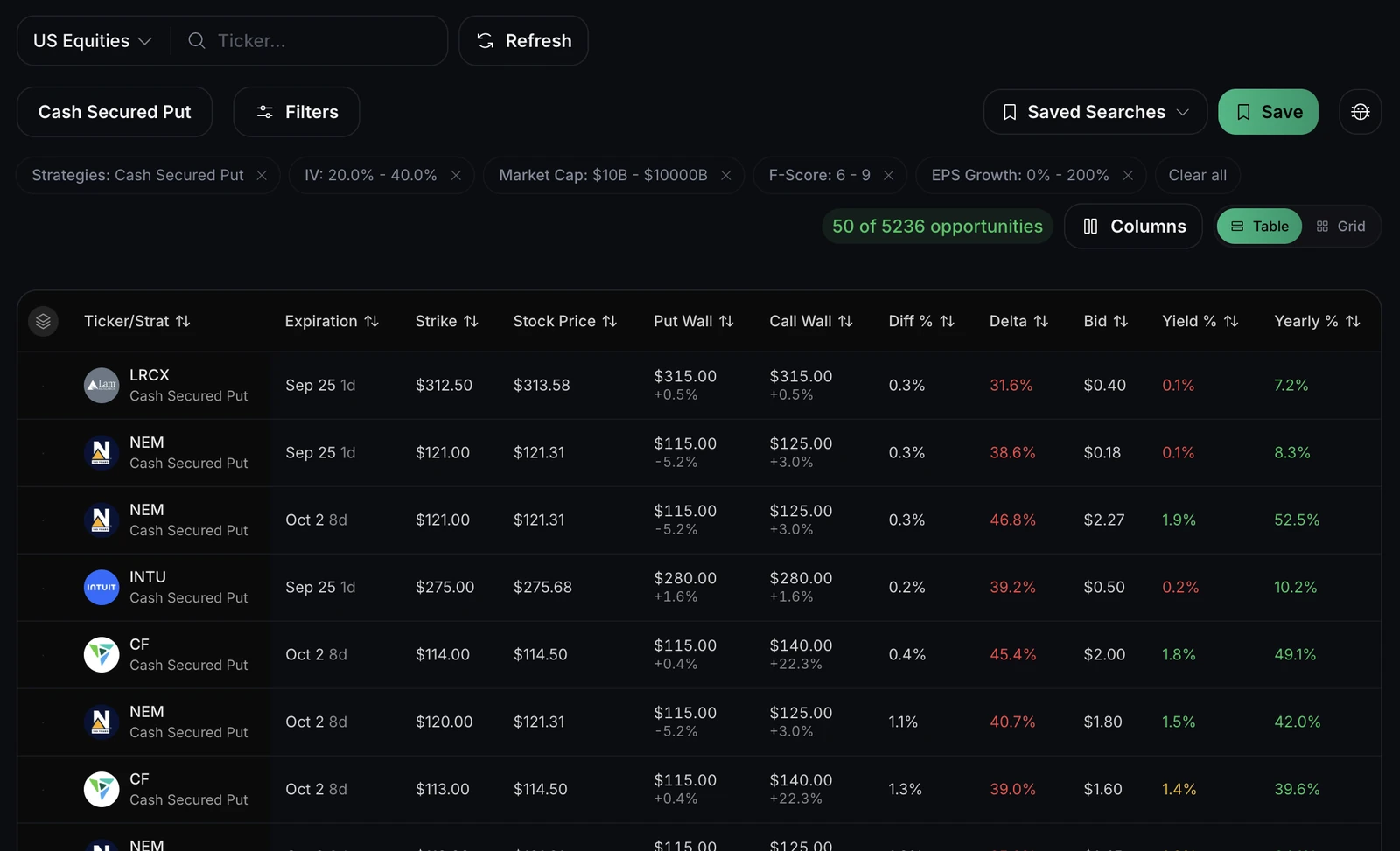
This means your stock selection process inverts traditional options trading logic. Instead of asking "which stock will generate the most premium," successful wheel traders ask "which stocks do I want to own that also generate attractive premium?"
This mindset shift transforms the wheel from gambling into investing with enhanced returns.
The wheel strategy consists of two phases: selling cash-secured put until assignment, then selling covered calls against your shares.
Your stock choice must work effectively in both phases. A stock might generate excellent put premium but terrible call premium, or vice versa. The best wheel strategy stocks excel in both scenarios.
The Premium vs. Risk Balance
Every wheel trader faces this tension: higher volatility generates more premium, but also increases assignment risk and potential losses. A stock with 60% implied volatility might let you collect $8 per share monthly on puts, while a 25% IV stock might only generate $3 per share. But when the high-IV stock drops 30% in a week, you're stuck with a massive unrealized loss and diminished premium going forward.
The optimal zone for most wheel traders sits between 20-40% implied volatility. This range generates meaningful premium while keeping downside risk manageable. Stocks below 20% IV often don't produce sufficient income to justify the capital allocation and opportunity cost. Stocks above 50% IV typically signal elevated risk that can overwhelm premium collection.
Exact Screener Filters for Wheel Stock Selection
| Filter | Conservative | Aggressive |
|---|---|---|
| Market Cap | > $10B | > $2B |
| Avg Daily Volume | > 1M shares | > 500K shares |
| Options Volume | > 1,000 contracts/day | > 500 contracts/day |
| IV Rank (IVR) | 20-50% | 30-70% |
| Bid-Ask Spread | < $0.10 ATM | < 5% of premium |
| Delta (for CSP) | 0.25-0.35 | 0.20-0.40 |
| DTE | 30-45 days | 21-45 days |
| Price Range | $30-$300 | $20-$500 |
| Debt/Equity | < 0.5 | < 1.5 |
| Free Cash Flow | Positive + growing | Positive |
You can apply some of these directly inside QuantWheel →
The 7 Critical Criteria for Best Wheel Strategy Stocks
1. Market Capitalization Above $10 Billion
Large-cap stocks provide the liquidity foundation that makes the wheel strategy practical. Companies with market caps below $10B often lack sufficient options volume, leading to wide bid-ask spreads that erode your returns. Every time you enter or exit a position, you pay the spread - and on small-cap stocks, this spread can consume 10-20% of your premium.
Large-cap stocks also demonstrate greater price stability. While they still experience volatility, they're less prone to the gap moves and manipulation that plague smaller companies. When you're selling puts with the intention of potentially owning shares, you want companies that trade on fundamentals rather than Twitter rumors or pump-and-dump schemes.
Market cap also correlates with information availability. Large companies have extensive analyst coverage, regular earnings calls, and transparent financial reporting. This information advantage helps you make informed decisions about strike selection and position management.
Liquidity matters more in the wheel strategy than almost any other approach. You're not making quick directional trades - you're establishing positions you might hold for weeks or months. When you need to roll a position, adjust a strike, or exit early, you need liquidity.
Stock volume of 1M+ shares daily typically ensures options liquidity as well. Check the options open interest and daily volume separately. Your target: at least 100+ open interest on the strikes you're considering, with daily options volume of 50+ contracts. This ensures you can enter and exit positions near mid-price without excessive slippage.
Volume consistency matters as much as absolute volume. A stock that trades 5M shares one day and 200K the next creates unpredictable execution. Look for consistent volume patterns that indicate stable institutional participation and retail interest.
3. Implied Volatility Between 20-40%
This IV range represents the "Goldilocks zone" for wheel traders. Below 20% IV, premium barely justifies the capital requirement and opportunity cost. You might collect $200 monthly on a $20,000 position - just 1% monthly return or 12% annualized, before accounting for assignment risk and potential losses.
Between 20-40% IV, you typically collect 1-3% monthly premium on cash-secured puts at reasonable deltas (0.30-0.40). This translates to 12-36% annualized returns if you avoid significant losses - attractive returns that can exceed broad market performance while generating regular income.
Above 40% IV, you enter elevated risk territory. Yes, the premium looks enticing. But high IV usually signals fundamental uncertainty, upcoming binary events (earnings, FDA decisions, litigation), or deteriorating business conditions. The premium compensates you for real risk, not free money.
Check 30-day implied volatility rank (IVR) and implied volatility percentile (IVP) to understand whether current IV is elevated or suppressed relative to the stock's history. Selling premium when IVR is above 50 generally offers better risk-adjusted returns than selling when IVR is below 30.
4. Strong Balance Sheet and Fundamentals
The wheel strategy transforms into a nightmare when you're assigned shares of a deteriorating business. Your "income strategy" becomes a value trap where each covered call generates diminishing returns as the stock bleeds lower month after month.
Evaluate these fundamental metrics before adding any stock to your wheel strategy watchlist:
Debt-to-equity ratio: Under 0.5 for conservative choices, under 1.0 maximum. High debt loads create bankruptcy risk and limit the company's flexibility during downturns.
Free cash flow: Positive and growing. Companies that generate cash can weather storms and return capital to shareholders. Negative free cash flow companies burn through resources and eventually need to raise capital through dilution.
Revenue growth: Stable or growing revenue indicates the business maintains relevance. Declining revenue signals competitive threats or obsolescence.
Profit margins: Industry-dependent, but expanding margins indicate competitive advantages while contracting margins suggest pricing pressure or rising costs.
Return on equity (ROE): Above 15% suggests efficient capital allocation. Below 10% raises questions about management effectiveness and competitive positioning.
You don't need to become a fundamental analysis expert, but you should understand the basic business model and financial health. If you can't explain what the company does and why it makes money, you shouldn't run the wheel on it.
5. Stocks You're Comfortable Owning Long-Term
This criterion seems obvious but gets violated constantly. Traders see attractive premium on a stock they'd never actually want to own, convince themselves "I won't get assigned," and then face the unpleasant reality of owning shares 15% underwater.
The wheel strategy works best when you have genuine conviction about the underlying business. If assignment happens, you should feel neutral or even pleased about owning shares at your net cost basis (strike price minus collected premium). This mindset transforms assignment from a problem into a planned outcome.
Ask yourself: "Would I be happy owning 100 shares of this company at my strike price for the next 6-12 months?" If the honest answer is no, don't sell the put. The premium isn't worth the stress and potential losses from holding a position you don't believe in.
This criterion naturally eliminates most meme stocks, penny stocks, and speculative plays from your wheel strategy universe. These might offer explosive premium, but they're explosive because the risk is real. Stick to businesses you understand and respect.
6. Tight Options Bid-Ask Spreads (Under 5%)
The bid-ask spread represents your cost of doing business in options trading. Every time you sell an option, you typically receive closer to the bid price. Every time you buy to close or roll, you pay closer to the ask price. These spreads compound over multiple transactions throughout the wheel cycle.
Calculate spread as a percentage: (Ask - Bid) / Mid-Price × 100. Target spreads under 5% of the option's mid-price. A $2.00 option should have a bid-ask spread under $0.10. If the spread is $1.80 bid / $2.20 ask, you're paying 10% in transaction costs - that's excessive and will substantially reduce your returns.
Wide spreads indicate low liquidity and market maker dominance. When you need to roll a position or exit early, you'll pay dearly. Tight spreads indicate competitive market making and sufficient volume to support efficient price discovery.
Check spreads during regular trading hours (9:30 AM - 4:00 PM ET). Spreads widen significantly during pre-market, after-hours, and the first/last 15 minutes of the trading day. If spreads are tight during normal hours, you can efficiently manage positions when needed.
7. Consistent Options Open Interest
Open interest indicates how many contracts exist at each strike price. Low open interest means few traders have established positions, suggesting limited liquidity and potentially difficulty closing or rolling your position.
Target at minimum 100+ open interest on strikes within 10% of the current price. Popular wheel stocks like major tech companies, financial institutions, and blue-chip industrials often show 1,000+ open interest across multiple strikes, providing excellent liquidity.
Check open interest across multiple expirations. Strong open interest in the current monthly cycle but empty further-dated expirations suggests the stock might not maintain options liquidity when you need to roll positions forward. The best wheel stocks show consistent open interest across 2-4 months of expirations.
Rising open interest over time indicates growing trader participation and improving liquidity. Declining open interest suggests fading interest and potentially deteriorating options markets that could make future position management difficult.
Stock Sectors That Work Well for Wheel Strategy
Certain sectors naturally align with wheel strategy characteristics better than others. Understanding sector dynamics helps you build a diversified wheel portfolio that generates consistent premium while managing risk.
Technology - Large Cap Leaders
Established technology companies often represent ideal wheel strategy candidates. Companies with mature business models, strong cash flow, and dominant market positions offer the stability needed for successful wheeling while maintaining enough volatility to generate attractive premium.
The key distinction: established tech leaders, not speculative growth. A profitable software company with recurring revenue trades very differently from a pre-revenue startup. Focus on companies that have proven their business model and generate consistent cash flow.
Technology stocks typically maintain higher implied volatility than defensive sectors, generating premium in the 20-35% IV range even during calm markets. This volatility reflects rapid innovation cycles and competitive dynamics rather than existential business risk.
Financials - Banks and Insurance
Major financial institutions can work well for wheel trading, particularly regional banks and insurance companies with strong balance sheets. These stocks typically trade with moderate volatility and pay dividends, creating dual income streams.
Be cautious during interest rate transition periods and regulatory changes. Financial stocks can experience sudden volatility spikes during banking crises or regulatory announcements. Size matters significantly in this sector - major money-center banks offer far better liquidity than regional players.
Financial stocks often trade at lower valuations (1-2x book value) compared to other sectors, providing a margin of safety when you get assigned. However, dividend considerations matter more in this sector when managing covered calls around ex-dividend dates.
Consumer Staples - Defensive and Stable
Consumer staples companies provide defensive characteristics and stable cash flows. These businesses sell products people need regardless of economic conditions - food, beverages, household products, personal care items.
The trade-off: lower volatility means lower premium. Consumer staples stocks often have implied volatility in the 15-25% range, at the lower end of the wheel-friendly spectrum. You collect less premium per position but experience fewer dramatic price swings.
These stocks work particularly well during uncertain markets or when you want to reduce portfolio volatility. They're unlikely to generate spectacular returns but also unlikely to create large losses, making them suitable for conservative wheel traders or as portfolio stabilizers.
Healthcare - Pharmaceuticals and Devices
Large pharmaceutical companies and medical device manufacturers can serve as solid wheel strategy stocks. Focus on diversified pharma companies with multiple revenue streams rather than biotech companies dependent on single drug candidates.
Healthcare stocks offer moderate volatility (25-35% IV typically) and often pay dividends. However, be aware of binary events like FDA decisions, patent cliffs, and clinical trial results that can create sudden price movements.
Avoid running the wheel through major announcements. The premium might look attractive before an FDA decision, but the risk of a gap move overwhelms the income potential. Healthcare stocks work best for wheel trading between major catalysts.
Industrial and Materials - Cyclical Considerations
Industrial companies and materials producers can generate solid premium during economic expansion but face cyclical challenges during slowdowns. These sectors require more active monitoring and willingness to adjust positions based on economic conditions.
The advantage: clear correlation with economic data. When GDP growth, manufacturing data, and infrastructure spending trend positively, these stocks offer attractive wheel trading opportunities. When economic indicators weaken, reduce exposure or tighten position management.
Many industrial stocks pay dividends and trade at reasonable valuations, providing some downside protection. However, cyclical sensitivity means you might face extended periods of reduced premium or underwater positions during recessions.
Stocks to Avoid for Wheel Strategy
Understanding what to avoid matters as much as knowing what to pursue. These stock categories consistently create problems for wheel traders:
Meme Stocks and Social Media Hype
Stocks driven by social media sentiment rather than fundamentals create unpredictable price action that overwhelms systematic premium collection. Yes, the IV is high. Yes, the premium looks incredible. But you're collecting premium on chaos, not on analyzable risk.
These stocks can gap 30-50% overnight on tweets, Reddit posts, or short squeeze dynamics. Your carefully selected strike price becomes meaningless when the stock gaps from $40 to $65 because someone posted a meme. The premium doesn't compensate for this tail risk.
Even if you get lucky and profit on a few cycles, you're gambling rather than trading systematically. Eventually, you'll get caught on the wrong side of a gap move that creates losses exceeding months of premium collection.
Biotech and Pre-Revenue Companies
Small biotech companies with pipeline-dependent valuations don't fit the wheel strategy framework. These businesses trade on binary outcomes - FDA approvals, clinical trial results, partnership announcements - rather than gradual fundamental progress.
A biotech stock might trade at $8 one day and $3 the next after a trial failure, or jump from $12 to $30 on an approval announcement. This isn't volatility you can harvest with the wheel strategy; it's event-driven risk that either wipes you out or gaps past your strikes.
If you want biotech exposure, stick to large diversified pharmaceutical companies with multiple revenue-generating drugs and deep pipelines. Single-asset biotech companies belong in venture-style portfolios, not wheel strategy portfolios.
Stocks Under $5 or Over $500
Very low-priced stocks (under $5) typically lack the institutional quality and liquidity needed for effective wheel trading. Many trade on pink sheets or have questionable fundamentals. Options spreads are typically terrible, and the companies often face delisting risk.
Very high-priced stocks (over $500) create capital concentration issues. Each contract requires $50,000+ in capital, limiting your ability to diversify. While some mega-cap tech stocks trade above $500 and have excellent liquidity, the capital requirement restricts accessibility for most wheel traders.
The sweet spot: $30-300 per share. This range allows reasonable diversification while maintaining position sizes large enough to generate meaningful premium. You can run the wheel on 5-10 different stocks without requiring $500,000+ in capital.
Stocks Experiencing Litigation or Regulatory Issues
Companies facing major lawsuits, regulatory investigations, or legal challenges carry headline risk that creates unpredictable volatility. The elevated premium reflects real risk of adverse outcomes that could devastate the stock price.
You might convince yourself you're getting "paid to wait" through the uncertainty. But when the headline hits - fraud charges, regulatory fines, criminal indictments - the stock can drop 40-60% immediately. Your months of premium collection vanish in a single gap down.
Even if the company ultimately wins the case, the stress and uncertainty aren't worth the modest premium advantage. Plenty of clean companies generate adequate premium without legal clouds hanging over them.
Stocks You Don't Understand
If you can't explain what the company does, how it makes money, and what risks it faces, don't run the wheel on it. Complexity creates blind spots where unexpected problems can emerge.
This doesn't mean you need an MBA or industry expertise. But you should understand the basic business model. "They sell software to hospitals" is sufficient understanding. "Something about blockchain and AI and fintech" is not.
When you understand the business, you make better decisions about strike selection, position sizing, and whether to hold through earnings or exit early. Ignorance leads to mistakes that cost more than the premium you collect.
How to Screen for Best Wheel Strategy Stocks
Building a watchlist of wheel-friendly stocks requires systematic screening rather than random selection. Start with quantitative filters, then apply qualitative judgment.
Step 1: Apply Quantitative Filters
Use your broker's screener or a third-party platform to filter for:
- Market cap: Minimum $10B
- Average volume: Minimum 1M shares daily
- Option volume: Minimum 500 contracts daily
- Implied volatility: 20-40% range
- Price range: $30-300 per share
This initial filter reduces thousands of stocks to a manageable list of 100-200 candidates that meet basic liquidity and volatility criteria.
Step 2: Check Options Liquidity
For each candidate, examine specific strikes you'd actually trade:
- Open interest at-the-money and nearby strikes
- Bid-ask spread as a percentage of option premium
- Multiple expiration cycles with adequate liquidity
- Consistent options volume over several weeks
Eliminate stocks with wide spreads (over 5%) or inconsistent liquidity. You need 30-50+ contracts to build your watchlist, so be selective.
Step 3: Fundamental Review
Research each remaining candidate's fundamentals:
- Read recent earnings call transcripts (key highlights)
- Check debt-to-equity, free cash flow, ROE
- Understand primary business model and revenue sources
- Identify upcoming catalysts (earnings, product launches)
- Review analyst sentiment and price target consensus
This step eliminates fundamentally weak companies and helps you understand what you might own if assigned. Budget 10-15 minutes per stock for basic research.
Step 4: Historical Price Action
Review 1-2 year price charts to understand the stock's behavior:
- Trading range and support/resistance levels
- Volatility patterns (stable vs. spiky)
- Dividend dates and typical price behavior
- Earnings reaction history (stable vs. volatile)
- Overall trend (upward, sideways, declining)
Historical behavior predicts future behavior more often than traders expect. A stock that gaps 10% on earnings consistently will likely continue that pattern. A stock that grinds steadily higher will likely continue grinding.
Step 5: Build Your Watchlist
Create a final watchlist of 20-30 stocks that pass all criteria. Diversify across sectors:
- 4-6 technology stocks
- 3-5 financial stocks
- 3-5 healthcare stocks
- 2-4 consumer staples
- 2-4 industrials
- 2-4 consumer discretionary
This diversification ensures you're not overexposed to single-sector risk. At any given time, you might run the wheel on 5-15 positions from this watchlist, rotating based on market conditions and individual opportunities.
Position Sizing and Portfolio Management
Identifying the best stocks is only half the equation. Proper position sizing and portfolio management determine whether you build wealth or create concentrated risk.
The 10% Rule
Never allocate more than 10% of your wheel strategy capital to a single position. If you're running the wheel with $100,000, no single position should require more than $10,000 in capital. This limits single-stock risk while allowing adequate diversification.
Some traders use a 5% rule for even more conservative positioning. The exact percentage depends on your risk tolerance, but exceeding 15% in any single position creates dangerous concentration.
Sector Diversification
Even if all your stocks meet individual criteria, clustering positions in a single sector creates correlation risk. If you're running the wheel on six different tech stocks, a sector-wide selloff impacts all positions simultaneously.
Target maximum 30-40% of your wheel portfolio in any single sector. This allows you to overweight sectors with attractive opportunities while maintaining diversification protection.
Managing Through Assignment
Assignment is not failure - it's part of the wheel strategy's natural cycle. When you get assigned on a put, you own shares at your strike price. Your real cost basis is strike price minus the put premium you collected.
After assignment, immediately evaluate:
- Is the stock still fundamentally sound?
- What covered call strikes are available?
- What premium can you collect on calls?
- Do you need to adjust position size?
Most wheel traders sell covered calls 30-45 days out at strikes 5-10% above their cost basis. This generates meaningful premium while allowing profit if the stock rallies.
If the stock has deteriorated fundamentally since assignment, consider selling immediately rather than forcing the covered call phase. Don't fall victim to sunk cost fallacy - exit bad positions and redeploy capital to better opportunities.
Rolling Positions
Rolling means buying back your current option and selling a new option at a different strike or expiration. Master this skill to maximize wheel strategy returns.
Roll up and out: Stock rallied, your put is far from being assigned. Buy back the put for minimal cost and sell a new put at a higher strike and further expiration to collect additional premium.
Roll down and out: Stock declined, your put is in danger of assignment. If you still want to own the stock, roll to a lower strike and further expiration to collect additional premium and delay assignment. If you don't want assignment, close the position for a loss.
Roll out: Stock hasn't moved much, your put is near breakeven. Roll to the same strike but further expiration to extend duration and collect additional premium.
Only roll when the net credit justifies the capital commitment. Rolling for $0.20 credit on a $5,000 position rarely makes sense - either accept assignment or close the position.
QuantWheel: Built for Wheel Strategy Position Management
Managing 5-15 wheel positions simultaneously creates complexity that spreadsheets struggle to handle. Which puts are still open? What's your real cost basis after assignment? How much total premium have you collected per position?
Here's where most traders struggle: calculating your actual cost basis after assignment. Your broker shows $185 per share, but your real basis is $176.80 after the $8.20 premium you collected on the put. For covered calls, you need to track this basis accurately to avoid selling calls below your breakeven.
QuantWheel automatically tracks your cost basis adjustments throughout the wheel cycle - put premium collected, assignment prices, call premium collected, and dividend adjustments. You see your real position P&L including all premium, not just the current stock price.
QuantWheel was built specifically for wheel strategy traders by traders who got tired of spreadsheet errors and manual tracking. When you manage multiple positions through assignment cycles, QuantWheel ensures you never lose track of your true cost basis or premium history.
$1 for 7 days • Cancel anytime • 14-day money-back guarantee
Advanced Stock Selection Strategies
Once you've mastered the basic criteria, these advanced approaches can enhance your stock selection process.
Using Implied Volatility Rank
Don't just look at absolute implied volatility - check implied volatility rank (IVR). IVR shows where current IV sits relative to the stock's 52-week IV range. IVR of 80 means current IV is in the 80th percentile of the past year.
Selling premium when IVR is elevated (above 50) typically produces better risk-adjusted returns than selling when IVR is low (below 30). High IVR means you're collecting above-average premium relative to the stock's normal volatility.
However, extremely high IVR (90+) often signals something wrong with the company. Investigate why volatility is so elevated before selling puts. Is it temporary uncertainty or fundamental deterioration?
Earnings Cycle Timing
Many wheel traders avoid holding positions through earnings announcements, closing positions before earnings and re-establishing after the announcement. This avoids earnings gap risk but sacrifices the elevated pre-earnings premium.
An alternative approach: run the wheel on stocks with historically stable earnings reactions. Some companies consistently beat estimates without dramatic price movements. These stocks let you collect elevated pre-earnings premium without excessive gap risk.
Review 8-12 quarters of earnings reactions before deciding whether to hold through announcements. If the stock typically moves less than 5% on earnings, holding through might make sense. If it regularly gaps 10%+, close before and reopen after.
Dividend Capture Considerations
Dividend-paying stocks add complexity to covered call management. When your call is in-the-money approaching ex-dividend date, early assignment becomes likely if the dividend exceeds the remaining extrinsic value in your call.
Some wheel traders specifically target dividend stocks to collect both option premium and dividends. Others avoid them to prevent early assignment complications. Neither approach is wrong - understand the trade-offs and manage accordingly.
If you run the wheel on dividend stocks, monitor extrinsic value as ex-dividend date approaches. If your call has less extrinsic value than the dividend amount, expect early assignment. You can close the call before ex-dividend to avoid this outcome.
Seasonal and Cyclical Patterns
Certain stocks and sectors exhibit seasonal patterns that affect option premium and stock performance. Retail stocks might show elevated volatility approaching holiday seasons. Energy stocks might react to summer driving season dynamics.
Understanding these patterns helps you time wheel strategy entry and exit. Establish positions when seasonal factors favor your trade structure. Reduce or exit positions when seasonal headwinds typically emerge.
This doesn't require complex modeling - simply observe 2-3 years of seasonal patterns and adjust your watchlist emphasis accordingly. Prioritize retail stocks in Q2-Q3 (before holiday uncertainty), reduce them in January (after holiday results).
Correlation Management
Portfolio-level correlation matters for wheel traders. Running the wheel on ten stocks that all move together doesn't provide true diversification. When they decline, all your positions suffer simultaneously.
Check correlation coefficients between your wheel positions. Target average correlation below 0.6 across your portfolio. Mix sectors, business models, and volatility profiles to achieve lower correlation.
Some wheel traders intentionally pair negatively correlated positions - for example, energy producers (benefit from high oil prices) and airlines (hurt by high fuel costs). This creates more stable aggregate premium collection through different market environments.
Common Mistakes in Stock Selection
Even experienced traders make these stock selection errors. Recognizing and avoiding them improves your wheel strategy results.
Chasing Premium
The biggest mistake: selecting stocks solely based on premium without considering risk. A stock offering $8 premium looks better than a stock offering $3 premium, but if the high-premium stock carries 3x the downside risk, you're not getting paid enough.
Always evaluate premium relative to risk. Calculate premium as a percentage of your capital at risk, then qualitatively assess whether that return compensates for the underlying volatility and downside potential.
If a stock offers 5% monthly premium but has 60% IV and questionable fundamentals, you're not getting a bargain - you're accepting elevated risk that might overwhelm your premium collection.
Ignoring Liquidity
Traders sometimes select stocks that barely meet minimum liquidity thresholds, thinking "it's good enough." Then when they need to roll a position or exit early, they discover the bid-ask spread consumes half their profit.
Never compromise on liquidity. The best premium opportunity is worthless if you can't efficiently enter and exit positions. Prioritize liquidity over slight premium differences.
Getting Assigned on Stocks You Don't Want to Own
This mistake reveals itself in your internal reaction to assignment. If your first thought is "oh no" rather than "okay, now I'll sell calls," you selected the wrong stock.
Assignment should feel neutral or even positive. You collected premium on the put, now you own shares at a discount to where the stock traded when you sold the put. If this outcome makes you uncomfortable, you violated the cardinal rule: only run the wheel on stocks you're willing to own.
Overcomplicating the Process
Some traders create elaborate models with 20+ criteria and complex weighting systems for stock selection. This complexity creates analysis paralysis and prevents you from actually trading.
The seven criteria in this guide provide sufficient framework. Use quantitative filters to narrow the universe, then apply qualitative judgment. Trust the process rather than seeking perfect precision.
The best stock for wheel strategy is one that meets the basic criteria and that you understand well enough to manage through assignment and market volatility. You don't need the theoretically optimal stock - you need good stocks you'll actually trade consistently.
Failing to Reassess Holdings
Stock quality changes over time. A company that fit your criteria perfectly last year might have deteriorated - declining cash flow, rising debt, management changes, competitive threats.
Review your wheel watchlist quarterly. Remove stocks that no longer meet your criteria. Add new candidates that have emerged. This ongoing curation prevents you from running the wheel on stocks that have become unsuitable.
If you're assigned shares of a company that's fundamentally weakening, don't stubbornly hold and sell calls while the stock bleeds lower. Exit the position and redeploy capital to better opportunities.
Building Your Personal Wheel Strategy Watchlist
Theory transforms into profits only through implementation. Use this step-by-step process to build your personal wheel strategy watchlist this week.
Day 1: Screen for Candidates Run quantitative screens for market cap, volume, price range, and implied volatility. Generate your initial list of 100-200 candidates that meet basic numerical criteria. Use your broker's screener or a free tool like Finviz or Yahoo Finance.
Day 2: Check Options Markets Review options chains for your candidates. Check bid-ask spreads, open interest, and options volume. Eliminate stocks with poor options liquidity. Target reducing your list to 50-75 stocks with good options characteristics.
Day 3: Fundamental Research Research 15-20 stocks per day from your remaining list. Read recent earnings summaries, check financial ratios, understand the business model. Eliminate fundamentally weak companies. After three days, you should have 30-40 candidates remaining.
Day 4: Chart Analysis Review price charts for your remaining candidates. Identify historical volatility patterns, earnings reactions, and trading ranges. Look for stocks with behavior patterns you understand and can work with. Narrow to your final 25-30 stock watchlist.
Day 5: Set Up Tracking Create a system to monitor your watchlist. This might be a spreadsheet, dedicated software like QuantWheel, or your broker's watchlist feature. Record current IV rank, upcoming earnings dates, and dividend schedules.
Ongoing: Weekly Review Spend 30 minutes weekly reviewing your watchlist. Check for upcoming earnings or dividends. Monitor IV rank to identify elevated premium opportunities. Remove stocks that no longer fit your criteria. Add new candidates as you discover them.
This systematic approach transforms abstract criteria into a concrete, actionable watchlist. You'll know exactly which stocks meet your standards and where current opportunities exist.
Conclusion: Quality Selection Drives Wheel Strategy Success
The best stocks for wheel strategy combine sufficient premium generation with manageable risk and strong underlying business quality. Your stock selection determines whether the wheel strategy generates consistent income or traps you in problematic positions that erase months of gains.
Focus on the seven critical criteria: adequate market cap and liquidity, moderate implied volatility in the 20-40% range, strong fundamentals, stocks you genuinely want to own, tight options spreads, and consistent open interest. These characteristics ensure you can efficiently enter and exit positions while collecting attractive premium on companies you'd be comfortable holding through assignment.
Avoid the temptation to chase extreme premium on questionable stocks. The wheel strategy works through consistent execution over time, not through spectacular wins on high-risk positions. Build a diversified watchlist of 20-30 high-quality stocks, then systematically run the wheel on 5-15 positions based on current market conditions and specific opportunities.
Remember that assignment isn't failure - it's part of the strategy's natural flow. Select stocks where assignment at your strike price (minus collected premium) represents a acceptable outcome. When you eliminate the fear of assignment, you can select strikes and manage positions more effectively.
The wheel strategy succeeds through discipline, systematic stock selection, and proper position management. Master the stock selection framework in this guide, build your personal watchlist, and implement the strategy consistently. Over time, you'll develop intuition for which stocks work well in the wheel framework and which create more problems than they're worth.
$1 for 7 days • Cancel anytime • 14-day money-back guarantee
Risk Disclosure
Options trading involves substantial risk and is not suitable for all investors. Past performance does not guarantee future results. This content is for educational purposes only and should not be considered investment advice. The examples used in this article are for educational purposes only and are not recommendations to buy or sell any security. Always do your own research and consider consulting with a financial advisor before making investment decisions.
The wheel strategy can result in significant losses, including loss of your entire investment. You may be assigned shares at prices above current market value, and the premium collected may not offset losses from declining stock prices. Never invest capital you cannot afford to lose.