
In this guide I go deeper into rolling options and cover what most people learn the hard way or unfortunately "click with" later on. This guide is written from my own experience and from what I've seen happen to other traders. Author: David Romic - retail options trader and active member in the options trading communities on Reddit (u/thedavidromic). I share wheel strategy setups, trade management, and lessons learned from real positions.
TLDR: Rolling Options Explained (The Essentials)
- Track your real breakeven - Subtract every rolled loss from the new premium to know your true cost, not just what the new position shows.
- Wait for extrinsic to drain before rolling - Don't roll just because the trade is going against you; wait until there's almost no extrinsic value left in the option first.
- Rolling for credit ≠ adding risk - Unlike doubling down on a stock, rolling for a net credit actually lowers your breakeven without committing more capital.
- Split the decision in two - Ask "would I close this?" and "would I open a fresh position on this ticker right now?" separately; if the answer to the second is no, don't roll.
- Tied-up capital is a real cost - A $50 roll credit on $10k locked for 45 more days may be worse than closing and redeploying that capital elsewhere.
- Rolling deep ITM ≈ taking assignment - The P&L is nearly identical, so choose whichever one you'd be more comfortable explaining to yourself as a fresh decision.
- Rolling has a tax use case - Rolling a CC out instead of getting called away can defer a big taxable gain on long-term appreciated shares; this alone is sometimes worth the roll.
- Only roll mean-reverting tickers - Rolling assumes the stock will recover; on a fundamentally broken company, you're just buying more time to be wrong.
When NOT to roll: The stock fundamentals have changed negatively, you're chasing a losing position with no plan, or the credit you'd receive doesn't justify the additional time commitment.
Key insight: Rolling gives you more time and potentially better positioning, but every roll is a new trade that should meet your original criteria for entering the position.
Rolling a Covered Call trade example
Position: $UMAC with strike price $17.5, stock currently at $18.59. Situation: Stock ran up to $20 and then fell to $18.59. I'm looking to roll as late as possible, since this wasn't a news-driven run-up.
Outcome: I picked the first recommended roll. NEW (Rolled) position: $21 strike with 35 DTE, giving me 20% more upside and costing me $0 to do this roll.
That's the perfect roll - executed at the correct time and with the right reason.
Get help with your own rolls →
Here are 3 possible types of rolls in case you didn't know, this trade example represents the "Rolling out" (time extension) type of roll. You can read more about it below.
The Three Types of Rolls
Rolling Out (Time Extension):
- Same strike price, later expiration date
- Example: $50 put expiring Friday → $50 put expiring next month
- Most common roll for slightly losing positions
- Usually results in net credit
Rolling Up or Down (Strike Adjustment):
- Different strike price, same or different expiration
- Up: Higher strike for calls, Down: Lower strike for puts
- Example: $50 put → $48 put (both same expiration)
- Reduces risk but may require paying debit
Rolling Out and Up/Down (Combined):
- Both strike and expiration change
- Example: $50 put Friday → $48 put next month
- Most flexible, can optimize for credit and safety
- Standard approach for wheel strategy management
Net Credit vs Net Debit Rolls
When you roll, you're paying to close one option and receiving premium for opening another. The difference determines your net result:
Net Credit Roll:
- New option premium > Current option cost
- Example: Close for $2.50, Open for $3.00 = $0.50 credit
- You receive additional money
- Preferred for wheel strategy traders
Net Debit Roll:
- Current option cost > New option premium
- Example: Close for $3.00, Open for $2.50 = $0.50 debit
- You pay money to execute
- Sometimes acceptable if strike improvement is significant
Most wheel strategy traders target net credit rolls whenever possible to maintain their premium collection approach.
When Should You Roll Options?
Rolling is a tool, not a default action. Here are the specific scenarios when rolling makes strategic sense:
Scenario 1: Managing Losing Positions (20-50% Down)
When: Your option is in-the-money with 7-21 days until expiration, and you're down 20-50% on the position.
Why roll: You still believe in the stock long-term and want more time for it to move back in your favor. You're not ready to accept assignment yet.
Example:
- Sold $100 put on AAPL for $2.00 premium
- Stock dropped to $97, put now worth $3.50 (down $150, or 75%)
- 14 days until expiration
- You could roll to next month's $100 put for $4.50
- Net credit: $1.00 ($4.50 received - $3.50 paid)
- Decision: Roll if you still want AAPL at $100 and believe it will recover
Red flags:
- Stock fundamentals have changed (earnings miss, guidance cut)
- You're just avoiding loss without conviction in recovery
- This would be your 3rd+ roll on the same position
Scenario 2: Capturing Early Profit (50%+ Gain, 21+ DTE)
When: Your option has gained 50%+ of maximum profit with more than 21 days until expiration.
Why roll: You can lock in most of the profit and immediately reopen a new position to keep working capital active.
Example:
- Sold $50 put for $2.00 (max profit: $200)
- Stock stable at $53, put now worth $0.80 (profit: $120, or 60%)
- 28 days still remaining
- You could close for $0.80 and sell next month's $50 put for $2.20
- Net credit: $1.40 additional premium
- Decision: Roll to capture the gain and reopen fresh position
This is technically closing and reopening rather than a defensive roll, but many traders think of it as "rolling for profit."
Scenario 3: Strike Adjustment Before Expiration
When: Your option is slightly in-the-money near expiration, and you'd prefer to own the stock at a better (lower for puts, higher for calls) price.
Why roll: You're willing to accept assignment but would prefer a more favorable strike price.
Example:
- Sold $100 put, stock at $98 with 3 days until expiration
- Likely to be assigned at $100
- You could roll to next month's $95 put for net credit
- Decision: Roll if you'd be happier owning at $95 instead of $100
Scenario 4: Earnings or Event Management
When: You have a position open through earnings or another major event, and you want to avoid the volatility spike.
Why roll: High implied volatility before events can make rolls expensive, but avoiding the binary event risk may be worth it.
Example:
- $50 put on XYZ expiring during earnings week
- Stock stable but earnings could cause 10%+ move either direction
- Roll to week after earnings to avoid binary event
- May require small debit but reduces risk
- Decision: Roll if event risk is too high for your comfort
When NOT to Roll Options
Rolling isn't always the answer. Here's when you should close the position instead of rolling:
Don't Roll If the Stock Is Broken
If company fundamentals have deteriorated - earnings miss, guidance cut, management changes, industry headwinds - don't roll just to avoid a loss. Take the loss and move on.
Example: You have puts on a retail stock. The company reports terrible earnings, cuts guidance by 40%, and announces store closures. Don't roll hoping for a bounce. Close the position and accept the loss.
Don't Roll More Than 2-3 Times on Same Position
Each roll is a new decision to enter that trade. If you've rolled the same position multiple times, you're likely in denial about a losing trade.
Rule of thumb: After 2-3 rolls, either accept assignment or close entirely. Don't keep "rolling down and out" hoping for recovery.
Don't Roll When Credit Received Is Too Low
If the additional premium you'd collect is minimal compared to the additional time commitment, the roll probably isn't worth it.
Example: Rolling would give you $0.25 credit for another 30 days of exposure. Your capital could earn better returns in a new position elsewhere.
Don't Roll If You No Longer Want the Position
If you've changed your mind about wanting to own this stock (for puts) or cap your gains (for calls), close the position instead of rolling. Don't roll out of habit.
How to Calculate if a Roll Makes Sense
Rolling decisions shouldn't be emotional. Here's a systematic framework for evaluating whether to roll:
Step 1: Calculate Net Credit or Debit
Formula:
- Net Credit = Premium Received on New Option - Cost to Close Current Option
- Aim for net credit when possible
Example:
- Current put worth $3.50 (cost to close)
- New put premium $4.00 (received)
- Net credit: $0.50 per share, or $50 per contract
Step 2: Calculate Time Added
How many additional days are you committing?
- Current option: 12 DTE
- New option: 45 DTE
- Additional time: 33 days
Step 3: Calculate Daily Return on New Position
Formula:
- Daily Return = (Net Credit ÷ Strike Price) ÷ Days Added
- Annualize: Daily Return × 365
Example:
- Net credit: $50
- Strike price: $50
- Days added: 33
- Daily return: ($50 ÷ $5,000) ÷ 33 = 0.03% per day
- Annualized: 11% (0.03% × 365)
Step 4: Compare to Original Trade
Is this rolled position as attractive as your original trade?
- Original trade: Sold $50 put for $2.00 with 45 DTE = 32% annualized
- Rolled trade: Net $0.50 credit for 33 days = 11% annualized
In this example, the roll is less attractive than the original trade. You'd need to decide if the additional 11% is worth maintaining the position versus closing and finding a better opportunity.
Step 5: Consider Opportunity Cost
What else could you do with this capital?
- Other stocks offering better premium?
- Higher conviction trades available?
- Would you enter this exact rolled position fresh today?
The last question is critical: If you had cash sitting on the sidelines today, would you enter this rolled position as a new trade? If not, you probably shouldn't roll.
Rolling Options Mechanics: Step-by-Step
Here's how to actually execute a roll with your broker:
Step 1: Evaluate Your Current Position
Before rolling, know exactly what you're working with:
- Current option details (strike, expiration, quantity)
- Current option price (mid-point of bid/ask)
- Your P&L on the position
- Days until expiration
- Stock's current price and why it moved
Step 2: Choose Your New Option
Decide on your roll parameters:
Expiration Selection:
- Next week: Short-term adjustment
- Next month: Standard roll for time extension
- 45+ days: Aggressive time extension, maximum credit
Strike Selection:
- Same strike: Pure time extension
- Better strike (lower for puts): Reduces risk, may cost debit
- Worse strike (higher for puts): Increases risk, increases credit
Credit Target:
- Ideally net credit on the roll
- If paying debit, strike improvement should be significant
- Calculate if new trade meets your return requirements
Step 3: Find the Roll Option on Your Platform
Most brokers have a dedicated "Roll" function:
ThinkorSwim:
- Right-click on position → "Create rolling order"
- Select new expiration and strike
- Review net credit/debit
Robinhood:
- Tap on option position
- Select "Roll"
- Choose new expiration and strike
- Review cost/credit
Fidelity:
- Select position → "Roll position"
- Choose parameters
- Review order
E*TRADE:
- Right-click position → "Roll"
- Select new option parameters
- Verify pricing
Step 4: Check Bid/Ask Spread
Rolling involves two transactions, so the spread matters twice:
- Spread to close current option
- Spread to open new option
Tip: Use limit orders on the net credit/debit rather than market orders. This ensures you get the specific credit you calculated.
Step 5: Execute the Roll
Place your order:
- Most platforms default to limit order at mid-point
- Adjust limit price if needed (better credit, faster fill)
- Confirm you're getting expected net credit/debit
- Submit order
Note: The roll executes as one transaction. You won't have a period where you're "in between" positions.
Step 6: Verify and Track
After execution:
- Confirm both legs filled
- Check new position details
- Update your tracking system with new cost basis
- Set alerts for the new expiration and strike
This is where manual tracking becomes tedious. After getting assigned at $50, collecting premium from covered calls, then rolling, your actual cost basis becomes complicated. Many wheel traders struggle to calculate their real breakeven after multiple rolls and assignments.
Rolling Strategies for Wheel Traders
Here are specific rolling strategies optimized for the wheel strategy:
The Conservative Roll (My Standard Approach)
When: Position down 20-30%, 14-21 DTE remaining
Strategy:
- Roll out one expiration cycle (usually 30-45 days)
- Keep same strike price
- Target 0.25-0.50 credit per contract minimum
- Maximum 2 rolls per position before accepting assignment
Example:
- Sold $100 put, stock at $96, 14 DTE
- Roll to next month's $100 put
- Collect $0.50 additional credit
- If doesn't work out after 2nd roll, accept assignment at $100
This approach gives positions time to recover while maintaining premium collection, but doesn't chase losers indefinitely.
The Aggressive Roll (Higher Risk, Higher Credit)
When: Position significantly ITM, willing to own at current level
Strategy:
- Roll out 45-60 days
- Consider slightly higher strike (for puts) to increase credit
- Target 0.75-1.00+ credit per contract
- Willing to accept assignment if it doesn't recover
Example:
- Sold $50 put, stock dropped to $45, 7 DTE
- Roll to 45 DTE $52 put (higher strike, worse risk)
- Collect $2.00 credit (your breakeven improves to $50)
- Higher credit but increased assignment risk
This works when you'd happily own the stock at current levels and want maximum premium.
The Defensive Roll (Reduce Risk)
When: Position against you, want to lower assignment risk
Strategy:
- Roll out AND down (for puts) or up (for calls)
- Accept smaller credit or even small debit
- Prioritize risk reduction over credit maximization
- Usually final roll before closing entirely
Example:
- Sold $50 put, stock at $46, 10 DTE
- Roll to next month's $47 put (safer strike)
- Net credit only $0.20, but reduces your assignment risk
- If this doesn't work, likely close position
This is for positions where you're losing conviction but willing to give them one more chance at a safer strike.
The Early Profit Roll (Offensive)
When: Position up 50%+, 21+ DTE remaining
Strategy:
- Close current position for profit
- Immediately reopen similar position next cycle
- Essentially "resetting" the trade
- Compounds smaller wins rather than holding for max profit
Example:
- Sold $50 put for $2.00, stock at $54, put now worth $0.60
- Close for $140 profit (70% of max profit)
- Sell next cycle's $50 put for $2.20
- Lock in $140 + have new $220 position working
This is technically closing and reopening, but I consider it a "profit roll" - it keeps capital constantly working.
Common Rolling Mistakes (And How to Avoid Them)
Mistake 1: Rolling Without a Plan
The Problem: Rolling reflexively when positions go ITM without considering if it's the right move.
The Fix: Before every roll, ask: "If I had cash right now, would I enter this rolled position as a new trade?" If no, don't roll.
Mistake 2: Rolling Too Early
The Problem: Rolling at first sign of trouble (5-10% down) wastes the option's time value.
The Fix: Wait until position is 20%+ down or within 7-21 DTE. Earlier rolls give up too much extrinsic value.
Mistake 3: Rolling Forever ("Rolling to Zero")
The Problem: Rolling the same losing position 5-6 times, turning a small loss into a large one.
The Fix: Set a rule: maximum 2-3 rolls per position. After that, accept assignment or close entirely.
Mistake 4: Accepting Terrible Credits
The Problem: Rolling for $0.10-0.15 credit on a $50 strike ($20-30 total) for 30+ days of additional risk.
The Fix: Calculate annualized return. If it's below 10-15%, the roll probably isn't worth it. Close and find better opportunities.
Mistake 5: Ignoring the Stock's Story
The Problem: Rolling mechanically without considering why the stock moved against you.
The Fix: Before rolling, review:
- Why did stock move? (company-specific or market-wide)
- Has the fundamental thesis changed?
- Do I still want to own this at the strike?
- Are there better opportunities elsewhere?
Mistake 6: Not Tracking Real Cost Basis
The Problem: After multiple rolls, assignment, and covered calls, losing track of your actual cost basis and breakeven.
The Fix: Track every premium collected through the full cycle. Your real cost basis = Strike Price - All Premium Collected. This becomes complicated fast, which is why many wheel traders eventually use automated tracking.
Advanced Rolling Concepts
Rolling into Different Strategies
You're not limited to rolling within the same strategy:
Put to Covered Call: Instead of rolling your ITM put, accept assignment and immediately sell covered calls against the stock position. This converts your put into a covered call and begins the second half of the wheel.
Call to Strangle: If your covered call is ITM and you don't want to cap gains, you could roll to a higher strike and simultaneously sell a put at a lower strike, creating a short strangle. More advanced but increases premium.
The "Roll and Reduce" Technique
When rolling losing positions, some traders reduce position size:
Example:
- Currently have 5 contracts of $50 puts, down 40%
- Roll only 3 contracts to next month
- Close 2 contracts for loss
This lets you maintain some exposure while reducing risk and freeing capital for better opportunities.
Using Roll Debit Strategically
Most wheel traders avoid roll debits, but they can make sense when:
Scenario 1: Strike improvement is significant
- Pay $0.50 debit to roll from $50 put down to $47 put
- Reduces your risk substantially
- Worth the cost if you still want the position
Scenario 2: Time extension during recovery
- Stock improving but need more time to get back OTM
- Pay small debit for substantial time extension
- Better than closing for large loss if thesis intact
Rolling Options: Quick Decision Framework
When your option needs attention, use this framework:
Question 1: Do I still want this position?
- No → Close it, take the loss/profit, move on
- Yes → Continue to Question 2
Question 2: Is the stock fundamentally sound?
- No → Close position, fundamentals matter most
- Yes → Continue to Question 3
Question 3: How many times have I rolled this position?
- 2+ times → Close position, stop chasing
- 0-1 times → Continue to Question 4
Question 4: Can I get reasonable credit?
- No (< $0.25 per contract) → Close position, not worth it
- Yes → Continue to Question 5
Question 5: Would I enter this rolled position fresh today?
- No → Close position, opportunity cost too high
- Yes → Execute the roll
This framework prevents emotional rolling decisions and keeps you focused on making good trades.
Tools and Calculators for Rolling Decisions
Manual Calculation Method
Track in spreadsheet:
Position Details:
- Current Strike: $50
- Current Expiration: 12 DTE
- Current Option Price: $3.50
- Original Premium: $2.00
- Current P&L: -$150

Roll Analysis:
- New Strike: $50
- New Expiration: 45 DTE
- New Option Premium: $4.00
- Net Credit: $0.50 ($50 per contract)
- Days Added: 33
- Annualized Return: ($50/$5,000)/33*365 = 11%

Decision: ROLL / CLOSE
Broker Tools
Most brokers show roll options:
- ThinkorSwim: "Analyze" tab shows all roll possibilities
- TastyWorks: "Roll" function with credit/debit calculator
- Interactive Brokers: Option Lab for roll analysis
QuantWheel Roll Assistant
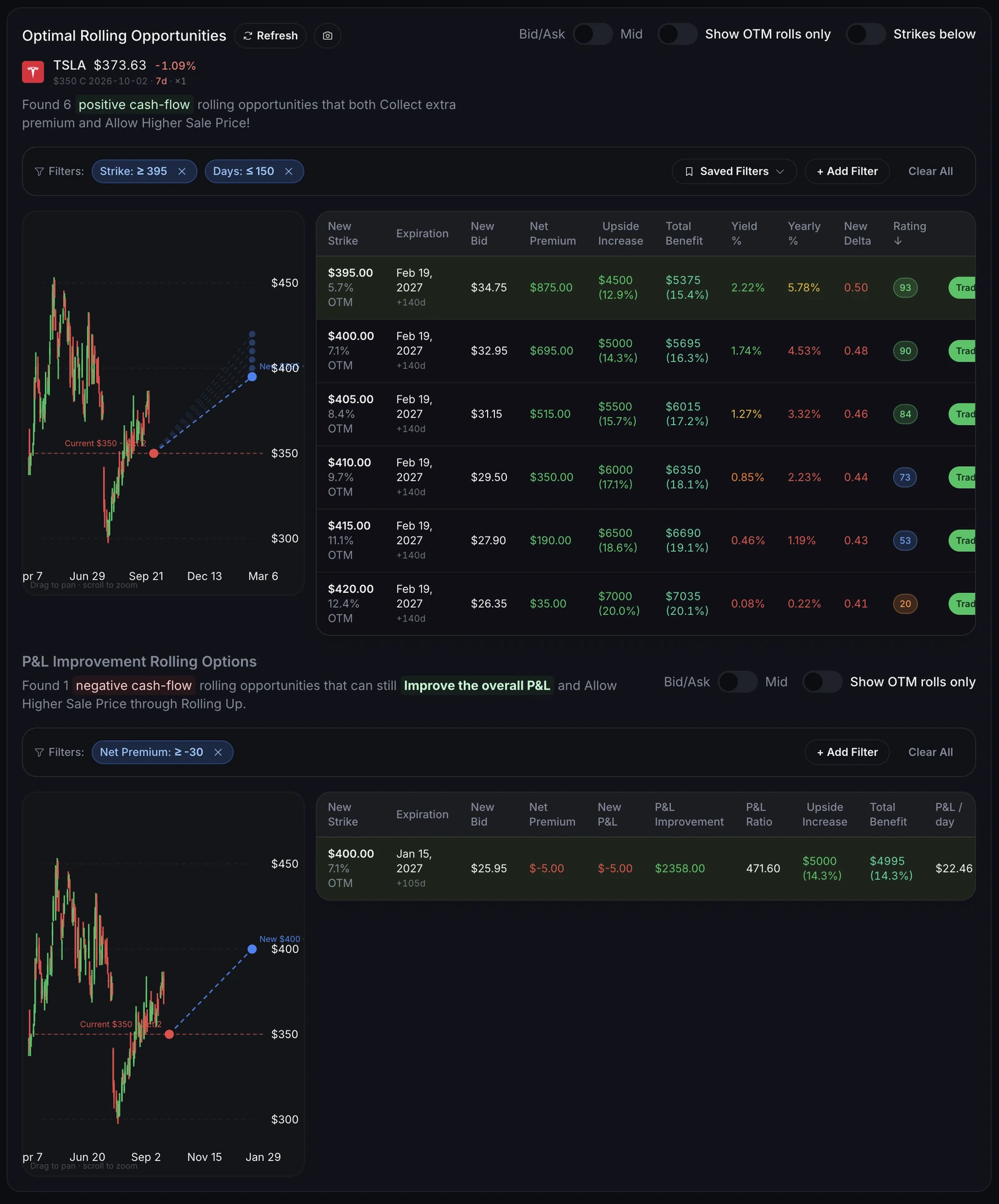
When deciding whether to roll, I use QuantWheel's Roll Assistant. It analyzes every possible strike and expiration combination, calculates the net credit/debit for each, shows the annualized return, and recommends the optimal roll based on your criteria (maximize credit, minimize risk, or balance both).
Instead of spending 20 minutes manually comparing 15 different roll options and calculating returns for each, the Roll Assistant shows all possibilities ranked in seconds. It's particularly helpful when managing 10+ positions since you can quickly evaluate which positions are worth rolling and which should be closed.
$1 for 7 days • Cancel anytime • 14-day money-back guarantee
Key Takeaways: Rolling Options Explained
Rolling options closes your current option and opens a new one with different parameters (expiration, strike, or both). You receive net credit or pay net debit based on the difference.
Roll when:
- Position is down 20-50% with 7-21 DTE
- You still believe in the stock fundamentally
- You can get reasonable credit (0.25+ per contract)
- You haven't rolled this position 2+ times already
- You'd enter this rolled position as a fresh trade today
Don't roll when:
- Stock fundamentals have deteriorated
- You've already rolled 2-3 times
- Credit received is minimal (<0.25)
- You're avoiding a loss without conviction
- You wouldn't enter this position fresh today
Calculate rolls systematically:
- Net credit/debit amount
- Time extension in days
- Annualized return on new position
- Comparison to other opportunities
- Opportunity cost of capital
Remember: Every roll is a new trading decision. Don't roll out of habit or to avoid facing losses. Roll when the rolled position meets your criteria for entering new trades.
For wheel strategy traders, rolling is a powerful tool for managing positions through temporary setbacks. Used strategically, it extends profitable positions and gives time for recovery. Used poorly, it turns small losses into large ones through endless "roll and hope."
The key is having a systematic framework for when to roll and when to close, then sticking to it.
Risk Disclosure: Options trading involves substantial risk and is not suitable for all investors. Rolling options extends your exposure to the underlying security and can increase losses if the position continues to move against you. Past performance does not guarantee future results. This content is for educational purposes only and should not be considered investment advice. Always do your own research and consider consulting with a financial advisor before making investment decisions.
The examples used in this article are for educational purposes only and are not recommendations to buy or sell any security. All investment decisions should be based on your own analysis and risk tolerance.