
Author: David Romic - retail options trader and active member in the options trading communities on Reddit (u/thedavidromic). I share wheel strategy setups, trade management, and lessons learned from real positions.
Done incorrectly, rolling can lock you into bad positions, pile up losses, and turn manageable trades into disasters. This guide will teach you exactly when to roll, how to roll, and most importantly, how to know if a roll is actually worth it.
Worthwhile related reads to come back to after the reading: Complete guide to executing the wheel strategy -> Wheel Strategy: Complete Options Income Guide Learn how to choose the right strike price when rolling -> How to Choose the Right Strike Price for Wheel Strategy Calculate your optimal roll strategy instantly -> Free Optimal Roll Calculator Common options rolling and assignment mistakes -> The 7 Biggest Wheel Strategy Mistakes
TL;DR: Rolling Options in the Wheel Strategy
Rolling options means closing your current option contract and simultaneously opening a new option contract with a different expiration date, strike price, or both. Think of it as "kicking the can down the road" while collecting more premium.
Why wheel traders roll: Instead of taking an unwanted assignment or closing at a loss, you extend your position's timeline and collect additional premium. This gives your trade more time to work out.
Simple example: You sold a $50 put on XYZ stock and collected $2.00 premium. The stock dropped to $47, and your option is now worth $3.50 (you're down $1.50). With expiration approaching, you have three choices:
- Take assignment - Buy 100 shares at $50 (while stock trades at $47)
- Close for a loss - Buy-to-close at $3.50, locking in a $1.50 loss
- Roll the option - Close the $50 put (costing $3.50) and open a new $47 put 30 days out (collecting $2.50), for a net cost of $1.00
By rolling, you've moved your strike from $50 to $47 (better for you), extended your time by 30 days, and only spent $1.00 compared to the $1.50 loss from closing. If the stock recovers, you keep all the premium. If it stays flat, you've still improved your position.
Key rules for rolling in the wheel:
- Roll for a credit when possible (you receive money, not pay it)
- Roll when ITM approaching expiration (5-7 days out)
- Roll to strikes you'd accept if assigned at the new strike
- Calculate the roll before executing (is it actually better?)
- Don't roll forever - sometimes taking assignment or closing is the right move
Bottom line: Rolling is a tool to manage positions when the original trade isn't working out as planned, but you still believe in the stock and want to stay in the trade while collecting more premium.
What Does "Rolling Options" Actually Mean?
Rolling an option is a two-step transaction executed simultaneously:
Step 1: Close your current position (buy-to-close) You buy back the option you originally sold, removing your obligation.
Step 2: Open a new position (sell-to-open) You immediately sell a new option, creating a new obligation with different terms.
The key word is "simultaneously." Most brokers allow you to execute both legs as a single order, which means:
- You see the net credit or debit before executing
- You avoid timing risk between closing and opening
- Your broker can route it as a spread for better pricing
Also, keep in mind that rolling costs: Commissions and bid-ask spreads
The Three Types of Rolls
1. Rolling Out (Extending Time)
- Keep the same strike price
- Move to a later expiration date
- Collects additional premium from time value
- Example: $50 put expiring Friday → $50 put expiring in 30 days
2. Rolling Out and Down (Puts) / Rolling Out and Up (Calls)
- Change the strike price in your favor
- Move to a later expiration date
- Most common in the wheel strategy
- Example: $50 put → $47 put 30 days out
- Example: $50 call → $52 call 30 days out
3. Rolling Out and Up (Puts) / Rolling Out and Down (Calls)
- Change the strike price against your favor
- Move to a later expiration date
- Used when you need more premium or better probability
- Example: $47 put → $50 put 30 days out (more premium but higher assignment risk)
- Example: $52 call → $50 call 30 days out (more premium but lower exit price)
If you’re ready to exit the position or stock is called away, accept the assignment.
Find out more about that here: FINRA: Options Trading Rules and Risks
Net Credit vs Net Debit
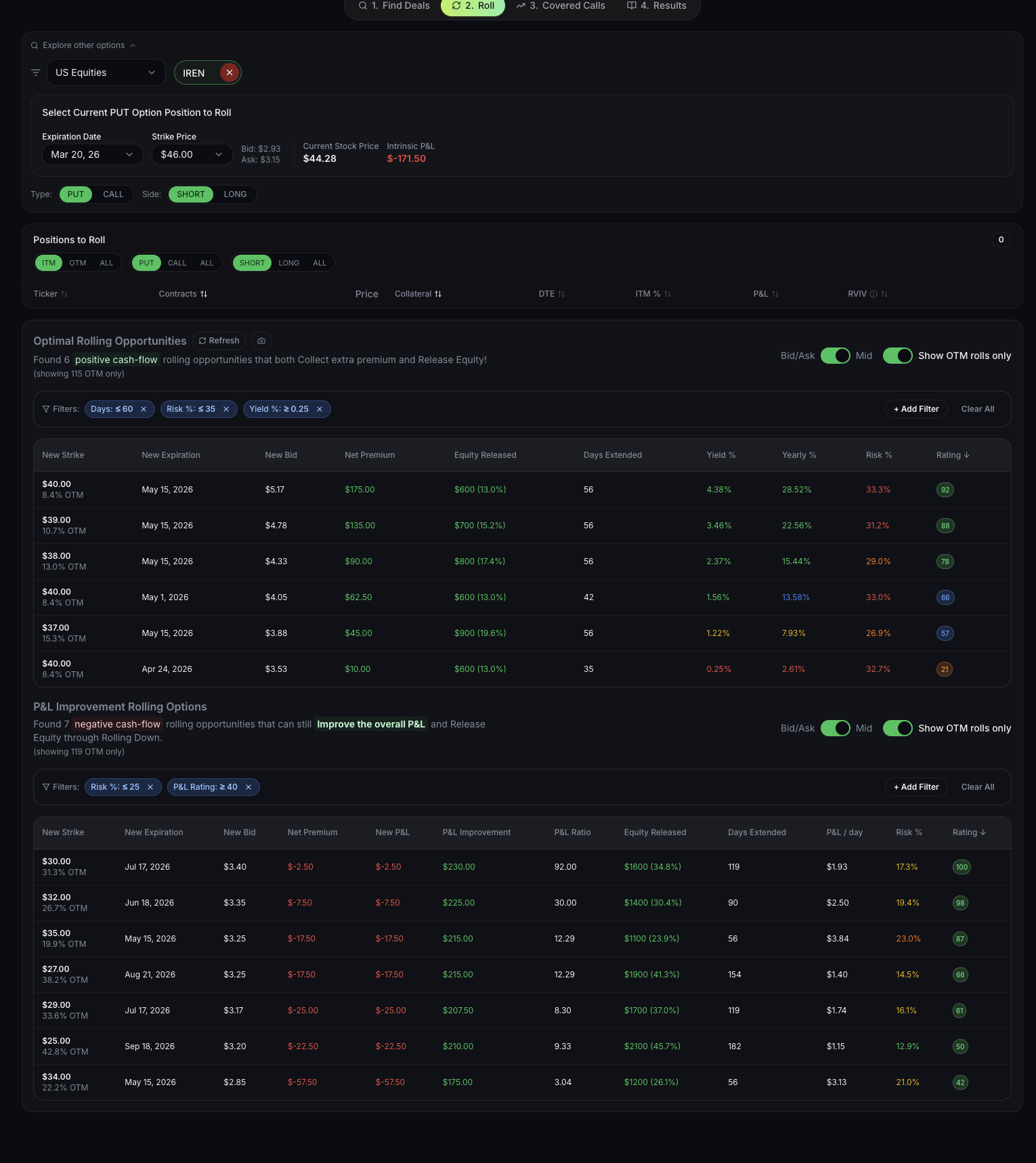
Example trade from picture: IREN CSP roll - 3DTE until expiration, currently down 3.8% (3.8% ITM)
What's the difference between net credit and net debit? When you roll, you'll either:
Receive a net credit (money goes into your account)
- The premium from the new option > cost to close the old option
- This is the ideal scenario for wheel traders
- Example: Close $50 put for $3.50, open $47 put for $2.50 = net debit of $1.00... but if you roll to $48 put for $4.00 = net credit of $0.50
Pay a net debit (money goes out of your account)
- The premium from the new option < cost to close the old option
- Sometimes acceptable if small (< $0.20) and improves position significantly
- Example: Close $50 call for $1.50, open $52 call 30 days out for $1.30 = $0.20 debit
Advice: Only roll a losing position if you can do so for a net credit AND your original thesis on the stock remains intact
When Should You Roll Your Options?
The decision to roll comes down to three questions:
- Do I want to avoid assignment?
- Can I improve my position by rolling?
- Does rolling align with my overall trade thesis?
Let's break down the specific scenarios where rolling makes sense.
Scenario 1: ITM Cash-Secured Puts (Don't Want Assignment)
Situation: Your put is in-the-money, expiration is approaching (5-7 days), and you don't want to own the stock at this price.
Why roll: Taking assignment would tie up capital in a losing stock position. Rolling gives you more time for the stock to recover while collecting additional premium.
When to roll:
- Stock is below your strike price
- Less than 7 days to expiration
- You can roll for a net credit
- The new strike is at a price you'd accept
Example:
- Sold $100 put on AMD, collected $3.00
- AMD now trading at $95
- 5 days to expiration, put worth $5.50
- Roll to $95 put 30 days out for $4.00
- Net debit: $1.50 ($5.50 - $4.00)
- This improves your position: $95 strike vs $100, more time, only $1.50 cost vs $5.50 loss
Decision rule: "If ITM with 7 DTE and I can roll down/out for less than my original credit, I roll."
Scenario 2: ITM Covered Calls (Don't Want to Sell Stock Yet)
Situation: Your call is in-the-money, stock has rallied above your strike, and you want to keep holding the stock.
Why roll: Assignment would force you to sell your shares. Rolling up and out lets you keep the shares while collecting more premium.
When to roll:
- Stock is above your call strike
- Less than 7 days to expiration
- Stock has more upside potential
- You can roll up and out for a credit
Example:
- Own 100 shares of NVDA at $90 cost basis
- Sold $95 covered call, collected $2.00
- NVDA now at $102
- Roll $95 call (worth $7.50) to $100 call 30 days out (selling for $5.00)
- Net debit: $2.50 ($7.50 - $5.00)
- Not ideal, but you keep shares and raise exit price to $100
Decision rule: "If ITM with 7 DTE and stock has momentum, I roll up/out if net debit < $0.50 per share."
Scenario 3: Profitable Position with Short Time
Situation: Your option is out-of-the-money and profitable, but expiration is near and you want to extend the position.
Why roll: Instead of letting it expire and selling a new option, you can roll for additional premium efficiently.
When to roll:
- Option is 50-80% profitable
- Less than 21 days to expiration
- Rolling collects meaningful premium (0.5%+ of stock price)
- Stock fundamentals still align with your thesis
Example:
- Sold $50 put on PLTR, collected $2.50
- PLTR trading at $55, put worth $0.60
- 14 days to expiration
- Close put for $0.60, open $52 put 45 days out for $2.80
- Net credit: $2.20 ($2.80 - $0.60)
- Extended position and collected $2.20 more premium
Decision rule: "If profitable with < 21 DTE and I can collect 0.5%+ net credit, I consider rolling."
Scenario 4: Losing Position Needs More Time
Situation: Your position is underwater (down 20%+), but your thesis hasn't changed and you believe the stock will recover.
Why roll: Taking the loss or assignment isn't ideal. Rolling gives more time for the thesis to play out while reducing your strike.
When to roll:
- Position down 20%+ from original premium
- Stock fundamentals still strong
- Technical support levels nearby
- You can roll for a reasonable credit or small debit
Example:
- Sold $45 put on SOFI, collected $1.50
- SOFI dropped to $40, put worth $5.30 (down $3.80)
- Still believe in SOFI long-term
- Roll $45 put (costing $5.30) to $42 put 45 days out (collecting $3.50)
- Net debit: $1.80 ($5.30 - $3.50)
- Total loss now $3.30 ($1.50 original + $1.80 debit) vs $3.80 realized loss
- Lower strike ($42 vs $45) and more time
Decision rule: "If down 20%+, thesis intact, and I can reduce strike meaningfully, I'll roll once. If it fails again, I take assignment."
When Should You NOT Roll?
Rolling isn't always the answer. Here are situations where rolling makes your position worse:
Don't Roll When Your Thesis is Broken
If the stock's fundamentals have deteriorated or your reason for the trade no longer exists, rolling just delays the inevitable loss.
Example: You sold puts on a growth stock expecting strong earnings. They reported terrible results and lowered guidance. Don't roll - take the loss or assignment.
Rule: Only roll if you'd be willing to sell a new put on this stock today at the rolled strike.
Don't Roll for Large Debits
Rolling for a credit is premium collection. Rolling for a large debit (> $0.50/share) is throwing good money after bad.
Example: Your $50 put is ITM, stock at $45. Closing costs $5.50, and the best roll to $46 put only collects $4.00. Net debit: $1.50. That's too expensive - take assignment instead.
Rule: Avoid rolls with net debits > $0.20-$0.30/share unless the strike improvement is substantial.
Don't Roll Into Earnings
Rolling into an upcoming earnings announcement adds significant risk. IV crush after earnings can move violently.
Example: Your position expires in 5 days. Rolling 30 days out puts you through earnings. The risk isn't worth it - close or take assignment.
Rule: Check earnings dates before rolling. If earnings are within the new expiration, reconsider.
Don't Roll Forever (The "Wheel of Death")
Rolling repeatedly on the same losing position without taking assignment or a loss can trap you in a bad trade indefinitely.
Example: You've rolled the same put position three times over 4 months. The stock keeps dropping. You're now at a $35 strike on a stock that started at $50. Stop rolling - take assignment and manage it.
Rule: Set a "roll limit" (typically 2-3 rolls max). After that, take assignment or realize the loss.
Don't Roll When You Need the Capital
If you need the buying power for better opportunities, close the position and redeploy capital.
Example: Your $10K put position is marginal, but a high-IV opportunity just appeared. Close the mediocre position and take the better trade.
Rule: Opportunity cost matters. Don't stay in bad positions just to avoid a loss.
How to Calculate if a Roll is Worth It
The math behind rolling is straightforward, but many traders skip this step and roll blindly. Here's exactly how to evaluate a roll:
Step 1: Calculate Net Credit/Debit
Formula:
Net Credit/Debit = Premium from New Option - Cost to Close Current Option
Example:
- Current put worth $3.50 (cost to close)
- New put would collect $2.80 premium
- Net Debit = $2.80 - $3.50 = -$0.70
Negative means you pay (debit). Positive means you receive (credit).
Step 2: Calculate Effective Daily Premium
Formula:
Daily Premium = Net Credit ÷ Days Added
Example:
- Net credit of $1.20
- Adding 30 days
- Daily premium = $1.20 ÷ 30 = $0.04/day
Compare this to your original trade's daily premium:
- Original premium: $2.00 for 45 days = $0.044/day
- Roll premium: $0.04/day
- Slightly worse, but acceptable if it improves your strike
Step 3: Evaluate Strike Improvement
For Puts (rolling down improves your position):
- Original strike: $50
- New strike: $47
- Improvement: $3.00/share better breakeven
For Calls (rolling up improves your position):
- Original strike: $95
- New strike: $100
- Improvement: $5.00/share more upside
Step 4: Compare to Alternatives
Option A: Roll
- Net debit of $0.70
- Strike improves from $50 to $47
- 30 more days for stock to recover
- Total loss if stock stays: Original premium + net debit = $1.50 + $0.70 = $2.20
Option B: Close Now
- Realize loss of $1.50 immediately
- Free up capital for new trades
- No more risk on this position
Option C: Take Assignment
- Own 100 shares at $50
- Stock at $47 = unrealized loss of $3.00/share ($300)
- Can sell covered calls to recover
- Capital tied up until stock recovers
The best choice depends on your conviction in the stock, available capital, and opportunity cost.
The Roll Decision Matrix
Use this framework:
ROLL if:
- Net credit OR small debit (< $0.30/share)
- Strike improves meaningfully (> $2/share for puts, > $3/share for calls)
- Thesis still intact
- No earnings in new expiration period
- Haven't rolled this position 3+ times
CLOSE if:
- Large debit required (> $0.50/share)
- Thesis is broken
- Better opportunities available
- You've rolled multiple times already
TAKE ASSIGNMENT if:
- Roll would require large debit
- You're comfortable owning stock at this level
- Stock fundamentals strong for long-term hold
- You have capital available
How to Execute a Roll (Step-by-Step)
Here's exactly how to place a rolling order with your broker:
Method 1: Single Order (Preferred)
Most brokers support rolling as a single spread order:
Step 1: Find your current position in your positions list
Step 2: Look for "Roll" button or option
- ThinkorSwim: Right-click position → "Create rolling order"
- Tastytrade: Click position → "Roll"
- Robinhood: Not supported (must do manually)
- Interactive Brokers: Right-click → "Roll option"
Step 3: Select new expiration and strike
- Choose date (typically 30-45 days out)
- Choose strike (same, up, or down)
- System will show net credit/debit
Step 4: Review the order
- Confirm net credit/debit
- Check quantity (should match current position)
- Verify expiration and strike
Step 5: Set limit price
- Use the mid-price as starting point
- For credits: Set slightly below mid-price
- For debits: Set slightly above mid-price
- Be patient - don't chase with market orders
Step 6: Submit and monitor
Method 2: Manual Two-Leg Order (If Broker Doesn't Support Rolling)
Step 1: Create a spread order manually
- Buy to close: Your current option
- Sell to open: Your new option
Step 2: Calculate net credit/debit
- New option premium - current option cost
Step 3: Enter as limit order for net credit/debit
Step 4: Submit as single spread
Important: Don't execute these as separate orders. You'll get bad fills and expose yourself to timing risk.
Common Execution Mistakes
Mistake 1: Using Market Orders Market orders on rolls can cost you 10-30% of the trade value in slippage. Always use limit orders.
Mistake 2: Rolling Too Early Rolling with 21+ days to expiration gives away time value. Wait until 7-14 days unless you have a specific reason.
Mistake 3: Not Checking Bid-Ask Spread Wide spreads can make seemingly good rolls unprofitable. Check the spread width before rolling.
Mistake 4: Rolling on Expiration Day Last-day rolls have terrible pricing due to low liquidity. Roll with 3-7 days remaining.
Rolling Cash-Secured Puts: Specific Strategies
Rolling puts in the wheel strategy has unique considerations:
The Standard Roll: Down and Out
When: Put is ITM, stock below strike, don't want assignment
How:
- Close current put (costs money)
- Open new put at lower strike, later expiration (collects premium)
- Aim for net credit or small debit
Example:
Current position: $50 put, 5 DTE, stock at $47
- Close $50 put: -$3.20
- Open $47 put, 30 DTE: +$2.50
- Net debit: $0.70

New position is better:
- Strike down from $50 to $47 ($3 improvement)
- 30 more days
- Total cost: $0.70 vs $3.20 realized loss
The Aggressive Roll: Same Strike, Out in Time
When: Stock dropped temporarily, expecting recovery, want to keep same strike
How:
- Close current put
- Open new put at SAME strike, later expiration
- Collects maximum premium due to time value
Example:
Current position: $50 put, 5 DTE, stock at $48
- Close $50 put: -$2.30
- Open $50 put, 45 DTE: +$3.50
- Net credit: $1.20

Keeps same strike, adds 45 days, collects $1.20
Risk: Still need stock above $50 at new expiration
The Conservative Roll: Further Down, Further Out
When: Stock fell hard, need significant time for recovery
How:
- Close current put
- Open new put well below current stock price, 45-60 days out
- May require small debit but dramatically reduces risk
Example:
Current position: $50 put, 5 DTE, stock at $42
- Close $50 put: -$8.50
- Open $43 put, 60 DTE: +$4.00
- Net debit: $4.50

Much better risk profile:
- Strike down from $50 to $43 ($7 improvement)
- Stock only needs to stay above $43 (vs $50)
- 60 days for recovery
Managing Multiple Rolls
If you roll a put and it goes ITM again, you have to decide: roll again or take assignment?
Rule of thumb:
- First roll: Roll if thesis intact
- Second roll: Only if stock near support and thesis strong
- Third roll: Strongly consider assignment
Example of serial rolling:
Trade 1: Sold $50 put, collected $2.00
Roll 1: Stock at $47, rolled to $47 put, net debit $0.80
Roll 2: Stock at $44, rolled to $44 put, net debit $1.20
Total invested: $2.00 - $0.80 - $1.20 = -$0.00 breakeven

Now at $44 strike instead of $50
Consider assignment and move to covered calls
Rolling Covered Calls: Specific Strategies
Rolling calls has different mechanics than puts:
The Standard Roll: Up and Out
When: Call is ITM, stock rallied above strike, want to keep shares
How:
- Close current call (costs money, often a lot)
- Open new call at higher strike, later expiration
- Usually requires net debit, but you keep shares + upside
Example:
Current position: $95 call, 5 DTE, stock at $102, own shares at $90 basis
- Close $95 call: -$7.50
- Open $100 call, 30 DTE: +$5.00
- Net debit: $2.50

Trade-off analysis:
- Keep shares (worth $12/share gain vs $90 basis)
- Raised exit price from $95 to $100 ($5 more upside)
- Cost: $2.50
- Better than assignment at $95 if you believe in more upside
The Earnings Roll: Out Past Earnings
When: Approaching earnings, call is near-the-money, want to capture earnings move
How:
- Close current call before earnings
- Open new call after earnings date, same or higher strike
- May cost money but preserves unlimited upside through earnings
Example:
Current position: $50 call, 7 DTE (before earnings), stock at $49
- Close $50 call: -$1.20
- Open $52 call, 35 DTE (after earnings): +$2.00
- Net credit: $0.80

Benefits:
- Keep shares through earnings
- Higher strike ($52 vs $50)
- Collected $0.80
The Assignment Prevention Roll
When: Deep ITM call, expiration approaching, desperately want to keep shares
How:
- Close ITM call (expensive)
- Open new call far OTM, 30-60 days out
- Accept the net debit as "cost of keeping shares"
Example:
Current position: $90 call, 3 DTE, stock at $100, basis $85
- Close $90 call: -$10.50 (painful!)
- Open $105 call, 45 DTE: +$3.00
- Net debit: $7.50

Analysis:
- Keep $15/share unrealized gain (vs $5 if assigned at $90)
- Net debit of $7.50, but total position still profitable
- New exit price $105 gives more upside
- Only do if conviction is very strong
Advanced Rolling Concepts
Rolling for Repair
If you have an assigned stock position (from a put) and it's underwater, you can use rolling calls to repair the position faster.
Strategy:
- Sell covered call at your cost basis
- When profitable, roll out and down slightly
- Collect premium each roll
- Gradually lower effective cost basis
Example:
Assigned 100 shares at $50, stock now $47

Month 1: Sell $50 call, collect $1.00
Month 2: Stock at $49, roll $50 call to $49 call, collect $0.50
Month 3: Stock at $50, assigned at $49

Total outcome:
- Bought at $50, sold at $49 = -$1.00 loss
- Collected $2.50 in call premium
- Net profit: $1.50 vs $3.00 loss without rolling
Rolling to Hedge
Use rolling to adjust your delta exposure when market sentiment changes.
Bullish adjustment:
- Roll puts down aggressively (reduce delta)
- Roll calls up and out (increase time)
Bearish adjustment:
- Roll puts to higher strikes (increase protection)
- Roll calls down and out (reduce exposure)
Rolling Between Strategies
You can roll between different strategies:
Put to Strangle:
- Close ITM put
- Open further OTM put + OTM call
- Collect more premium, define both sides
Call to Covered Strangle:
- Close ITM call
- Open higher call + sell OTM put
- Collect premium from both sides
These are advanced and add complexity - only use if you understand the risks.
Tools to Help You Roll Smarter
Here's where most traders struggle: the math of rolling is tedious. You need to:
- Check current option value
- Look at all possible new strikes
- Compare 3-5 different expirations
- Calculate net credit/debit for each combination
- Evaluate which combination optimizes for time, premium, and probability
By the time you manually calculate 10+ possible rolls, the opportunity has changed.
This is exactly where QuantWheel's Roll Assistant helps. Instead of spending 30 minutes comparing every possible roll manually, it:
- Analyzes all possible roll combinations instantly
- Calculates net credit/debit for each
- Shows you which rolls optimize for max return, min time, or min risk
- Displays before/after comparisons
- Recommends the optimal roll based on your priorities
For position management specifically, QuantWheel also tracks your full wheel cycle automatically - from cash-secured put, through assignment (with automatic cost basis adjustment), to covered calls, and eventual exit. You never lose track of where you are in the wheel.
It's built by wheel traders who got tired of the manual math. If you run the wheel strategy seriously and manage 5+ positions, the time savings alone makes it worth trying.
$1 for 7 days • Cancel anytime • 14-day money-back guarantee
Common Rolling Mistakes (And How to Avoid Them)
Mistake 1: Rolling Too Early
What it looks like: Rolling with 21+ days to expiration because you're nervous
Why it's bad: You give away valuable time premium. Options decay slowly far from expiration.
Fix: Wait until 7-14 DTE unless the position is down 30%+ or you have a specific reason (earnings, etc.)
Mistake 2: Rolling for Hope, Not Strategy
What it looks like: Stock down 40%, fundamentals deteriorating, but you keep rolling to avoid the loss
Why it's bad: You're throwing good money after bad. The loss grows with each roll.
Fix: Ask yourself: "Would I open this exact trade today?" If no, stop rolling.
Mistake 3: Ignoring Opportunity Cost
What it looks like: Rolling a mediocre position while better opportunities exist
Why it's bad: Capital is finite. Staying in bad trades costs you better trades.
Fix: Compare the rolled position's expected return to new opportunities. Take the better trade.
Mistake 4: Rolling for Tiny Credits
What it looks like: Rolling for a net credit of $0.10-$0.20/share
Why it's bad: Commission and slippage eat most of the credit. Not worth the complexity.
Fix: Only roll if net credit is meaningful (0.5%+ of stock price, or $0.50+/share minimum)
Mistake 5: Death Spiral Rolling
What it looks like: Roll → stock drops → roll again → stock drops more → repeat indefinitely
Why it's bad: You're in a losing position that keeps getting worse. Strike keeps dropping, loss keeps growing.
Fix: Set a "roll limit" of 2-3 maximum. After that, take assignment and manage from there.
Mistake 6: Rolling Based on Emotion
What it looks like: "I hate taking losses" or "I really want to win on this trade"
Why it's bad: Emotional decisions override strategy. You violate your own rules.
Fix: Use a rolling checklist:
- Thesis still intact?
- Net credit or small debit?
- Strike improves?
- Haven't rolled 3+ times?
- Would I open this trade today?
If all yes, roll. If any no, reconsider.
Mistake 7: Not Tracking Total P&L
What it looks like: "I rolled three times and collected credits each time - I'm winning!"
Reality: Original premium $2.00, roll 1 debit $1.20, roll 2 debit $0.90, roll 3 debit $1.50 = net loss of $1.60
Fix: Track cumulative P&L on each position through all rolls. Know your real profit/loss.
Your Rolling Decision Checklist
Before every roll, ask these questions:
☐ Is my thesis still valid?
- Has anything changed fundamentally?
- Do I still believe in this stock at this price?
- Would I open this exact trade today?
☐ What's the net credit/debit?
- Can I roll for a credit?
- If debit, is it < $0.30/share?
- Is the debit justified by strike improvement?
☐ Does the strike improve meaningfully?
- Puts: Am I rolling down 3+ strikes?
- Calls: Am I rolling up 3+ strikes?
- Is the new strike acceptable for assignment?
☐ How many times have I rolled this position?
- Is this my first roll? (Usually OK)
- Second roll? (Only if thesis very strong)
- Third roll? (Strongly consider assignment instead)
☐ Are there earnings or events in the new period?
- Check earnings calendar
- Any FDA approvals, court rulings, etc.?
- Can I handle the additional risk?
☐ What's the opportunity cost?
- Is this better than closing and taking a new trade?
- Are better opportunities available right now?
- Am I holding this just to avoid a loss?
☐ Can I afford assignment if the roll fails?
- Do I have buying power?
- Am I OK owning at the new strike?
- Can I manage the stock position?
If you answer "yes" to questions 1, 2, 3, and 7, rolling is probably the right move.
If you answer "no" to question 1 or have rolled 3+ times (question 4), seriously consider assignment or closing instead.
Final Thoughts: Rolling is a Tool, Not a Strategy
Rolling options is powerful when used correctly. It gives you flexibility to manage positions, extend time, and collect additional premium while avoiding unwanted assignments.
But rolling isn't a magic fix for bad trades. It's a tool - like any tool, it can be used well or poorly.
Use rolling when:
- Your thesis is intact
- The position can be improved (better strike, more premium, more time)
- The math makes sense (net credit or minimal debit)
- You haven't rolled the same position 3+ times
Don't use rolling when:
- Your thesis is broken (fundamentals changed)
- You're rolling just to avoid a loss (emotional decision)
- The math doesn't work (large debit, minimal strike improvement)
- Better opportunities exist elsewhere
The best wheel traders know when to roll, when to take assignment, and when to close. They use a systematic decision framework instead of emotion. They track their real P&L through multiple rolls. And they don't fall into the "wheel of death" by rolling forever.
Rolling is a tool. Use it wisely.
$1 for 7 days • Cancel anytime • 14-day money-back guarantee
Risk Disclosure
Options trading involves substantial risk and is not suitable for all investors. Past performance does not guarantee future results. This content is for educational purposes only and should not be considered investment advice. Rolling options can extend time in losing positions and may result in larger losses if the underlying stock continues to move against you. Always do your own research and consider consulting with a financial advisor before making investment decisions.
The examples used in this article are for educational purposes only and are not recommendations to buy or sell any security. All investment decisions should be based on your own analysis and risk tolerance.