
Options risk management is the process of deciding how much to risk per trade, how much capital to deploy overall, and when to cut losses so no single trade or month can destroy your account or make you panic. In practice, that means risking 2-5% per position, keeping roughly 40-50% of your capital in cash, and exiting losers around 20-25% loss before they snowball.”
Protecting your options trading capital boils down to four pillars:
- strict position sizing (2 -5 % per ticker and up to 12% only for 1-3 core conviction names)
- mechanical trade rules
- diversification across sectors
- different expirations on same tickers
The framework looks something like this..
The QuantWheel Risk Framework:
Max 5% risk per position (2-3% preferred)
Max 50% of capital deployed at any time
Enter around 45 DTE and exit/roll near 21 DTE or 50% profit.
With this framework, you avoid oversized bets and let a rules-based system handle profit-taking, rolling, and assignments instead of your emotions. This guide shows you exactly how to apply those numbers - IV rank filters, DTE windows, profit targets, and rolling rules - to keep your account alive through any market regime. Once you go through these, you can set them up in QuantWheel and create a system for yourself to avoid bad trades.
$1 for 7 days • Cancel anytime • 14-day money-back guarantee
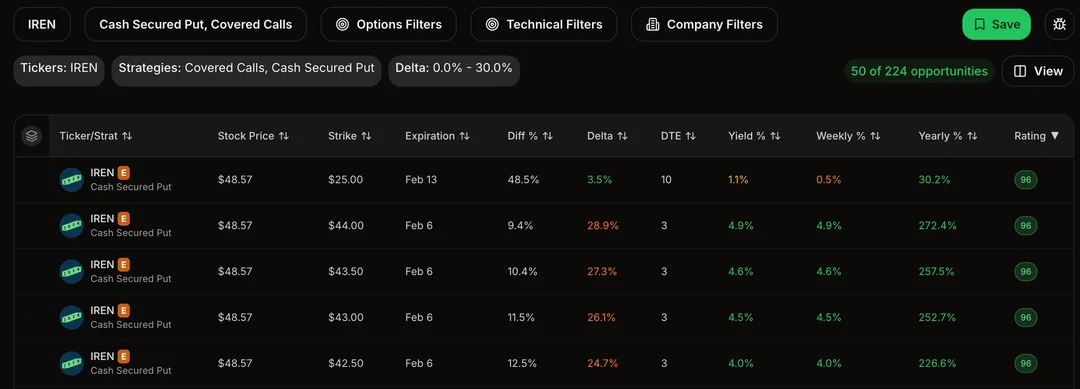
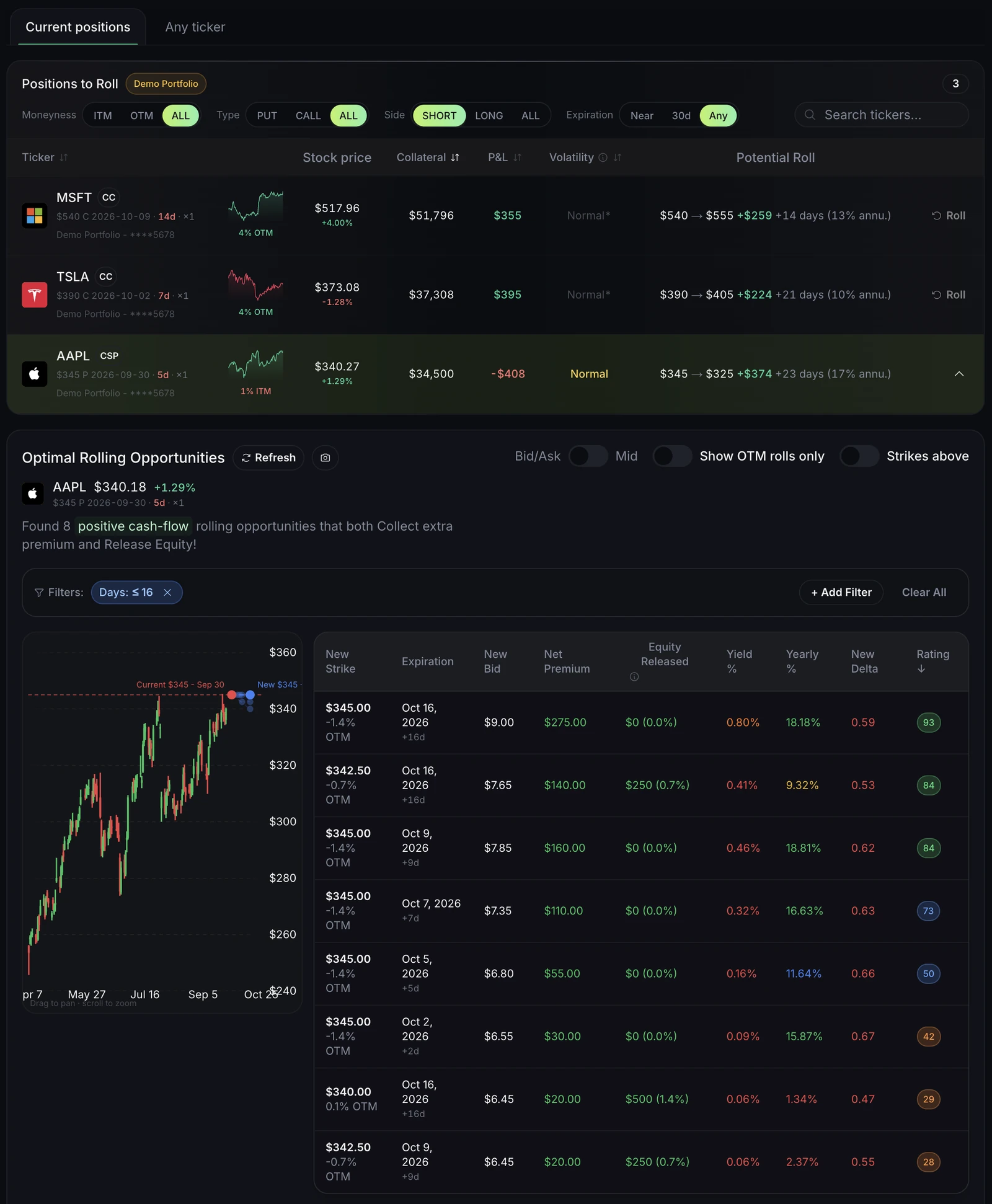
QuantWheel can help you stick to the rules and also find the best deals possible. It will also alert you about your positions and provide rolling advice.
Risk Management in Options Trading
The Math of Recovery
Losses require disproportionately larger gains to recover:
| Loss | Gain Needed to Recover |
|---|---|
| 10% | 11% |
| 20% | 25% |
| 30% | 43% |
| 50% | 100% |
| 75% | 300% |
A 50% loss requires a 100% gain just to get back to even. This is why preventing large losses is more important than maximizing gains.
Account Blowups Are Permanent
Many traders never recover from major losses:
- Psychological damage (fear, PTSD)
- Capital destroyed (starting over)
- Time lost (years to rebuild)
Risk management is survival.
Position Sizing in Options trading
The 5% Rule
Never risk more than 5% of your portfolio on any single position.
For a $100,000 account:
Maximum per position: $5,000 at risk
For CSPs, this often means $15,000-25,000 collateral (depending on how far OTM)
Conservative Approach: 2-3% Per Position
Many successful traders use 2-3% maximum:
- More positions possible (better diversification)
- Single loss doesn't hurt significantly
- Psychological comfort (sleep well at night)
Position Size Calculation
For Cash-Secured Puts:
- Max Position = Account Value × 5%
- Collateral Needed = Strike × 100
Example:
- Account: $100,000
- 5% max risk: $5,000
- If $170 put, collateral = $17,000
- But max loss if stock goes to $150 = $2,000 (within 5% rule)
Practical Position Sizing Table
| Account Size | Max Per Position (5%) | Typical Position Count |
|---|---|---|
| $25,000 | $1,250 | 3-5 positions |
| $50,000 | $2,500 | 5-8 positions |
| $100,000 | $5,000 | 8-12 positions |
| $250,000 | $12,500 | 12-20 positions |
Capital Deployment Rules
The 50% Rule
Keep at least 50% of your capital in cash or easily available. This provides:
- Buffer for unexpected assignments
- Cash for opportunities (market dips)
- Psychological comfort
- Margin safety
Example Deployment
$100,000 Account:
- Maximum deployed: $50,000
- Cash reserve: $50,000
With $50,000 deployed:
- 5 positions × $10,000 collateral each
- OR 10 positions × $5,000 each
Why Not Deploy 100%?
Risk scenario:
- Market drops 15%
- Multiple positions assigned simultaneously
- Need cash to buy shares
- No cash = margin call = forced liquidation at worst prices
With 50% cash:
- Assignments covered
- Can buy more at lower prices
- No forced selling
Loss Limits
Per-Position Loss Limit
Close positions at 20-25% loss (or 200% of premium received).
Example:
- Sold put for $3.00 premium
- 200% loss = $6.00 loss beyond premium
- Close at $9.00 (lose $600 instead of more)
Why use loss limits:
- Prevents catastrophic single-position losses
- Preserves capital for recovery
- Removes emotional decision-making
Per-Day Loss Limit
Stop trading after 3% daily loss.
- Review what went wrong
- Avoid revenge trading
- Come back tomorrow with clear head
Per-Month Loss Limit
Stop opening new positions at 10% monthly loss.
- Protect annual returns
- Recognize when market isn't cooperating
- Preserve capital for better conditions
Diversification in Options Trading
Across Positions
Minimum 3-5 positions, ideally 8-12. Single position = single point of failure Multiple positions = distributed risk
Across Sectors
Avoid concentration in single sector. Bad: 5 tech stocks (AAPL, MSFT, GOOGL, NVDA, META) Good: Mix of tech, finance, healthcare, consumer, energy
Across Time
Stagger expirations across multiple weeks.
- Not all positions expiring same Friday
- Spread risk across time
- Cash flow throughout month
Correlation Awareness
Understand that some positions move together:
- Tech stocks correlate
- Banks correlate
- Market-wide events affect everything
True diversification = uncorrelated positions
Margin Rules
Avoid Margin for Beginners
Cash-secured trading only:
- Know exactly your maximum loss
- No margin calls
- No forced liquidation
If Using Margin
Never exceed 50% of available margin.
- Margin calls come fast during volatility
- Forced liquidation at worst prices
- Can lose more than deposited
Margin Danger Signs
Red flags:
- Using 80%+ of margin
- Multiple positions ITM
- Can't cover all assignments
- Waking up to margin calls
The 45-21 Rule for Risk
Entry: 45 DTE
Entering at 45 DTE provides:
- Time for position to work
- Time for management (rolling)
- Optimal theta decay zone
Exit: 21 DTE or 50% Profit
Exiting at 21 DTE avoids:
- Gamma risk acceleration
- Assignment pressure
- Weekend risk
This rule IS risk management.
Black Swan Protection
What Is a Black Swan?
Unexpected market event causing massive moves:
- COVID crash (March 2020)
- Financial crisis (2008)
- Flash crashes
Protection Strategies
1. Position sizing
- No single position can destroy you
2. Cash reserves
- Always have capital to survive
3. Stop losses
- Automated protection when away
4. Hedges (Optional)
- Long puts on SPY for portfolio protection
- Cost: 1-2% annually for insurance
Surviving Black Swans
During the event:
- Don't panic sell at bottom
- Don't add to losing positions
- Wait for dust to settle
After the event:
- Review what happened
- Adjust position sizing if needed
- Take advantage of high IV for selling
Emotional Risk Management
Trading Rules That Work
- Written trading plan - Follow it, don't improvise
- Position size limits - Never violate
- Loss limits - Close when hit
- Profit taking - 50% profit rule
- No revenge trading - Walk away after losses
When Not to Trade
Don't trade when:
- Emotionally upset
- After big loss
- Tired or distracted
- Feeling FOMO
- Breaking your rules
Risk Management Checklist
Before Opening Any Position
- [ ] Position size ≤ 5% of portfolio
- [ ] Total deployed ≤ 50% of capital
- [ ] Correlation checked (not too much in one sector)
- [ ] Stock is quality (would hold for years)
- [ ] Understand max loss scenario
- [ ] Have management plan (when to roll, close)
Weekly Review
- [ ] Total exposure check
- [ ] Correlation check
- [ ] Approaching expirations
- [ ] Positions near loss limits
- [ ] Overall P&L vs limits
Monthly Review
- [ ] Total returns vs expectations
- [ ] Biggest winners (what worked)
- [ ] Biggest losers (what to avoid)
- [ ] Rule violations (learn from mistakes)
- [ ] Adjust strategy if needed
Related Articles
- Portfolio Allocation for Options
- Managing Losing Trades
- When to Cut Your Losses
- Diversification for Options
- Margin and Buying Power
$1 for 7 days • Cancel anytime • 14-day money-back guarantee