
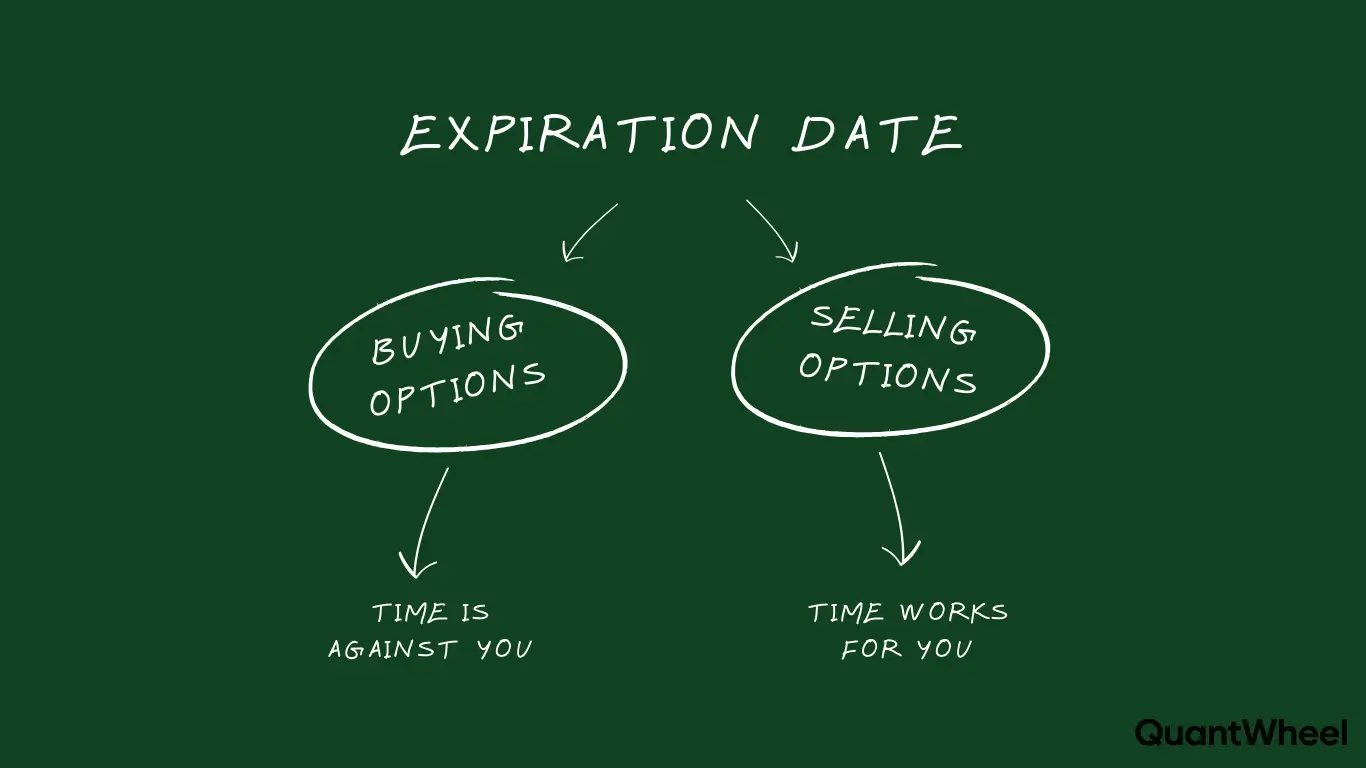
If you're running the wheel strategy for example, options expiration day is when everything comes together. Your cash-secured put either expires worthless (profit), or you get assigned the stock and move to the next phase. Understanding exactly what happens at expiration, when it happens, and how to manage your positions is crucial for successful wheel trading.
Optimize trading the wheel with QuantWheel →
TLDR: Options Expiration for Wheel Traders
Options expiration is the date when your options contract becomes void and settlement occurs. For wheel strategy traders, this is the moment of truth where you either keep the premium as profit or get assigned the underlying stock.
Here's what you need to know:
Expiration timing: Options expire at 4:00 PM Eastern Time on the expiration date (usually Friday). Settlement happens after hours, and you'll see assignment notifications Saturday morning. This means you wait through the weekend to know your final status.
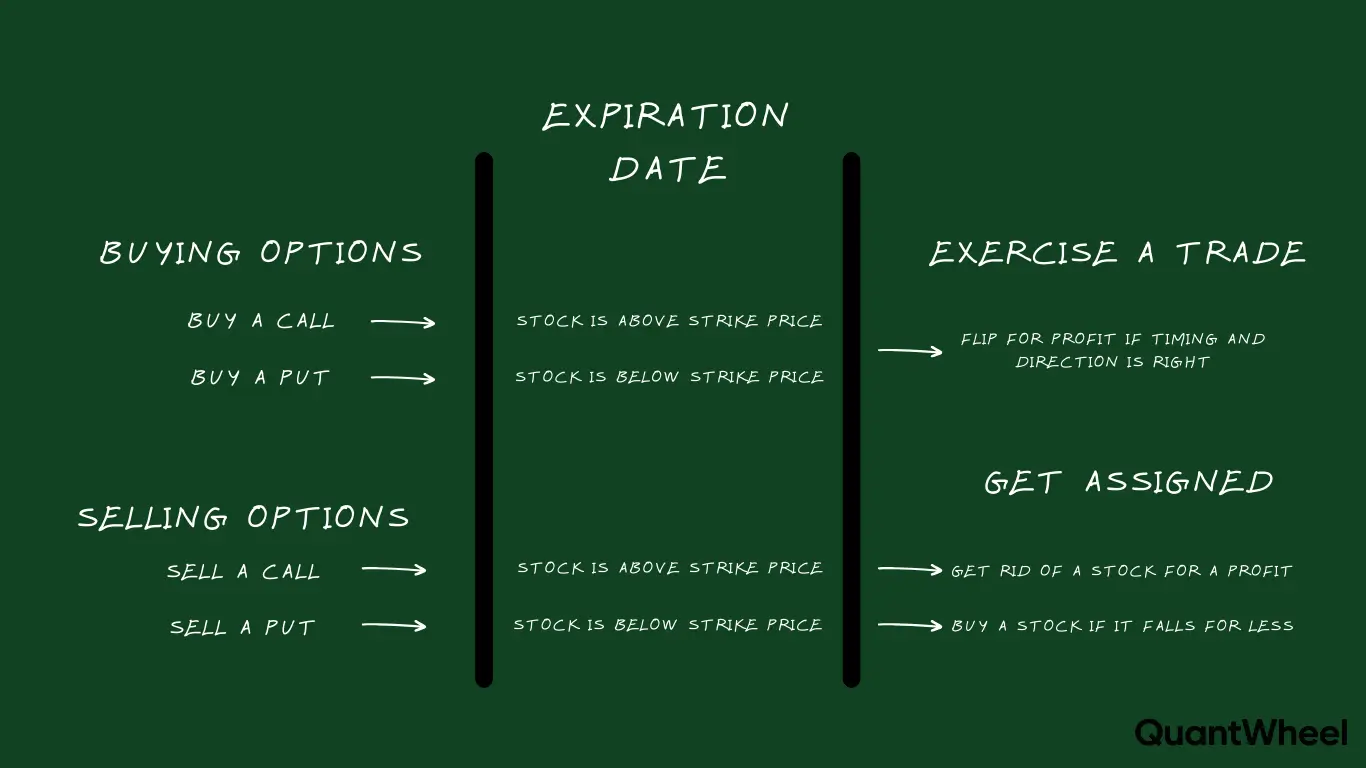
Cash-secured puts at expiration: If the stock price is above your strike price at 4:00 PM ET, your put expires worthless. You keep the entire premium as profit, your cash is released, and you can sell another put. If the stock is below your strike, you're automatically assigned 100 shares at the strike price.
Cost basis reality: When assigned, your broker shows the strike price as your cost basis. But your real cost basis is lower because you collected premium. If you sold a $50 put for $2, your actual cost basis is $48 per share, not $50. This matters for taxes and knowing your true breakeven point.
Example: You sell a $100 cash-secured put on AMD for $3 premium. At expiration, AMD is trading at $98. You get assigned 100 shares. Your broker shows cost basis: $100 per share. Your actual cost basis: $97 per share ($100 strike - $3 premium). That's a $300 difference in how you understand your position.
The key challenge? Tracking this through multiple wheel cycles becomes a manual nightmare unless you use automated tools built specifically for wheel strategy tracking.
Understanding Options Expiration Timing
Options expiration has specific timing that every wheel trader needs to understand. The expiration date listed on your contract is when the option becomes void, but the actual settlement process happens in stages.
Standard expiration schedule: Most options expire on the third Friday of the month. Weekly options expire every Friday. The last trading day for the option is the expiration date itself, and you can trade the option right up until market close at 4:00 PM Eastern Time.
Settlement processing: After the market closes at 4:00 PM ET, the Options Clearing Corporation (OCC) begins processing which options are in-the-money and will be automatically exercised. This happens Saturday morning, which is why you typically see assignment notifications over the weekend rather than Friday evening.
Assignment notifications: Your broker will notify you of assignments Saturday morning or Monday before market open. For wheel strategy traders, this weekend gap means you can't immediately sell covered calls on assigned shares until Monday. Some traders factor this time cost into their strategy decisions.
Early assignment risk: While rare for cash-secured puts, early assignment can happen before expiration if the option is deep in-the-money. This is more common near ex-dividend dates. For the wheel strategy, early assignment just accelerates your move into the covered call phase.
The timing matters because it affects when you can deploy capital into your next trade. Understanding the settlement process helps you plan your trading week more effectively.
Cash-Secured Puts at Expiration
When you're running the wheel strategy, cash-secured puts are your entry point. What happens at expiration determines whether you collect profit and move on, or whether you're assigned shares and continue the wheel cycle.
Scenario 1: Expires worthless (out-of-the-money). If the stock price is above your strike price at 4:00 PM ET on expiration day, your put expires worthless. This is actually the ideal outcome for maximum return with minimum work. You keep the entire premium as profit, your cash is immediately available, and you can sell another cash-secured put on Monday. From a wheel strategy perspective, this is the simplest and most capital-efficient outcome.
Scenario 2: Expires in-the-money (assignment). If the stock price is below your strike price at expiration, you're automatically assigned 100 shares per contract at the strike price. Your broker uses your cash to purchase the shares, and Monday morning you own the stock. This isn't a loss or a problem - it's literally part of the wheel strategy plan. You now move to phase two: selling covered calls against those shares.
The strike price boundary: Even a one-cent difference matters. If your strike is $50 and the stock closes at $50.01, your put expires worthless. If it closes at $49.99, you get assigned. This is why some traders will close positions before expiration if the stock is hovering near the strike price - they want certainty rather than weekend stress.
Timing your next move: If assigned, you can't immediately sell covered calls Friday after hours. You have to wait until Monday when the shares officially settle in your account. Some traders factor this weekend capital lag into their decisions about whether to roll the put or accept assignment.
What most brokers don't show you: your actual cost basis after assignment. They'll display the strike price as your cost basis, but you collected premium upfront. That premium reduces your real cost basis, which matters for understanding your true breakeven and for tax reporting. This is exactly where manual tracking breaks down and professional tools like QuantWheel automatically adjust your cost basis through the full wheel cycle.
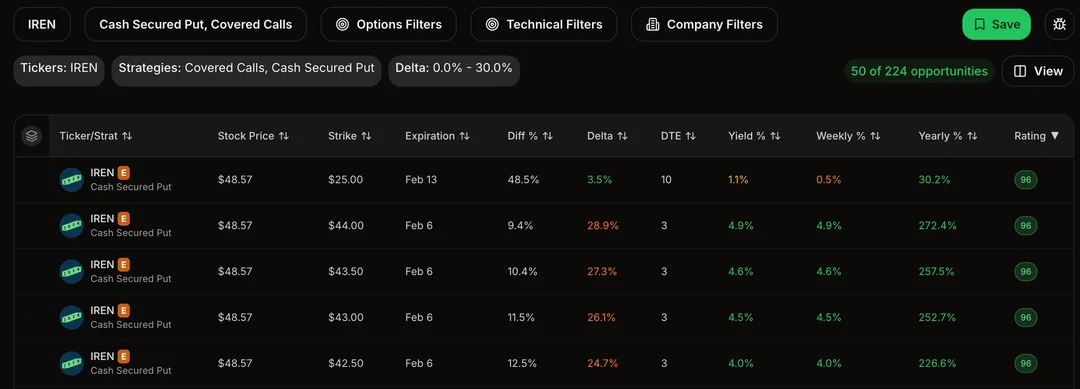
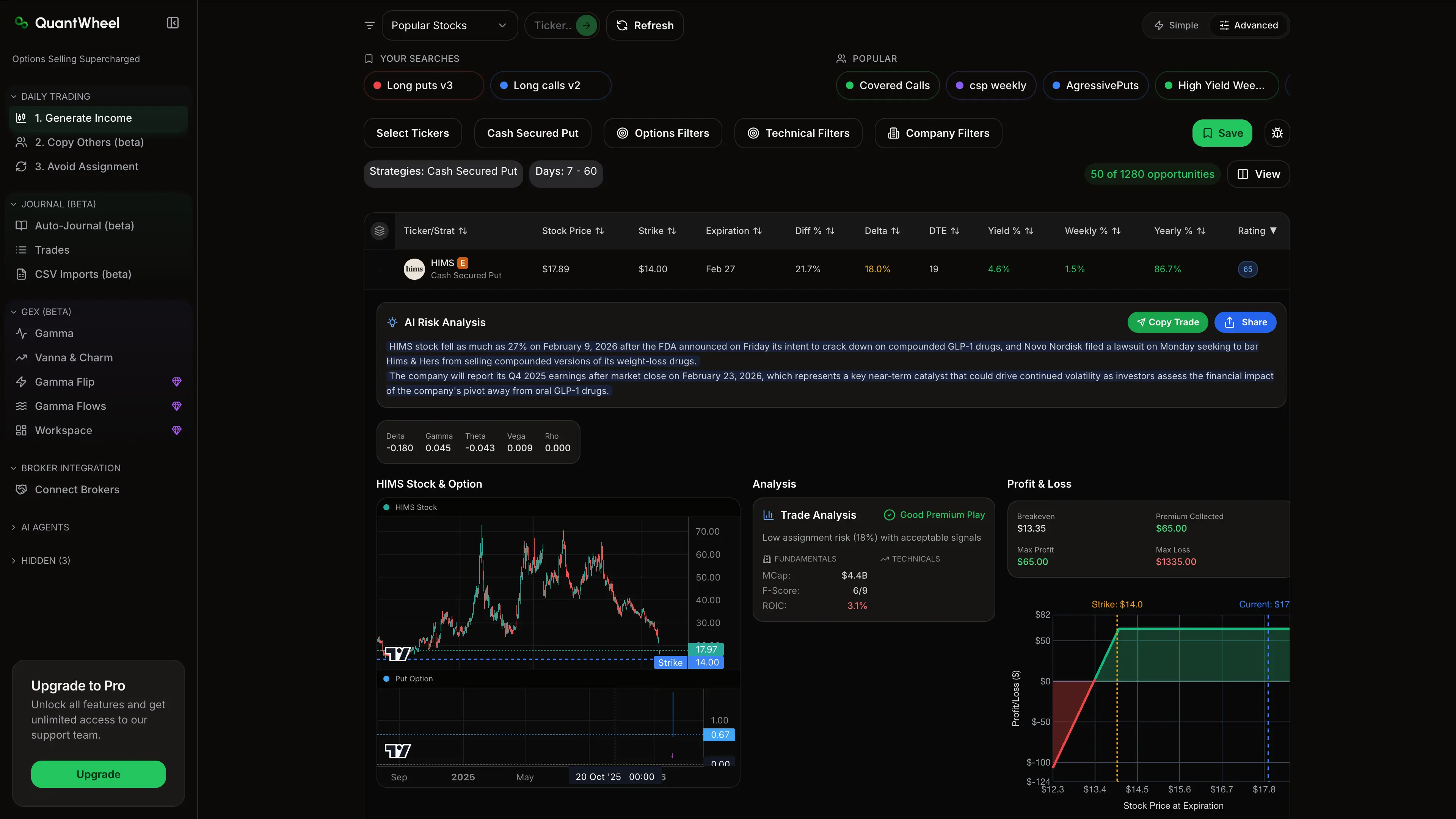
You can jump in and see how it finds trades for you and keeps track of the ones that you make in your brokerage account. Sign up with QuantWheel → Example deals that QuantWheel has found:
Covered Calls at Expiration
Once you're assigned shares from a cash-secured put, you move into the covered call phase of the wheel strategy. Understanding covered call expiration helps you know when you'll either keep the shares (and sell another call) or have shares called away (completing the cycle).
Scenario 1: Expires worthless (out-of-the-money). If the stock price is below your strike price at expiration, your covered call expires worthless. You keep your shares, you keep the full call premium as profit, and Monday you can sell another covered call. This generates consistent income while you continue holding the stock. Many wheel traders repeat this phase multiple times, collecting premium each cycle until the shares are finally called away.
Scenario 2: Expires in-the-money (shares called away). If the stock price is above your strike price at expiration, your shares are automatically called away. You sell your 100 shares at the strike price, and the stock leaves your account. This completes the full wheel cycle: collected put premium, got assigned, collected call premium(s), shares called away. You now calculate your total profit: put premium + call premium(s) + capital gain/loss on the shares.
The ideal outcome: The wheel strategy works best when you get assigned, sell multiple covered calls collecting premium, then eventually have shares called away for a small capital gain. For example: Sold $50 put for $2 premium, assigned at $50, sold three covered calls for $1.50 each while holding, shares finally called at $52. Total profit: $2 (put) + $4.50 (calls) + $2 (capital gain) = $8.50 per share, or $850 per contract.
Managing near-the-strike scenarios: If your stock is hovering near your call strike heading into expiration, you have to decide whether you want the shares called away or not. If you want to keep the stock, you can roll the call up and out to a higher strike and later expiration. If you're ready to close the position, you can let it expire and take assignment.
Cost basis complexity: Through multiple covered calls and potential assignment, your true cost basis includes the original put premium, all call premiums collected, and the final sale price. This calculation becomes tedious with manual tracking, especially when running 10+ wheel positions simultaneously. Tools built for wheel strategy automatically track the complete cycle and calculate total realized profit when shares are called away.
Assignment Mechanics: What Actually Happens
Assignment is the process where your options obligation converts into a stock position. For wheel strategy traders, understanding exactly how assignment works removes the mystery and stress.
Automatic exercise: If your option is in-the-money at expiration, it's automatically exercised by the Options Clearing Corporation. You don't need to take any action - it happens automatically. For cash-secured puts, this means buying shares. For covered calls, this means selling shares.
Saturday processing: The actual assignment processing happens Saturday morning after Friday's market close. Your broker receives the assignment notification from the OCC and processes it in your account. You'll see the notification Saturday or early Monday before market open.
Broker holds cash: For cash-secured puts, your broker has been holding the cash required to buy the shares since you opened the position. At assignment, they use that cash to purchase the shares at the strike price. The cash wasn't available for other trades, which is why it's called "cash-secured" - the cash secures the put obligation.
Share delivery: The 100 shares per contract appear in your account Monday morning when the market opens (or pre-market). At this point, you can immediately sell covered calls against those shares, or you can hold them and wait for a better opportunity.
Cost basis tracking is where brokers fail: Your broker will show your cost basis as the strike price you paid for the shares. But that ignores the premium you collected when you sold the put. Your actual cost basis is strike price minus premium collected. For example: Assigned at $100 strike after collecting $3 premium means your real cost basis is $97, not $100. This $3 difference per share ($300 per contract) is critical for knowing your true breakeven, planning your covered call strikes, and filing accurate taxes.
Here's where most wheel traders struggle: calculating your actual cost basis after assignment. Your broker shows one number, but your real basis is different. You need to track this manually - unless you're using software like QuantWheel that automatically adjusts your cost basis when assignments happen. It's one less spreadsheet calculation to maintain, and it ensures your breakeven calculations are always accurate.
Expiration Week Position Management
The week leading up to expiration is when experienced wheel traders make key decisions about their positions. Holding through expiration, closing early, or rolling to a new expiration each have trade-offs.
The 50% profit rule: Many wheel traders automatically close positions when they hit 50% of maximum profit, regardless of days to expiration. The logic is simple: you've captured half the premium in a fraction of the time, and you free up capital to deploy into a new position with fresh premium potential. This rule reduces risk and increases capital efficiency, but it does mean giving up that last 50% of profit potential.
Holding through expiration: If your position hasn't hit your profit target by expiration week, you face a decision: hold through Friday, or close and move on. Holding captures the maximum premium but carries maximum risk if the stock moves against you. In expiration week, theta decay (time value) accelerates, which works in your favor as a premium seller.
Rolling before expiration: If your option is in-the-money heading into expiration week but you don't want assignment, you can roll the position. For cash-secured puts, this means buying back the current put and simultaneously selling a new put at a later expiration (and often a different strike). For covered calls, rolling avoids having shares called away while collecting additional premium. The key question: does the roll collect enough premium to justify the extra time commitment?
Expiration Friday management: By Friday morning of expiration week, time value has mostly decayed. If your position is out-of-the-money and profitable, many traders just let it expire worthless to avoid commissions on closing the trade. If it's in-the-money, you need to decide before 4:00 PM ET whether to roll, close, or accept assignment. After 4:00 PM, you've committed to whatever happens at expiration.
The tracking challenge: Managing multiple wheel positions through different expirations becomes complex without systematic tracking. You need to know which positions need attention, which rules you follow for each position, and what your adjusted cost basis will be after any assignments. After managing 15+ wheel positions, your spreadsheet becomes a nightmare. This is exactly why software like QuantWheel exists - built specifically for wheel traders who need to track positions across expirations without manual calculation errors.
Track your trades automatically with QuantWheel →
Cost Basis After Expiration and Assignment
Here's the biggest tracking challenge wheel strategy traders face: calculating your actual cost basis after options expiration and assignment. Your broker shows one number, but your real basis is different. This matters for taxes, for knowing your true breakeven, and for planning your next covered call strikes.
Broker cost basis vs real cost basis: When you're assigned shares from a cash-secured put, your broker records your cost basis as the strike price you paid. If you were assigned at a $50 strike, your broker shows $50 per share cost basis. But you collected premium when you sold the put - let's say $2 per share. Your actual cost basis is $48, not $50. That's a $200 difference per 100 shares that your broker doesn't automatically track.
Why this matters: If you think your cost basis is $50 but it's actually $48, you're miscalculating your breakeven point and potentially selling covered calls at strikes that don't make sense. You might sell a $49 call thinking you're selling above your cost, when actually you're $1 above your real basis. This impacts your strategy decisions and your profit calculations.
The full wheel cycle complexity: Let's walk through a complete cycle: You sell a $100 put for $3 premium (real basis: $97). You get assigned. You sell a $102 covered call for $1.50 (real basis now: $95.50). The call expires worthless. You sell another $102 call for $1.50 (real basis now: $94). Shares get called away at $102. Your total profit is $8 per share ($800 per contract), but calculating this requires tracking four separate transactions with premium adjustments through each phase.
Tax reporting accuracy: At tax time, you need accurate cost basis to report capital gains correctly. If you use your broker's stated cost basis without adjusting for premiums collected, you'll overstate your cost basis and potentially overpay taxes. With 10-20 wheel trades per year, these errors add up.
Manual tracking breaks down: You can track this in a spreadsheet - and many wheel traders start this way. You build columns for strike price, premium collected, adjusted basis, call premiums, final sale price. But after your tenth position, with some getting assigned and some not, with multiple covered calls on some positions, your spreadsheet becomes error-prone. You forget to update a cell, or you miscalculate a formula, and suddenly your tracking is wrong.
This is where automated options tracking becomes essential. QuantWheel automatically adjusts your cost basis when assignments happen, tracking the complete put → assignment → call → exit cycle without manual calculations. You always know your real cost basis, your true breakeven, and your actual profit on each position. No spreadsheet maintenance, no calculation errors, just accurate tracking built specifically for wheel strategy traders.
Early Assignment Before Expiration
While most assignments happen at expiration, early assignment can occur before the expiration date. Understanding when and why this happens helps wheel strategy traders avoid surprises.
When early assignment happens: Early assignment is most common when an option is deep in-the-money and has little to no time value remaining. The option holder (who is long the option) can exercise anytime before expiration, and if they do, you as the seller get assigned early. For cash-secured puts, this typically happens when the stock has dropped significantly below your strike and the put buyer wants to sell their shares immediately rather than wait for expiration.
Ex-dividend date risk: The most predictable early assignment scenario is around ex-dividend dates. If you're short a call (sold covered calls) and the dividend is larger than the remaining time value in the option, the call holder might exercise early to capture the dividend. They buy the shares from you before the ex-dividend date, collect the dividend, and this makes more financial sense than waiting for expiration. For wheel strategy traders, this means your shares get called away earlier than expected.
Deep in-the-money puts: If you sold a cash-secured put and the stock drops dramatically, the put buyer might exercise early to lock in their profit immediately. This is less common than early call assignment, but it does happen. You get assigned the shares before expiration, which just accelerates your move into the covered call phase of the wheel.
Why early assignment isn't a problem: For the wheel strategy, early assignment doesn't hurt your plan. If your put is assigned early, you get the shares and can immediately start selling covered calls rather than waiting until expiration. If your call is exercised early, your shares are sold and you can immediately sell a new cash-secured put on a different ticker. The wheel keeps turning, just on a different timeline than you originally planned.
Broker notifications: If you're assigned early, your broker notifies you the next morning. You'll see the shares (for put assignment) or the cash from shares being called away (for call assignment) in your account when the market opens. From there, you continue with your wheel strategy process.
The main consideration with early assignment is tracking. If you're manually maintaining a spreadsheet with expected expiration dates and planned cycles, early assignment throws off your tracking. Professional tools handle this automatically, noting when assignment occurred and adjusting your cost basis calculations immediately.
Expiration Strategies for Wheel Traders
Experienced wheel traders develop systematic rules for managing positions through expiration. Here are proven approaches based on what successful thetagang traders actually do.
Strategy 1: Close at 50% profit with 21+ DTE. If your position hits 50% of maximum profit and there are still 21 or more days until expiration, close it immediately and redeploy capital into a new position. You've captured half the premium in less than half the time. This maximizes capital efficiency and reduces risk from unexpected stock moves. Many professional premium sellers use this exact rule across all their positions.
Strategy 2: Hold to expiration if profitable. If your position is profitable heading into expiration week and you don't mind assignment, hold through Friday and let it expire. This captures 100% of the premium. The risk is the stock moves against you in the final week, but theta decay accelerates in your favor. This strategy works best when you're running fewer positions and can actively monitor them.
Strategy 3: Never hold through expiration. Some traders always close positions before expiration Friday, even if they have to pay a small debit. This eliminates assignment uncertainty and weekend stress. You always know your status by Friday close, and you can deploy capital Monday morning without waiting for assignment notifications. The cost is slightly lower profit due to closing before full expiration.
Strategy 4: Roll threatened positions on Wednesday. If your position is in-the-money by Wednesday of expiration week, roll it to the next expiration before Friday. This avoids assignment while collecting additional premium. The decision point is Wednesday because you still have enough time value to make rolling worthwhile. By Friday, time value has decayed too much for an attractive roll.
Strategy 5: Let winners expire, close losers early. If your position is comfortably out-of-the-money heading into expiration week, let it expire worthless. If it's in-the-money or close to the strike, close or roll early to avoid assignment uncertainty. This hybrid approach reduces commission costs on winners while managing risk on threatened positions.
The best strategy depends on your risk tolerance, portfolio size, and time availability. The key is having a systematic rule you follow consistently across all positions. Without rules, you'll make emotional decisions based on each position's story, which usually leads to suboptimal results. Professional wheel traders automate their rules with alerts and tracking systems, ensuring they execute their strategy consistently across 10-20+ positions.
Tracking Multiple Expirations Systematically
Once you're running 10+ wheel positions across different stocks and different expirations, systematic tracking becomes essential. Missing an expiration, forgetting to roll a position, or miscalculating cost basis can cost hundreds or thousands of dollars per mistake.
The spreadsheet approach: Most wheel traders start with a spreadsheet. Columns for ticker, strike, expiration, premium collected, current P&L, days to expiration, action needed. You update it daily or weekly, checking off positions as they expire or get assigned. This works fine for 2-3 positions. At 10+ positions with different management rules for each, your spreadsheet becomes a part-time job.
Common tracking mistakes: Forgetting to check earnings dates and getting caught in IV crush after earnings. Not noticing a position has hit your 50% profit target until days later. Miscalculating adjusted cost basis after assignment and multiple covered calls. Missing an expiration entirely because you thought it was next Friday, not this Friday. These mistakes are common because manual tracking requires constant attention and perfect execution.
The calendar approach: Some traders use a calendar view showing all expirations. Monday: check positions expiring this week. Wednesday: roll or close threatened positions. Friday: confirm expirations. Saturday: process assignments and plan Monday trades. This systematic weekly routine helps ensure nothing falls through the cracks, but it still requires manual checking and decision-making.
Alert-based management: More advanced traders set up broker alerts for positions hitting profit targets or breaching loss thresholds. When an alert fires, you review that position and make a decision. This reactive approach works well for active traders who can respond to alerts during market hours, but it doesn't solve the tracking and cost basis calculation problems.
Professional tracking software: After managing 15+ wheel positions, many traders move to software built specifically for premium sellers. These tools automatically track positions through expiration, assignment, and the full wheel cycle. They calculate adjusted cost basis, show aggregate portfolio metrics, and alert you when positions need attention based on your rules. QuantWheel was built specifically for this - it handles the tedious tracking so you can focus on trading decisions rather than spreadsheet maintenance.
The question isn't whether you need systematic tracking. The question is whether manual tracking is a productive use of your time once you're managing a portfolio-scale wheel strategy. Most wheel traders graduate from spreadsheets to professional tools around the 10-position mark, when manual tracking becomes more time-consuming than it's worth.
Common Expiration Mistakes to Avoid
Even experienced wheel traders make avoidable mistakes around options expiration. Learning from these common errors helps you protect profits and reduce stress.
Mistake 1: Forgetting about expiration entirely. You're running 8 positions, and you forget one of them expires this Friday. You notice Saturday morning when you see assignment notification. You missed the opportunity to roll or close the position, and now you're committed to assignment whether you wanted it or not. This happens more often than traders admit, especially when managing many positions across different brokers.
Mistake 2: Thinking expiration is next week when it's this week. Weekly options and monthly options can blur together. You glance at your position and think "this expires next Friday" when it actually expires in two days. By the time you realize the error, it's too late to manage the position optimally. Double-checking expiration dates every Monday prevents this mistake.
Mistake 3: Not closing at 50% profit because you want the last dollar. Your cash-secured put is up 50% with three weeks left until expiration. You decide to hold for that last 50% of profit. The stock gaps down on earnings news you didn't check, and suddenly you're assigned at a cost basis higher than current price. You gave up $200 in locked-in profit to chase $200 more, and ended up losing. Taking profits at 50% is a proven rule for a reason.
Mistake 4: Panic-closing on Thursday when you should wait until Friday. Your cash-secured put is slightly in-the-money Thursday afternoon, and you panic-close it, paying $50 to get out of the position. Friday the stock bounces back, and the put would have expired worthless for maximum profit. You paid $50 to avoid a risk that didn't materialize. Unless you have strong reasons to close early, waiting until Friday often works out better.
Mistake 5: Not tracking cost basis through assignment. You're assigned shares at $100 after collecting $3 in put premium, but you don't adjust your mental cost basis to $97. You sell a $99 covered call thinking you're above breakeven, but actually you're $2 below your real cost. This miscalculation compounds across multiple wheel cycles, and you end up uncertain about your actual profitability.
Mistake 6: Missing the ex-dividend date and getting called away early. You sold covered calls on a dividend stock and didn't check the ex-dividend date. The call buyer exercises early to capture the dividend, and your shares are called away before the dividend payment. You missed the dividend you were planning to collect. Checking ex-dividend dates before selling covered calls prevents this.
Mistake 7: Managing positions without rules. You close some positions at 30% profit, hold others to 80%, roll some on Friday, and roll others on Tuesday. Without systematic rules, you're making emotional decisions on each position. Some work out, some don't, and you can't figure out what actually works because you're not consistent. Having clear rules and following them consistently beats ad-hoc decision-making over time.
The common thread in these mistakes: lack of systematic tracking and consistent rules. Wheel strategy works when you execute the same process repeatedly across all positions. Mistakes happen when you make it up as you go, forget to check important dates, or deviate from proven rules because of emotions. Tools and systems eliminate most of these mistakes by automating tracking and enforcing consistent rules across all positions.
Start your free trial of QuantWheel
Managing options through expiration is tedious work: tracking dates, calculating adjusted cost basis, monitoring positions against your rules, planning your next trades after assignment. The wheel strategy itself is simple, but the operational complexity grows with every position you add.
QuantWheel handles the tedious tracking automatically. When you get assigned, cost basis adjusts automatically. When positions hit your profit targets, you get alerted. When expirations approach, you see exactly which positions need attention. Built specifically for wheel strategy traders who want to focus on trading decisions, not spreadsheet maintenance.
Try it free for 14 days and see the difference systematic, automated tracking makes when you're running 10+ wheel positions.
$1 for 7 days • Cancel anytime • 14-day money-back guarantee
Risk Disclosure: Options trading involves substantial risk and is not suitable for all investors. Past performance does not guarantee future results. This content is for educational purposes only and should not be considered investment advice. Always do your own research and consider consulting with a financial advisor before making investment decisions.
Examples Disclosure: The examples used in this article are for educational purposes only and are not recommendations to buy or sell any security. All investment decisions should be based on your own analysis and risk tolerance.