
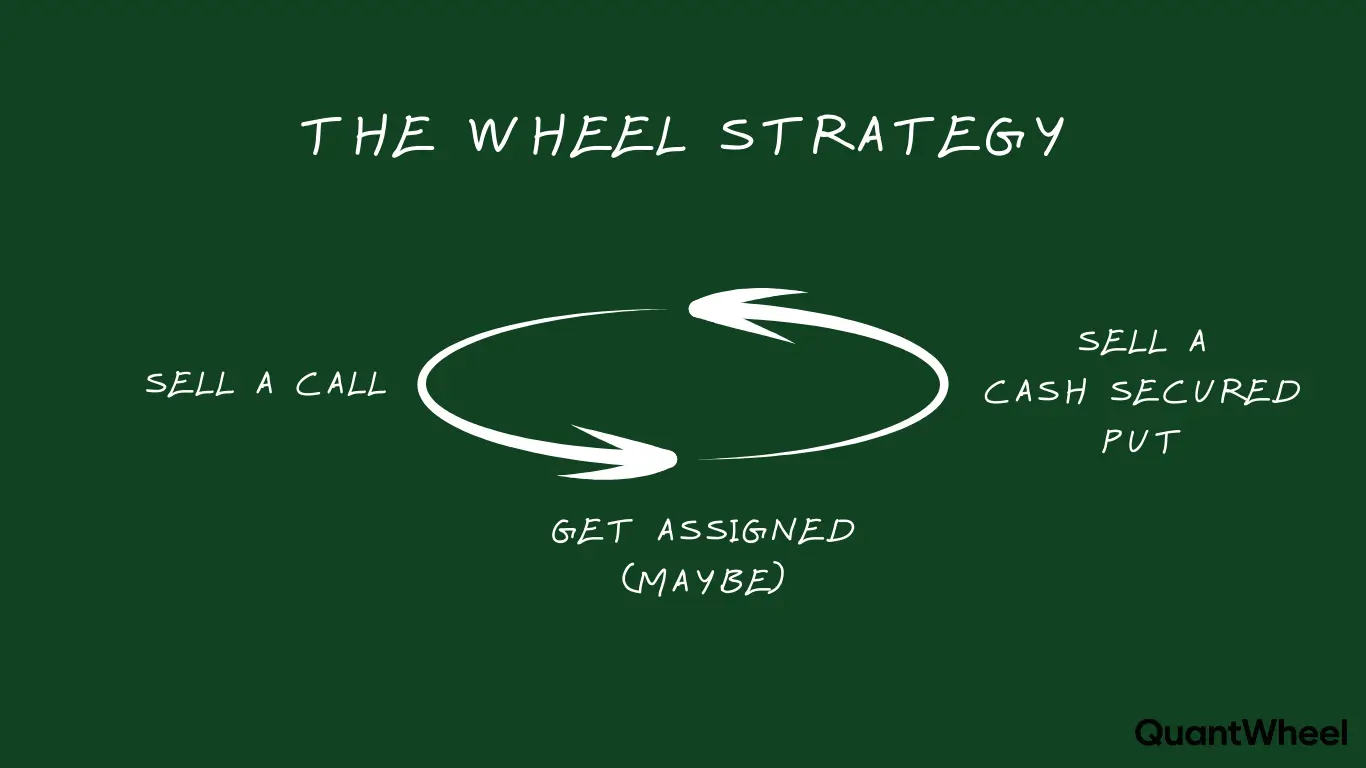
This step-by-step guide will show you exactly how the wheel strategy works, from your first cash-secured put to completing full wheel cycles across multiple positions.
TL;DR: How the Wheel Strategy Works (Simple Summary)
The wheel strategy is a three-step process for generating consistent options income:
- Sell cash-secured puts on quality stocks you want to own at a discount. You collect premium upfront and wait 30-45 days. If the stock stays above your strike price, the put expires worthless and you keep the premium. If the stock drops below your strike, you get assigned 100 shares.
- Get assigned shares at your strike price (minus the premium you collected). Your real cost basis is lower than the strike because of the premium. For example, if you sold a $50 put for $2, your actual cost basis is $48 per share.
- Sell covered calls on your assigned shares to generate additional premium income. You set a strike price above your cost basis where you'd be happy to sell. If the stock rises above that strike, your shares get called away for a profit. If not, you keep the premium and sell another call.
Then the cycle repeats - like a wheel turning. You go back to step 1, selling puts on the same stock or a different one.
The wheel strategy works because you're getting paid (via premiums) to do what long-term investors already do - buy quality stocks at good prices and sell them at higher prices.
If you want to dig deeper, you can jump to: Phase 1: Selling Cash-Secured PutsPhase 2: Getting AssignedPhase 3: Selling Covered CallsComplete Cycle ExampleCommon MistakesStock Selection
Understanding the Wheel Strategy: The Complete Picture
Before we dive into the step-by-step process, let's understand what makes the wheel strategy different from simply buying and holding stocks.
Traditional investors wait for dips, buy shares, and hope for appreciation. The wheel strategy investor gets paid to wait for dips (via put premiums), gets paid while holding shares (via call premiums), and profits from appreciation when shares get called away.
The strategy combines two fundamental options strategies - cash-secured puts and covered calls - into a systematic cycle that generates income regardless of whether you own shares or not. When you don't own shares, you're selling puts. When you do own shares, you're selling calls. You're always collecting premium.
This is why experienced options traders call it "the wheel." The strategy keeps turning, rotating between puts and calls, generating consistent premium income while maintaining a conservative risk profile similar to long-term stock ownership.
Phase 1: Selling Cash-Secured Puts (The Entry)
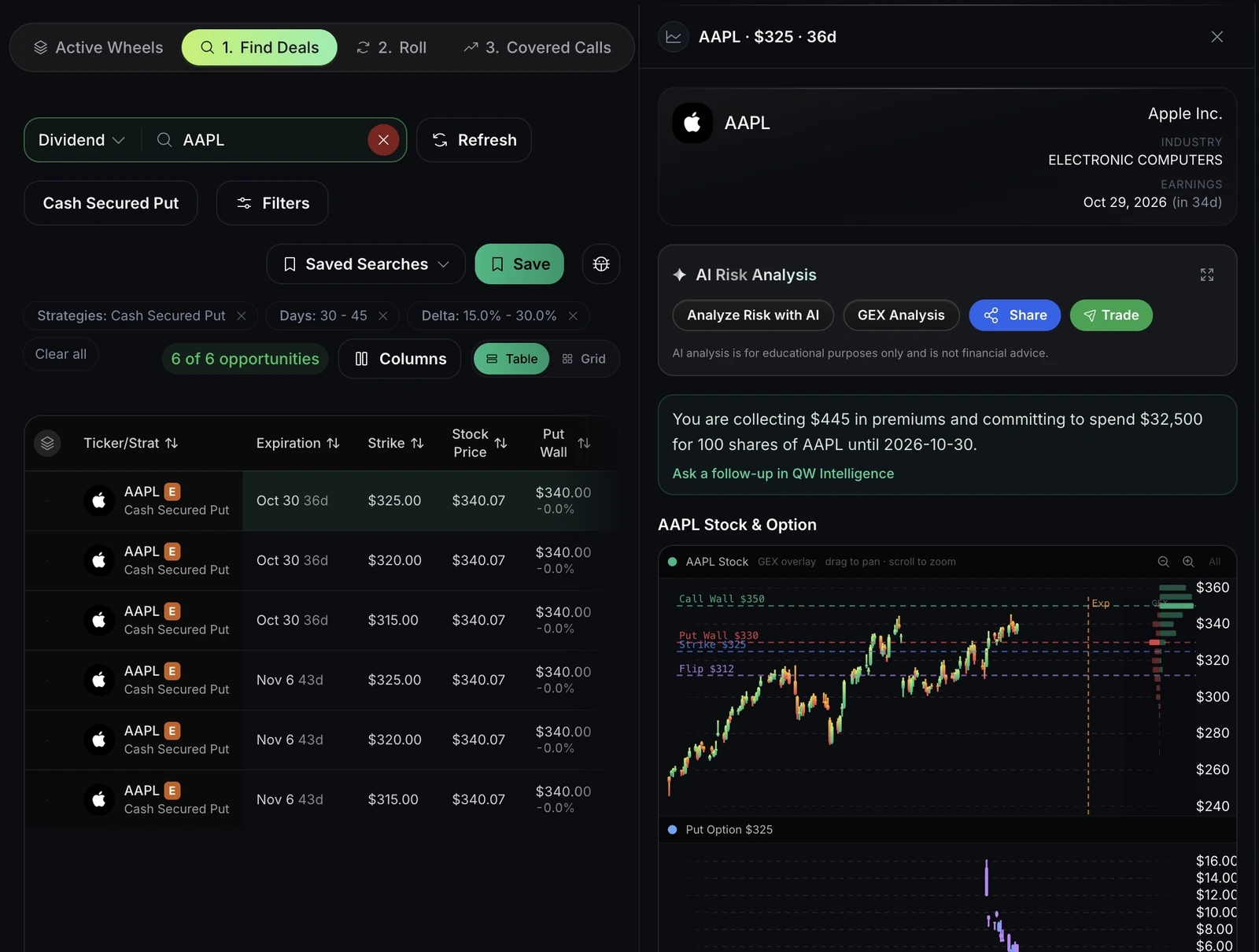
The wheel strategy begins by selling cash-secured puts on stocks you genuinely want to own. This is crucial - never sell puts on stocks you wouldn't want in your portfolio, because assignment is part of the plan.
What is a Cash-Secured Put?
A cash-secured put is an options contract where you sell someone else the right to sell you 100 shares of stock at a specific price (the strike price) by a specific date (the expiration date). In exchange, you receive a premium upfront.
The "cash-secured" part means you hold enough cash in your account to buy the 100 shares if assigned. This makes it a conservative strategy with defined risk.
Step-by-Step: Selling Your First Cash-Secured Put
Step 1: Choose a Quality Stock
Select a stock you'd be happy to own for months. Look for:
- Established companies with solid fundamentals
- Stocks you believe have long-term value
- Adequate liquidity (avoid thinly traded options)
- Implied volatility that provides decent premium
Popular wheel strategy stocks include AMD, PLTR, NVDA, SPY, and other actively traded names. The key is choosing stocks where you'd be comfortable holding shares through temporary downturns.
Step 2: Select Your Strike Price
Choose a strike price below the current stock price where you'd be happy to buy shares. Most wheel traders target the 30-delta level, which typically sits 5-10% below the current price.
For example, if AMD is trading at $150, you might sell the $145 put (around 30 delta). This gives you a 5% cushion - the stock can drop 5% and your put expires worthless.
Step 3: Choose Your Expiration Date
Most wheel traders use 30-45 days to expiration (DTE). This timeframe offers a good balance between:
- Collecting meaningful premium
- Reasonable probability of expiring worthless
- Not tying up capital too long
Weekly options expire too quickly and collect less premium. Options beyond 60 DTE tie up capital longer than necessary.
Step 4: Execute the Trade
Using your broker's platform, sell to open one cash-secured put contract. The order looks like:
- SELL TO OPEN
- AMD PUT $145 Strike
- Expiration: 35 days out
- Premium: $4.00 ($400 credit per contract)
The premium ($400 in this example) is deposited into your account immediately. Your broker will hold $14,500 in cash as collateral to ensure you can buy the shares if assigned.
Step 5: Manage the Position
Now you wait. Three things can happen:
- Stock stays above your strike - The put expires worthless, you keep the entire $400 premium, and you start over by selling another put (either on the same stock or a different one).
- Stock drops below your strike - You get assigned 100 shares at the $145 strike price. Move to Phase 2 (covered calls).
- Opportunity to close early - If the put value drops to 50% of what you collected (from $400 to $200), many traders close it early to free up capital and reduce risk. This is called "closing at 50% profit."
QuantWheel automates everything covered in this guide - finding trades, tracking cost basis, assignment alerts, and cycle management across all your positions.
Phase 2: Assignment (Getting Your Shares)
Assignment in the wheel strategy happens when the stock price is below your strike price of a previously sold Cash-Secured put at expiration. Your broker automatically purchases 100 shares at your strike price and debits your account. Next step is to sell covered calls but more on that in the phase 3 below.
What Actually Happens During Assignment
Let's continue our AMD example. You sold the $145 put for $4 premium. AMD dropped to $140 by expiration. Here's what happens:
On expiration day:
- Your broker buys 100 shares of AMD at $145 (your strike price)
- Your account is debited $14,500
- You now own 100 shares of AMD at $145 per share
- The stock is currently trading at $140 (you're down $500 on paper)
But here's the critical part most new traders miss: Your real cost basis isn't $145 - it's $141 per share.
Why? Because you collected $4 premium when you sold the put. That $400 premium reduces your effective purchase price:
- Strike price: $145
- Premium collected: $4
- Real cost basis: $141 per share
At the current stock price of $140, you're only down $100 total ($1 per share), not $500. This is why tracking cost basis accurately is essential in the wheel strategy. Your broker shows $145, but your real basis is $141.
After managing 15+ positions, tracking adjusted cost basis becomes a nightmare in spreadsheets. This is exactly why software like QuantWheel automatically adjusts your cost basis when assignments happen - no manual calculations needed.
Assignment Is Part of the Plan
New wheel traders often worry about assignment. Don't. Assignment is not a failure - it's how the strategy works.
When you get assigned, you've acquired shares at a price below where they were trading when you sold the put. You collected premium. You're now positioned to sell covered calls and collect even more premium. This is the wheel turning from puts to calls.
The only time assignment is problematic is if you sold puts on a stock you don't actually want to own. This is why stock selection is the most important decision in the wheel strategy.
Phase 3: Selling Covered Calls (The Exit)
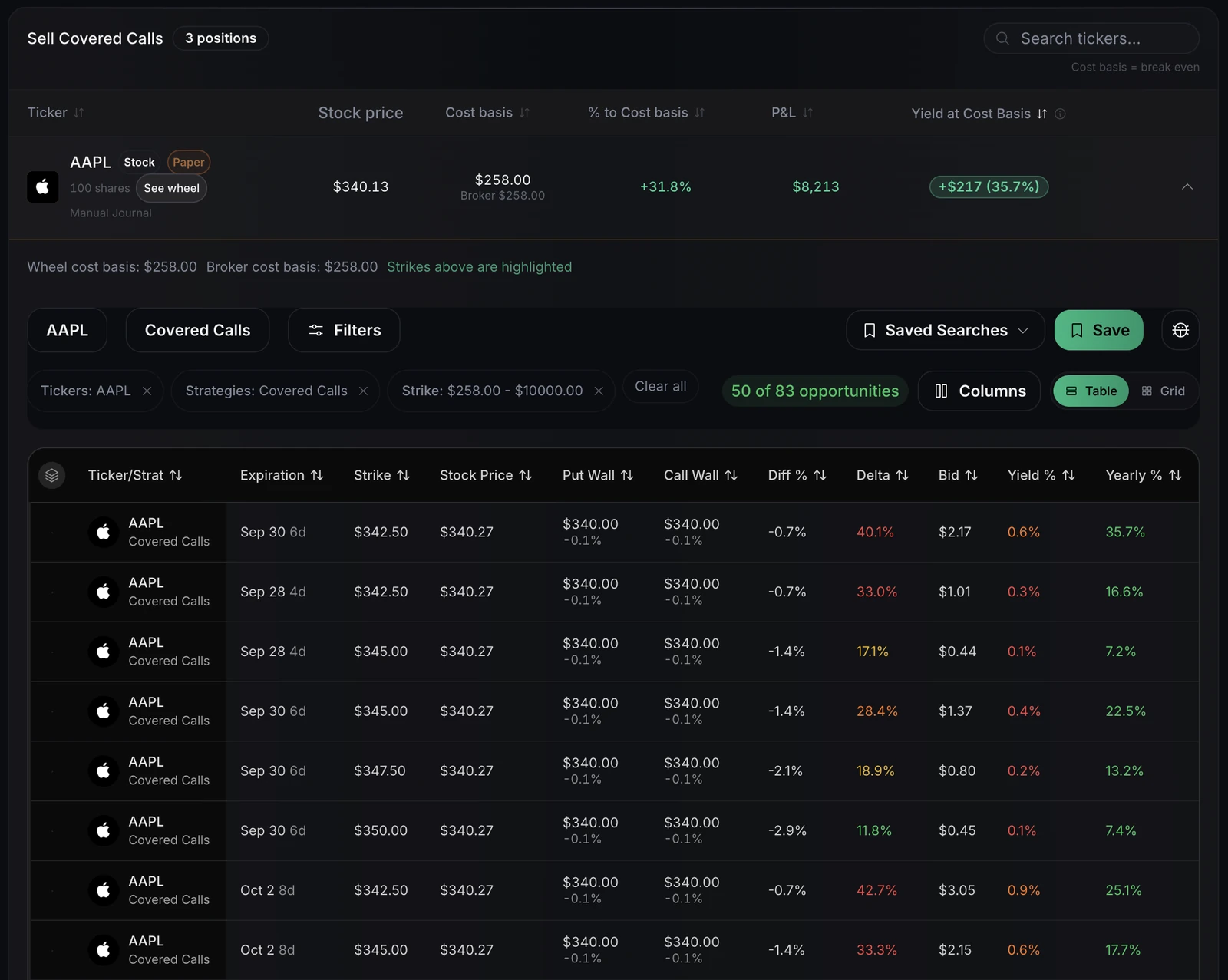
Once you own shares from assignment, you immediately move to selling covered calls. A covered call means you own 100 shares of stock and you sell a call option against those shares.
What is a Covered Call?
When you sell a covered call, you're giving someone else the right to buy your 100 shares at a specific price (the strike price) by a specific date. In exchange, you receive premium upfront.
The "covered" part means you own the underlying shares. If the stock rises above your strike and gets called away, you simply deliver your shares. There's no additional risk beyond missing out on further upside.
Step-by-Step: Selling Your First Covered Call
Step 1: Determine Your Breakeven
Before selling a covered call, know your true cost basis. In our AMD example:
- Shares assigned at: $145
- Put premium collected: $4
- Call premium you're about to collect: Let's say $3
- Total cost basis: $145 - $4 - $3 = $138 per share
You want to sell a call with a strike price above $138 to guarantee a profit if called away.
Step 2: Select Your Strike Price
Choose a strike price where you'd be happy to sell your shares. Common approaches:
- Conservative: Strike at or above your original put strike ($145 in our example). This ensures a profit even before counting premiums.
- Moderate: Strike 5-10% above current price. Balances premium collection with probability of being called away.
- Aggressive: Strike closer to current price (higher premium, higher chance of being called away).
For our AMD example (currently at $140, cost basis $138 after put premium), you might sell the $145 call. This strike is:
- Above your cost basis (profit if called away)
- Above current price (room for appreciation)
- At your original put strike (clean round trip)
Step 3: Choose Your Expiration
Same as with puts - most wheel traders use 30-45 DTE for covered calls. This maximizes premium collection while not tying up shares too long.
Step 4: Execute the Trade
Using your broker's platform:
- SELL TO OPEN
- AMD CALL $145 Strike
- Expiration: 35 days out
- Premium: $3.00 ($300 credit per contract)
The $300 premium is deposited into your account immediately. You still own your 100 shares - the call just obligates you to sell them at $145 if AMD rises above that price.
Step 5: Manage the Covered Call Position
Three outcomes are possible:
- Stock stays below your strike - The call expires worthless, you keep the $300 premium, and you sell another call. You keep repeating this, collecting premium while you own shares.
- Stock rises above your strike - Your shares get called away at $145. You've completed a full wheel cycle. Calculate your total profit and start over with Phase 1 (selling puts).
- Opportunity to close early - Similar to puts, if the call value drops to 50% of what you collected, consider closing early to reduce risk and free up shares.
Completing the Wheel Cycle: Putting It All Together
Let's follow our AMD example through a complete wheel cycle to see exactly how the strategy works step by step and how much profit you make.
Complete Wheel Cycle Example
Starting Point: AMD trading at $150, you have $14,500 cash
Week 1 - Sell Cash-Secured Put:
- Action: Sell AMD $145 put, 35 DTE
- Premium collected: $400
- Waiting period: 35 days
- Capital tied up: $14,500
Week 6 - Assignment Occurs:
- AMD is at $140 at expiration
- Result: Assigned 100 shares at $145
- Cash spent: $14,500
- Running premium total: $400
- Current position: Long 100 AMD at $145 (market value $14,000)
Week 6 - Immediately Sell Covered Call:
- Action: Sell AMD $145 call, 35 DTE
- Premium collected: $300
- Running premium total: $700 ($400 put + $300 call)
- Position: Long 100 AMD with $145 call sold
Week 11 - Called Away:
- AMD is at $148 at expiration
- Result: Shares called away at $145
- Cash received: $14,500
- Running premium total: $700
Final Accounting:
- Put premium: $400
- Call premium: $300
- Stock appreciation: $0 (bought at $145, sold at $145)
- Total profit: $700 on $14,500 invested
- Return: 4.8% in 11 weeks
- Annualized return: ~22%
This example shows a "perfect" wheel cycle where you collect premium, get assigned, collect more premium, and get called away at the same strike you were assigned at. In reality, cycles may take longer, you might sell multiple calls before being called away, or you might not get assigned at all and just keep collecting put premiums.
QuantWheel automates everything covered in this guide - cost basis tracking, assignment alerts, and cycle management across all your positions.
Managing Multiple Wheel Positions
Once you understand the basic wheel cycle, the strategy becomes more powerful when you run multiple positions simultaneously. This is where position tracking becomes critical.
The Multi-Position Challenge
Managing one wheel position is straightforward. Managing 10+ positions across different stocks, strike prices, expirations, and cycle phases gets complex quickly:
- Which positions need attention this week?
- What are my upcoming expirations?
- What's my total premium collected across all positions?
- Which stocks have upcoming earnings?
- What's my aggregate cost basis on assigned positions?
Tracking all this in spreadsheets works initially but breaks down as you scale. Missed expirations, forgotten rolls, and cost basis calculation errors become expensive mistakes.
After managing 20+ positions in spreadsheets, I built QuantWheel's Wheel Native Journal to automate the tracking. It syncs with your broker and automatically adjusts cost basis when you get assigned - no manual spreadsheet updates needed. You can focus on making trading decisions instead of maintaining Excel formulas.
Position Sizing Rules
Don't put all your capital in one stock. Proper diversification protects you if one stock drops significantly. Common allocation rules:
- Conservative: No more than 10% of capital per position (10 positions minimum)
- Moderate: No more than 15% per position (6-7 positions)
- Aggressive: No more than 25% per position (4 positions)
Also avoid sector concentration. If you're running wheels on AMD, NVDA, and TSM, you're heavily concentrated in semiconductors. One sector-wide selloff affects all positions simultaneously.
When to Roll Options in the Wheel Strategy
Rolling an option means closing your current position and opening a new position with a different strike price, expiration, or both. Rolling is an important tool for managing losing positions in the wheel strategy.
Rolling Puts (When Stock Drops)
If the stock drops significantly below your put strike before expiration, you have choices:
- Accept assignment - Take the shares and start selling covered calls
- Roll down and out - Close the current put, sell a new put at a lower strike with later expiration
- Close the position - Take the loss and move on
When to roll puts:
- The stock dropped due to temporary factors, not fundamental deterioration
- You still want to own the stock long-term
- Rolling collects enough premium to make it worthwhile
How to roll puts:
- Buy to close your current put (take the loss)
- Sell to open a new put at a lower strike, further expiration
- Collect net premium on the roll
- Extend your timeline for recovery
Example: You sold the AMD $145 put for $4. AMD drops to $135. Your put is now worth $11 (you'd lose $7 to close). Instead of closing, you:
- Buy to close AMD $145 put for $11 (debit $1,100)
- Sell to open AMD $140 put, 30 days further out, for $8 (credit $800)
- Net debit: $300 to roll (plus your original $400 credit = $100 net credit so far)
- New position: AMD $140 put with 30 more days
Rolling gives the stock more time to recover while lowering your strike for better probability.
Rolling Calls (When Stock Rises)
If the stock rises significantly above your covered call strike before expiration, you face a decision:
- Let shares get called away - Take the profit and complete the wheel cycle
- Roll up and out - Close the current call, sell a new call at higher strike with later expiration
- Buy back the call - Keep shares but lose premium collected
When to roll calls:
- You believe the stock has more upside potential
- Rolling captures most of the unrealized gains while keeping shares
- The stock movement was rapid and you expect consolidation
When to let shares get called away:
- You've hit your profit target
- The stock is overextended
- You want to free up capital for better opportunities
Rolling covered calls is more nuanced than rolling puts because you're choosing between guaranteed profits (letting shares get called away) versus potential for more upside (rolling up). Many wheel traders simply let shares get called away and restart the cycle rather than chase further gains.
Common Wheel Strategy Mistakes to Avoid
After watching hundreds of traders learn the wheel strategy, certain mistakes appear repeatedly. Avoid these to improve your results.
Mistake 1: Selling Puts on Stocks You Don't Want to Own
This is the biggest mistake. The wheel strategy requires being comfortable owning the underlying stock. If you're selling puts purely for premium on a stock you don't like, you're setting yourself up for painful assignments.
Bad example: Selling puts on a meme stock with 80% IV because the premium is juicy, but you'd never actually own the stock long-term.
Good example: Selling puts on established companies you believe in long-term, even if the premium is lower.
Mistake 2: Selling Puts Without Enough Cash
A cash-secured put requires having full cash to buy 100 shares. Some traders sell puts on margin or without sufficient capital, creating risk if they get assigned when the account is down.
Always ensure you have:
- Full cash to cover assignment ($14,500 for a $145 strike)
- Buffer cash for adverse price movements
- Diversification capital for multiple positions
Mistake 3: Selling Covered Calls Below Your Cost Basis
This guarantees a loss if called away. Always sell covered calls with strikes above your true cost basis (purchase price minus all premiums collected).
Wrong: Shares assigned at $145, you collected $4 premium, and you sell the $140 call. If called away, you lose $1 per share despite collecting premiums.
Right: Shares assigned at $145, you collected $4 premium, and you sell the $146 call (or higher). If called away, you profit.
Mistake 4: Chasing High IV Without Considering Risk
High implied volatility means high premiums, which is attractive. But high IV often signals high risk - earnings announcements, pending news, or fundamental concerns.
Selling a $50 put for $5 premium (10% return!) might seem great until you realize the stock has binary FDA approval pending and could easily drop to $20 if rejected.
Premium is compensation for risk. If premium seems too good to be true, investigate why the risk is elevated.
Mistake 5: Not Having a Plan for Assignment
New traders panic when they get assigned, seeing it as a mistake rather than part of the strategy. Assignment is the plan. What's not okay is getting assigned and then freezing - not knowing whether to sell calls, at what strike, or when.
Before selling any put, know:
- What strike you'll sell calls at if assigned
- How long you're willing to hold the shares
- What you'll do if the stock drops further
This preparation prevents emotional decisions after assignment.
Risk Management in the Wheel Strategy
The wheel strategy is conservative compared to most options strategies, but it's not risk-free. Understanding and managing the risks is essential for long-term success.
Maximum Risk: Stock Goes to Zero
Your maximum theoretical loss is if the stock goes to zero minus any premiums you collected. If you're assigned 100 shares at $145 and collected $4 premium, your max loss is $14,100 if the stock somehow reaches $0.
This is the same risk as buying 100 shares outright, except you have $400 less at risk due to the premium. The wheel strategy doesn't eliminate stock ownership risk - it slightly reduces it through premium collection.
Opportunity Cost: Missing Rallies
When you sell covered calls, you cap your upside. If the stock rallies 50% in one month, you only profit up to your call strike. The additional gains go to the call buyer.
This is the trade-off: You collect guaranteed premium in exchange for giving up unlimited upside. For most wheel traders, consistent premiums are preferable to hoping for massive rallies.
Assignment Risk on Short Puts
Getting assigned is part of the strategy, but getting assigned at a bad time or on a deteriorating stock creates problems. If you get assigned on multiple positions simultaneously during a market crash, you could use all your capital at poor prices.
Mitigation strategies:
- Diversify across sectors and stocks
- Keep some cash in reserve (don't sell puts on 100% of capital)
- Use smaller position sizes
- Focus on quality companies that can recover from drawdowns
Early Assignment Risk
American-style options can be exercised any time before expiration. While rare, early assignment can happen, especially on:
- Deep in-the-money puts before earnings
- Covered calls on stocks going ex-dividend
Early assignment on puts means you buy shares earlier than expected. Early assignment on calls means you sell shares earlier than expected. Both are manageable but can affect your planning if unexpected.
Choosing Stocks for the Wheel Strategy
Stock selection is the most important decision in the wheel strategy. Everything else - strikes, expirations, premiums - is secondary to choosing the right underlying stocks.
Ideal Characteristics
Strong fundamentals: Look for companies with:
- Sustainable business models
- Reasonable valuations
- Competitive advantages
- Financial stability
You're potentially going to own these stocks for months. Choose companies you'd be happy to hold through volatility.
Adequate liquidity: Options need:
- Tight bid-ask spreads (usually a few cents)
- Reasonable open interest
- Active trading volume
Illiquid options make it hard to enter and exit positions at fair prices. Stick to well-known stocks with active options markets.
Acceptable volatility: The sweet spot is:
- Enough IV to generate meaningful premiums
- Not so much IV that the risk is unacceptable
- IV rank between 30-70 (historically elevated but not extreme)
Very low IV stocks (10-20) don't pay enough premium to make the wheel worthwhile. Very high IV stocks (80+) often carry risks you don't want to accept.
Stock Categories That Work Well
Large-cap tech: AMD, NVDA, MSFT, AAPL
- High liquidity, good premiums, strong fundamentals
- Can be volatile but generally recover from dips
ETFs: SPY, QQQ, IWM
- Diversification built-in, very liquid
- Lower premiums than individual stocks but lower risk
Established growth: PLTR, CRWD, SNOW
- Higher premiums due to growth volatility
- More risk than blue chips but strong businesses
Dividend payers: KO, PEP, JNJ, PG
- Lower premiums but very stable
- Dividends provide additional income while holding shares
Stocks to Avoid
Meme stocks: High IV is tempting, but fundamental risk is unacceptable Penny stocks: Illiquid options, high risk of going to zero Companies with pending binary events: FDA approvals, major litigation, acquisition rumors Stocks you don't understand: If you can't explain what the company does, don't sell options on it
Advanced Wheel Strategy Variations
Once you're comfortable with the basic wheel strategy, several variations can optimize for different goals.
The Aggressive Wheel
Standard wheel uses 30-delta puts (5-10% out of the money). The aggressive wheel uses at-the-money or even slightly in-the-money puts (45-50 delta).
Benefits:
- Higher premiums collected
- More frequent assignments
- Faster wheel cycles
Drawbacks:
- Higher probability of assignment
- Less downside protection
- Requires more active management
Use the aggressive wheel when you're very bullish on a stock and want to build a position quickly while collecting maximum premium.
The Dividend Wheel
Run the wheel on dividend-paying stocks to collect both option premium and dividends while holding shares.
Benefits:
- Dividends add to total return
- More stable, lower-volatility stocks
- Often blue-chip companies with strong fundamentals
Drawbacks:
- Lower option premiums (due to lower volatility)
- Watch for ex-dividend dates (can trigger early assignment of calls)
- Slower growth potential
The dividend wheel is ideal for traders prioritizing stability and income over aggressive returns.
The Portfolio Margin Wheel
If you have portfolio margin approval (usually requires $125K+ account), you can run more positions with less capital per position.
Benefits:
- Capital efficiency (4-5x more positions)
- Can run larger diversified portfolios
- Risk-based margin calculations
Drawbacks:
- Requires larger account
- More complex margin calculations
- Higher risk if mismanaged
Only consider portfolio margin after mastering the basic wheel strategy with cash accounts.
Tracking and Measuring Wheel Strategy Performance
To know if the wheel strategy is working for you, proper tracking is essential. You need to measure not just total returns but also consistency, time invested, and risk-adjusted performance.
Key Metrics to Track
Total premium collected: The lifeblood of the wheel strategy. Track:
- Premium from puts
- Premium from calls
- Total premium across all positions
- Premium as percentage of capital deployed
Win rate: Percentage of positions that expire worthless (for puts) or stay below strike (for calls). A 70-80% win rate is typical for 30-delta options.
Average profit per position: Total profit divided by number of closed positions. Helps compare different stocks and strategies.
Capital efficiency: How much capital is deployed vs sitting idle. Higher efficiency means more of your capital is generating returns.
Time to complete cycles: How long from selling initial put to final profit taking. Shorter cycles mean faster capital turnover and more opportunities per year.
Why Manual Tracking Breaks Down
After your third or fourth position, tracking everything in spreadsheets becomes tedious. Cost basis calculations after assignments require manual formulas. Roll tracking gets confusing. Aggregate metrics require complex pivots.
I spent 30 minutes after each trading day updating Excel. Still made calculation errors on cost basis. Eventually realized manual tracking doesn't scale past 5-10 positions.
This is why QuantWheel automatically tracks full wheel cycles, adjusts cost basis on assignment, and shows aggregate performance across all positions in real-time.
$1 for 7 days • Cancel anytime • 14-day money-back guarantee
Getting Started With Your First Wheel Trade
Ready to execute your first wheel strategy trade? Here's your step-by-step action plan.
Week 1: Preparation
- Ensure you have options approval - Contact your broker to enable options trading (usually Level 2 for cash-secured puts, Level 3 for covered calls)
- Choose your first stock - Pick ONE quality stock you'd be comfortable owning. Don't overthink this. Start simple with a well-known name like AMD, MSFT, or SPY.
- Calculate position size - Determine how much capital to allocate. For your first trade, use a small position (5-10% of account) to learn without excessive risk.
- Paper trade first (optional) - Many brokers offer paper trading to practice without real money. Run one wheel cycle on paper to understand the mechanics.
Week 2: Execute Your First Put
- Open your broker's option chain for your chosen stock
- Navigate to puts with 30-45 days to expiration
- Find the 30-delta strike (usually 5-10% below current price)
- Review the premium - Calculate premium as percentage of strike price. 2-4% is typical.
- Sell to open one cash-secured put contract
- Set a calendar reminder for 21 days out to review the position
Weeks 3-6: Monitor and Learn
Check your position weekly (not daily - avoid overtrading). Observe how the option value changes with:
- Stock price movements
- Time decay
- Volatility changes
If the stock stays above your strike, the put will gradually lose value. This is good - you want it to expire worthless.
If the stock drops below your strike, start planning for assignment. What strike will you sell calls at? This mental preparation prevents emotional decisions.
Week 7+: Complete the Cycle
If your put expired worthless:
- Celebrate! You kept the full premium.
- Sell another put (same stock or different one)
- You've completed your first (partial) wheel cycle
If you got assigned:
- Review your true cost basis (strike minus premium collected)
- Immediately sell a covered call with strike above your cost basis
- Continue managing the covered call until called away or expiration
Scaling Up
After successfully managing one position through a complete cycle (or several put expirations), consider adding:
- A second position on a different stock
- Larger position sizes (still capping at 15-20% per position)
- More active management (rolling, early closures)
Most traders comfortably manage 5-10 positions once they've developed a systematic process. Beyond 10 positions, automation tools become valuable for tracking and management.
Conclusion: The Wheel Strategy in Context
The wheel strategy works because it combines proven options strategies - cash-secured puts and covered calls - into a systematic, repeatable process. You're doing what long-term investors already do (buying quality stocks and selling them at higher prices), but you're getting paid at every step via option premiums.
This strategy won't make you rich overnight. It won't double your account in a month. What it will do is generate consistent income through up markets, down markets, and sideways markets while maintaining a conservative risk profile similar to stock ownership.
The wheel strategy works best for traders who:
- Want systematic income without complexity
- Are comfortable owning quality stocks long-term
- Prefer boring consistency over exciting volatility
- Can dedicate time to managing positions
- Have sufficient capital ($10K+ to run multiple positions comfortably)
Is the wheel strategy right for you? The only way to know is to start small, learn the mechanics, and see if the process fits your personality and goals. Conservative. Consistent. Boring. Profitable.
$1 for 7 days • Cancel anytime • 14-day money-back guarantee
Risk Disclosure
Options trading involves substantial risk and is not suitable for all investors. Past performance does not guarantee future results. This content is for educational purposes only and should not be considered investment advice. Always do your own research and consider consulting with a financial advisor before making investment decisions.
The examples used in this article are for educational purposes only and are not recommendations to buy or sell any security. All investment decisions should be based on your own analysis and risk tolerance.