
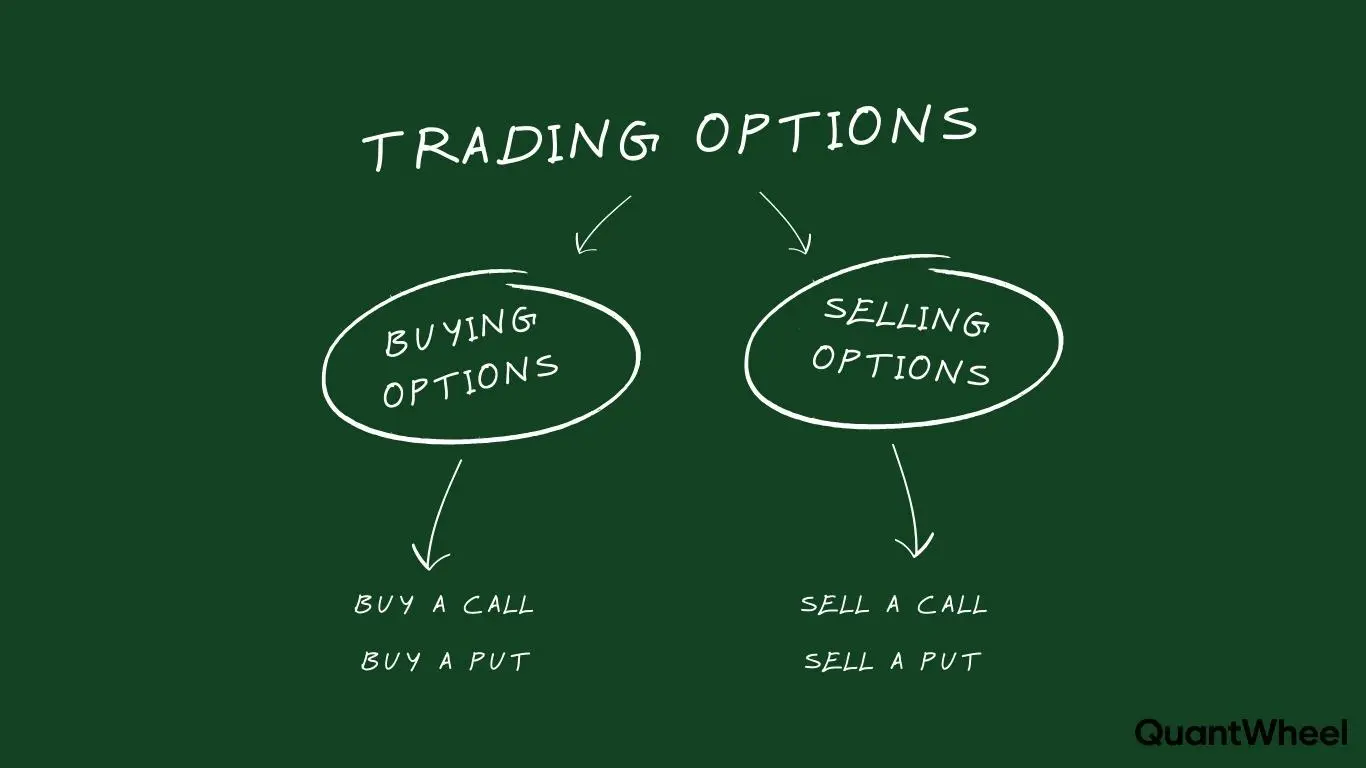
Options trading opens up powerful strategies for generating income, hedging positions, and leveraging your capital. Whether you want to buy call options on stocks you're bullish on or sell cash-secured puts to get paid while waiting to buy shares, understanding the mechanics of buying and selling options is essential.
This guide walks you through every step of options trading, from opening your first account to placing your first trade and managing positions afterward.
Master options trading with QuantWheel →
TLDR: How to Buy and Sell Options
Here's everything you need to know to start buying and selling options today:
First, open an options-approved brokerage account by completing an application that evaluates your trading experience. Most brokers approve Level 1-2 (buying options) within 1-2 business days.
To buy options, select your stock, choose a call (if bullish) or put (if bearish), pick a strike price and expiration date, then place a limit order. For example, if you're bullish on AAPL at $180, you might buy a $185 call expiring in 30 days for $3.50 per share ($350 total for one contract).
To sell options, you need more capital. Selling a cash-secured put requires enough cash to buy 100 shares. If you sell a $50 put on stock XYZ, you need $5,000 in cash. You collect the premium upfront (maybe $150) and either keep it if the option expires worthless, or buy the stock at $50 if you're assigned.
Simple example: You want to buy stock XYZ currently at $52, but you'd be happy to pay $50. Instead of placing a limit order, you sell a $50 put expiring in 30 days for $1.50 premium ($150 total). If XYZ stays above $50, you keep the $150. If it drops below $50, you buy 100 shares at $50 (which was your target anyway). Your real cost basis is $48.50 after collecting the $1.50 premium.
The key difference: buying options requires small capital with limited risk, while selling options requires more capital but lets you collect income upfront.
Advice if you're staring small: Buy a stock for $300-$600 and find a good covered call deal. Safest way to learn. Start your trading journey inside QuantWheel →
Step 1: Open an Options-Approved Brokerage Account
Before you can buy or sell options, you need a brokerage account with options trading approval. Not all accounts automatically have this access.
Choosing Your Broker
Popular brokers for options trading include:
- Fidelity - Great for beginners, excellent research tools
- Schwab - Strong platform, good customer service
- E*TRADE - User-friendly interface, solid options tools
- tastytrade - Built specifically for options traders
- Interactive Brokers - Best for active traders, lowest commissions
Most brokers charge $0 for stock trades but $0.50-$0.65 per options contract. If you trade frequently, these fees add up, so compare commission structures.
The Options Approval Process
When applying for options trading, you'll complete a questionnaire covering:
- Trading experience - How long you've been investing, your knowledge of options
- Financial situation - Annual income, net worth, liquid net worth
- Investment objectives - Income, growth, speculation
- Risk tolerance - Conservative to aggressive
Be honest but don't understate your knowledge. Brokers want to ensure you understand the risks, but being overly conservative might get you approved for lower levels only.
Options Approval Levels Explained
Level 1 (Covered Calls & Cash-Secured Puts)
- Sell covered calls against stock you own
- Sell cash-secured puts with cash in your account
- Lowest risk level
- Good starting point for income generation
Level 2 (Buying Calls & Puts)
- Buy call and put options
- Limited risk (can only lose premium paid)
- Most beginners start here
Level 3 (Spreads)
- Bull call spreads, bear put spreads
- Iron condors, credit spreads
- Defined risk multi-leg strategies
- Requires more experience
Level 4 (Naked Options)
- Sell uncovered calls or puts
- Highest risk level
- Requires significant capital and experience
- Most traders never need this level
Start with Level 1 or 2 approval and expand as you gain experience.
Step 2: Understand What You're Trading
Options are contracts that give you rights or obligations related to buying or selling stock at a specific price.
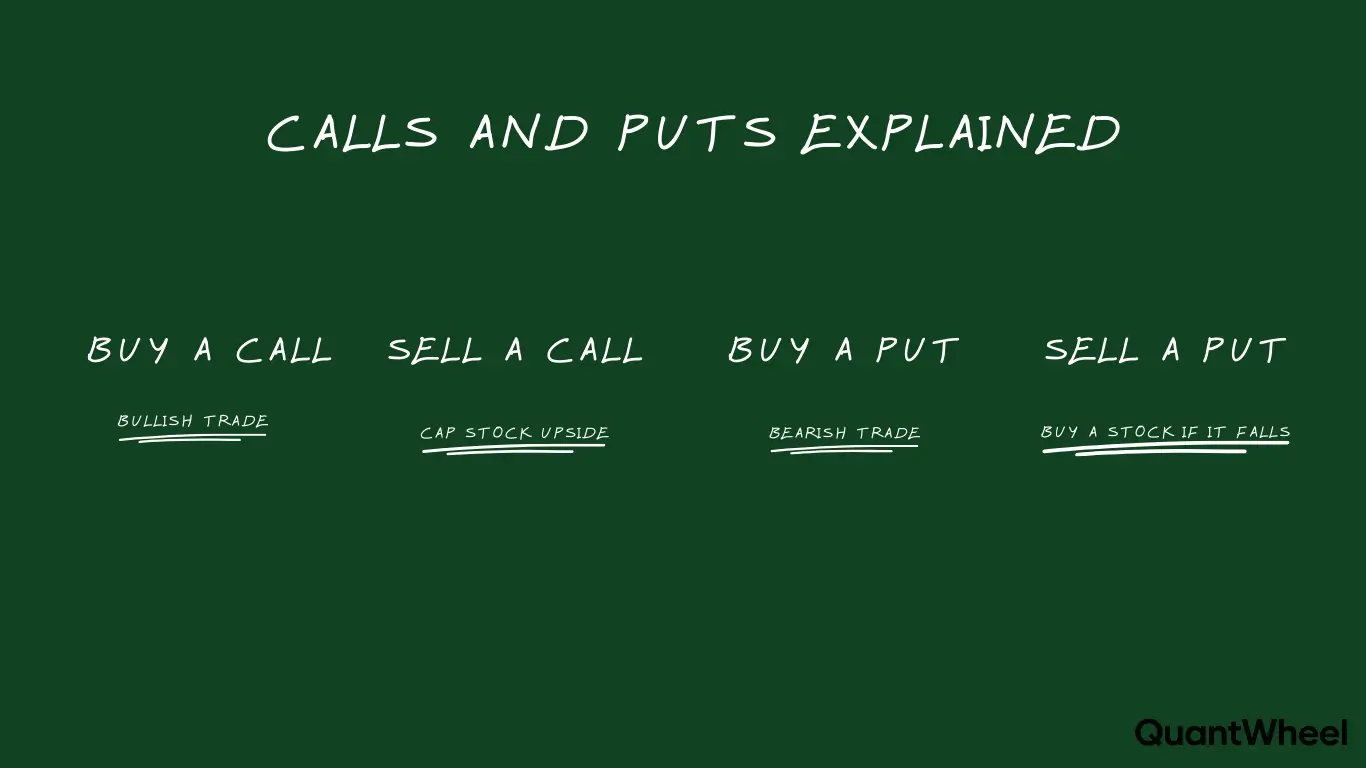
Call Options Explained
A call option gives you the right (but not obligation) to buy 100 shares of stock at a specific price (strike price) before a specific date (expiration).
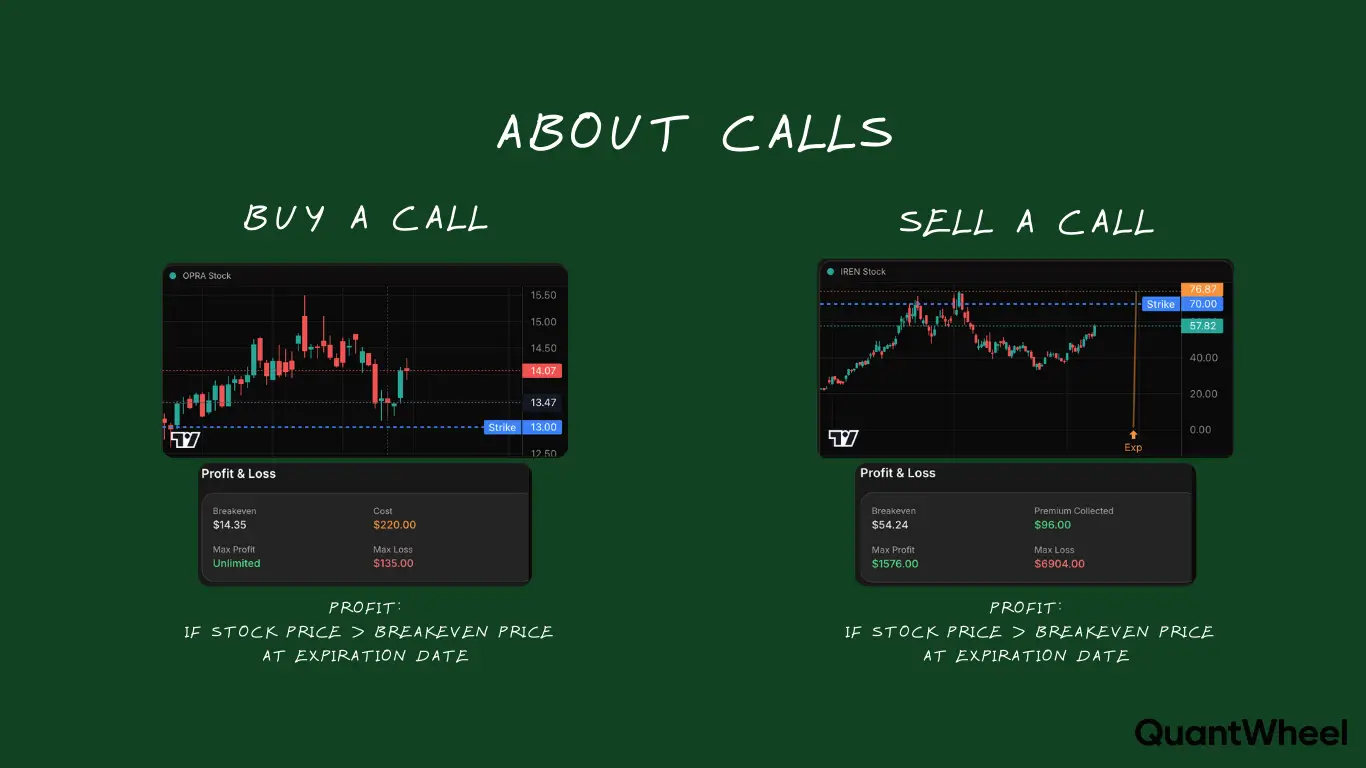
When you BUY a call:
- You're betting the stock will go UP
- You pay a premium upfront
- You can only lose what you paid
- You profit if stock price rises above strike + premium paid
Example: AAPL is trading at $180. You buy a $185 call expiring in 30 days for $3.50 per share ($350 for one contract). If AAPL rises to $195 by expiration, your call is now worth at least $10 ($1,000), giving you a $650 profit. If AAPL stays below $185, your option expires worthless and you lose the $350 premium.
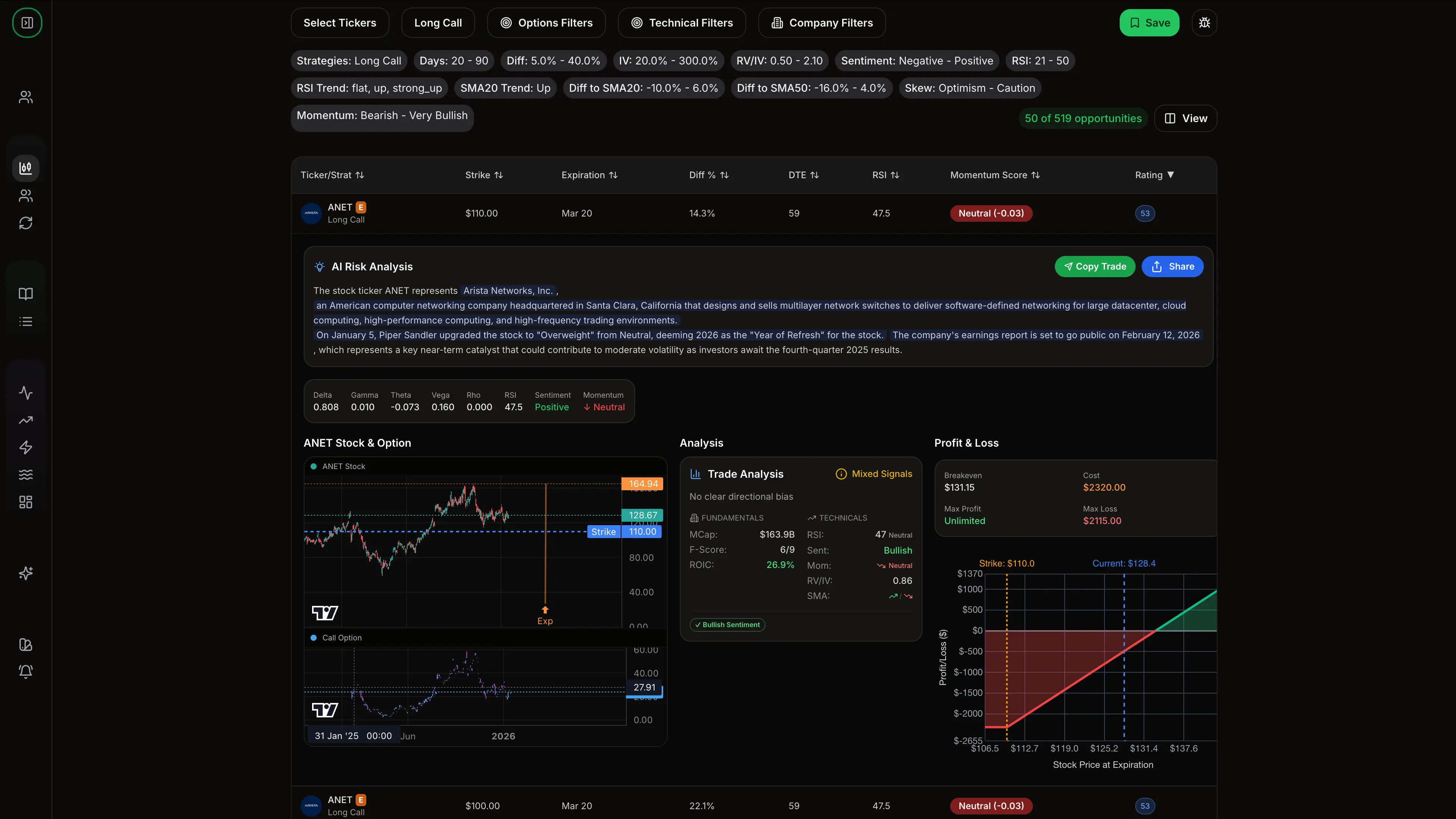
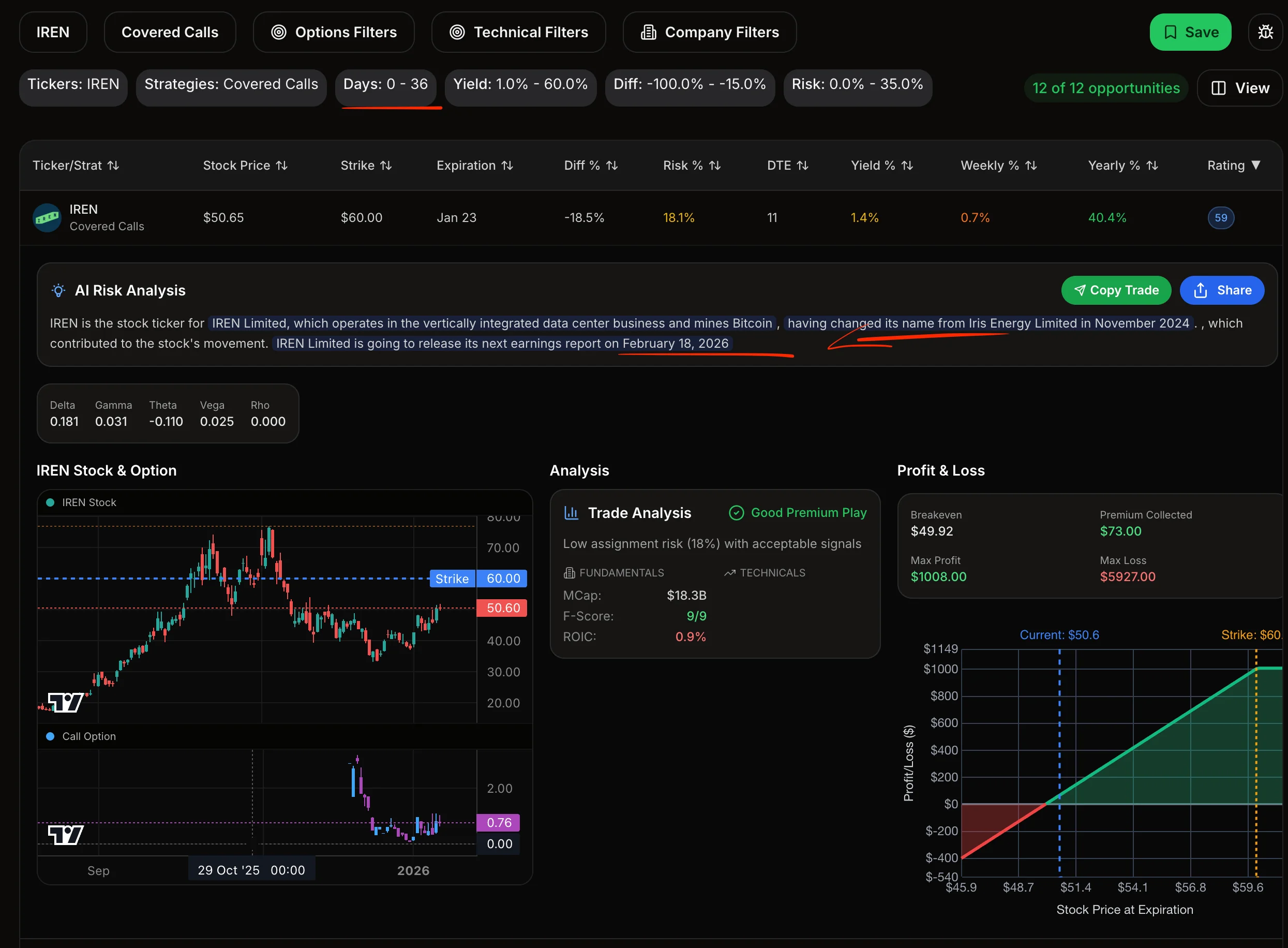
Example of a real trade that QuantWheel has found.
When you SELL a call (covered call):
- You own 100 shares of stock
- You collect premium upfront
- You're obligated to sell your shares if stock rises above strike
- You profit from the premium collected
Put Options Explained
A put option gives you the right (but not obligation) to sell 100 shares of stock at a specific price before expiration.
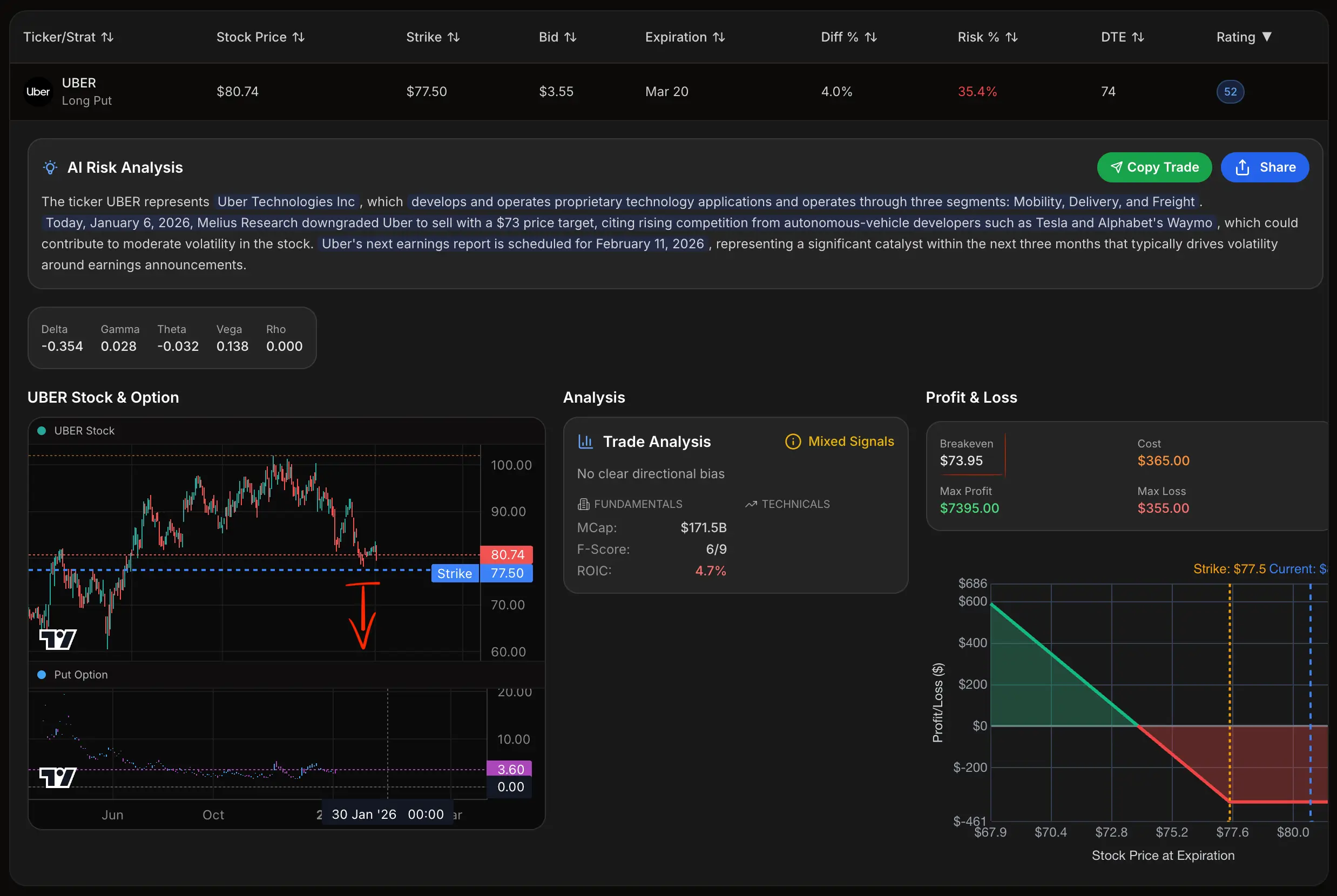
When you BUY a put:
- You're betting the stock will go DOWN
- You pay a premium upfront
- You can only lose what you paid
- You profit if stock price falls below strike - premium paid
Example: You think XYZ at $60 will drop. You buy a $55 put for $2 ($200 for one contract). If XYZ falls to $45, your put is worth at least $10 ($1,000), giving you an $800 profit.
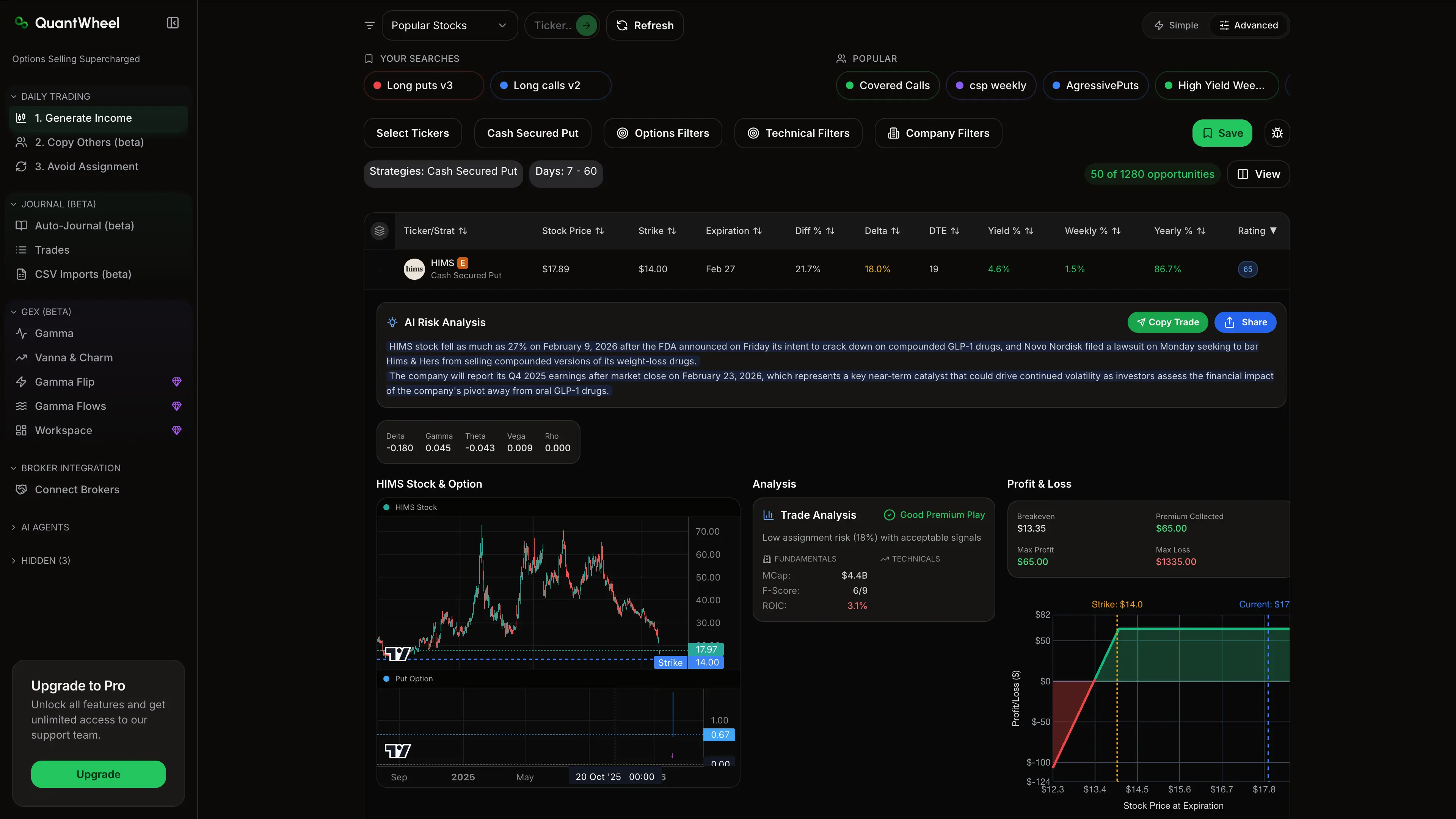
When you SELL a put (cash-secured put):
- You set aside cash to buy 100 shares
- You collect premium upfront
- You're obligated to buy shares if stock drops below strike
- You profit if stock stays above strike and you keep premium
Key Options Terms
- Strike Price - The price at which you can buy (call) or sell (put) the stock
- Expiration Date - When the option contract ends
- Premium - The price of the option per share (multiply by 100 for total cost)
- In the Money (ITM) - Option has intrinsic value (call: stock > strike, put: stock < strike)
- Out of the Money (OTM) - Option has no intrinsic value (call: stock < strike, put: stock > strike)
- Implied Volatility (IV) - How much price movement the market expects
Step 3: Choose Your Option Contract
Once you understand calls and puts, you need to select the specific contract that matches your trading strategy.
Selecting the Underlying Stock
Start with stocks you know and understand. Good characteristics for options trading:
- High liquidity - At least 1 million shares traded daily
- Tight bid-ask spread - Options should have narrow spreads (under $0.10 for liquid stocks)
- Sufficient volatility - Stocks that move generate better option premiums
- Weekly or monthly options - More flexibility in choosing expirations
Popular stocks for beginners include:
- Large-cap tech: AAPL, MSFT, NVDA, GOOGL
- Financial sector: JPM, BAC, GS
- ETFs: SPY, QQQ, IWM (excellent liquidity)
Choosing Strike Price
Your strike price selection depends on your market outlook and risk tolerance.
For buying calls:
- At-the-money (ATM) - Strike near current price, balanced risk/reward
- Out-of-the-money (OTM) - Strike above current price, cheaper but lower probability
- In-the-money (ITM) - Strike below current price, expensive but higher probability
For selling cash-secured puts:
- Most traders target OTM puts (strike below current price)
- Common approach: Sell the 30-delta put (roughly 30% chance of assignment)
- Further OTM = lower premium but lower assignment risk
Example: Stock XYZ trades at $52.
- $50 put (OTM) = Lower premium, less likely to be assigned
- $52 put (ATM) = Higher premium, 50/50 chance of assignment
- $55 put (ITM) = Highest premium, high probability of assignment
Selecting Expiration Date
Options expire on specific dates. Your choices typically include:
- Weekly expirations - Every Friday (high theta decay, active management)
- Monthly expirations - Third Friday of each month (most liquid)
- Quarterly expirations - Every three months
- LEAPS - Long-term options (up to 2+ years out)
Time decay (theta) works in favor of sellers, against buyers.
For buying options:
- Give yourself time - at least 30-45 days
- Avoid buying options expiring in under 2 weeks (rapid decay)
- Longer = more expensive but more time to be right
For selling options:
- Sweet spot: 30-45 days to expiration
- Maximizes premium while avoiding extended risk
- Many traders close at 50% profit or 21 days remaining
Checking Option Liquidity
Before trading any option, verify adequate liquidity:
- Open Interest - Should be at least 100 contracts (preferably 500+)
- Bid-Ask Spread - Should be narrow (under 5% of option price)
- Volume - Daily volume shows active trading
Illiquid options are difficult to exit and you'll lose money on wide spreads.
Step 4: Place Your Option Trade
Now you're ready to actually buy or sell an option through your broker's platform.
How to Buy a Call Option
Let's walk through buying a call option on AAPL.
Step 1: Navigate to option chain
- Search for AAPL in your broker's platform
- Click "Trade Options" or "Option Chain"
Step 2: Select expiration date
- Choose 30-45 days out for medium-term trades
- Look for the expiration that matches your timeframe
Step 3: Choose your call strike
- Review available strikes in the call side (right column)
- Check the premium, delta, and bid-ask spread
- For this example: $185 call trading at $3.50
Step 4: Place a limit order
- Select "Buy to Open"
- Enter number of contracts (start with 1)
- Set limit price at or below the ask (maybe $3.45)
- Review total cost (1 contract × $3.45 × 100 = $345)
Step 5: Submit and confirm
- Review order details carefully
- Confirm you're buying (not selling)
- Submit order
Your order will fill when someone sells at your limit price or better.
How to Sell a Cash-Secured Put
Selling puts requires more capital but generates income upfront.
Step 1: Ensure sufficient cash
- Check buying power in your account
- Need $5,000 cash to sell one $50 put
- Cash will be "held" as collateral
Step 2: Open option chain for your chosen stock
- Select stock trading at price you'd be happy to own it
- Click option chain
Step 3: Choose expiration (typically 30-45 days)
Step 4: Select put strike on put side (left column)
- Choose OTM strike (below current price)
- Review premium collected
- For this example: $50 put on $52 stock, premium $1.50
Step 5: Place limit order to sell
- Select "Sell to Open"
- Enter number of contracts (start with 1)
- Set limit price at or above the bid (maybe $1.55)
- Review premium collected (1 contract × $1.55 × 100 = $155)
Step 6: Submit order
- Confirm you're SELLING to open
- Premium is credited immediately upon fill
- $5,000 buying power is held as collateral
If the stock stays above $50 at expiration, you keep the $155 premium and the cash is released. If the stock drops below $50, you'll be assigned 100 shares at $50 per share.
Understanding Order Types
Market Order - Executes immediately at current market price
- Pros: Guaranteed fill
- Cons: Might get bad price on illiquid options
- When to use: Very liquid options only
Limit Order - Only executes at your specified price or better
- Pros: Price protection
- Cons: Might not fill
- When to use: Most of the time (default choice)
Stop-Loss Order - Triggers a market order when price hits your stop
- Useful for protecting profits on long options
- Less common for short options
Start with limit orders until you understand market dynamics.
Step 5: Manage Your Options Position
After your trade fills, active management separates successful traders from struggling ones.
Monitoring Your Position
Track these key metrics daily:
For long options (bought calls/puts):
- Current value vs. entry price
- Days until expiration (time decay accelerates)
- Underlying stock price movement
- Profit/loss percentage
For short options (sold puts/calls):
- Current value vs. premium collected
- Days until expiration (time decay working for you)
- Underlying stock price relative to strike
- Assignment risk
This is where position tracking becomes challenging when you have 5-10+ positions. Manual spreadsheets quickly become overwhelming - you need to track entry price, current price, days to expiration, P&L, and cost basis adjustments if you get assigned.
When to Close a Position Early
You don't have to hold options until expiration. Many traders close positions early to lock in profits or cut losses.
For long options - Take profits when:
- Hit your profit target (maybe 50-100% gain)
- Stock has moved substantially in your favor
- Less than 2 weeks to expiration (decay accelerates)
For long options - Cut losses when:
- Down 30-50% (your personal risk tolerance)
- Thesis is clearly wrong
- Better opportunity available
For short options - Close when:
- Captured 50-75% of max profit (common rule)
- 21 days until expiration (avoid gamma risk)
- Position has moved against you significantly
Example: You sold a $50 put for $1.50 premium ($150 collected). The option is now trading at $0.40. You can buy it back for $40, locking in $110 profit (73% of max profit). Many traders take this early win rather than holding for the last $40 over 2-3 more weeks.
Rolling Options
Rolling means closing your current option and opening a new one, typically to:
- Extend duration (buy more time)
- Adjust strike price
- Manage losing position
Example roll: You sold a $50 put expiring this Friday, currently at $48. Instead of taking assignment:
- Buy to close the $50 put (pay current price)
- Sell to open a $47 put expiring next month (collect premium)
- Net credit/debit determines if roll makes sense
Rolling is a powerful management tool but requires calculating whether you're improving your position.
Getting Assigned on Short Options
If you sell options, assignment will eventually happen. Here's what to expect:
Assignment on short puts:
- You buy 100 shares at the strike price
- Happens automatically over the weekend after expiration
- Your cash is used to purchase shares
- Cost basis = strike price - premium collected
Example: Sold $50 put for $1.50, got assigned.
- Broker's cost basis: $50.00
- Your real cost basis: $48.50 ($50 - $1.50 premium)
- You now own 100 shares at effective price of $48.50
Assignment on covered calls:
- Your 100 shares are sold at strike price
- Happens automatically if stock above strike at expiration
- You keep the premium + profit up to strike
Example: Own 100 shares at $48.50, sold $50 call for $1.00.
- Shares sold at $50.00
- Total profit: $1.50 (stock gain) + $1.00 (premium) = $2.50 per share = $250 total
This is where tracking becomes critical. Your broker shows purchase price, but your actual cost basis includes all premiums collected. After managing 10+ positions through assignments and rolls, manual tracking breaks down.
Step 6: Track Your Positions and Performance
Position tracking is where most options traders struggle. With multiple expirations, strikes, and assignment events, manual spreadsheets quickly become unmanageable.
What You Need to Track
Essential metrics:
- All open positions (strike, expiration, quantity)
- Entry price vs. current price
- Total premium collected per position
- Days until expiration
- Current P&L by position
- Aggregate portfolio P&L
- Cost basis after assignments
- Total buying power used
- Upcoming expiration dates
After 10+ positions, manual tracking becomes a nightmare. You spend 30+ minutes updating spreadsheets after each trade, and errors creep in when tracking cost basis through CSP → assignment → covered call → exit cycles.
QuantWheel's Automated Position Tracking
After struggling with spreadsheets for my own wheel strategy trading, I built QuantWheel to solve exactly this problem. The Wheel Native Journal syncs directly with your broker and automatically tracks:
- Full wheel cycles from CSP → assignment → covered call → exit
- Automatic cost basis adjustments when you get assigned
- Real-time P&L across all positions
- Upcoming expirations and earnings dates
- Roll tracking when you extend positions
The cost basis tracking is particularly valuable. When you get assigned on a $50 put after collecting $1.50 premium, QuantWheel automatically adjusts your cost basis to $48.50. Your broker shows $50, but your real breakeven is $48.50 - and that difference matters for every decision you make afterward.
Measuring Your Performance
Beyond position tracking, measuring your overall performance tells you if your strategy is actually working.
Key performance metrics:
- Total return percentage
- Win rate (percentage of profitable trades)
- Average winner vs. average loser
- Return per day (accounting for time value)
- Comparison to buy-and-hold
Many traders think they're profitable but haven't calculated actual returns when accounting for assignment costs, capital tied up, and opportunity cost.
Common Options Trading Strategies
Now that you understand how to buy and sell options, here are the most popular strategies beginners start with.
Strategy 1: Buying Call Options (Bullish)
When to use: You expect stock to rise significantly
How it works:
- Buy OTM or ATM call option
- Pay premium upfront
- Profit if stock rises above strike + premium paid
- Maximum loss = premium paid
Example: AAPL at $180, buy $185 call for $3.50, stock rises to $195.
- Profit = ($195 - $185 - $3.50) × 100 = $650
- Return = 186% on $350 invested
Risk: Stock stays flat or drops, lose entire $350 premium
Strategy 2: Buying Put Options (Bearish)
When to use: You expect stock to fall or want portfolio protection
How it works:
- Buy OTM or ATM put option
- Pay premium upfront
- Profit if stock falls below strike - premium paid
- Maximum loss = premium paid
Example: SPY at $480, buy $470 put for $4.00 as portfolio hedge.
- If market crashes to $450, put worth at least $20 ($2,000 value)
- Protected your portfolio for cost of $400 premium
Strategy 3: Cash-Secured Put (Income)
When to use: You want to buy stock at lower price and get paid to wait
How it works:
- Sell OTM put below current price
- Collect premium upfront
- Either keep premium if stock stays above strike, or buy stock at strike
Example: Want to buy XYZ at $50, currently $52.
- Sell $50 put for $1.50 premium ($150)
- If XYZ stays above $50: keep $150, didn't buy stock (fine to repeat)
- If XYZ drops below $50: buy 100 shares at effective price of $48.50
This is popular for wheel strategy traders who systematically sell puts, get assigned, then sell covered calls.
Strategy 4: Covered Call (Income on Owned Stock)
When to use: You own 100 shares and want to generate income
How it works:
- Own 100 shares of stock
- Sell OTM call above current price
- Collect premium upfront
- Either keep premium if stock stays below strike, or sell stock at strike
Example: Own 100 shares of MSFT at $400, sell $420 call for $5.00 ($500).
- If MSFT stays below $420: keep $500 premium, still own shares (repeat)
- If MSFT rises above $420: sell shares at $420, keep $500 premium
- Total profit = ($20 stock gain + $5 premium) × 100 = $2,500
Strategy 5: The Wheel Strategy (Combined Income)
When to use: You want systematic income generation
How it works:
- Sell cash-secured put, collect premium
- If assigned, buy stock at strike
- Sell covered call on owned stock, collect premium
- If called away, sell stock at strike
- Return to step 1
Example full wheel cycle on stock trading at $52:
Step 1: Sell $50 put for $1.50, collect $150
- Stock stays above $50: keep $150, repeat
- Stock drops to $48: get assigned
Step 2: Own 100 shares at $50, real cost basis $48.50
- Sell $52 covered call for $1.50, collect $150
Step 3: Stock rises above $52, shares called away
- Sell shares at $52
- Total profit: ($52 - $48.50) × 100 = $350 profit + $300 total premium = $650 total
The wheel strategy is popular because it's systematic, generates consistent premium, and assignment is part of the plan (not a failure).
Options Trading Risks to Understand
Options amplify both gains and losses. Understanding risks prevents costly mistakes.
Risk 1: Time Decay (Theta)
For option buyers: Every day, your option loses value even if the stock doesn't move. This theta decay accelerates in the final 30 days.
Mitigation: Buy options with at least 30-45 days until expiration, close positions early rather than holding to expiration.
Risk 2: Implied Volatility Crush
For option buyers: After earnings or major events, implied volatility often drops sharply. Your option can lose value even if stock moves in your favor.
Example: Buy call before earnings, stock rises 3%, but IV drops from 60% to 30%. Your call might still lose value.
Mitigation: Be cautious buying options before events, understand you're paying for inflated IV.
Risk 3: Assignment on Short Options
For option sellers: You can be assigned at any time (before expiration) if your option is ITM. Assignment usually happens right before ex-dividend dates or at expiration.
Mitigation: Monitor positions closely near expiration, close or roll ITM positions before expiration if you don't want assignment.
Risk 4: Undefined Risk (Naked Options)
For certain strategies: Selling naked calls has theoretically unlimited risk (stock can rise infinitely). Selling naked puts has substantial risk (stock can drop to zero).
Mitigation: Only sell cash-secured puts (defined risk) or covered calls (protected by stock ownership). Avoid naked options until you have significant experience.
Risk 5: Over-Trading and Commission Costs
Options commissions ($0.50-$0.65 per contract) add up quickly with frequent trading.
Example: Trade 100 contracts per month at $0.65 each = $65 in commissions = $780 per year.
Mitigation: Trade less frequently, use limit orders to minimize fills, consider commission structure when choosing strategies.
Tips for Successful Options Trading
After understanding mechanics, these principles separate profitable traders from struggling ones.
Start Small and Simple
Your first trades should be:
- Single contracts (not 10 at once)
- Liquid stocks (SPY, AAPL, MSFT)
- Simple strategies (CSP or covered call, not spreads)
- Short-dated (30-45 days, not LEAPs)
Master one strategy before adding complexity. Many traders fail by trying advanced strategies before understanding basics.
Follow a Systematic Process
Successful options trading requires consistency:
Before opening trade:
- Define your maximum acceptable loss
- Set profit target (maybe 50% for short options)
- Know your exit plan before entering
- Check earnings dates (avoid surprises)
While in trade:
- Monitor daily (5-10 minutes)
- Follow your rules (close at 50% profit if that's your rule)
- Don't let emotions override your process
After closing trade:
- Log what worked and what didn't
- Calculate actual return including commissions
- Review if you followed your plan
Manage Position Sizing
Never risk more than you can afford to lose:
- Start with 1-2% of portfolio per trade
- Don't use all buying power (keep reserves)
- Diversify across multiple stocks and expirations
- Account for correlation (don't sell 10 tech puts)
Example: $50,000 account
- Per position risk: $500-$1,000 (1-2%)
- Maybe 5-10 active positions
- Keep 30-40% cash reserve
- Maximum 2-3 positions in same sector
Keep Learning
Options trading is a skill that improves with study and practice:
- Track all trades in a journal
- Review what worked and why
- Learn from losses (most valuable lessons)
- Study one new strategy per month
- Join communities (r/thetagang, r/options)
The most successful traders view every trade as a learning opportunity, not just a chance for profit
Start Your Options Trading Journey Today
Buying and selling options opens powerful strategies for income generation, speculation, and portfolio protection. The mechanics are straightforward once you understand calls, puts, strikes, and expirations.
Your action plan:
- Open options-approved brokerage account (start with Level 1-2)
- Paper trade for 2-4 weeks to learn platform mechanics
- Start with one simple strategy (cash-secured put or covered call)
- Trade one contract at a time until consistently profitable
- Track every trade and learn from results
- Gradually add complexity as you gain experience
The most important factor is consistency. Follow a systematic process, manage risk carefully, and focus on learning rather than maximizing short-term profits.
Options trading rewards patience, discipline, and continuous learning. Start small, master the basics, and build your skills progressively.
$1 for 7 days • Cancel anytime • 14-day money-back guarantee
Risk Disclosure
Options trading involves substantial risk and is not suitable for all investors. Past performance does not guarantee future results. This content is for educational purposes only and should not be considered investment advice. Always do your own research and consider consulting with a financial advisor before making investment decisions.
The examples used in this article are for educational purposes only and are not recommendations to buy or sell any security. All investment decisions should be based on your own analysis and risk tolerance.