
Pick better trades with QuantWheel →
You've heard about options trading and how traders use them to generate income or leverage their positions, but every time you try to learn about them, you get hit with confusing jargon about "Greeks," "moneyness," and complex strategies with intimidating names.
Here's the truth: options are actually straightforward once you understand the basic mechanics. In this guide, I'll walk you through exactly how options work step by step, using plain English and real examples.
Options are contracts that control 100 shares of stock and give you rights without obligations.
Here's how they work in 5 simple steps:
Step 1: Pick Your Bet - Choose a stock you think will go up (buy a call) or down (buy a put).
Step 2: Choose Your Strike Price - This is the price at which you can buy or sell the stock. For example, a $50 strike call lets you buy shares at $50.
Step 3: Select Expiration Date - Options have a deadline. Pick a date by which your prediction needs to happen (weekly, monthly, or further out).
Step 4: Pay the Premium - This is your upfront cost for the right to buy/sell. If the option costs $2.00, you pay $200 (remember, one contract = 100 shares).
Step 5: Manage the Position - Before expiration, you can: sell the contract for profit, exercise it to buy/sell shares, or let it expire worthless.
Simple Example: You think ABC stock (trading at $48) will go to $55. You buy a $50 call expiring in 30 days for $2.00 premium ($200 total). If ABC goes to $55, your call is worth at least $5.00 ($500), giving you a $300 profit. If ABC stays at $48, your option expires worthless and you lose the $200 premium.
Key Point: As a buyer, you can never lose more than the premium you paid. That's your maximum risk.
What Are Options? The Foundation
An option is a financial contract that gives you the right, but not the obligation, to buy or sell 100 shares of stock at a predetermined price before a specific expiration date.
Think of it like a reservation at a restaurant. When you make a reservation, you have the right to dine there at a specific time, but you're not obligated to show up. If something better comes along or you change your mind, you can simply not go. Options work similarly - you pay upfront for the right to make a transaction later, but you're never forced to do it.
Key characteristics of options contracts:
- Standardized: Each contract represents exactly 100 shares
- Time-limited: They expire on a specific date (expiration date)
- Strike price: The predetermined price at which you can buy or sell
- Premium: The upfront cost you pay for the option contract
- Two types: Calls (right to buy) and Puts (right to sell)
The beauty of options is that they give you leverage and flexibility. You can control 100 shares of stock for a fraction of the cost of buying those shares outright.
Step 1: Understanding Call Options vs Put Options
Before you can trade options, you need to understand the two fundamental types.
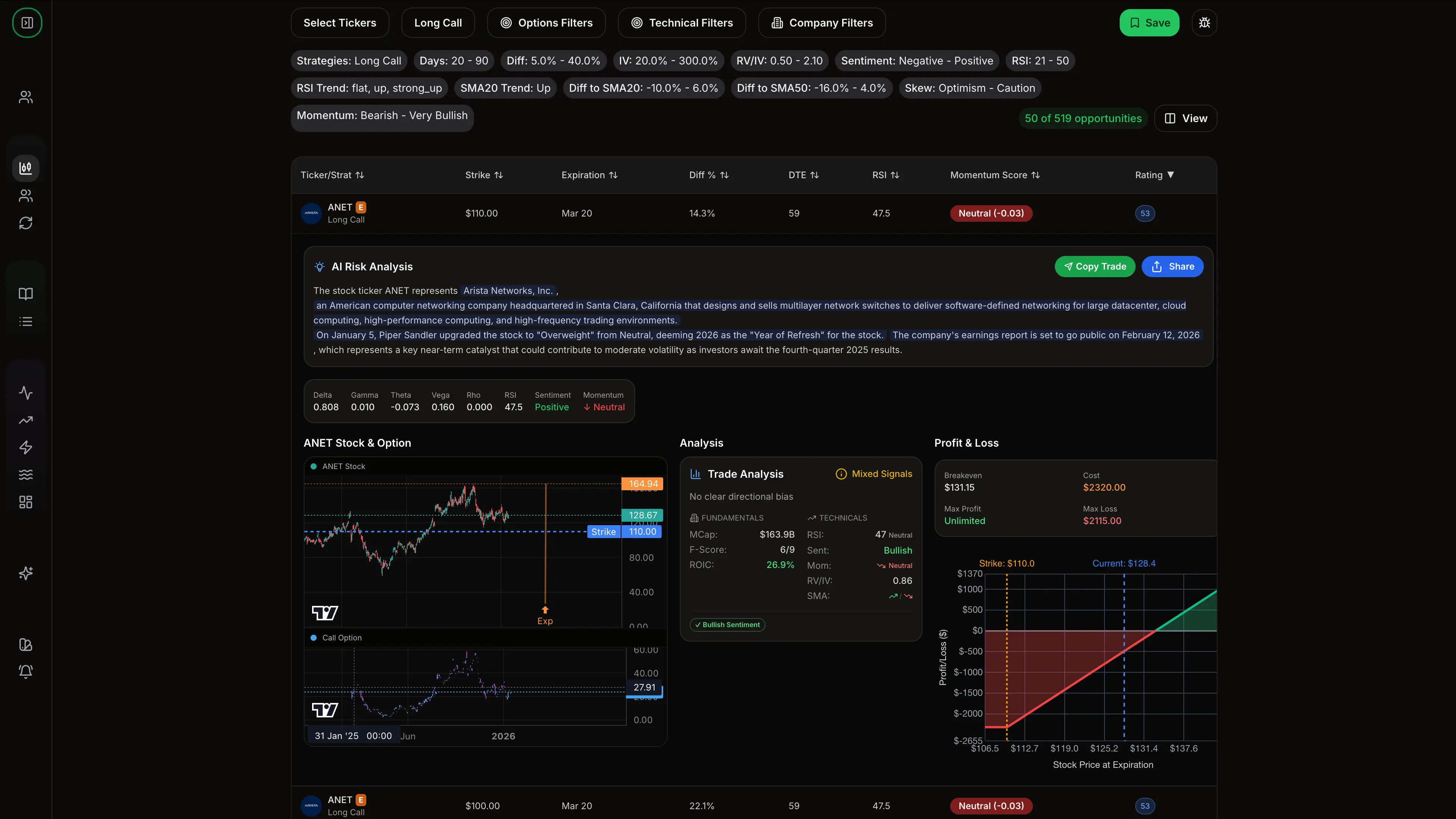
Call Options: Betting on Price Going Up
A call option gives you the right to buy 100 shares of stock at the strike price before expiration.
You buy calls when you think a stock will go up in price.
Real Example:
- Stock: Tesla (TSLA) currently trading at $245
- You buy: TSLA $250 Call expiring in 30 days
- Premium paid: $8.00 ($800 total for 1 contract)
- Your bet: TSLA will go above $250 before expiration
Profit scenario: If TSLA jumps to $270 by expiration, your $250 call is now worth at least $20 (the difference between $270 and $250). You can sell it for $2,000, making a $1,200 profit on your $800 investment (150% return).
Loss scenario: If TSLA stays at $245 or drops, your $250 call expires worthless. You lose the $800 premium you paid - that's your maximum loss.
Put Options: Betting on Price Going Down
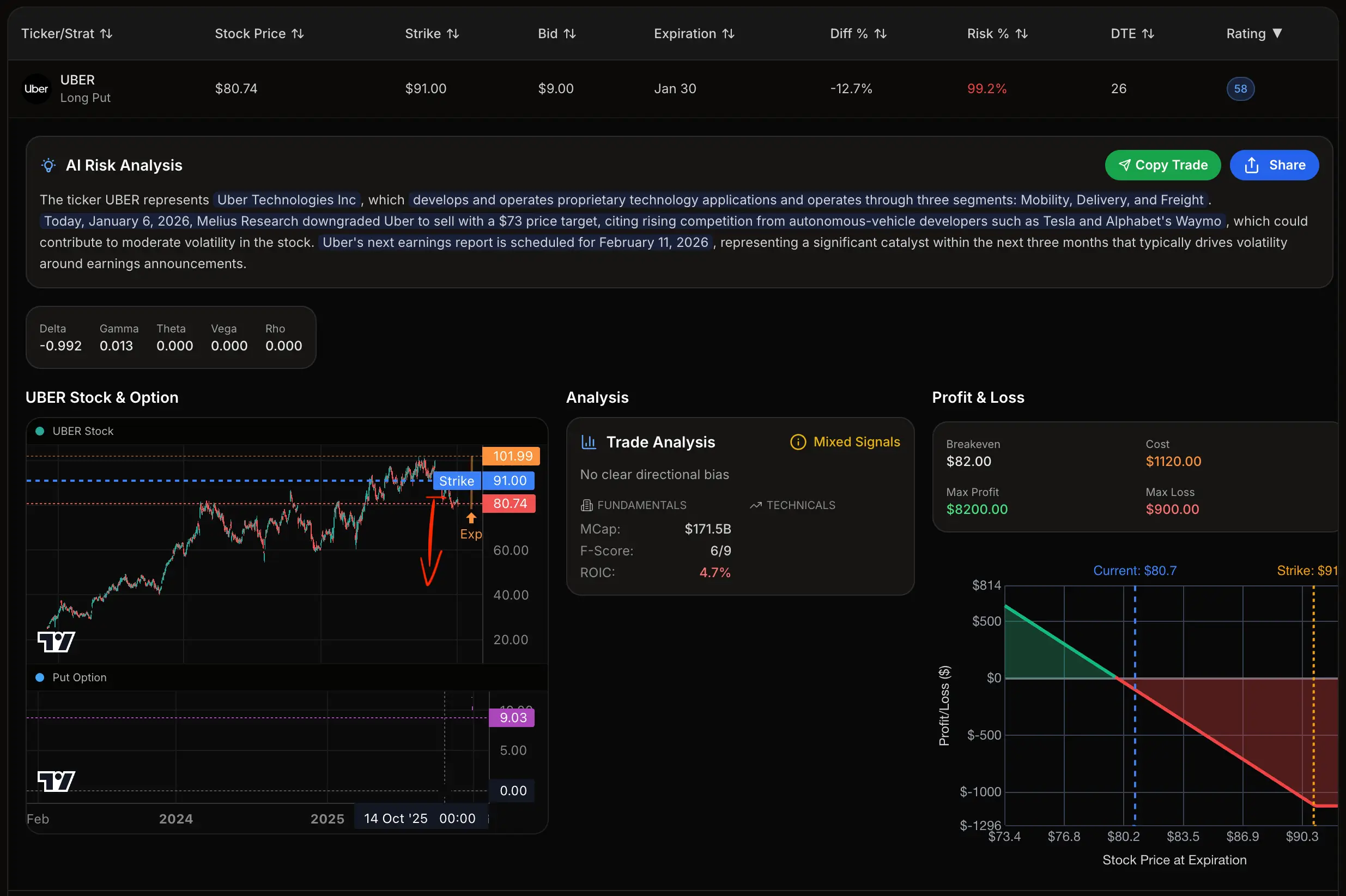
A put option gives you the right to sell 100 shares of stock at the strike price before expiration.
You buy puts when you think a stock will go down in price.
Real Example:
- Stock: Apple (AAPL) currently trading at $185
- You buy: AAPL $180 Put expiring in 30 days
- Premium paid: $5.00 ($500 total for 1 contract)
- Your bet: AAPL will go below $180 before expiration
Profit scenario: If AAPL drops to $165 by expiration, your $180 put is now worth at least $15 (the difference between $180 and $165). You can sell it for $1,500, making a $1,000 profit on your $500 investment (200% return).
Loss scenario: If AAPL stays at $185 or goes up, your $180 put expires worthless. You lose the $500 premium you paid - that's your maximum loss.
Key Distinction:
- Calls = bullish (you want the stock to go up)
- Puts = bearish (you want the stock to go down)
Find quality trades like this with QuantWheel →
Step 2: Choosing Your Strike Price
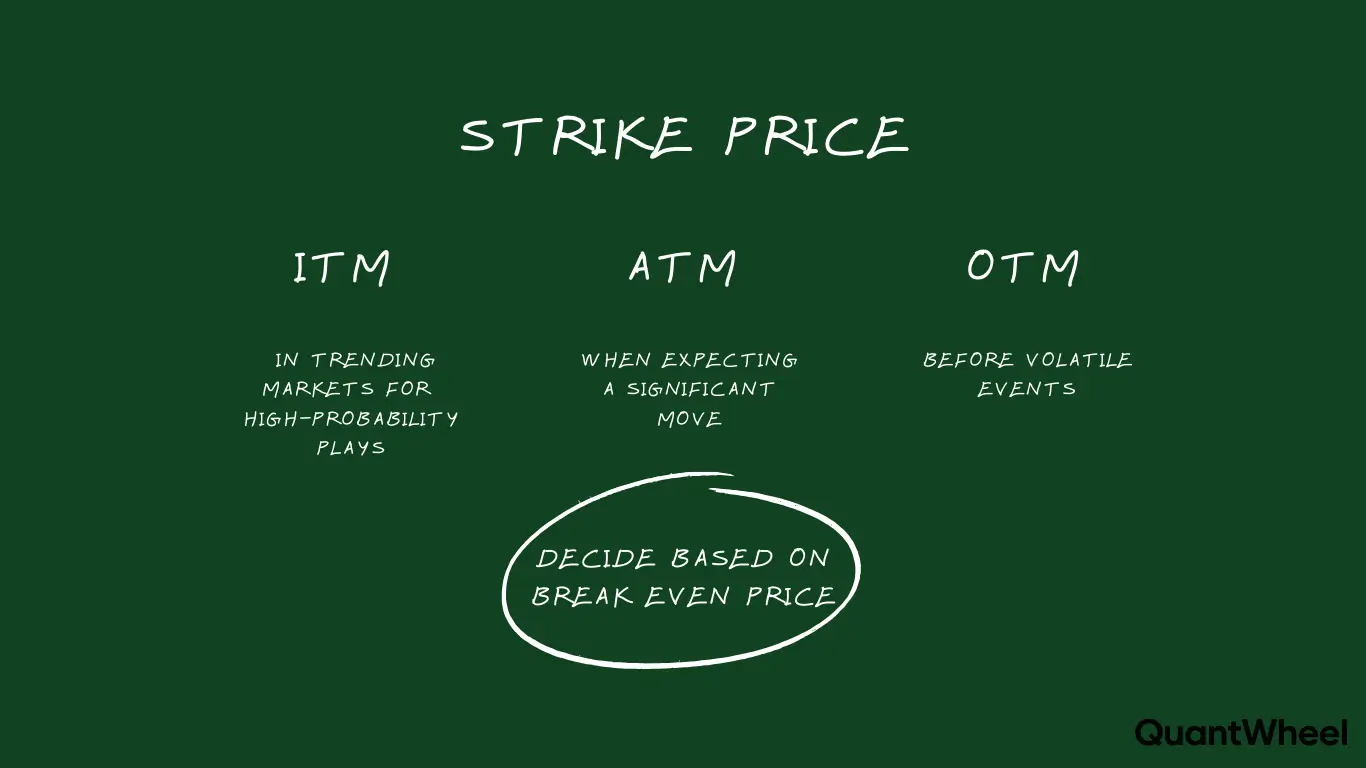
The strike price (also called exercise price) is the predetermined price at which you can buy (for calls) or sell (for puts) the stock.
Strike prices are listed in standard increments (often $5 or $10 apart, sometimes $1 for lower-priced stocks) and your choice dramatically affects both the cost and probability of profit.
Strike Price Selection: The Risk-Reward Balance
Out-of-the-Money (OTM):
- Calls: Strike price above current stock price
- Puts: Strike price below current stock price
- Cheaper premium, lower probability of profit
- Higher potential return percentage if you're right
At-the-Money (ATM):
- Strike price equal (or very close) to current stock price
- Moderate premium, moderate probability
- Balanced risk-reward
In-the-Money (ITM):
- Calls: Strike price below current stock price
- Puts: Strike price above current stock price
- Expensive premium, higher probability of profit
- Lower potential return percentage, but more conservative
Example with Stock at $100:
| Option Type | Strike | Premium | Cost | Needs Stock To... | Breakeven |
|---|---|---|---|---|---|
| Call (OTM) | $105 | $2.00 | $200 | Go above $105 | $107 |
| Call (ATM) | $100 | $5.00 | $500 | Go above $100 | $105 |
| Call (ITM) | $95 | $8.00 | $800 | Stay above $95 | $103 |
Notice how the ITM option costs more but requires less movement to profit, while the OTM option is cheaper but requires bigger moves.
The Break-Even Point
Your break-even point is crucial to understand:
For call buyers: Strike price + premium paid = break-even
- $100 strike + $5 premium = $105 break-even
- Stock must go above $105 for you to profit
For put buyers: Strike price - premium paid = break-even
- $100 strike - $5 premium = $95 break-even
- Stock must go below $95 for you to profit
Step 3: Selecting Your Expiration Date
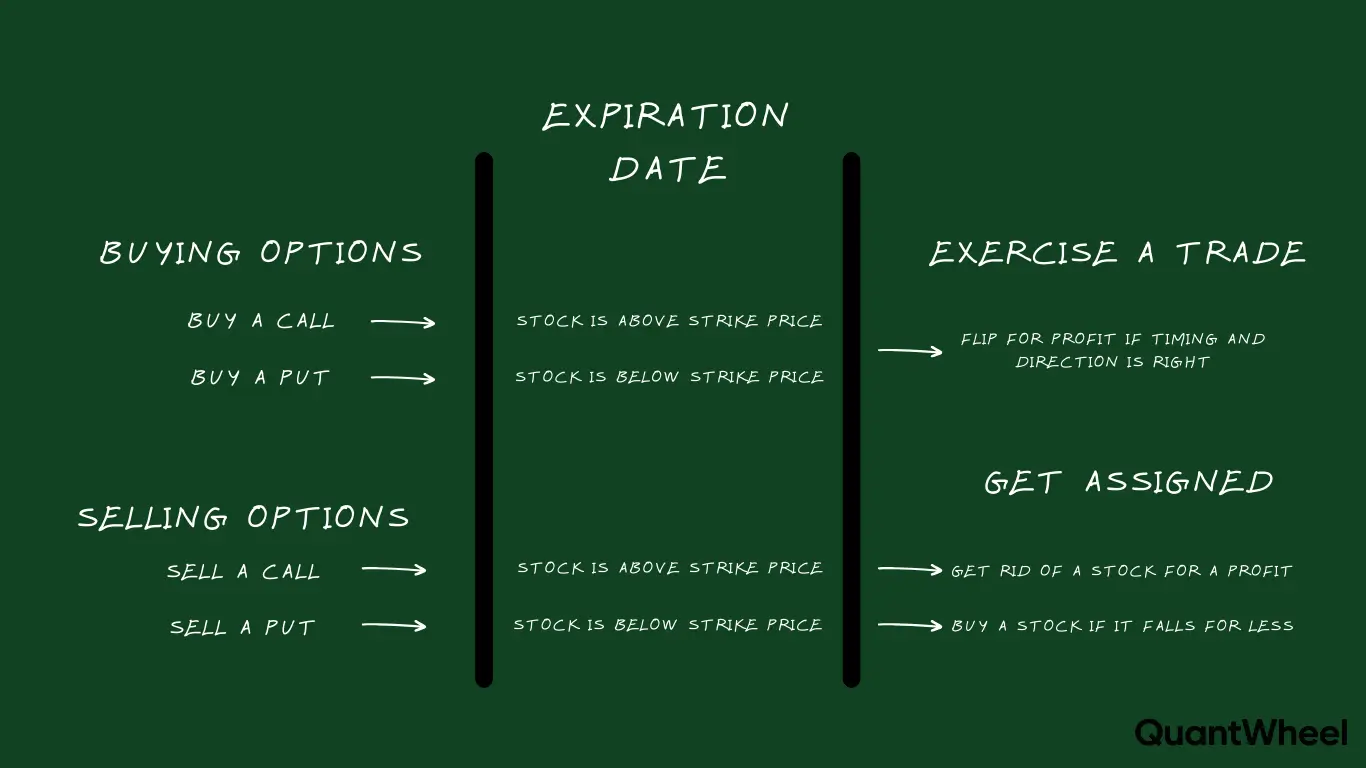
Every option has an expiration date - the deadline by which your prediction needs to come true.
Options expire on the third Friday of the expiration month (for monthly options), though weekly options expire every Friday.
Common Expiration Timeframes
Weekly Options (0-7 days):
- Cheapest premiums
- Highest theta decay (time decay accelerates)
- Extremely risky for buyers
- Requires precise timing
- Popular for experienced traders
Monthly Options (30-45 days):
- Moderate premiums
- Good balance of time and cost
- Most popular for retail traders
- Enough time for your thesis to play out
LEAPS (Long-term options, 6+ months):
- Expensive premiums
- Minimal daily theta decay
- Stock-like behavior
- Used for longer-term positions
- Lower risk for buyers
Example: AMD Trading at $140
| Expiration | Premium | Days | Daily Decay | Strategy |
|---|---|---|---|---|
| This Friday | $2.00 | 3 | -$0.67/day | High risk speculation |
| Next month | $6.00 | 35 | -$0.17/day | Standard trade |
| 6 months out | $18.00 | 180 | -$0.10/day | Position trade |
Time Decay (Theta)
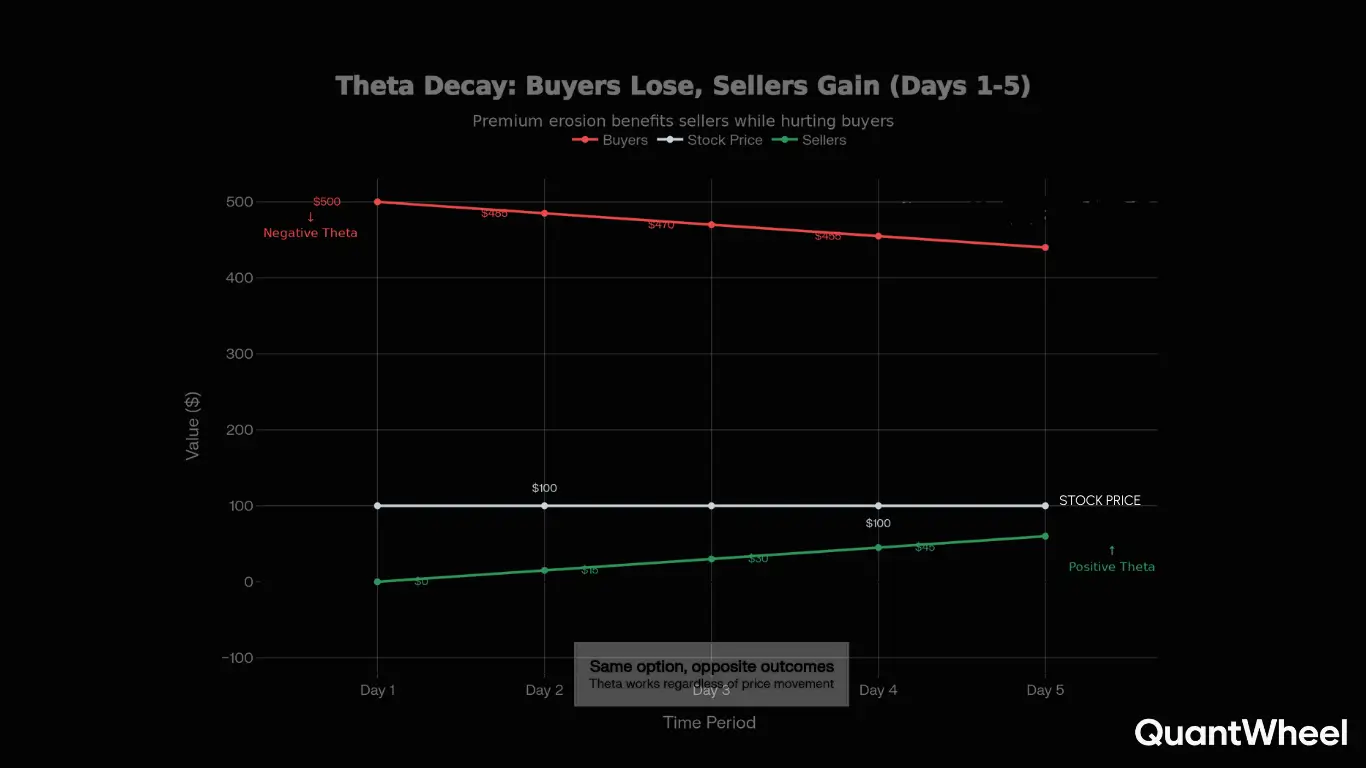
Here's what most beginners don't realize: options lose value every day, even if the stock doesn't move.
This phenomenon is called time decay or theta, and it accelerates as expiration approaches.
Think of it like a melting ice cube. A 90-day option melts slowly. A 7-day option melts rapidly. A 1-day option is practically water.
Time decay schedule:
- Days 45-90: Slow decay (barely noticeable)
- Days 21-45: Moderate decay (steady erosion)
- Days 7-21: Rapid decay (accelerating)
- Days 0-7: Extreme decay (exponential)
This is why buying options with only a few days left is extremely risky - you're fighting against time decay every single day.
Step 4: Paying the Premium (Your Cost and Risk)
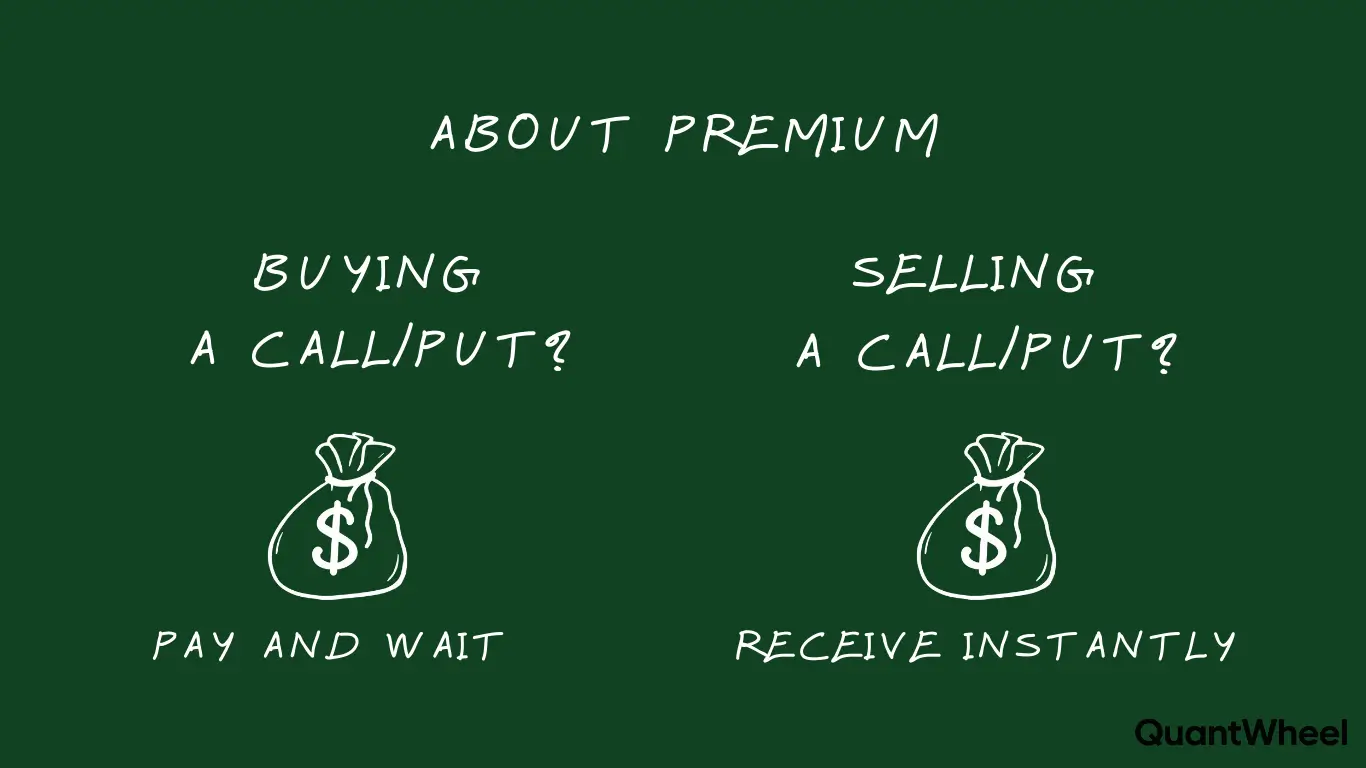
The premium is the price you pay upfront to buy an option contract. This is quoted on a per-share basis, but remember - each contract controls 100 shares.
How to Calculate Your Actual Cost
Premium quoted: $3.50 Actual cost: $3.50 × 100 shares = $350
When you see an option quoted at $3.50, you'll pay $350 to buy one contract.
What Determines Premium Prices?
Several factors influence how much premium you'll pay:
1. Distance from strike to current price (Intrinsic value)
- Further OTM = cheaper
- ITM = more expensive
2. Time until expiration (Extrinsic value)
- More time = higher premium
- Less time = lower premium
3. Implied volatility (Market expectation of movement)
- High volatility = expensive premiums
- Low volatility = cheap premiums
4. Stock price itself
- Expensive stocks = expensive options
- Cheap stocks = cheap options
Real Example Comparison:
Microsoft (MSFT) at $420 - High-priced stock, low volatility:
- 30-day ATM call: $12.00 premium ($1,200 cost)
GameStop (GME) at $25 - Low-priced stock, high volatility:
- 30-day ATM call: $4.50 premium ($450 cost)
Notice how the cheaper stock (GME) has a lower dollar premium, but GME options are actually more expensive relative to the stock price because of higher volatility.
Your Maximum Risk as a Buyer
Critical rule: As an options buyer, your maximum loss is always limited to the premium you paid.
If you buy a call for $500, the worst-case scenario is you lose $500 if the option expires worthless. You can never lose more than this initial premium.
This is fundamentally different from buying stock, where losses can continue as the stock price falls.
Step 5: Managing Your Options Position
Once you've bought an option, you have three possible outcomes before or at expiration.
Option 1: Sell the Contract for Profit
This is what 90% of options traders do.
You don't actually want to buy or sell the stock - you just want to profit from the change in the option's value.
Example:
- You bought: SPY $450 Call for $5.00 ($500 cost)
- SPY rallies from $445 to $455
- Your call is now worth $8.00 ($800 value)
- You sell to close: $300 profit (60% return in days/weeks)
You simply sell the option contract back to the market, pocketing the difference. No shares ever change hands.
When to sell:
- Hit your profit target (many traders close at 50% profit)
- Your thesis changes or you want to cut losses
- Expiration is approaching and you want to lock in gains
- You see better opportunities elsewhere
Option 2: Exercise the Option (Buy or Sell Shares)
This is less common but sometimes makes sense.
When you exercise an option, you're using your right to buy (calls) or sell (puts) the actual shares at the strike price.
Call Exercise Example:
- You own: NVDA $500 Call
- NVDA is now at $550
- You exercise: Buy 100 shares at $500 (total: $50,000)
- Immediate equity: $55,000 (100 shares × $550)
- Profit: $5,000 minus the premium you originally paid
When to exercise:
- You actually want to own the shares long-term
- It's dividend capture time (exercise calls before ex-dividend date)
- Deep ITM options with little extrinsic value left
- You're using a strategy like the wheel (more on this later)
Important: You need enough capital to exercise. Exercising a $100 call means you need $10,000 to buy 100 shares.
Option 3: Let It Expire
What happens at expiration depends on whether your option is ITM or OTM.
If Out-of-the-Money at expiration:
- The option expires worthless
- You lose the premium you paid
- Nothing else happens
- This is your maximum loss
If In-the-Money at expiration:
- Most brokers will automatically exercise ITM options
- You'll buy (calls) or sell (puts) 100 shares at the strike price
- Make sure you have the capital for this!
- Or close before expiration to avoid this
Example of automatic exercise:
- You own: AMD $130 Call
- Expiration day: AMD closes at $138
- Your call is $8 ITM
- Broker automatically exercises: You buy 100 shares at $130
- Your account now has 100 AMD shares at $130 cost basis
Many beginners are surprised by automatic exercise. If you don't want shares, close your position before expiration Friday.
How Options Sellers Work (The Other Side)
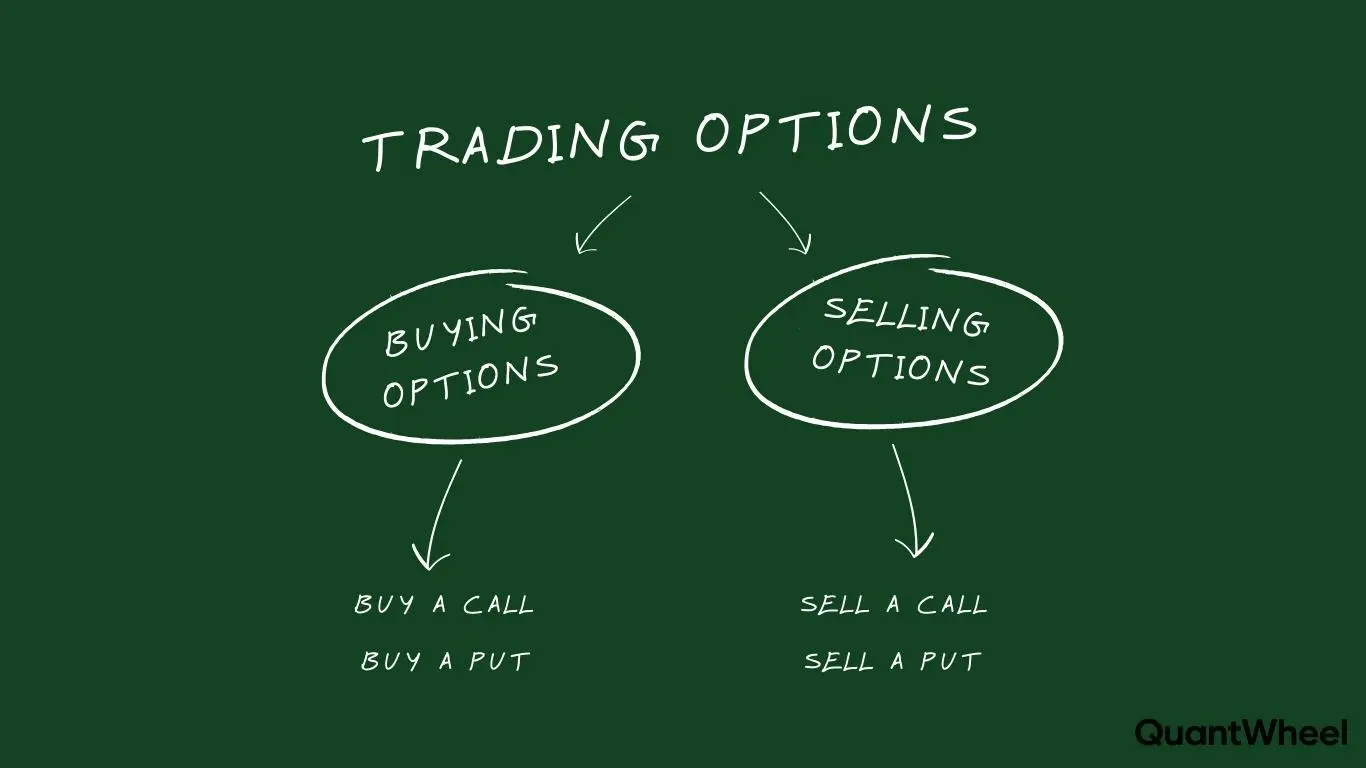
So far, we've discussed buying options. But for every buyer, there's a seller (also called the "writer").
Selling Options: Collecting Premium
When you sell an option, you:
- Collect the premium upfront (this is your income)
- Take on the obligation to buy (if you sold puts) or sell (if you sold calls) shares if the buyer exercises
- Have theoretically unlimited risk (much higher than buying)
Why would someone sell options?
Options sellers believe the stock will NOT move dramatically, so they collect premium betting that options will expire worthless or decrease in value.
This is a core component of income-generating strategies like the wheel strategy, which many traders use to generate consistent cash flow.
Cash-Secured Puts: Income Strategy Example
Here's how selling a cash-secured put works:
Setup:
- Stock: AMD trading at $140
- You sell: AMD $135 Put expiring in 30 days
- Premium collected: $3.00 ($300 total)
- Your obligation: Buy 100 shares at $135 if assigned
Best case scenario (Stock stays above $135):
- Put expires worthless
- You keep the $300 premium
- Annualized return: ~26% on the $13,500 cash backing the put
Assignment scenario (Stock drops to $128):
- You're obligated to buy 100 shares at $135 ($13,500 total)
- Your real cost basis: $135 - $3 premium = $132 per share
- You now own 100 shares at effectively $132 while market price is $128
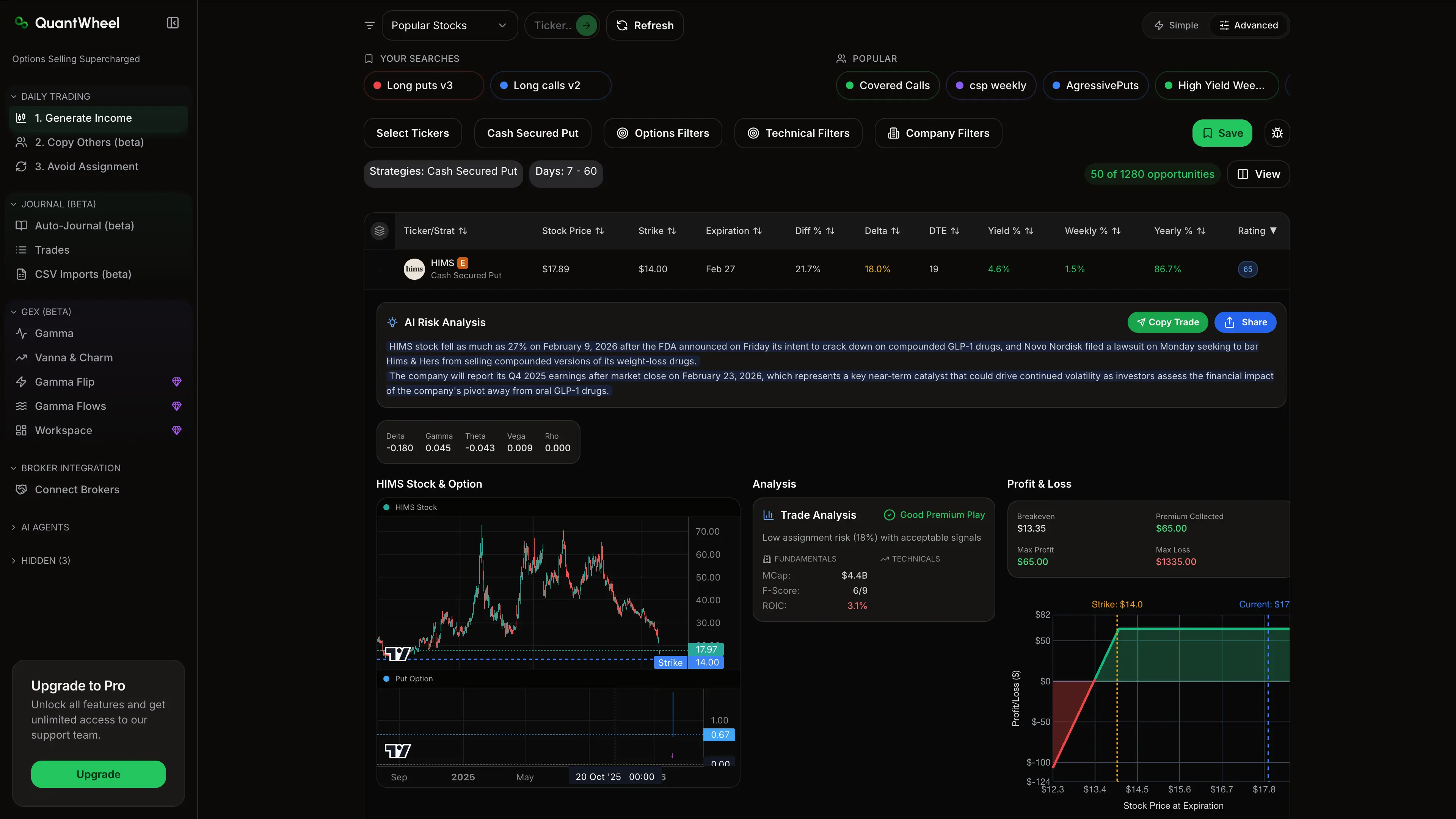
Here's where most traders struggle with options selling: calculating your actual cost basis after assignment. Your broker shows you bought shares at $135, but your real cost is $132 after accounting for the $300 premium you collected. You need to track this manually.
Unless you're using software like QuantWheel that automatically adjusts your cost basis when assignments happen. It's one of those accounting headaches that options sellers deal with constantly - but it doesn't have to be if you have the right tools tracking it for you.
Covered Calls: Generating Income on Shares You Own
If you own 100 shares of stock, you can sell call options against them to generate additional income.
Setup:
- You own: 100 shares of AAPL at $180
- You sell: AAPL $190 Call expiring in 30 days
- Premium collected: $4.00 ($400 total)
Best case scenario (Stock stays below $190):
- Call expires worthless
- You keep the $400 premium
- You still own your 100 shares
- Repeat next month
Assignment scenario (Stock rallies to $198):
- Your shares get called away at $190
- You keep the $400 premium
- Total profit: $1,000 capital gain ($180→$190) + $400 premium = $1,400
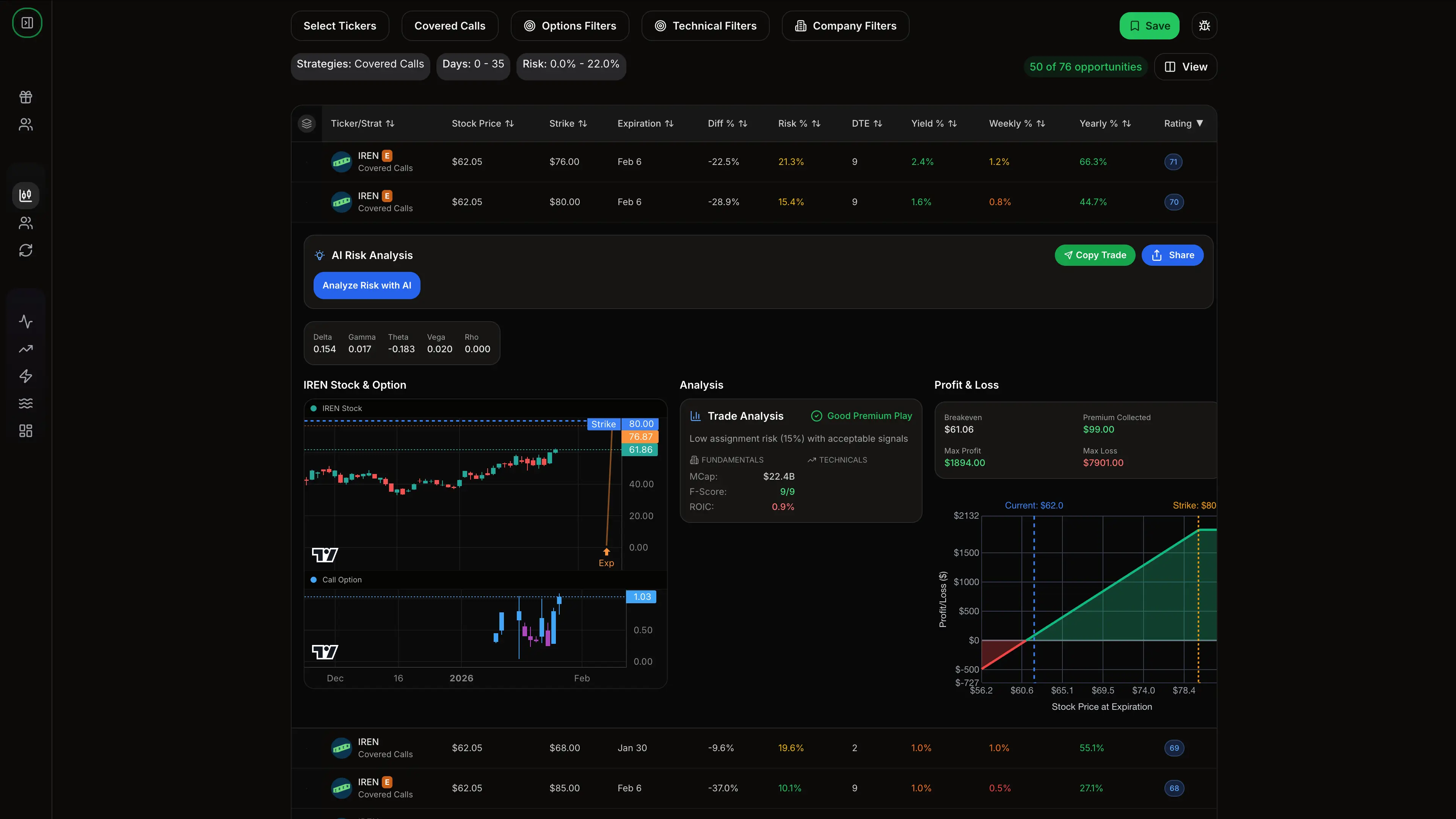
Covered calls cap your upside (you sold the right to buy your shares at $190), but you generate income in exchange.
Learn how to pick better trades with QuantWheel →
Options Trading Strategies: Beyond Basic Buying
Once you understand the fundamentals, you can combine options in various ways.
The Wheel Strategy: Conservative Income Generation
The wheel strategy combines cash-secured puts and covered calls into a systematic income approach.
How it works:
- Sell cash-secured puts and collect premium
- If assigned, now you own shares at a good cost basis
- Sell covered calls on those shares and collect more premium
- If called away, shares are sold at profit
- Repeat - the "wheel" keeps turning
Many traders use this because it's conservative, systematic, and generates consistent premium income. The wheel strategy is particularly popular in communities like r/thetagang.
The challenge with the wheel? Tracking all those moving parts - the put premium, the assignment cost basis adjustment, the covered call premium, and the final exit. After managing 10+ wheel positions, your spreadsheet becomes a nightmare.
This is exactly why software like QuantWheel exists - built specifically for wheel traders who need to track full cycles without losing their minds.
Other Common Strategies
Spreads (buying and selling options together):
- Reduce cost and risk
- Cap both potential profit and loss
- Examples: credit spreads, debit spreads, iron condors
Protective Puts (insurance for stock):
- Buy puts on stock you own
- Limits downside risk
- Costs premium but protects capital
Straddles/Strangles (betting on volatility):
- Buy both calls and puts
- Profit from large moves in either direction
- Lose from no movement
These advanced strategies are beyond the scope of this beginner's guide, but they show how flexible options can be once you master the basics.
Common Mistakes Beginners Make with Options
After helping thousands of traders learn options, here are the mistakes I see most often:
Mistake 1: Buying Options with Too Little Time
Buying options that expire in 3-7 days is gambling, not trading. Time decay will destroy your position even if you're directionally correct.
Better approach: Give yourself at least 30-45 days for your thesis to play out.
Mistake 2: Not Understanding Break-Even
Many beginners think if the stock hits their strike price, they profit. Wrong. You need the stock to move BEYOND your strike by the amount of premium you paid.
Always calculate: Your break-even is strike ± premium.
Mistake 3: Risking Too Much Per Trade
Some traders put 20-50% of their account in one options trade because "the most I can lose is the premium." While technically true, blowing up your account with one bad trade is very real.
Better approach: Risk 2-5% of your account per options trade, just like any other trading.
Mistake 4: Ignoring Volatility
Buying options right before earnings or major events means you're paying extremely high premiums due to implied volatility. Even if you're right about direction, you might lose money as volatility crashes after the event.
Better approach: Understand IV rank and avoid overpaying for options.
Mistake 5: Not Having an Exit Plan
Hope is not a strategy. Many traders buy options and then just watch them expire worthless because they didn't set profit targets or stop losses.
Better approach: Before entering, decide: "I'll close at 50% profit or 50% loss."
Mistake 6: Poor Record Keeping
If you're selling options or running strategies like the wheel, manual tracking becomes a nightmare. You'll lose track of cost basis, premium collected, and actual returns.
This is especially painful during tax season when you need to report everything accurately.
Better approach: Use automated tracking from day one. Whether it's a detailed spreadsheet or professional software like QuantWheel, have a system before you need it.
How Much Money Do You Need to Start Trading Options?
The capital required depends on whether you're buying or selling options.
Buying Options (Lower Capital Required)
You can start buying options with $500-$2,000.
Example starting portfolio:
- Account size: $1,000
- Risk per trade: 5% = $50
- Buy 1-2 contracts at a time
- Focus on learning, not big wins
Advantages:
- Low barrier to entry
- Limited, defined risk
- Can start small
Disadvantages:
- Time decay works against you
- Need to be right on direction AND timing
- Easy to blow up account with risky plays
Selling Options (Higher Capital Required)
Selling cash-secured puts or covered calls typically requires $5,000-$25,000.
Example for cash-secured puts:
- Want to sell puts on a $50 stock
- Need $5,000 in cash to secure each put (100 shares × $50)
- Collect $100-$300 premium per contract per month
- Can manage 2-5 positions with $10,000-$25,000 account
Advantages:
- Time decay works FOR you
- Higher probability of success
- Generate consistent income
Disadvantages:
- Requires significant capital
- Risk is much higher than premium collected
- Account can be tied up in positions
Many traders start by buying options to learn mechanics, then transition to selling options (like the wheel strategy) once they build more capital and experience.
Important Risk Disclosures
Before trading options, understand these critical risks:
Options are risky instruments:
- Most options expire worthless
- Time decay erodes value daily
- You can lose 100% of premium paid
- Sellers face potentially unlimited losses
Leverage cuts both ways:
- Options magnify both gains and losses
- Small account moves can wipe out positions
- Emotional decisions are amplified
Education is essential:
- Paper trade before risking real money
- Start small, even if you have capital
- Learn one strategy deeply before adding more
- Track every trade to learn from wins and losses
Consider starting with simulation:
Most brokers offer paper trading accounts where you can practice with fake money. Spend at least 1-3 months practicing before risking real capital.
Next Steps: Your Options Trading Journey
If you've made it this far, you now understand more about options than 90% of people who start trading them.
Here's your action plan:
Step 1: Open a broker account with options approval
- Popular choices: TD Ameritrade, Interactive Brokers, Tastytrade
- Request Level 2 options approval (for buying calls/puts)
- Fund your account with capital you can afford to lose
Step 2: Paper trade for 30-60 days
- Practice buying calls and puts
- Watch how time decay affects positions
- Test different strike prices and expirations
- Track every trade's outcome
Step 3: Start small with real money
- Begin with 1-2 contracts
- Risk only 2-5% per trade
- Focus on learning, not profit
- Keep detailed records
Step 4: Master one strategy before expanding
- Don't try to learn everything at once
- Pick one approach (buying calls, wheel strategy, etc.)
- Execute it 20-30 times before adding complexity
- Build competence through repetition
Step 5: Build your trading infrastructure
- Develop a consistent tracking system
- Set up alerts for expirations and opportunities
- Create a trade journal to review decisions
- Consider tools that automate the tedious stuff
If you're planning to trade systematically (especially income strategies like the wheel), having proper tracking in place from day one will save you countless hours and headaches.
$1 for 7 days • Cancel anytime • 14-day money-back guarantee
Risk Disclosure
Options trading involves substantial risk and is not suitable for all investors. Past performance does not guarantee future results. This content is for educational purposes only and should not be considered investment advice. Always do your own research and consider consulting with a financial advisor before making investment decisions.
The examples used in this article are for educational purposes only and are not recommendations to buy or sell any security. All investment decisions should be based on your own analysis and risk tolerance.