
Covered calls are one of the most popular options strategies for generating income from stocks you already own. But understanding exactly how covered calls work - from the moment you open the position to expiration day - can be confusing for beginners.
This guide breaks down the complete mechanics and timeline of covered calls in plain English, with real examples and specific numbers. By the end, you'll understand exactly what happens at each step, when money changes hands, and what outcomes to expect.
Find Covered Calls with QuantWheel →
How Covered Calls Work: TLDR Summary
A covered call works by selling someone the right to buy your stock at a fixed price while you collect money upfront. Here's the simple version:
- You own 100 shares of a stock (example: XYZ trading at $50/share = $5,000 invested)
- You sell 1 call option at $52 strike price expiring in 30 days
- You collect $150 premium immediately (deposited in your account)
- Two outcomes at expiration:
- Stock below $52: Option expires worthless, you keep shares + $150 premium, can repeat
- Stock above $52: Shares are sold at $52 ($5,200 total), you keep $150 premium + $200 gain on shares = $350 profit total
Simple example: You own 100 shares of Apple at $180. You sell a covered call at $185 strike for $3.00 premium ($300 total). Apple is at $183 at expiration. The option expires worthless, you keep your 100 shares AND the $300. You can now sell another covered call next week and collect more premium.
The catch: If Apple goes to $200, you still only sell at $185 (missing $15/share in extra gains). You cap your upside in exchange for the immediate premium income.
What Is a Covered Call?
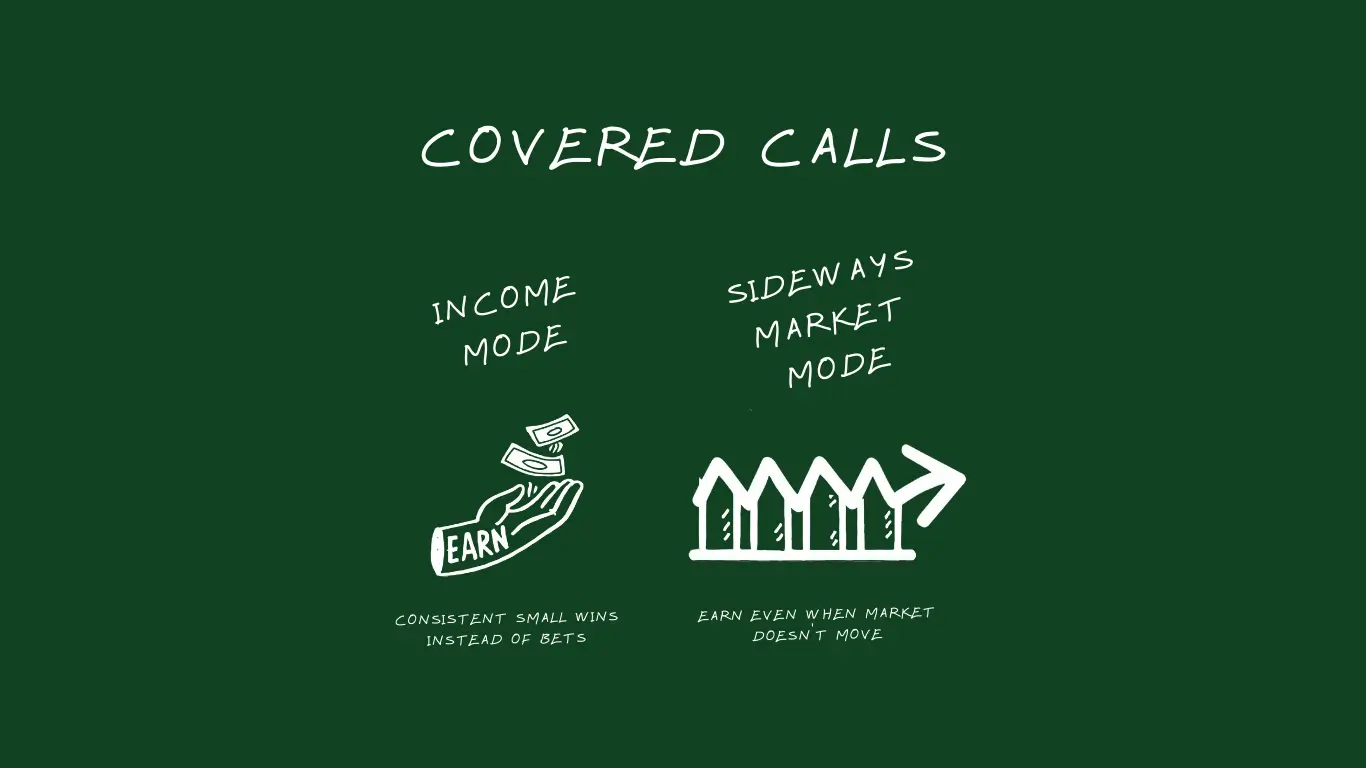
A covered call is an options strategy where you own 100 shares of stock and sell one call option contract against those shares. The word "covered" means you actually own the underlying stock, which "covers" your obligation if the option is exercised.
The mechanics work like this:
- You own 100 shares (the coverage)
- You sell 1 call option contract (represents 100 shares)
- Buyer pays you premium for the right to buy your shares
- You keep the premium no matter what happens
Think of it like renting out your shares: you get paid upfront (the premium), and if the "renter" (option buyer) wants to keep them permanently at the agreed price (strike price), you must sell. If they don't want them, you keep both the rental payment and the shares.
The Complete Covered Call Timeline: Step by Step
Step 1: You Own the Stock (Day 0)
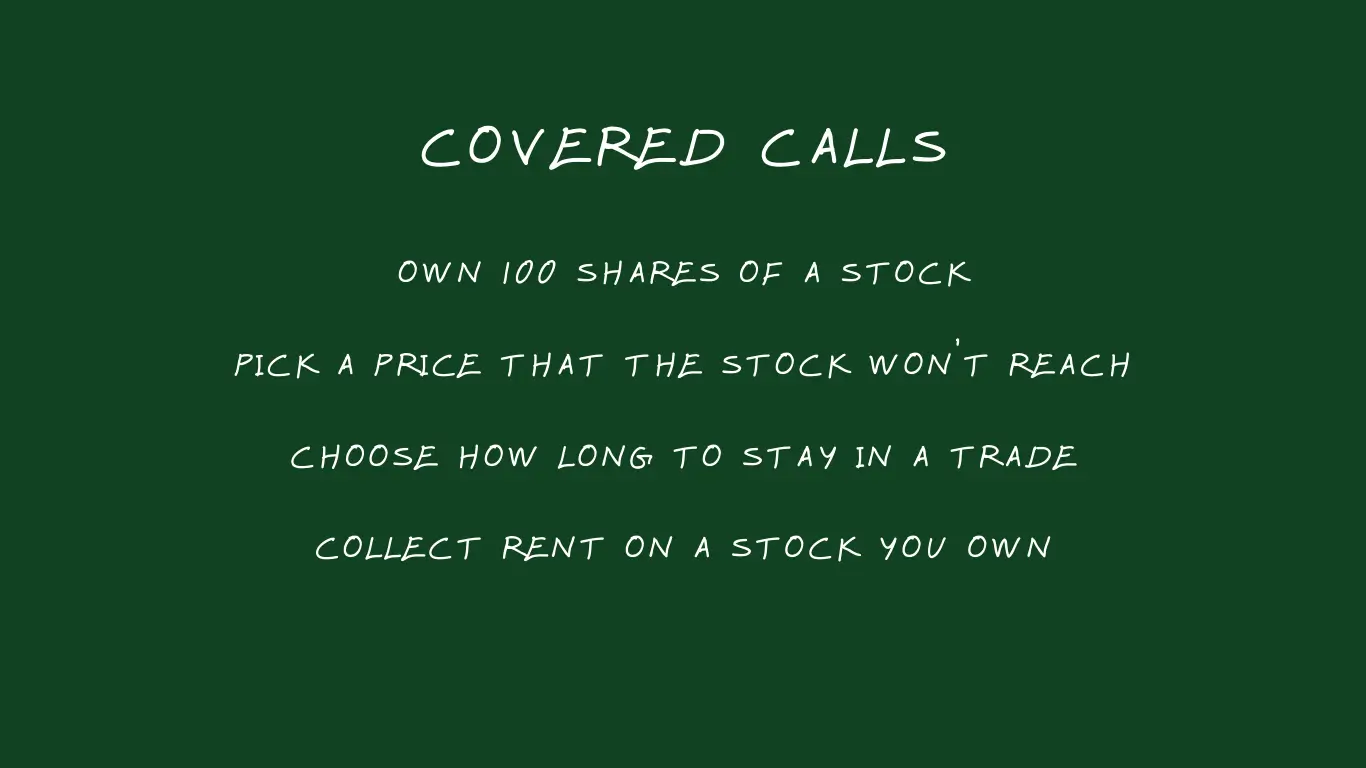
Before selling a covered call, you must own 100 shares of the underlying stock. This is a requirement - you can't sell "naked" calls without the shares.
Example starting position:
- Stock: XYZ Corporation
- Current price: $50.00 per share
- Your position: 100 shares
- Your investment: $5,000
You've owned these shares and now want to generate additional income from them while you hold.
Step 2: You Sell the Call Option (Day 0)
You sell a call option contract against your 100 shares. When selling, you choose:
Strike price: The price at which your shares can be purchased ($52 in our example) Expiration date: When the option expires (30 days out) Premium: The amount you collect for selling the option ($1.50 per share = $150 total)
What you're selling: The right (but not the obligation) for someone else to buy your 100 shares at $52 per share anytime before expiration.
Transaction details:
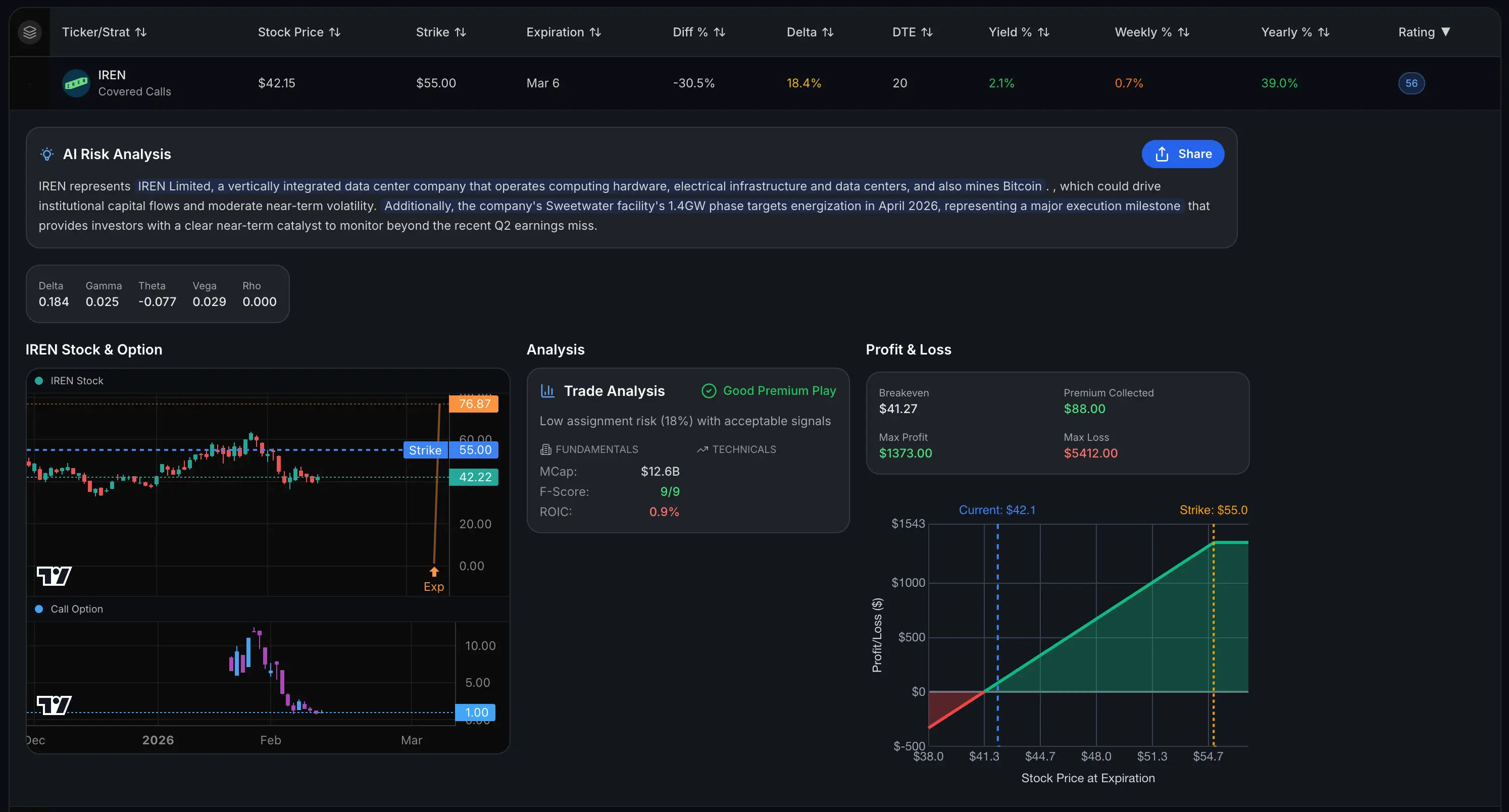
- Option: XYZ $52 Call expiring in 30 days
- Premium collected: $1.50 per share × 100 shares = $150
- This $150 is deposited immediately into your account
- Your shares remain in your account (you still own them)
Here's a visual trade example:
Step 3: Premium is Yours Immediately (Day 0)
Critical point: The $150 premium is yours to keep no matter what happens next. This is not a loan. This is your money now.
What this means:
- Premium hits your account instantly
- Available to withdraw or trade with immediately
- You keep it if stock goes up, down, or sideways
- You keep it if assigned or if option expires worthless
This is why covered calls are called "income strategies"-you generate immediate income from stocks you already own.
Step 4: Waiting Period (Days 1-29)
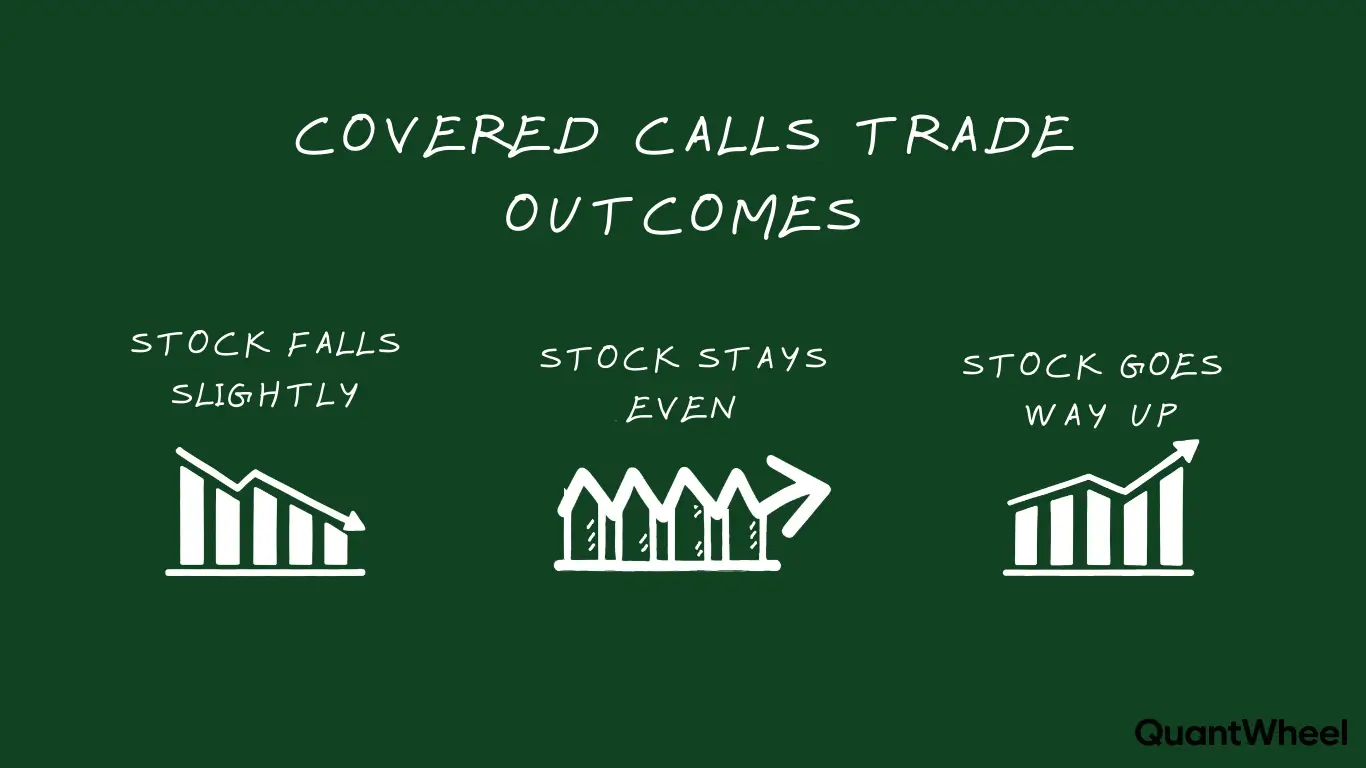
For the next 30 days, several things can happen:
Scenario A: Stock Stays Flat or Goes Down
- Stock price: $48 (down from $50)
- Your option: Still out of the money (OTM) since $48 < $52 strike
- What happens: Nothing yet, you wait
- Your shares: Still yours
- Your premium: Still yours ($150)
Scenario B: Stock Goes Up Slightly
- Stock price: $51 (up from $50)
- Your option: Still out of the money (OTM) since $51 < $52 strike
- What happens: Nothing yet, you wait
- Your shares: Still yours, now worth more
- Your premium: Still yours ($150)
Scenario C: Stock Goes Way Up
- Stock price: $55 (up from $50)
- Your option: Now in the money (ITM) since $55 > $52 strike
- What happens: Option holder might exercise early (rare) or wait until expiration
- Risk: You might be assigned and forced to sell at $52 (missing out on $3/share above strike)
During this waiting period, you can:
- Close early: Buy back the call option to exit the position (costs money)
- Roll the position: Buy back this call and sell a different call at a new strike/date
- Do nothing: Most traders wait until expiration
Step 5: Expiration Day (Day 30)
Expiration day is when the outcome is determined. One of two things happens:
Outcome 1: Stock Below Strike Price (Option Expires Worthless)
Example:
- Stock price at expiration: $51
- Your strike price: $52
- Result: Option expires worthless (no value to buyer)
What happens to you:
- Your 100 shares: You keep them (still in your account)
- The $150 premium: You keep it (already yours)
- Your shares: Now worth $5,100 (100 shares × $51)
- Total gain: $100 stock appreciation + $150 premium = $250
Next steps: You can immediately sell another covered call for next month and collect more premium. This is called "rolling" or "repeating" the strategy.
Outcome 2: Stock Above Strike Price (Assignment)
Example:
- Stock price at expiration: $55
- Your strike price: $52
- Result: Option is in the money (ITM) by $3
What happens to you (automatic process):
- Your 100 shares: Sold automatically at $52/share = $5,200
- The $150 premium: You keep it (already yours)
- Total proceeds: $5,200 from shares + $150 premium = $5,350
Your profit breakdown:
- Original investment: $5,000 (100 shares at $50)
- Sale proceeds: $5,200 (100 shares at $52)
- Premium kept: $150
- Total profit: $350 (7% return in 30 days)
What you miss:
- Stock is now at $55, but you sold at $52
- Missed gain: $3/share × 100 = $300 in additional upside
- This is the trade-off: capped upside in exchange for premium income
The Money Flow: When Cash Changes Hands
Understanding exactly when money moves is critical to understanding how covered calls work.
Money In (Immediate)
Day 0 when you sell the call:
- Premium received: $150
- Posted to your account: Same day
- Available to use: Immediately
Money Out (Only if Assigned)
Day 30 at expiration (if stock above strike):
- Your shares are sold: 100 shares at $52 = $5,200
- This happens automatically
- Cash replaces your shares in your account
- You keep the $150 premium you already received
Net cash flow over 30 days:
- Day 0: +$150 (premium in)
- Day 30: +$5,200 (shares sold) - $5,000 (original investment) = +$200
- Total profit: $350
No Money Out (If Not Assigned)
Day 30 at expiration (if stock below strike):
- No money changes hands
- Your shares remain yours
- You keep the $150 premium
- You can sell another covered call tomorrow
What Happens at Every Price Point: Complete Outcomes
Understanding outcomes at different price points clarifies the mechanics.
Stock at Expiration: $45 (Down $5)
- Option: Expires worthless (below $52 strike)
- You keep: 100 shares + $150 premium
- Your loss: $500 on shares - $150 premium = $350 net loss
- Next step: Sell another call or hold
Stock at Expiration: $50 (Unchanged)
- Option: Expires worthless (below $52 strike)
- You keep: 100 shares + $150 premium
- Your profit: $150 (pure premium)
- Return: 3% in 30 days
- Next step: Sell another call
Stock at Expiration: $51.99 (Just Below Strike)
- Option: Expires worthless (barely below $52 strike)
- You keep: 100 shares + $150 premium
- Your profit: $199 stock gain + $150 premium = $349
- This is your best-case scenario (max gain without assignment)
Stock at Expiration: $52.00 (Exactly at Strike)
- Option: Might expire worthless or might be assigned (50/50)
- If assigned: Shares sold at $52, you keep premium
- If not: You keep shares and premium
- Either way: Similar outcome
Stock at Expiration: $52.01+ (Above Strike)
- Option: Will be assigned (guaranteed)
- Your shares: Sold at $52.00
- You keep: $150 premium
- Total profit: $200 (shares) + $150 (premium) = $350
- Maximum possible profit achieved
Stock at Expiration: $60 (Way Above Strike)
- Option: Assigned (forced to sell at $52)
- You keep: $150 premium
- Total profit: Still capped at $350
- Missed gains: $800 (the $8/share above strike × 100)
- This is the risk: Capping your upside
Assignment: What Actually Happens
Assignment is when your shares are called away (sold) because the option is in the money at expiration.
The Assignment Process (Automatic)
Saturday after expiration:
- All ITM options are assigned automatically
- You don't need to do anything
- Process handled by your broker and OCC (Options Clearing Corporation)
Monday morning:
- Your account no longer shows 100 shares of XYZ
- Your account shows $5,200 in cash (100 shares × $52 strike)
- The $150 premium is already in your account (received 30 days ago)
- Transaction appears as: "Sold 100 XYZ at $52 (via option assignment)"
What Assignment Feels Like
Before assignment (Friday at close):
Account holdings:
- 100 shares XYZ @ $55 current price = $5,500 market value
- Cash: $150 (premium collected 30 days ago)
- Open position: Short 1 XYZ $52 call (ITM)
After assignment (Monday morning):
Account holdings:
- 0 shares XYZ
- Cash: $5,350 ($5,200 from sale + $150 from premium)
- Open position: None
You don't get the $55/share market price. You get the $52 strike price because that's the contract you agreed to 30 days ago.
Early Assignment: Can It Happen Before Expiration?
Yes, but it's rare. The option buyer can exercise their right to buy your shares at any time before expiration.
When Early Assignment Happens
Dividends: If the stock pays a dividend before expiration, option holders might exercise early to capture the dividend. This is the most common reason for early assignment on covered calls.
Deep in the money: If the option is very far ITM with little time value remaining, assignment might happen early (though still uncommon).
What Early Assignment Looks Like
Example:
- Day 15 of your 30-day covered call
- Stock jumps to $60 (way above your $52 strike)
- Option buyer exercises early
Result:
- Your shares are sold at $52 on Day 15 instead of Day 30
- You keep the full $150 premium (you don't refund it)
- Your profit: $200 + $150 = $350 (same as waiting until expiration)
- You just realize the profit 15 days early
Key point: Early assignment is not bad. You still get your maximum profit; you just get it sooner.
Covered Call Mechanics: The Technical Details
Options Contract Specifications
1 covered call contract represents:
- 100 shares (standard contract size)
- Obligation to sell at strike price
- Premium quoted per share (multiply by 100 for contract value)
Example quote:
- Option: XYZ Mar 15 2026 $52 Call
- Premium: $1.50
- Contract value: $1.50 × 100 = $150
Your Obligations When Selling
You are obligated to:
- Sell your 100 shares at strike price if assigned
- Maintain 100 shares in your account while position is open
- Deliver shares within 2 business days if assigned (T+2 settlement)
You are NOT obligated to:
- Buy back the option before expiration (but you can)
- Keep the position until expiration (can close anytime)
- Sell another covered call after this one expires (it's optional)
Margin and Buying Power
Covered calls don't require margin because you already own the shares that "cover" your obligation.
Buying power:
- No additional buying power needed
- Your shares are pledged as collateral
- Premium collected increases your buying power
- If assigned, shares convert to cash, freeing up that buying power
Greeks and Covered Calls: How Time and Price Affect Value
Understanding how your covered call position changes over time helps predict outcomes.
Delta: Price Sensitivity
Delta measures: How much the option price changes when the stock moves $1
Covered call deltas:
- Stock delta: +100 (you own 100 shares)
- Short call delta: approximately -30 to -50 (depends on strike selection)
- Net position delta: +50 to +70
What this means: If the stock goes up $1, your position gains about $50-$70 instead of the full $100, because the call option you sold increases in value (a liability for you).
Theta: Time Decay
Theta measures: How much the option loses value each day as time passes
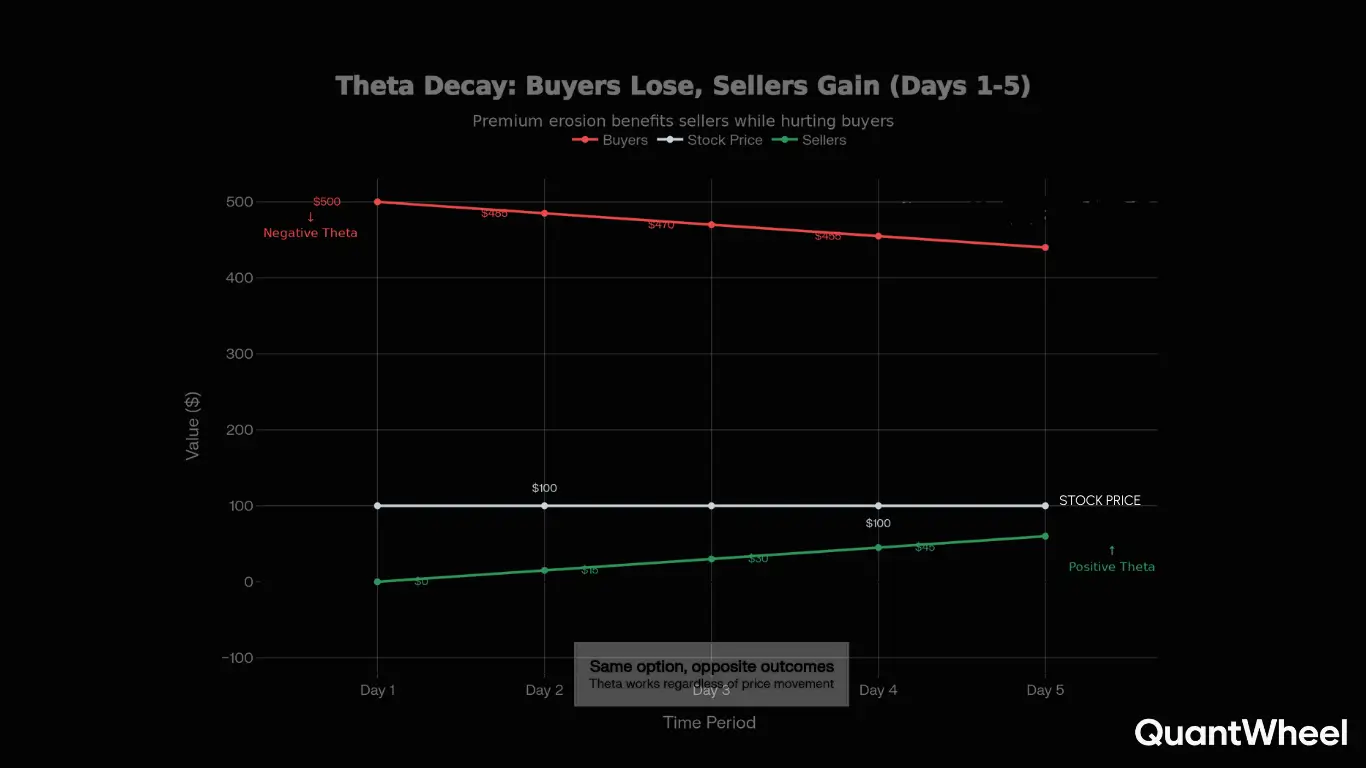
This is your friend in covered calls:
- Every day that passes, the call option you sold loses value
- This is good for you because you sold it
- As expiration approaches, time decay accelerates
- Last week before expiration: Fastest decay
Example:
- Day 0: Option worth $1.50 (you sold it)
- Day 15: Option worth $1.00 (decayed $0.50)
- Day 28: Option worth $0.20 (decayed another $0.80)
- Day 30: Option worth $0.00 (expired worthless)
You sold the option for $1.50 and it decayed to zero. That's pure profit from time decay.
Implied Volatility: Premium Levels
IV measures: Expected future volatility priced into options
Higher IV = Higher premiums:
- Tech stocks: Often high IV (higher premiums)
- Stable dividend stocks: Often low IV (lower premiums)
- Earnings announcements: Spike in IV (great time to sell calls)
When to sell covered calls:
- High IV periods: Collect more premium
- After volatility spikes: Premium is elevated
- Before expected calm: Capture inflated premium before it drops
Managing Your Covered Call: Options Before Expiration
You don't have to wait until expiration. You have options to manage the position.
Option 1: Do Nothing (Most Common)
Let it play out:
- Wait until expiration
- See if assigned or not
- Simplest approach
- Works well if you selected strike carefully
Option 2: Close Early (Buy Back the Call)
When to close early:
- Stock has moved significantly against you
- Option has lost 50-80% of value (quick profit)
- You want to sell shares for another reason
- You want to lock in profit and move on
How it works:
- Buy back the call option you sold
- Costs money to close
- Keeps your shares
- Eliminates obligation
Example:
- You sold call for $1.50 ($150)
- 20 days later, it's worth $0.30 ($30)
- Buy it back for $30
- Net profit: $150 - $30 = $120
- You've captured 80% of max profit in 67% of the time
- Shares still yours to hold or sell another call
Option 3: Roll the Call (Popular Strategy)
Rolling = Close current call + Open new call
When to roll:
- Stock is above strike and you don't want to be assigned
- Want to keep collecting premium
- Extend time or raise strike price
Example roll:
- Current position: Short $52 call expiring in 3 days (stock at $54)
- Roll to: $55 call expiring in 30 days
- Buy back $52 call: Costs $2.50 (it's ITM)
- Sell new $55 call: Collect $2.00
- Net cost: $0.50 to roll
- Result: Avoided assignment, have 30 more days at higher strike
Rolling lets you:
- Avoid assignment when stock rises
- Continue generating premium
- Raise your strike price over time
- Stay in the position longer
Many wheel strategy traders (who combine covered calls with cash-secured puts) roll covered calls regularly rather than accepting assignment. This is where position management becomes important - and where manual tracking in spreadsheets becomes a nightmare.
QuantWheel solves that. It gives you advice on where to roll.
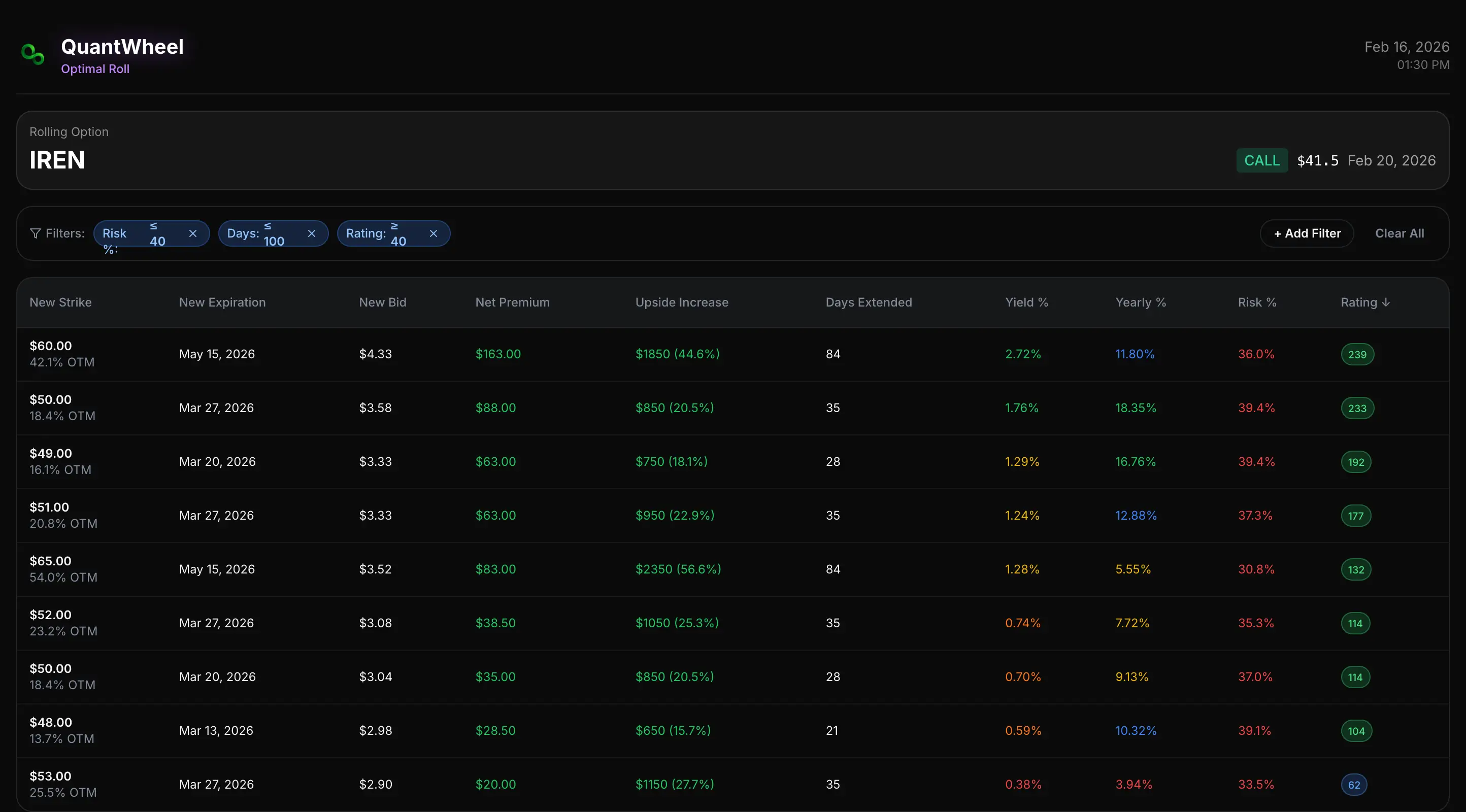
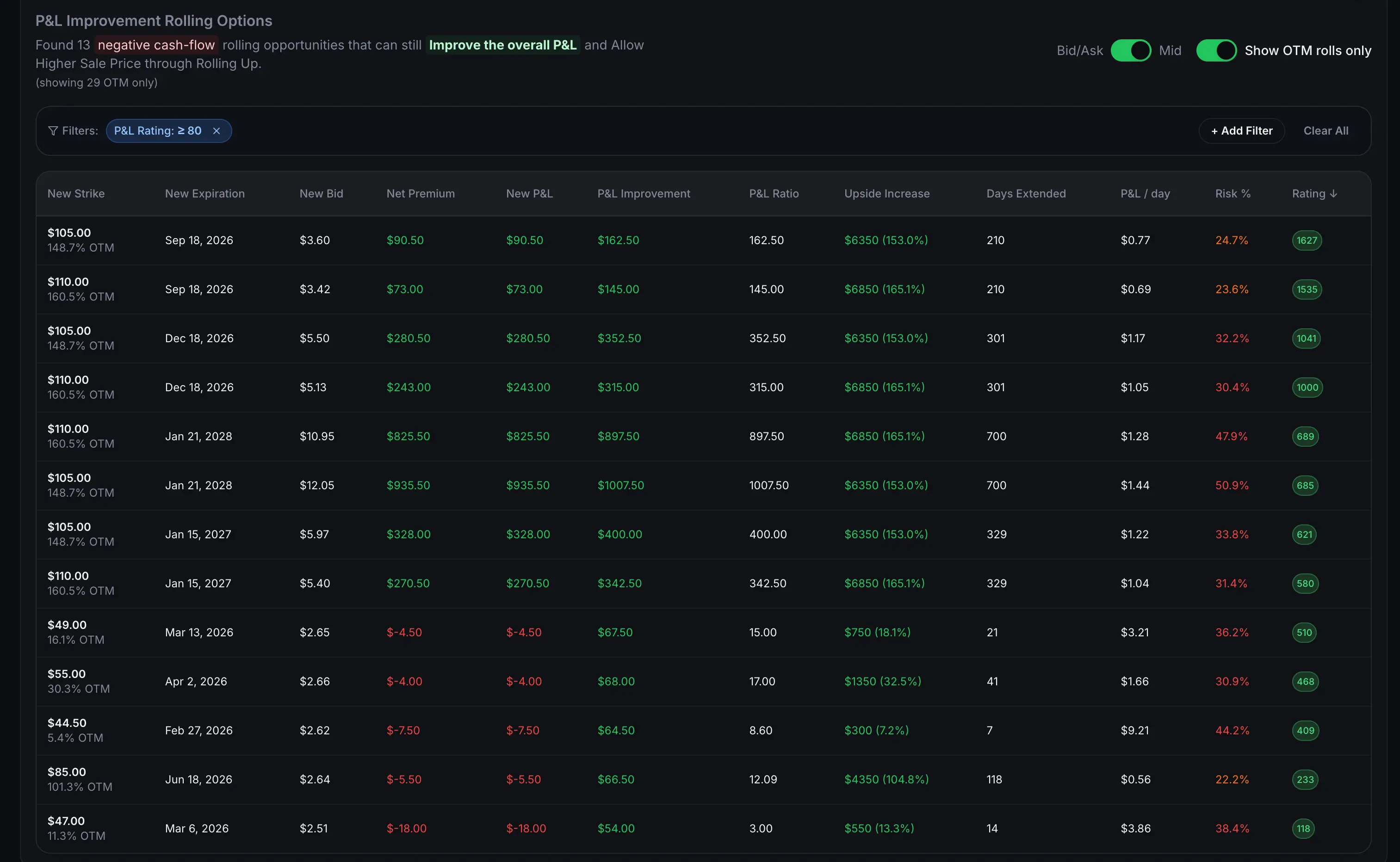
Get help with rolling trades inside QuantWheel →
Real-World Example: Complete 30-Day Cycle
Let's walk through a realistic covered call from start to finish with actual numbers.
Starting Position (January 15, 2026)
- Stock: AMD (Advanced Micro Devices)
- Purchase price: $145.00 per share
- Shares owned: 100
- Total investment: $14,500
Selling the Covered Call (January 15)
- Strike price selected: $150 (3.4% above current price)
- Expiration: February 14, 2026 (30 days)
- Premium collected: $4.20 per share
- Total premium: $4.20 × 100 = $420
- This $420 hits your account immediately
Why this strike?
- Slightly out of the money (OTM) gives stock room to grow
- $150 strike means max profit if stock goes above $150
- Conservative approach: Not too far OTM
Week 1 (January 22) - Stock Sideways
- Stock price: $146 (up slightly)
- Your call option: Now worth $3.50 (down from $4.20)
- Time decay working for you
- Unrealized gain on call: $70
- Action: Do nothing, let time decay continue
Week 2 (January 29) - Stock Drops
- Stock price: $142 (down from $145 entry)
- Your call option: Now worth $1.80 (down significantly)
- Stock loss: $300 ($3/share × 100)
- Call gain: $240 (sold at $4.20, now worth $1.80)
- Net loss: $60 (partially offset by premium)
- Action: Do nothing, expiration still 2 weeks away
Week 3 (February 5) - Stock Recovers
- Stock price: $148 (up from $142)
- Your call option: Now worth $2.50
- Stock gain: $300 since entry (from $145 to $148)
- Call gain: $170 (sold at $4.20, now worth $2.50)
- Total unrealized profit: $470
- Action: Could close early and take profit, or wait
Week 4 (February 14) - Expiration Day
- Stock price at close: $151.50
- Your strike: $150.00
- Result: Option is ITM (in the money) by $1.50
Assignment (automatic over weekend):
Monday, February 17 - Position closed:
- Shares sold: 100 AMD at $150 = $15,000
- Original cost: $14,500 (100 at $145)
- Profit on shares: $500
- Premium kept: $420
- Total profit: $920
- Return: 6.3% in 30 days
- Annualized: approximately 75% (if you could repeat monthly)
What you missed:
- Stock closed at $151.50
- You sold at $150.00
- Missed gain: $1.50/share × 100 = $150
But remember:
- You collected $420 in premium
- Without the covered call, profit would be: $650 (stock gain only)
- With the covered call, profit was: $920
- Extra $270 profit from selling the call (even after missing $150 in upside)
Common Mistakes and How to Avoid Them
Mistake 1: Selling Calls on Stocks You're Not Willing to Sell
The problem: You own Tesla at $200, hoping it hits $300. You sell a $210 call for premium. Stock goes to $250, you're assigned at $210. You missed $40/share in gains and you're upset.
The solution: Only sell covered calls on stocks you're willing to sell at the strike price. If you believe stock will rocket up, don't cap your upside with covered calls.
Mistake 2: Selecting Strikes Too Close to Current Price
The problem: Stock at $50, you sell $51 call for $2.50 premium. Stock moves to $51.50, you're assigned. You only captured $1 in stock gains plus $2.50 premium.
The solution: Select strikes with room for stock to move. Popular approach: 5-10% above current price, or around 30-delta options (30% probability of finishing ITM).
Mistake 3: Ignoring Earnings and Dividends
The problem: You sell a covered call, forgetting stock announces earnings in 2 weeks. Stock gaps up 15% on earnings, you're assigned well below current price and miss the move.
The solution: Check the earnings calendar. Many traders avoid selling covered calls into earnings, or they close positions before earnings announcements.
Dividend note: If the stock pays a dividend while you hold your covered call, you receive the dividend (you own the shares). However, if assigned before the ex-dividend date, you might miss the dividend. This is why early assignment sometimes happens right before ex-dividend dates.
Mistake 4: Not Taking Profits Early
The problem: Your call option has decayed 80% in value. You're holding for the last 20%, but stock suddenly rises and your unrealized profit disappears.
The solution: Many traders close covered calls when they've captured 50-80% of maximum profit. This locks in gains and frees up the position to sell a new call with more premium.
Example:
- Sold call for $3.00 ($300)
- 20 days later, worth $0.60 ($60)
- Close for $60 loss, net profit $240
- Immediately sell a new call for $2.50 ($250)
- Total premium from two calls: $490 vs $300 from holding one to expiration
Mistake 5: Forgetting About Tax Implications
The problem: You own shares for 11 months (almost at long-term capital gains). You sell covered calls that get assigned in month 11. You realize short-term gains (higher tax) instead of waiting one more month for long-term rates.
The solution: If you're close to the 1-year holding period for long-term capital gains, consider waiting to sell covered calls, or select strikes far enough out that assignment is unlikely.
Tax note: Premium from covered calls is generally taxed as short-term capital gains. If assigned, your stock sale is a separate tax event based on how long you held the shares.
When Covered Calls Work Best
Covered calls are most effective in specific market conditions and with certain types of stocks.
Best Market Conditions
Sideways/neutral markets:
- Stock trades in range
- Time decay works perfectly
- Repeatedly sell calls month after month
- This is ideal: Stock doesn't move much, you collect premium repeatedly
Mildly bullish markets:
- Stock slowly drifts higher
- You capture stock gains + premium
- Occasional assignment at higher prices is fine
- Example: Stock goes from $50 to $53 over 3 months, you sold $52 calls throughout
High volatility environments:
- Premiums are elevated (higher income)
- Even if stock is flat, premium is high
- Excellent for income generation
- Tech stocks often fit this profile
Best Stock Characteristics
Dividend stocks:
- Stable, reliable companies
- Slow price movement (less assignment risk)
- Collect dividends + premiums
- Examples: Johnson & Johnson, Coca-Cola, AT&T
Large-cap tech:
- High implied volatility (bigger premiums)
- Liquid options markets (tight spreads)
- You're willing to sell if assigned (less emotional attachment)
- Examples: Apple, Microsoft, AMD, NVIDIA
Stocks you're neutral to mildly bullish on:
- You like the stock but don't expect huge moves
- Happy to hold or sell at higher prices
- Looking for income while waiting
When NOT to Use Covered Calls
Strongly bullish outlook: If you believe the stock will rise significantly, covered calls cap your upside. You'll regret being assigned if stock doubles.
Before major catalysts: Product launches, FDA approvals, major announcements - if you expect a big move, don't sell calls beforehand.
On small positions: With only 100 shares, transaction costs and management time might not be worth it. Some traders wait until they have 200-500 shares.
When you're holding for long-term capital gains: If you're 11 months into holding a stock and want long-term tax treatment, don't risk assignment before hitting the 1-year mark.
Tracking Covered Calls: The Hidden Challenge
Understanding how covered calls work mechanically is one thing. Tracking multiple covered call positions accurately is another challenge entirely.
The Tracking Problem
What you need to track:
- Original stock purchase price (cost basis)
- Current stock price
- Strike price of call sold
- Premium collected
- Days to expiration
- Current option value (for early closing)
- Profit/loss on stock
- Profit/loss on option
- Total position P&L
- Assignment risk (ITM probability)
For ONE position, this is manageable.
For 5-10 positions across different stocks with different expirations?
This is where most traders struggle. Your broker shows basic information, but they don't show:
- Total premium collected across all positions
- Which positions should be closed early
- Which positions should be rolled
- Effective return calculations
- Historical performance of your covered call strategy
The Spreadsheet Solution (And Its Limits)
Many traders create spreadsheets to track covered calls:
Excel/Google Sheets tracking:
- Manual entry of each trade
- Formulas to calculate P&L
- Conditional formatting for assignment risk
- Works well for 1-3 positions
But breaks down when:
- You're managing 10+ positions
- Positions are at different stages (some ITM, some OTM)
- You want to see aggregate metrics
- You're rolling positions (complex tracking)
- You want historical analysis
After managing 15+ covered call positions, spreadsheets become tedious. You spend more time updating cells than analyzing opportunities. This is exactly why software like QuantWheel exists - to automate the tracking so you can focus on strategy, not data entry.
If you're running multiple covered calls and finding manual tracking overwhelming, QuantWheel's journal syncs with your broker and automatically tracks each position's full lifecycle, from opening to assignment or expiration. It handles the math, tracks your cost basis, and shows you which positions need attention.
Track your trades inside QuantWheel →
Advanced Covered Call Concepts
Legging Into Covered Calls
Definition: Buying the stock and selling the call as separate transactions, rather than simultaneously.
Why do this:
- You own the stock already (most common)
- You want to time the call sale for higher premium (volatility spike)
- You're waiting for stock to reach a certain price before selling calls
Example:
- Buy 100 shares AMD at $145 (January 1)
- Wait for earnings volatility spike (January 15)
- Sell covered call when IV is high (collect more premium)
Covered Calls in Retirement Accounts
Tax advantage: Covered calls in IRAs or 401(k)s have tax benefits because:
- Premium is not taxed until withdrawal (in retirement)
- No annual reporting of gains/losses
- No wash sale rules to worry about
- Simplifies tax filing
Restrictions: Most retirement accounts allow covered calls (Level 1 options approval), but check with your broker.
The Wheel Strategy Integration
Covered calls are half of the "wheel strategy"-a popular options income approach:
The complete wheel:
- Sell cash-secured puts (collect premium)
- Get assigned (buy stock at strike)
- Sell covered calls (collect more premium) ← This is where covered calls fit
- Get assigned (sell stock at strike) or expire worthless (keep shares)
- Repeat from step 1
The wheel strategy uses covered calls as the "second half" after being assigned shares from selling cash-secured puts. It's a systematic approach to generating premium income whether you own stock or not.
Covered Call Alternatives and Variations
Buy-Write (Buying Stock and Selling Call Simultaneously)
Same as covered call, but executed as one transaction. Some brokers offer "buy-write" orders that execute both legs at the same time, potentially getting better pricing.
Covered Call ETFs
Examples:
- QYLD: Nasdaq-100 Covered Call ETF
- XYLD: S&P 500 Covered Call ETF
- JEPI: JPMorgan Equity Premium Income ETF
These funds:
- Systematically sell covered calls on indices
- Distribute high monthly income to shareholders
- Cap upside (just like individual covered calls)
- Good for passive income seekers who don't want to manage positions
Trade-off: You pay management fees and lose control over strike selection and timing. But you get diversification and professional management.
Ratio Covered Calls (More Advanced)
Selling more calls than you have shares to cover. For example: Own 100 shares, sell 2 calls. This is partially covered and partially "naked"-requires margin and advanced options approval. Not recommended for beginners.
Tools and Resources for Covered Call Traders
What You Need
Options approval: Most brokers require Level 2 options approval for covered calls (this is standard).
Broker with options: TD Ameritrade, E*TRADE, Schwab, Fidelity, Interactive Brokers, Robinhood - all support covered calls.
Options chain: Real-time options data showing strikes, expirations, premiums, and Greeks.
Position tracking: Especially important as you scale to multiple positions. Manual tracking works initially, but dedicated tools save time as you grow.
Free Resources
CBOE (Chicago Board Options Exchange): Educational resources on options strategies, including covered calls: cboe.com
Tastytrade: Free options education videos, many covering covered call mechanics.
r/thetagang: Reddit community focused on premium-selling strategies like covered calls and cash-secured puts.
Paid Tools
Professional options platforms:
- Thinkorswim (free with TD Ameritrade)
- TastyWorks
- Interactive Brokers Trader Workstation
Position management:
- QuantWheel: Wheel strategy-specific software with automated position tracking and cost basis management
- OptionSLAM: Options analytics
- OptionsPlay: Strategy-focused platform
Most traders start with their broker's built-in tools, then graduate to specialized platforms as they scale to 10+ positions.
Key Takeaways: How Covered Calls Work
The mechanics: Covered calls work by selling someone the right to buy your 100 shares at a fixed price (strike) before expiration, in exchange for immediate premium income. You keep the premium no matter what happens. If the stock finishes below the strike, you keep shares and premium. If the stock finishes above the strike, you sell shares at the strike price and keep the premium.
The timeline: The typical covered call timeline is 30-45 days from sale to expiration. Premium hits your account immediately on Day 0. During the holding period, time decay works in your favor as the option loses value. At expiration, you're either assigned (forced to sell shares) if stock is above strike, or the option expires worthless and you keep shares.
The math: Maximum profit is capped at: (strike price - purchase price) + premium collected. Maximum loss is: (purchase price - $0) - premium collected. The premium provides a small cushion against downside but doesn't fully protect you.
The trade-off: You exchange unlimited upside for immediate income. If the stock skyrockets, you miss gains above the strike price. In exchange, you collect premium that you keep regardless of what the stock does.
Best use cases: Covered calls work best in sideways or mildly bullish markets, on stocks with high implied volatility, and when you're willing to sell shares at the strike price. They provide income while you hold, reducing your cost basis over time.
The hidden work: The strategy is simple for one position, but tracking multiple covered calls across different stocks with different expirations requires organization. As you scale to 10+ positions, manual tracking becomes time-consuming, and dedicated tools become valuable.
Next Steps: Putting Covered Calls Into Practice
Now that you understand exactly how covered calls work - from the mechanics to the timeline to the actual cash flows - you're ready to implement the strategy.
Before your first covered call:
- Ensure you have 100 shares of a stock you're willing to sell
- Get Level 2 options approval from your broker (if you don't have it)
- Study the options chain for your stock (focus on 30-45 day expirations)
- Select a strike price 5-10% above the current stock price
- Calculate your maximum profit (strike - purchase price + premium)
- Confirm you're comfortable selling at that strike
For your first trade:
- Start with one position to learn the mechanics
- Use a stock you know well
- Select a conservative strike (further out of the money)
- Track everything manually at first to understand the process
- Let it go to expiration rather than closing early
As you scale:
- Add more positions gradually (2-3 at a time)
- Experiment with different strikes and expirations
- Learn when to close early vs hold to expiration
- Practice rolling positions when stock moves against you
- Consider tools for tracking as you reach 5-10 positions
Most importantly: Remember that covered calls are an income strategy, not a growth strategy. You're trading potential upside for current income. Make sure this trade-off aligns with your goals for each stock position.
The mechanics are straightforward. The timeline is predictable. The math is simple. Now it's about execution and consistent management over time.
If you're ready to automate the tracking and focus on strategy rather than spreadsheets, try QuantWheel free for 14 days. It's built specifically for traders running premium-selling strategies like covered calls, with automatic position tracking, cost basis management, and assignment handling.
$1 for 7 days • Cancel anytime • 14-day money-back guarantee
Risk Disclosure
Options trading involves substantial risk and is not suitable for all investors. Past performance does not guarantee future results. This content is for educational purposes only and should not be considered investment advice. Always do your own research and consider consulting with a financial advisor before making investment decisions.
The examples used in this article are for educational purposes only and are not recommendations to buy or sell any security. All investment decisions should be based on your own analysis and risk tolerance.