
You sold a cash-secured put last month. The stock dropped. Now your broker sent a notification: "You've been assigned." Your heart races. What just happened to your account? Where did your cash go? What should you do next? Here's everything you need to know about what happens when you get assigned when trading options.
Getting assigned on options isn't a mistake or failure - it's the natural outcome of selling options contracts. Whether you're running the wheel strategy or just got caught off-guard, next time you can get a notification for this in time and avoid it.
Start your free trial of QuantWheel and track assignments automatically with accurate cost basis calculations.
$1 for 7 days • Cancel anytime • 14-day money-back guarantee
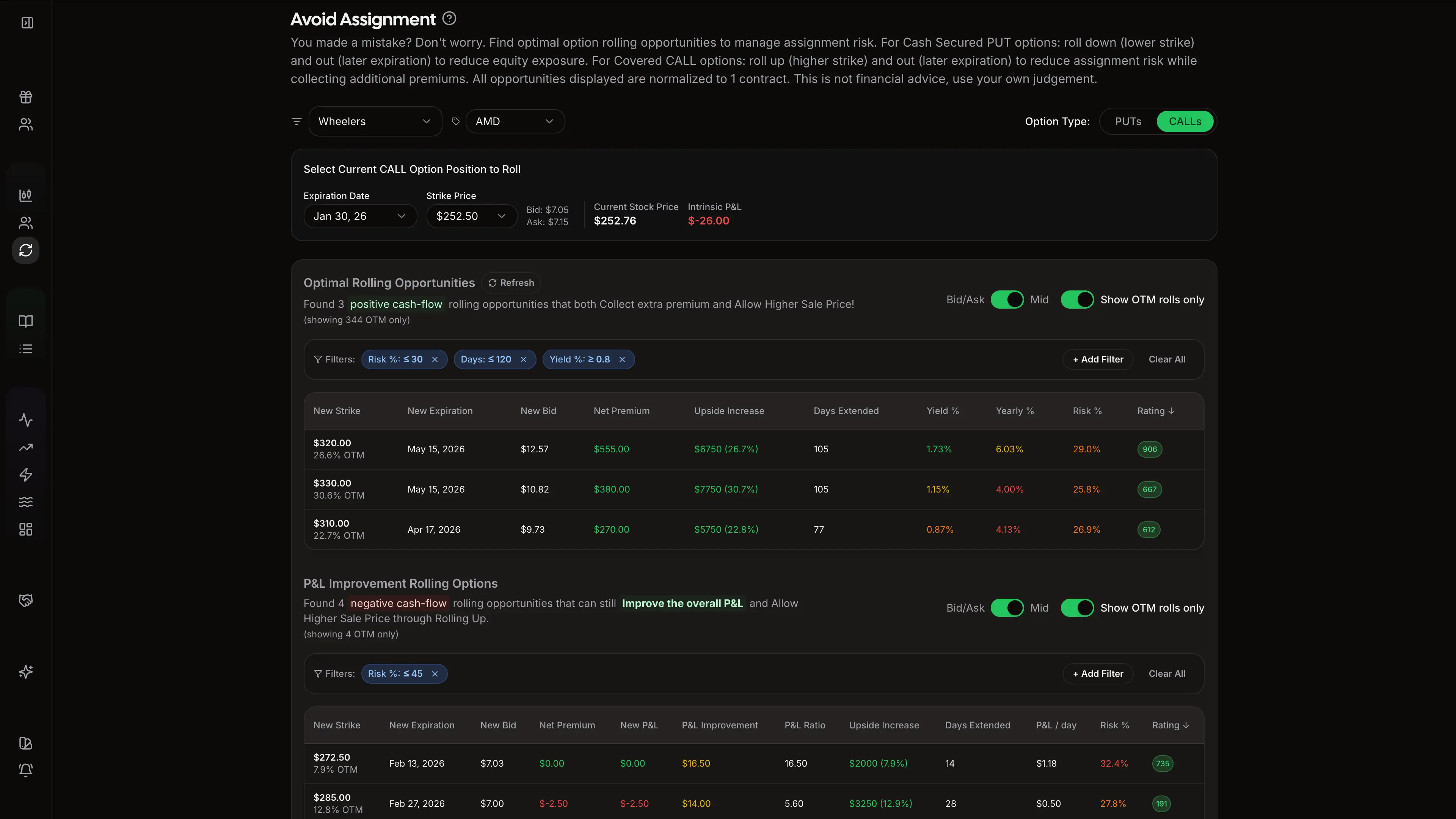
Are you about to get assigned? QuantWheel can help you avoid this.
TLDR: What Happens When You Get Assigned on Options
Assignment means you must fulfill your option contract obligation. Here's what happens to your account:
For Cash-Secured Puts (CSP):
- Your cash ($5,000 for a $50 strike) purchases 100 shares at the strike price
- You keep all premium collected ($200 for a $2 premium)
- Your broker shows $50 cost basis, but your real cost is $48 ($50 - $2 premium)
- You now own 100 shares and can sell covered calls
For Covered Calls:
- Your 100 shares are sold at the strike price
- You keep all premium collected plus stock appreciation up to the strike
- If you bought at $45, sold $50 call for $2, and got assigned, you made $7/share total ($5 appreciation + $2 premium)
Simple Example: You sell a $50 cash-secured put on Stock ABC for $2 premium ($200 total). The stock drops to $47 and you get assigned at expiration. Your broker debits $5,000 from your cash and credits you with 100 shares. You keep the $200 premium. Your real cost basis is $48 per share ($50 strike - $2 premium), even though your broker shows $50. You're down $100 on paper ($4,800 real cost vs $4,700 current value), not $300 as your broker suggests.
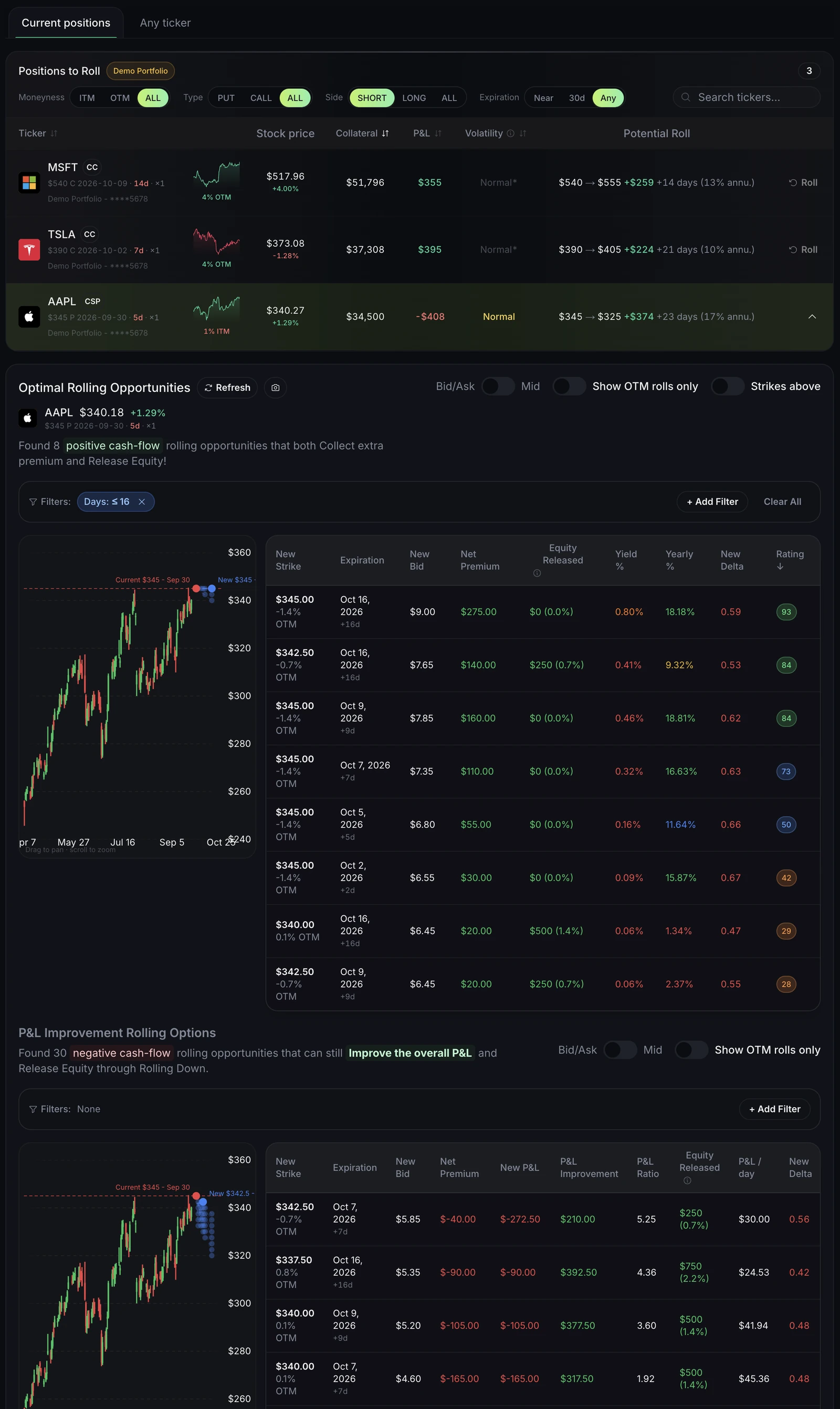
What happens if assigned call/put: Assigned on a call? You deliver (sell) 100 shares at strike price you picked. Assigned on a put? You buy 100 shares at strike price you picked. - Broker handles settlement T+1; you keep the premium received. You got assigned, what's next: Shares appear in your account and you can decide to hold, sell, or manage (e.g., sell covered calls in wheel strategy). When does assignment happen: Simply - most often at the last day of your trade. When exactly? Anytime before 5:30 PM ET on expiration day (exercise cutoff). Notification typically comes next morning (T+1). Early assignments? These happen intraday if exercised; most occur at/near expiration for ITM options Early assignment risk with dividends and ex-dividends: It's a high chance of assignment for short calls before ex-dividend date. Buyer may exercise early to capture dividend earlier (because he must own shares by record date). You can avoid this by closing ITM calls pre-ex-date. How to avoid options assignment: Watch your open CC or CSP positions, if their worth becomes extremely low, close or roll them early (e.g., 7-21 DTE remaining). Option ITM and you want to avoid assignment? Check an options chain for the best deal or look at what QuantWheel recommends for you to solve this issue.
$1 for 7 days • Cancel anytime • 14-day money-back guarantee
What Does "Getting Assigned" Actually Mean?
Assignment is when you're obligated to fulfill the terms of the options contract you sold. As the option seller (writer), you granted someone else the right to make you buy or sell stock at a specific price. When they exercise that right, you get assigned.
Two scenarios where you get assigned:
- You sold a cash-secured put: You must buy 100 shares per contract at the strike price
- You sold a covered call: You must sell 100 shares per contract at the strike price
Assignment isn't optional - it's automatic and handled entirely by your broker. You don't get to decline or negotiate. The contract you sold gave this right to the buyer, and now they're using it.
Who Decides When Assignment Happens?
The option buyer (holder) decides whether to exercise their right. However, most assignments happen automatically at expiration rather than through manual exercise:
- At expiration: Any option more than $0.01 in-the-money is typically auto-exercised by the clearinghouse
- Before expiration (early assignment): The option holder manually exercises their right
Early assignment is uncommon but happens most frequently before ex-dividend dates on covered calls, when traders want to capture the dividend.
The Assignment Process: What Happens Step-by-Step
Timeline of Events
Day 1 (Assignment Day):
- The option holder exercises their contract (or it's auto-exercised at expiration)
- The Options Clearing Corporation (OCC) randomly assigns the obligation to an option seller
- This happens after market close
Day 2 (Notification Day):
- You see the assignment notification in your brokerage account (usually early morning)
- Your account reflects the new stock position
- Your cash balance is adjusted
Day 3 (Settlement Day):
- The transaction officially settles (T+1 for options, T+2 for stock prior to 2024, now T+1 for most securities)
- Funds and shares are fully exchanged
What Changes in Your Account
If you sold a cash-secured put and got assigned:
Before assignment:
- Cash: $5,000 (set aside)
- Options: Short 1 put at $50 strike (collected $200 premium)
- Stock: 0 shares
After assignment:
- Cash: $0 (used to buy stock)
- Options: Position closed
- Stock: 100 shares (shown at $50 cost basis by broker)
- Premium: $200 (kept in your account)
If you sold a covered call and got assigned:
Before assignment:
- Stock: 100 shares (purchased at $45)
- Options: Short 1 call at $50 strike (collected $200 premium)
After assignment:
- Stock: 0 shares (sold at $50)
- Options: Position closed
- Cash: $5,000 (from stock sale)
- Premium: $200 (kept, so total proceeds = $5,200)
- Total profit: $700 ($500 stock appreciation + $200 premium)
Cost Basis Confusion: The Hidden Complexity
Here's where most traders get confused, and it's the single biggest pain point of options assignment: Your broker's displayed cost basis is wrong for calculating your real breakeven.
Why Your Broker Shows the Wrong Cost Basis
When you get assigned on a cash-secured put, your broker records your cost basis as the strike price - period. The premium you collected isn't reflected in the displayed cost basis. This creates confusion because your real breakeven is actually lower.
Example:
- Sold $50 put, collected $2 premium
- Got assigned, purchased 100 shares
- Broker shows: Cost basis $50 per share ($5,000 total)
- Your real cost: $48 per share ($4,800 total investment after premium)
If the stock is trading at $49, your broker's interface might show you down $100 (-2%), but you're actually up $100 (+2.1%) because of the premium collected.
Why This Matters for Taxes and Trading
The cost basis confusion creates three problems:
- Inaccurate P&L tracking: You can't see your real performance at a glance
- Wrong breakeven calculation: You might exit too early or hold too long
- Tax reporting complexity: At year-end, you need to manually adjust for premium collected
For wheel strategy traders managing multiple positions through assignment cycles, this tracking becomes a nightmare. You need to manually record:
- Original put premium collected
- Assignment price (strike price)
- Covered call premiums collected
- Final exit price
That's four data points per complete wheel cycle, and if you're running 10+ positions, manual tracking becomes error-prone.
How to Calculate Your Real Cost Basis
For put assignment:
Real Cost Basis = Strike Price - (Premium Collected / 100)

Example: $50 strike, $2 premium
Real Cost Basis = $50 - ($200 / 100) = $48 per share
For call assignment (total proceeds):
Real Proceeds = Strike Price + (Premium Collected / 100)

Example: Bought at $45, sold $50 call for $2 premium
Real Proceeds = $50 + ($200 / 100) = $52 per share
Total Profit = $52 - $45 = $7 per share
Here's where most traders struggle: calculating your actual cost basis through assignment requires manual tracking that your broker doesn't provide. After collecting $2 premium on a put and getting assigned at the $50 strike, you need to remember that your real cost is $48, not the $50 your broker shows. When you're managing 15+ wheel positions through multiple assignment cycles, this manual cost basis tracking becomes a headache. This is exactly why software like QuantWheel exists - to automatically adjust your cost basis when assignments happen, showing your true breakeven without the manual spreadsheet calculations.
What Should You Do After Getting Assigned?
Getting assigned isn't the end - it's actually just the middle of the wheel strategy cycle. Here's your step-by-step action plan.
Step 1: Verify the Assignment Details
Check your account to confirm:
- Number of shares received (should be 100 per contract)
- Price paid (should be the strike price)
- Cash debited from account
- Premium retained in account
Step 2: Assess Your Position
Ask yourself three questions:
1. Do I still want to own this stock?
- Yes: Proceed to Step 3 (sell covered calls)
- No: Consider exiting immediately or wait for a bounce
2. What's the current price relative to my real cost basis?
- Above your cost basis: You're profitable, selling calls is easy
- Below your cost basis: You're underwater, need to be patient or take the loss
3. What's the volatility outlook?
- High IV: Great for selling premium-rich covered calls
- Low IV: Premiums will be smaller, might need patience
Step 3: Sell Covered Calls (The Wheel Strategy)
If you're following the wheel strategy, assignment is your signal to start selling covered calls on your new stock position. This is how you continue collecting premium while waiting to exit the position.
Covered call strike selection:
- At or above your real cost basis: Ensures profitability if assigned
- 30-45 DTE (days to expiration): Balances premium collection and flexibility
- Around 30-40 delta: Higher probability of expiring worthless while still collecting decent premium
Example:
- Assigned at $50 strike after collecting $2 put premium (real cost: $48)
- Stock currently at $49
- Sell $50 call for $1.50 premium, 30 DTE
If the call expires worthless, you collected $1.50 more premium (total $3.50), lowering your real cost basis to $46.50. If you get assigned on the call, you exit at $50, making $2/share profit ($50 exit - $48 real cost) plus the original $2 premium, for $4 total per share.
Step 4: Manage the Position Actively
Don't just sell a covered call and forget about it. Monitor for:
Rolling opportunities:
- If the stock rallies above your call strike with plenty of time remaining, consider rolling up and out to capture more upside
- If the stock drops significantly, you might roll your call down to collect more premium
Early exit opportunities:
- If the stock bounces back above your cost basis quickly, you might exit the shares and take your profit
- If the stock continues dropping and fundamentals deteriorate, cutting the loss might be better than waiting
Earnings considerations:
- Avoid having calls outstanding through earnings unless you're comfortable with assignment risk
- IV typically increases before earnings, making it a good time to sell calls
Understanding Assignment Risk in Different Scenarios
Assignment at Expiration (Most Common)
This is the straightforward scenario: your option expires in-the-money, and assignment happens automatically.
For cash-secured puts:
- If the stock is below your strike at expiration, you get assigned
- Even $0.01 in-the-money triggers auto-exercise in most cases
- You'll see the assignment notification Saturday or Monday morning
For covered calls:
- If the stock is above your strike at expiration, you get assigned
- Your shares are sold at the strike price
- You keep all premium collected
Pro tip: If you want to avoid assignment at expiration, close or roll your position on the Friday before expiration (or earlier).
Early Assignment (Less Common)
Early assignment happens before expiration, catching some traders off-guard.
Most common reason: Ex-dividend dates When a stock is about to pay a dividend, call option holders might exercise early to capture the dividend. This is most likely when:
- The stock is in-the-money
- The dividend amount exceeds the remaining time value in the option
- Ex-dividend date is approaching
Example:
- You sold a $50 covered call for $2.50 with 15 DTE
- Stock is at $52, option has $0.50 time value remaining
- Stock pays $1 dividend tomorrow (ex-dividend date)
- Option holder exercises early to capture the $1 dividend
Other reasons for early assignment:
- Deep in-the-money options with little time value remaining
- Trader needs to close their position immediately
- Random bad luck (assignment is random among all sellers)
Assignment on Cash-Secured Puts vs Covered Calls
The mechanics differ slightly:
Cash-secured put assignment:
- Impact: You spend cash to acquire stock
- Result: Your buying power decreases substantially
- Next step: Sell covered calls to continue the wheel
- Biggest risk: The stock continues dropping after assignment
Covered call assignment:
- Impact: You sell stock and receive cash
- Result: Your buying power increases
- Next step: Sell cash-secured puts to restart the wheel
- Biggest risk: The stock continues rallying after you sold (opportunity cost)
How Assignment Affects Your Buying Power and Margin
Assignment has significant implications for your account's buying power, especially if you're running multiple wheel positions.
Cash Account Assignment
In a cash account, assignment mechanics are straightforward:
Put assignment:
- Your $5,000 cash (for $50 strike) is used to buy 100 shares
- You now have $5,000 less buying power
- No margin implications since it's a cash account
Call assignment:
- Your 100 shares are sold for $5,000 (at $50 strike)
- You now have $5,000 more buying power
- Can immediately sell new puts if desired
Margin Account Assignment
In a margin account, the situation is more complex:
Put assignment impact:
- You receive 100 shares with 50% margin requirement (Reg T)
- Your cash is used to buy the stock
- Your margin buying power is affected by the stock's margin requirement
- If you're near max margin usage, assignment could trigger a margin call
Example:
- You have $10,000 cash and sold two $50 puts
- Both get assigned, requiring $10,000 cash
- You now have 200 shares worth $10,000 (if stock is at $50)
- Margin requirement: $5,000 (50% of stock value)
- Your excess margin: $5,000
- Buying power for new positions: Limited until you free up margin
Portfolio Margin Considerations
If you have portfolio margin (typically requires $125k+ and approval), assignment affects risk calculations differently:
- Your margin requirement is based on overall portfolio risk, not individual position requirements
- Assignment might increase or decrease required margin depending on the position
- Generally provides more flexibility but requires sophisticated risk management
Important: If you're running multiple wheel positions and several get assigned simultaneously (like during a market downturn), you could face a margin call even if you planned for each assignment individually. Always maintain a buffer in your buying power.
Common Assignment Mistakes Wheel Traders Make
Mistake 1: Selling Puts on Stocks You Don't Want to Own
The error: Chasing high premiums on sketchy stocks because the IV is attractive.
Why it's bad: Assignment is likely on these high-IV names, and you'll be stuck holding a declining stock you never wanted in the first place.
The fix: Only sell puts on stocks you'd be happy to buy at the strike price minus premium collected. If you wouldn't buy the stock at that price, don't sell the put.
Mistake 2: Selling Too Many Puts Relative to Account Size
The error: Selling 5 contracts on a $50 stock with only $25,000 in your account (100% utilization).
Why it's bad: If all get assigned, you have zero buying power left and can't manage the positions effectively. You're forced to sell covered calls at whatever strikes are available, removing your flexibility.
The fix: Never use more than 50-60% of your account on wheel positions. Maintain buying power buffer for adjustments, rolls, and new opportunities.
Mistake 3: Ignoring Your Real Cost Basis
The error: Looking at your broker's P&L and making decisions based on the strike price instead of your real cost (strike minus premium).
Why it's bad: You might exit positions too early (thinking you're at breakeven when you're profitable) or hold too long (thinking you're profitable when you're actually at a loss).
The fix: Manually track your real cost basis through the full wheel cycle, or use software that automatically adjusts for premium collected.
Mistake 4: Panicking When Assigned
The error: Immediately selling the stock at a loss after assignment because you're scared or didn't expect it.
Why it's bad: Assignment is part of the plan in the wheel strategy. Panic-selling locks in losses instead of working the position through covered calls.
The fix: Have a plan before assignment happens. Know your max position size, your action steps after assignment, and your exit criteria before you sell the first put.
Mistake 5: Forgetting About Earnings and Ex-Dividend Dates
The error: Holding puts or calls through earnings without considering assignment risk, or being surprised by early assignment before ex-dividend.
Why it's bad: Earnings can cause massive moves that result in deep-in-the-money options and certain assignment. Ex-dividend dates trigger early assignment on calls.
The fix: Always know when earnings and ex-dividend dates are coming. Close or roll positions before these events if you want to avoid assignment.
Assignment in the Wheel Strategy: It's the Plan, Not a Problem
For wheel strategy traders, assignment isn't something to avoid - it's the core mechanism that makes the strategy work. Understanding this mindset shift is crucial.
Why Assignment Is Good in the Wheel
1. You already got paid to wait: The premium you collected for selling the put means you're buying the stock at a discount to the current price when you sold the put.
2. You wanted this stock anyway: If you followed proper stock selection criteria, you sold puts on a quality stock you're happy to own.
3. You can now sell covered calls: Assignment transitions you from the put-selling phase to the call-selling phase, where you continue collecting premium.
4. You have a clear exit plan: You'll sell covered calls at or above your real cost basis until assigned, exiting profitably.
The Complete Wheel Cycle Through Assignment
Phase 1: Sell Cash-Secured Put
- Collect premium upfront (e.g., $200 for $2 premium)
- Wait for expiration or assignment
- Stock drops, you get assigned
Phase 2: Assignment → Stock Ownership
- Buy 100 shares at strike price (e.g., $5,000 at $50 strike)
- Keep the $200 premium (real cost: $4,800 or $48/share)
- Now own 100 shares
Phase 3: Sell Covered Calls
- Sell calls at or above your real cost basis (e.g., $50 strike for $150 premium)
- Collect more premium, reducing your cost basis further (now $46.50)
- Wait for expiration or assignment
Phase 4: Exit Through Call Assignment
- Stock rallies above your call strike
- Get assigned on the call, selling shares at $50
- Total profit: $350 ($200 put premium + $150 call premium) on $4,800 invested
- That's 7.3% return on this wheel cycle
Phase 5: Repeat
- Use the $5,000 (plus $350 profit) to sell new cash-secured puts
- Start the wheel cycle again
What If the Stock Keeps Dropping After Assignment?
This is the real risk of the wheel strategy: You get assigned, start selling covered calls, but the stock continues declining below your cost basis.
Your options:
Option 1: Be patient and keep selling calls
- Continue selling covered calls below your cost basis
- Each call collected reduces your cost basis further
- Eventually, either the stock recovers or your basis drops enough to exit profitably
Option 2: Take the loss and move on
- Accept that this wheel cycle lost money
- Exit the position and redeploy capital to better opportunities
- The premiums collected from puts and calls reduced your loss
Option 3: Average down (risky)
- Sell more puts at lower strikes to acquire more shares
- This increases your exposure to a declining stock
- Only do this if fundamentals remain strong and you have conviction
The key: Assignment on a declining stock isn't a failure if you collected enough premium along the way. Even if you exit at a small loss, the premiums collected might make the overall trade break-even or slightly profitable.
Tax Implications of Options Assignment
Assignment affects your tax reporting, and understanding these implications helps you avoid surprises at tax time.
How Assignment Affects Your Cost Basis for Taxes
For put assignment (buying stock): Your cost basis for tax purposes is the strike price you paid, NOT adjusted for premium collected. However, the premium is already taxed as short-term capital gain in the year you collected it.
Example:
- 2025: Sold $50 put, collected $200 premium → Report $200 short-term capital gain in 2025
- 2026: Assigned, bought 100 shares → Cost basis is $5,000 (not $4,800)
- 2026: Sold shares at $52 → Capital gain is $200 ($5,200 - $5,000)
- Total taxable gain: $400 ($200 + $200)
For call assignment (selling stock): Your sale price for tax purposes is the strike price you received, NOT adjusted for premium collected. The premium was already taxed when you collected it.
Short-Term vs Long-Term Capital Gains
Options premiums: Always short-term capital gains (or losses), regardless of how long you held the position.
Stock held after assignment:
- Less than 1 year: Short-term capital gains (taxed as ordinary income)
- More than 1 year: Long-term capital gains (preferential tax rate)
For wheel strategy traders: Since you're typically assigned and then assigned out again within weeks or months, most gains are short-term. This is tax-inefficient compared to buy-and-hold, but the consistent income generation can offset the higher tax rate.
Wash Sale Rules and Assignment
Wash sale rules can complicate assignment situations:
What's a wash sale: If you sell stock at a loss and buy substantially identical stock within 30 days before or after the sale, you can't claim the loss immediately. It's added to your cost basis of the new shares.
How this affects assignment: If you:
- Sell stock at a loss
- Then sell a put on the same stock within 30 days
- Get assigned on that put
The wash sale rule may apply, disallowing your loss and adding it to the cost basis of your newly assigned shares.
The fix: Be aware of wash sale implications when managing wheel positions. Sometimes waiting 31 days before selling puts on the same stock (after taking a loss) is worth it for the tax benefit.
Record Keeping for Assignment
For accurate tax reporting, track:
- Date and amount of premium collected
- Date and price of assignment
- Date and amount of any covered call premiums collected
- Date and price of final stock sale
Manual tracking of this information is tedious, especially with multiple wheel cycles running simultaneously. This is another pain point that automated tracking software solves.
Start your free trial of QuantWheel to automatically track assignments, cost basis, and tax reporting through complete wheel cycles.
$1 for 7 days • Cancel anytime • 14-day money-back guarantee
Risk Disclosure: Options trading involves substantial risk and is not suitable for all investors. Past performance does not guarantee future results. This content is for educational purposes only and should not be considered investment advice. Always do your own research and consider consulting with a financial advisor before making investment decisions.
The examples used in this article are for educational purposes only and are not recommendations to buy or sell any security. All investment decisions should be based on your own analysis and risk tolerance.