

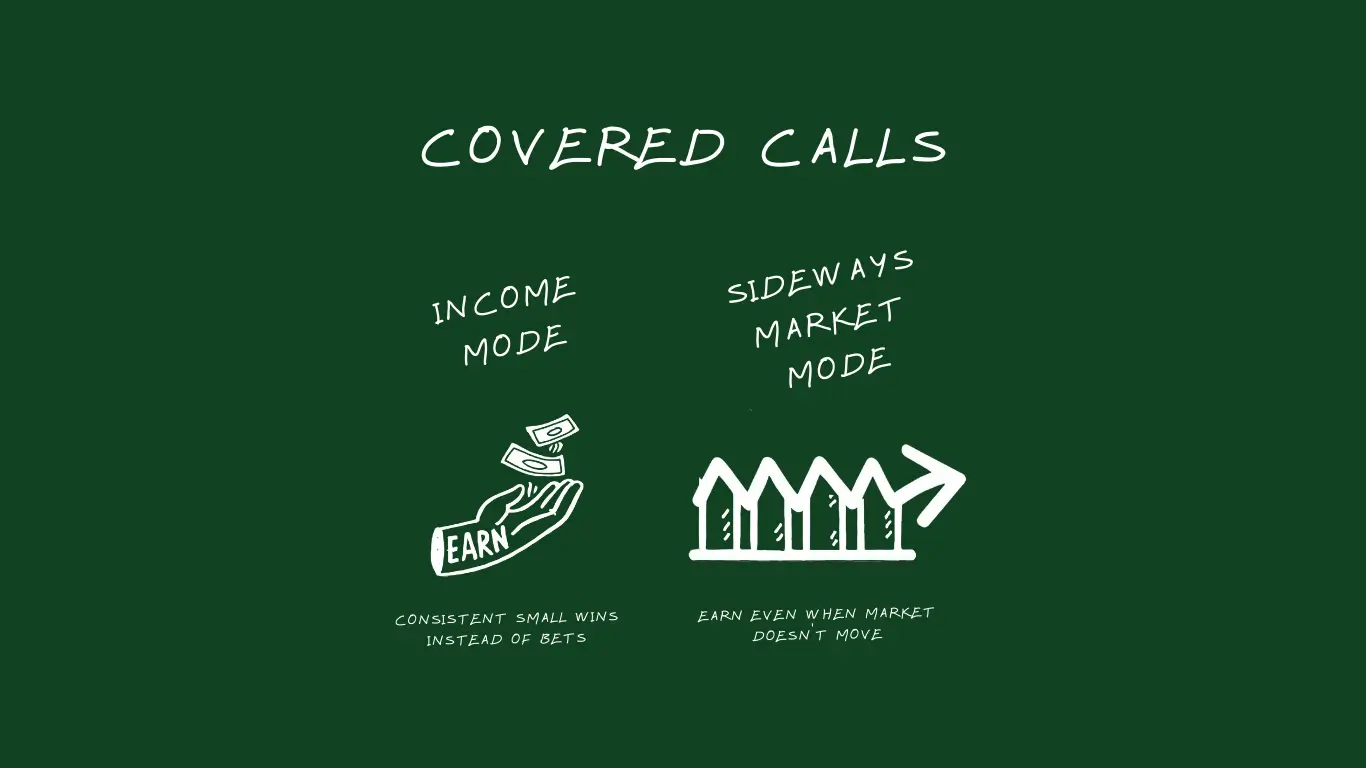
If you own stocks and want to generate extra income from your holdings, covered calls are one of the simplest strategies to do exactly that. This approach lets you collect cash upfront on shares you already own, creating income whether the market goes up, down, or sideways.
In this complete guide, I'll walk you through exactly what covered calls are, how they work mechanically, when to use them, and the real risks you need to understand before your first trade.
Optimize trading Covered Calls with QuantWheel →
What Are Covered Calls? (Simple Answer)
A covered call is an options strategy where you sell call options on stocks you already own. Here's what that means in plain English:
You own 100 shares of a stock. You sell someone else the right (but not the obligation) to buy those shares from you at a specific price (called the "strike price") by a certain date (the "expiration date"). In exchange for granting them this right, they pay you money upfront - this payment is called the "premium."
Think of it like renting out your shares. You collect rent money now, and if the renter wants to buy your house later (your stock goes above the strike price), you're obligated to sell at the agreed price. If they don't want it (stock stays below the strike), you keep your shares and the rent money.
The "covered" part means you actually own the 100 shares needed to fulfill the contract. This makes it a conservative strategy compared to selling "naked" calls on stocks you don't own.
TLDR: Everything You Need to Know About Covered Calls
Here's how covered calls work in the simplest terms possible:
You own 100 shares of XYZ stock currently trading at $50 per share (your $5,000 investment). You sell one call option with a $55 strike price expiring in 30 days and collect $100 in premium.
Two things can happen:
- Stock stays below $55: The option expires worthless. You keep your 100 shares, plus the $100 premium. You can sell another covered call next month.
- Stock goes above $55: You're assigned - meaning you must sell your 100 shares at $55. You make $500 from stock appreciation ($50 to $55), plus you keep the $100 premium, for $600 total profit.
The trade-off: You cap your gains at the strike price. If XYZ shoots to $70, you still only sell at $55. The premium cushions downside - if XYZ drops to $49, you lost $100 on the stock but made $100 in premium, breaking even.
Best for: Stocks you're willing to sell at a profit, when you expect modest price movement, and you want to generate income while you wait.
How Covered Calls Work (Step-by-Step)
Let's walk through a real example with actual numbers so you can see exactly how the mechanics work.
Starting Position
- You own 100 shares of ABC stock
- Current stock price: $50 per share
- Total investment: $5,000
Step 1: Sell the Call Option
You decide to sell a covered call:
- Strike price: $55 (you'll sell shares at $55 if assigned)
- Expiration: 30 days from now
- Premium collected: $150 ($1.50 per share × 100 shares)
You immediately receive $150 in your account. This money is yours to keep regardless of what happens next.
Step 2: Wait for Expiration
Over the next 30 days, three scenarios could play out:
Scenario A: Stock stays flat or drops (stock at $48)
- Your option expires worthless (no one wants to buy at $55 when market price is $48)
- You keep your 100 shares
- You keep the $150 premium
- Your stock is down $200, but the premium reduces your loss to $50
- You can sell another covered call next month
Scenario B: Stock rises but stays below strike (stock at $54)
- Your option expires worthless (no one exercises at $55 when they can buy at $54)
- You keep your 100 shares, now worth $5,400
- You made $400 on stock appreciation
- Plus you keep the $150 premium
- Total profit: $550
Scenario C: Stock rises above strike (stock at $60)
- You're assigned - you must sell at $55
- Stock profit: $500 ($50 to $55 × 100 shares)
- Premium profit: $150
- Total profit: $650
- You miss out on the extra $500 gain from $55 to $60
Step 3: What Happens at Assignment
If the stock closes above $55 at expiration, you'll be "assigned." This means:
- Your broker automatically sells your 100 shares at $55 per share
- You receive $5,500 in your account
- The buyer receives your 100 shares
You made money (the stock went from $50 to $55, plus you kept the $150 premium), but you no longer own the stock.
Why Traders Use Covered Calls
Covered calls serve several strategic purposes:
Generate Income on Holdings
If you plan to hold a stock long-term anyway, covered calls let you collect extra income while you wait. Instead of your shares sitting idle, they're generating premium payments monthly or weekly.
Many income-focused investors use covered calls on blue-chip stocks they want to own for years, treating the premium as an additional dividend.
Reduce Cost Basis
Every premium you collect reduces your effective cost basis in the stock. If you bought shares at $50 and collected $5 in premiums over several months, your real cost basis is now $45.
This provides a cushion if the stock declines and improves your overall returns if you eventually sell at a profit.
Plan Your Exit Price
Covered calls let you decide in advance at what price you're willing to sell. If you bought shares at $40 and would be happy selling at $50, you can sell the $50 call and collect premium while you wait for your target price.
If you're assigned, you hit your target and got paid premium on top. If you're not assigned, you keep the premium and try again next month.
Outperform in Flat Markets
In sideways or slightly bullish markets, covered calls often outperform buy-and-hold. You collect premium month after month while the stock trades in a range.
Historical data shows that covered call strategies tend to outperform during low-volatility periods and underperform during strong bull markets.
Choosing Your Strike Price and Expiration
The two main decisions in covered call trading are which strike price to select and how far out to sell.
Strike Price Selection
Your strike price determines your risk-reward balance:
At-the-money (ATM) calls: Strike price close to current stock price
- Highest premium collected
- Most likely to be assigned
- Lower probability of keeping shares
- Example: Stock at $50, sell $50 call
Out-of-the-money (OTM) calls: Strike price above current stock price
- Lower premium collected
- Less likely to be assigned
- Stock has room to appreciate before assignment
- Example: Stock at $50, sell $55 call
In-the-money (ITM) calls: Strike price below current stock price
- Highest premium (includes intrinsic value)
- Very likely to be assigned
- Rarely used for standard covered calls
- Example: Stock at $50, sell $45 call
Most covered call sellers use OTM strikes between 5-15% above the current stock price. This provides reasonable premium while leaving room for stock appreciation before assignment.
Expiration Selection
Common expiration timeframes:
Weekly options (7 days):
- Fastest premium collection
- Most management required
- Higher trading costs (more transactions)
- Good for active traders
Monthly options (30-45 days):
- Balanced premium vs time commitment
- Most liquid (tightest bid-ask spreads)
- Standard expiration on 3rd Friday of each month
- Most popular for covered call trading
Quarterly options (60-90 days):
- Higher total premium
- Less management required
- Longer commitment to strike price
- Good for set-it-and-forget-it approach
The sweet spot for many traders is 30-45 days to expiration. This is where time decay (theta) is strongest, meaning option value deteriorates fastest, which benefits you as the seller.
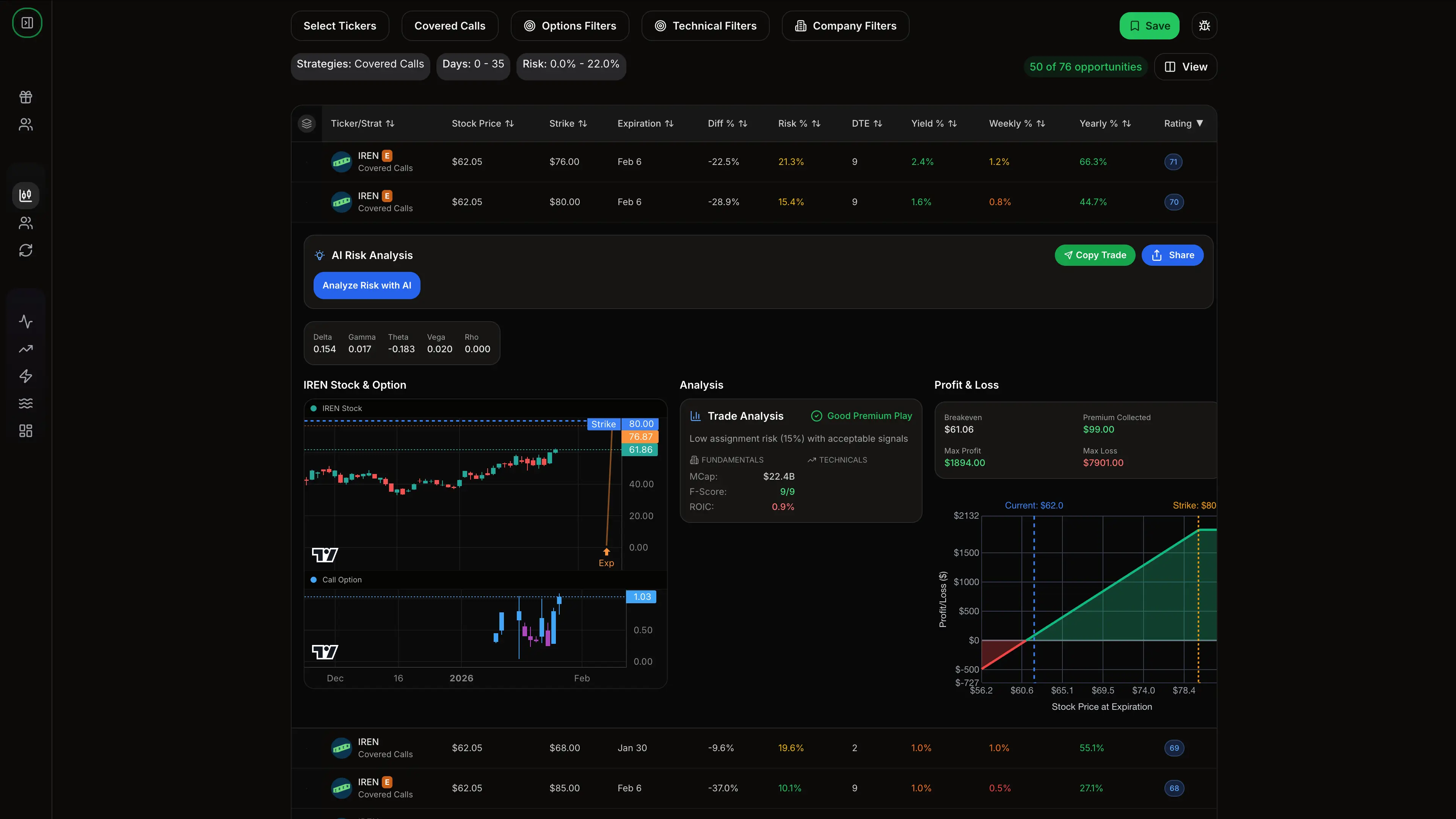
To find the trades that are "worth it" and simply ignore the bad ones, QuantWheel can help you with that by finding the deals which fit your risk filters.
Find trades like this inside QuantWheel →
Understanding Covered Call Risks
Covered calls are considered conservative compared to most options strategies, but they're not risk-free. Here are the real risks you need to understand:
Risk 1: Missing Upside Gains
The primary risk is opportunity cost. If your stock rallies significantly, you're obligated to sell at the strike price and miss the additional gains.
Real example: You sell a $55 covered call on stock currently at $50. The stock shoots to $75 on great earnings. You must sell at $55, missing out on $20 per share in gains. The $150 premium doesn't compensate for the $2,000 in missed opportunity.
This is why covered calls work best on stocks you're willing to sell anyway, not on your highest-conviction long-term holds that might 10x.
Risk 2: Full Downside Exposure
The premium provides only limited downside protection. If the stock drops significantly, you're still holding a losing position.
Example: You collect $150 premium on a $5,000 position (3% cushion). If the stock drops 20%, you've lost $1,000 minus the $150 premium, for an $850 net loss.
Covered calls do NOT protect you from major declines - they only reduce the loss slightly.
Risk 3: Assignment Timing
You might get assigned earlier than expiration if the stock goes deep in-the-money or pays a dividend. This is called "early assignment" and means you lose control over exit timing.
While early assignment is uncommon, it can happen, and you need to be prepared to sell your shares at any time once you've sold a covered call.
Risk 4: Transaction Costs
Frequent covered call trading generates commissions, fees, and bid-ask spread costs that eat into your returns. On small accounts, these costs can be significant.
If you're selling weekly calls, you're making 52 transactions per year on each position, which adds up.
Risk 5: Tax Implications
Premium income from covered calls is taxed as short-term capital gains (your ordinary income tax rate), even if you've held the underlying stock long-term.
Additionally, if you're assigned on shares you've held less than a year, your stock gains also become short-term. This can have significant tax consequences compared to holding shares for long-term capital gains treatment.
Always consult with a tax professional about your specific situation, as tax rules for options can be complex.
Covered Calls vs the Wheel Strategy
Many traders start with covered calls and then discover the wheel strategy - a systematic approach that combines cash-secured puts and covered calls into a complete income system.
Here's how they relate:
Covered calls alone:
- You must already own 100 shares to start
- Requires capital upfront to buy shares
- Only generates income if you own the stock
- Works great on existing holdings
The wheel strategy:
- Starts by selling cash-secured puts (getting paid to potentially buy stock)
- If assigned on puts, you own shares at a discount (your real cost basis is strike minus premium)
- Then sell covered calls on those shares
- If assigned on calls, restart the wheel
- Creates income at every step of the cycle
The wheel is essentially covered calls with a systematic approach to stock acquisition. Instead of buying shares outright, you sell puts first and get paid to potentially buy them at a lower price.
The wheel strategy is a complete, systematic framework for covered call traders: you sell cash‑secured puts, get assigned shares, then sell covered calls until exit. Tools like QuantWheel automate that full workflow - screening trades, tracking assignments and cost basis, managing and rolling positions, alerting you to risks, and logging everything in a trading journal.
Create a system inside QuantWheel →
Best Stocks for Covered Calls
Not all stocks are good candidates for covered calls. Here's what to look for:
High Implied Volatility (IV)
Options premium is directly related to volatility. Higher volatility stocks generate bigger premiums for the same strike and expiration.
Look for stocks with IV rank above 50, meaning current volatility is in the upper half of its annual range. This ensures you're collecting premium when it's elevated, not when it's at historical lows.
Stocks You're Willing to Sell
Never sell covered calls on your favorite long-term holdings that you want to own for decades. If you'd be devastated to sell at the strike price, don't sell that call.
Best candidates are stocks you'd be happy to sell at a 10-20% profit, or stocks you're neutral on long-term but willing to hold.
Adequate Liquidity
Stick to stocks with liquid options markets - tight bid-ask spreads and decent open interest. Illiquid options have wide spreads that eat into your returns.
Generally, focus on stocks with average daily volume above 1 million shares and options with bid-ask spreads under $0.10 for near-the-money strikes.
Stable, Mature Companies
Blue-chip stocks and established companies tend to work well for covered calls. They're less likely to make dramatic overnight moves that result in assignment at inopportune times.
Tech stocks, biotech, and other high-growth sectors can generate great premiums but come with higher assignment risk and gap-up potential.
Avoid Before Earnings
Many traders avoid selling covered calls in the week before earnings announcements. Earnings can cause significant stock moves, leading to either assignment at the strike (if you go above) or giving back premium value (if you drop).
Some advanced traders specifically target earnings volatility, but beginners should avoid this until they understand the mechanics better.
Managing Your Covered Call Positions
Once you've sold a covered call, you have several management options as expiration approaches.
Let It Expire
The simplest approach: do nothing and let the option expire.
If the stock is below the strike at expiration, the call expires worthless and you keep your shares plus the premium. You can then sell another covered call for the next month.
If the stock is above the strike, you'll be assigned and sell your shares. You book your profit and decide whether to redeploy the capital.
Buy to Close
You can buy back (close) your covered call at any time before expiration.
Why would you close early?
- Captured 50-80% of the premium and want to move to the next trade
- Stock is dropping significantly and you want to cut losses
- You need to free up the shares for another opportunity
- You want to avoid assignment
Many systematic traders close covered calls when they reach 50% profit with 21+ days until expiration, then sell a new call at a higher strike or further expiration.
Roll the Position
Rolling means simultaneously closing your current covered call and opening a new one, usually at a higher strike or later expiration.
Common rolling scenarios:
- Roll up: Stock moved higher, close current call and sell higher strike (collect more premium, set higher exit price)
- Roll out: Keep same strike but extend expiration (collect more time premium, delay potential assignment)
- Roll up and out: Combine both (higher strike and later expiration)
Rolling is a core skill for active covered call traders. It lets you stay in the position while adjusting your strike and timeline. However, tracking rolls across multiple positions can become complex, which is why many traders use automated tools to manage this.
Here's where position tracking becomes critical: manually calculating your cost basis through assignment and rolls gets messy fast. Software like QuantWheel automatically adjusts your cost basis when you get assigned and track full covered call cycles so you know your real breakeven and returns at all times.
Accept Assignment
Sometimes assignment is exactly what you wanted. If you're assigned at a strike above your purchase price, you made money on the stock appreciation plus you kept all the premium.
Take the win, collect your profit, and decide on your next trade.
Common Covered Call Mistakes to Avoid
After watching hundreds of traders learn this strategy, here are the mistakes I see most often:
Selling Calls on Stocks You Don't Want to Lose
The biggest emotional mistake is selling covered calls on your favorite long-term holdings. When those shares get called away at your strike, you'll regret capping your gains.
Reserve covered calls for stocks you're neutral on or willing to exit, not your core portfolio holdings.
Chasing Premium with Low-Strike Calls
New traders often sell calls too close to the current stock price (low strike) to maximize premium. This dramatically increases assignment probability.
Yes, you collect more premium, but you're likely giving up stock appreciation and triggering assignment. Balance premium collection with room for the stock to rise.
Ignoring Earnings Dates
Selling a covered call that expires right after an earnings announcement is asking for trouble. Earnings cause outsized moves that often result in assignment (if positive) or significant unrealized premium loss (if negative).
Always check earnings dates before selling calls, and avoid expirations within a few days of earnings unless you specifically want that risk.
Not Having an Exit Plan
Before selling a covered call, decide in advance what you'll do if assigned, if the stock drops significantly, or if you hit a profit target early.
Without a plan, you'll make emotional decisions in the moment. Systematic traders have rules: "Close at 50% profit with 21+ DTE" or "Roll up if stock is within 2% of strike with 7+ DTE."
Overtrading on Small Accounts
Options have fixed costs (minimum commissions, bid-ask spreads). On a small position, these costs are a larger percentage of your premium.
Generally, covered calls work better on positions of at least $5,000 (100 shares of a $50 stock). Below that, transaction costs eat too much of your premium.
Forgetting About Taxes
That premium income isn't free money - it's taxed as ordinary income. If you're in a high tax bracket, covered call returns are reduced by 25-40% depending on your state and federal rates.
Factor taxes into your expected returns and consult a tax professional if you're trading actively.
Getting Started with Covered Calls
Ready to make your first covered call trade? Here's your step-by-step action plan:
Step 1: Ensure Account Approval
Contact your broker to request options trading approval. Most brokers have tiered approval levels - covered calls are typically Level 1 or 2 (the most basic).
You'll need to complete an options application answering questions about your experience, risk tolerance, and financial situation.
Step 2: Select Your First Stock
Choose a stock you already own (or are willing to buy) that meets the criteria:
- You own at least 100 shares
- You'd be happy selling at a 10-15% profit
- Options are liquid (tight bid-ask spreads)
- IV rank is above 30
Step 3: Analyze the Options Chain
Look at your broker's options chain for the stock. Find the expiration closest to 30-45 days out (usually the next monthly expiration).
Look at call strikes 5-10% above the current stock price. Check the bid price - this is the premium you'll collect.
Calculate your return: (Premium ÷ Stock Price) × (365 ÷ Days to Expiration) = Annualized Return
Step 4: Place Your Order
In your broker's options platform:
- Select "Sell to Open"
- Choose "Call" option
- Select your expiration date
- Select your strike price
- Quantity: 1 contract per 100 shares you own
- Use a limit order at the bid price or slightly above
Step 5: Collect Your Premium
Once your order fills, you'll immediately see the premium credited to your cash balance. This money is yours regardless of what happens next.
Step 6: Track and Manage
Set calendar reminders for:
- 21 days to expiration (decision point to close or roll)
- 7 days to expiration (final management decision)
- Expiration Friday (be aware of assignment possibility)
Consider using a tracking system to monitor your cost basis, especially if you plan to make this a regular strategy. Manual tracking works for one position, but gets complicated fast with multiple stocks.
Simplify tracking option trades with QuantWheel →
Final Thoughts
Covered calls are a powerful tool for generating income from stocks you own. They work best when you understand the mechanics, select appropriate stocks and strikes, and manage positions systematically.
The strategy isn't magic - you're making a trade-off between upside potential and income certainty. In exchange for capping your gains, you collect premium that provides downside cushion and generates cash flow.
For many traders, covered calls are the entry point into systematic income strategies. Once you master the basics, you might explore the full wheel strategy, which combines cash-secured puts and covered calls into a complete system for generating consistent premium income.
The key to long-term success is staying disciplined: choose strikes thoughtfully, avoid selling calls on stocks you don't want to lose, manage positions actively, and track everything accurately so you know your real returns.
Risk Disclosure
Options trading involves substantial risk and is not suitable for all investors. Past performance does not guarantee future results. This content is for educational purposes only and should not be considered investment advice. Always do your own research and consider consulting with a financial advisor before making investment decisions.
The examples used in this article are for educational purposes only and are not recommendations to buy or sell any security. All investment decisions should be based on your own analysis and risk tolerance.