
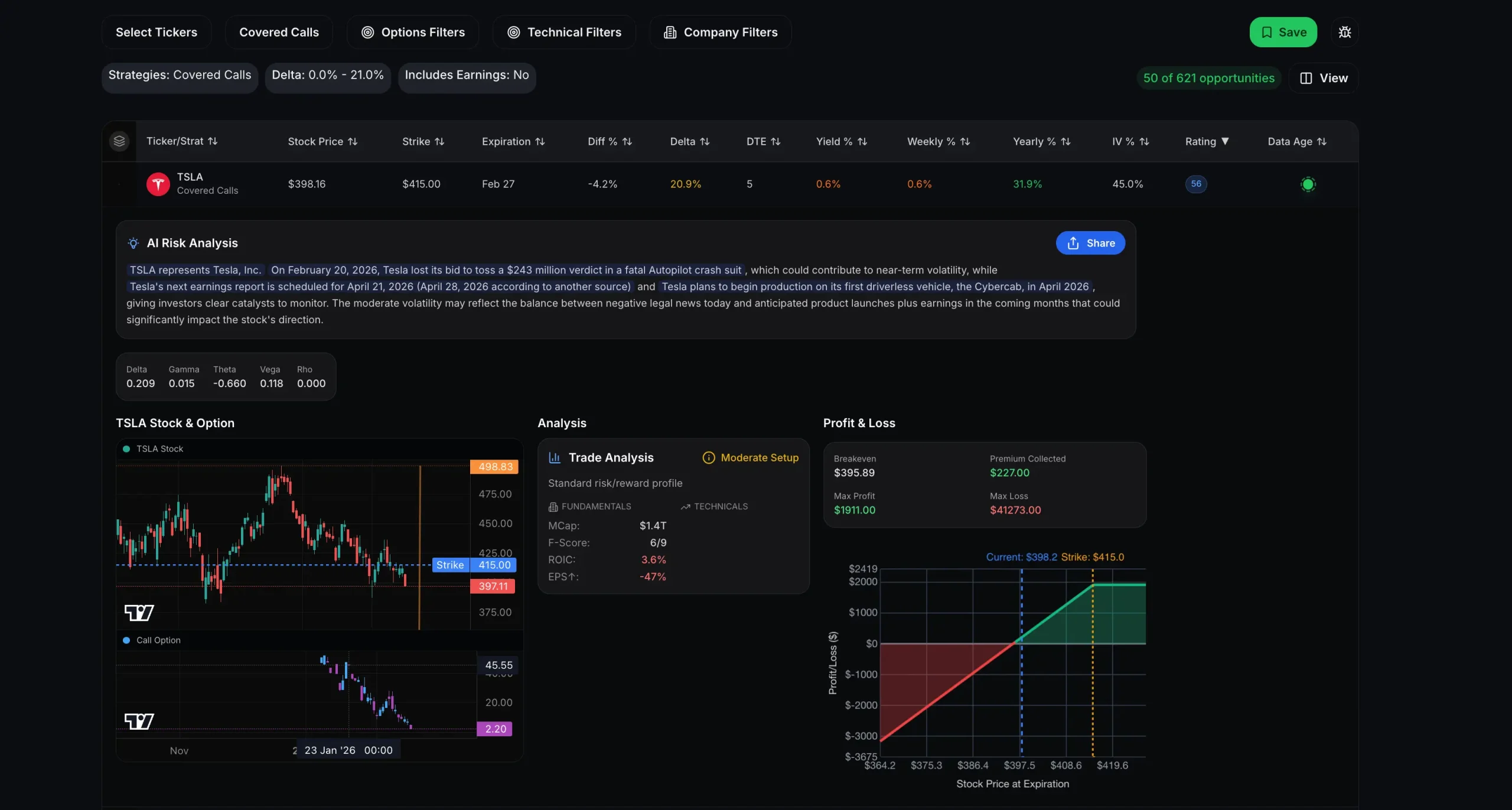
You're sitting at your computer on a Sunday evening, scanning through financial Twitter. Another trader just posted a screenshot showing 8% monthly returns from covered calls. "This is easy money!" they claim. You've been considering the covered call strategy, but something feels off about these numbers.
Here's the reality: covered call returns are more nuanced than the screenshots suggest. After analyzing thousands of covered call trades, I'm going to show you what realistic returns look like, what factors actually drive performance, and how to set expectations that lead to sustainable success rather than disappointment.
Start your free trial of QuantWheel to track your covered call returns accurately and see real-time performance metrics.
$1 for 7 days • Cancel anytime • 14-day money-back guarantee
TL;DR: Covered Call Returns at a Glance
Covered call returns typically range from 1-3% monthly (12-36% annually) on the premium collected, though this varies significantly based on market conditions and your strategy.
How it works: When you own 100 shares of a stock worth $50 and sell a call option at a $55 strike for $2 per share, you collect $200 in premium immediately. If the stock stays below $55, you keep the shares and the $200 (a 4% return on your $5,000 investment). If the stock rises above $55, your shares get called away, and you keep the $200 premium plus the $500 gain from the stock appreciation ($50 to $55), for a total return of $700 or 14%.
Key factors affecting returns:
- Implied Volatility (IV): Higher IV = bigger premiums (2-3x difference between low and high IV stocks)
- Strike Selection: Closer strikes = higher premium but more likely to cap gains
- Time to Expiration: 30-45 days typically offers the best risk/reward
- Stock Quality: Stable stocks produce consistent but lower returns; volatile stocks produce higher but riskier returns
Real example: On a $10,000 position in a moderate IV stock, you might collect $200-300 per month selling 30-45 day calls at the 0.30 delta. That's 2-3% monthly or 24-36% annualized - but only if the stock doesn't decline significantly.
The catch: Your upside is capped. If your $50 stock suddenly jumps to $70, you only profit up to $55. You miss the extra $15 per share ($1,500 on 100 shares). This opportunity cost is the hidden price of collecting premium.
Understanding Covered Call Returns: The Two Components
Covered call returns come from two distinct sources, and understanding each is crucial for setting realistic expectations.
Premium Collection (The Primary Return)
The premium you collect upfront is the bread and butter of covered call returns. When you sell a call option, you receive cash immediately in exchange for giving someone else the right to buy your shares at the strike price.
This premium represents pure income - it's yours to keep regardless of what happens to the stock, unless you buy back the option to close the position early.
In practical terms, if you own 100 shares of a $100 stock (total position value: $10,000) and sell a call for $2.50 per share, you collect $250 in premium. That's a 2.5% return on your position right away, before considering any stock movement.
Stock Appreciation (The Bonus Return)
The second component of covered call returns is any appreciation in your stock up to the strike price you selected. This is often overlooked when traders calculate returns, but it can significantly impact your total performance.
If you own shares at $100 and sell a $105 call, you can capture both the premium AND any stock appreciation up to $105. If the stock climbs to $105 by expiration, you gain $5 per share ($500 total) plus the premium you collected.
The key limitation: if the stock rises above your strike price, your gains are capped. A move from $100 to $120 only nets you the appreciation to $105, not the full $20. This is the fundamental trade-off of the covered call strategy.
Realistic Return Expectations by Market Condition
Covered call returns aren't static - they fluctuate dramatically based on market volatility and the broader environment. Here's what you can realistically expect in different scenarios.
Low Volatility Markets (VIX Below 15)
When the market is calm and implied volatility is low, option premiums shrink substantially. During these periods, covered call returns typically fall to the lower end of the spectrum.
Expect 0.5-1.5% monthly returns from premium collection during low volatility environments. On a $10,000 position, this translates to $50-150 per month in premium income. Not terrible, but barely outpacing inflation once you account for opportunity cost and transaction fees.
Low volatility environments favor long-term holders who are comfortable with modest premium collection in exchange for lower risk. The upside: your shares are less likely to experience significant downside moves.
Moderate Volatility Markets (VIX 15-25)
This is the sweet spot for covered call traders. Moderate volatility provides enough premium to make the strategy worthwhile without excessive downside risk.
In these conditions, expect 1.5-3% monthly returns from premium collection. Your $10,000 position might generate $150-300 per month in premium income. Over a year, that's $1,800-3,600 in additional income beyond any stock appreciation.
Most successful covered call traders build their strategies around moderate volatility stocks that consistently offer attractive premiums without the wild swings that lead to assignment stress or significant losses.
High Volatility Markets (VIX Above 25)
High volatility environments create dramatically higher premiums - but they come with significantly increased risk. This is when you see those 4-5% monthly return screenshots on Twitter.
During volatility spikes, covered call returns can reach 4-6% monthly on premium alone. A $10,000 position might generate $400-600 in monthly premium. Annualized, that's 48-72% returns - which sounds incredible.
The catch: high volatility means large price swings. Your stock might drop 15-20% in the same month you collected that juicy premium, resulting in a net loss despite the income. These conditions require careful position sizing and risk management to avoid catastrophic losses that wipe out months of premium collection.
Factors That Actually Impact Your Covered Call Returns
Understanding the theoretical returns is one thing. Achieving them consistently is another. Several key factors determine whether your actual results match your expectations.
Strike Selection: The Return vs Risk Trade-Off
Your strike selection is the single most important decision affecting covered call returns. Sell closer to the current stock price, and you collect more premium but cap your gains sooner. Sell further out, and you collect less premium but retain more upside potential.
At-the-money (ATM) calls with deltas around 0.50 generate the highest premiums - often 2-3x more than out-of-the-money options. But these positions have a 50% probability of assignment, meaning you're frequently capping your gains just as the stock starts rallying.
Most experienced traders target the 0.30-0.40 delta range, strikes typically 5-10% above the current stock price. This balance generates reasonable premium (1-3% monthly) while maintaining some upside participation. The assignment probability sits around 30-40%, allowing you to keep your shares through moderate rallies.
Time Decay: The 30-45 Day Sweet Spot
Options lose value over time through theta decay, and this decay accelerates as expiration approaches. Understanding the decay curve helps you maximize returns per unit of time.
Options in the 30-45 day window offer the best risk-adjusted returns for most covered call traders. They decay fast enough to generate meaningful premium but slow enough that you're not constantly rolling positions and racking up transaction costs.
Selling weekly options (7 days or less) generates higher percentage returns per day, but the constant management and commission costs often eliminate the advantage. You're also taking more gamma risk - the rapid price sensitivity near expiration that can turn winners into losers overnight.
Longer-dated options (60-90 days) generate higher absolute premiums but lower returns when annualized. A 60-day option might collect $4 per share while a 30-day collects $2.50, but the 30-day position generates better returns when you compound over time.
Dividend Considerations
Dividends add an interesting wrinkle to covered call returns, particularly for dividend-focused portfolios. When you own shares, you collect dividends as long as you hold them through the ex-dividend date.
However, calls on dividend-paying stocks carry early assignment risk right before the ex-dividend date. If your call is in-the-money and the dividend is larger than the remaining time value in the option, the call owner might exercise early to capture the dividend.
Early assignment forces you to sell your shares before the ex-dividend date, meaning you forfeit the dividend. This hidden cost can reduce your total returns by 0.5-1.5% depending on the dividend yield and how often you experience early assignment.
Some traders adjust their strategy around dividends by selling calls with expirations after the ex-dividend date, ensuring they capture both the dividend and the premium. Others avoid dividend stocks entirely for covered calls, preferring growth stocks with higher IV and no early assignment risk.
Transaction Costs and Slippage
Every trade costs money. Commissions, bid-ask spreads, and assignment fees add up quickly when you're actively managing covered calls.
At $0.65 per contract (typical for most brokers), you pay $0.65 to open the position and another $0.65 to close it if you roll or buy it back early. That's $1.30 in commissions on a position where you might collect $200-300 in premium - not devastating, but it matters.
The bid-ask spread costs more than commissions for most traders. On less liquid options, you might give up $5-15 in slippage entering and exiting positions. Over 12 months of active trading, these seemingly small costs can reduce your net returns by 2-4% annually.
Assignment fees add another $10-25 per position when your shares get called away. If you're getting assigned monthly on multiple positions, these fees become a significant drag on returns.
Real Return Examples: What Different Strategies Actually Generate
Let's look at concrete examples showing what different covered call approaches actually return over time.
Conservative Approach: Blue Chip Stocks, 0.30 Delta
Portfolio: $50,000 across 5 positions in stable, dividend-paying blue chips (AAPL, MSFT, JNJ, PG, KO)
Strategy: Sell 45-day calls at 0.30 delta, close at 50% profit or roll at expiration
Average IV: 25-30%
Monthly premium: $750-1,250 (1.5-2.5% of portfolio)
Annual premium: $9,000-15,000 (18-30% of portfolio)
Dividend income: $1,500-2,000 (3-4% of portfolio)
Total annual return: $10,500-17,000 (21-34%)
The trade-off: You cap your upside at 5-10% above current prices. In a strong bull market where these stocks rally 30-40%, you significantly underperform buy-and-hold. But in sideways or down markets, you outperform by collecting income while others wait for appreciation.
Moderate Approach: Growth Stocks, 0.35 Delta
Portfolio: $50,000 across 5 positions in moderate-volatility growth stocks (NVDA, PLTR, AMD, TSLA, COIN)
Strategy: Sell 30-day calls at 0.35 delta, close at 50% profit with 21+ DTE or roll at expiration
Average IV: 40-55%
Monthly premium: $1,250-2,000 (2.5-4% of portfolio)
Annual premium: $15,000-24,000 (30-48% of portfolio)
Dividend income: $0 (growth stocks)
Total annual return: $15,000-24,000 (30-48%)
The trade-off: Higher returns come with much higher volatility. These stocks can easily drop 15-20% in a bad month, wiping out 4-6 months of premium collection. You need strong risk management and the stomach to hold through drawdowns.
Aggressive Approach: High-IV Stocks, 0.40 Delta
Portfolio: $50,000 across 5-8 positions in high-volatility stocks during earnings or market uncertainty
Strategy: Sell 14-21 day calls at 0.40 delta, actively manage, close at 40% profit
Average IV: 60-80%
Monthly premium: $2,000-3,000 (4-6% of portfolio)
Annual premium: $24,000-36,000 (48-72% of portfolio)
Dividend income: $0
Total annual return: $24,000-36,000 (48-72%) - IF everything goes right
The trade-off: This approach requires constant monitoring and generates significant short-term capital gains. The risk of large losses is substantial - a single bad position can lose 30-50%, wiping out months of gains. Most traders who attempt this approach eventually blow up their account or revert to more conservative strategies after experiencing major losses.
Hidden Costs That Reduce Your Actual Returns
The returns I've outlined above are gross returns before accounting for several hidden costs that reduce your actual take-home performance.
Opportunity Cost
This is the biggest hidden cost of covered calls, and it's not reflected in any brokerage statement. Every time you cap your gains at a strike price, you're paying an opportunity cost equal to any appreciation beyond that level.
If your $100 stock rallies to $120 but you sold a $110 call, you left $10 per share ($1,000 on 100 shares) on the table. That foregone gain is a real cost, even though it doesn't feel like one in the moment.
Over long bull markets, opportunity costs can dwarf your premium collection. The 2023-2024 tech rally saw stocks like NVDA and AMD appreciate 200-300%. Covered call sellers might have collected 30-40% in premium while missing 200%+ in stock appreciation.
Tax Implications
Covered calls generate mostly short-term capital gains, which are taxed at your ordinary income rate rather than the favorable long-term capital gains rate.
If you're in the 32% tax bracket, that 30% annual return becomes a 20.4% after-tax return. Compared to buy-and-hold generating long-term gains taxed at 15%, the tax drag significantly impacts your comparative performance.
Some covered call traders hold positions for over a year to generate long-term gains, but this defeats the purpose of the strategy which relies on frequent premium collection. The tax issue is particularly relevant for taxable accounts - covered calls work better in tax-advantaged retirement accounts.
Assignment and Rolling Costs
When your calls go in-the-money and assignment becomes likely, you face a decision: accept assignment and restart the wheel, or roll the call out to a further expiration to keep your shares.
Rolling costs money. You buy back the in-the-money call (typically at a loss relative to the premium you collected) and sell a new call at a further date. The net credit might be small or even negative, and you pay commissions on both legs of the trade.
If you accept assignment, you pay assignment fees ($10-25) and potentially create a taxable event. Then you need to restart the position, possibly at higher prices if the stock has rallied.
These transition costs happen frequently in actively managed covered call portfolios and can reduce annual returns by 2-5% depending on how often you experience assignments.
Time Investment
Time isn't money, but it's a cost nonetheless. Covered calls require ongoing management - monitoring positions, checking for profit targets, rolling positions, managing assignments, and tracking cost basis.
If you're spending 5-10 hours per month managing a $50,000 covered call portfolio that generates $1,000-1,500 in monthly premium, you're earning $100-300 per hour for your time. Not bad, but worth considering as an implicit cost.
Many traders start with manual spreadsheet tracking and quickly realize the time investment becomes unsustainable as their portfolio grows past 5-10 positions. This is where most traders struggle with calculating their actual cost basis after assignments - your broker shows your purchase price, but your real cost basis includes all the premium you've collected.
Software like QuantWheel automatically tracks your cost basis through complete covered call cycles, adjusting for premium collected and assignments so you always know your true breakeven.
This eliminates hours of manual spreadsheet work and ensures accurate performance tracking.
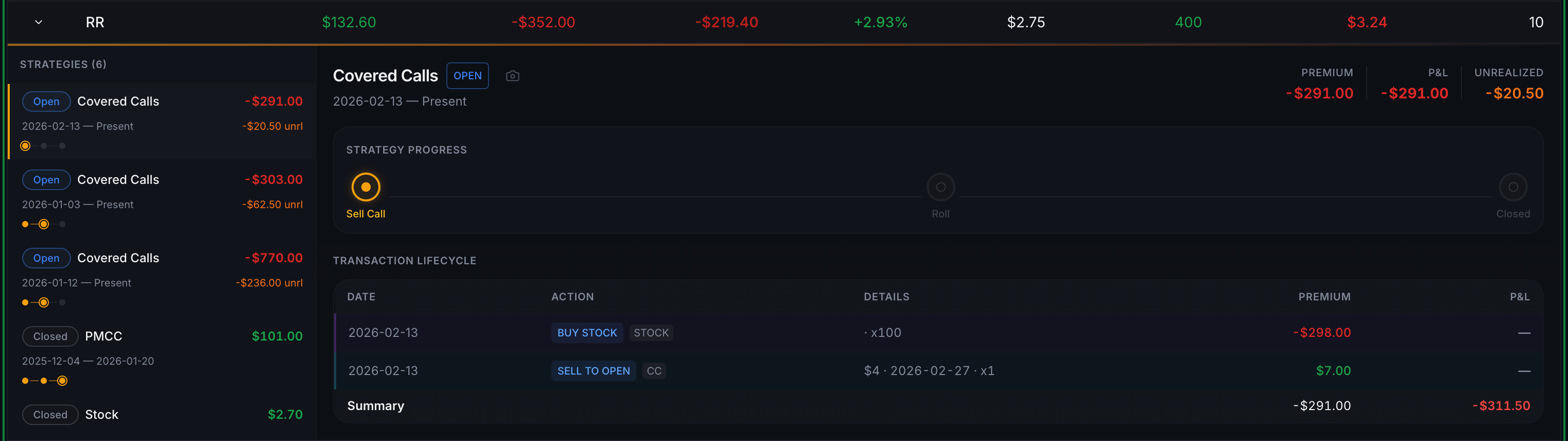
Keep track of trades automatically inside QuantWheel →
How to Track Your Covered Call Returns Accurately
Most traders significantly overestimate or underestimate their covered call returns because they don't track all the components correctly.
What You Must Track
To calculate true returns, you need to track: total premium collected (gross), premium after commissions (net), stock appreciation or depreciation, dividends received, assignment fees, rolling costs, and time in position to calculate annualized returns.
Your broker's P&L isn't accurate for covered calls because it doesn't account for cost basis adjustments. When you get assigned, your broker shows the sale price as your gain, but your real gain includes the premium you collected when selling the call.
Example: You bought shares at $100, sold a $110 call for $3, and got assigned. Your broker shows a $10 per share gain ($1,000 profit). But your actual gain is $13 per share ($1,300 profit) when including the premium. That 30% difference matters significantly when calculating true returns.
Cost Basis Adjustment
Every time you collect premium from selling a call, you're effectively reducing your cost basis in the underlying shares. A $100 share with $3 in premium collected has a real cost basis of $97.
When you get assigned, this adjusted cost basis determines your actual profit. If your shares sold at $110 with a $97 adjusted basis, you made $13 per share, not $10.
Most traders track this manually in spreadsheets, which breaks down after 5-10 positions. Missed adjustments lead to incorrect tax reporting and inaccurate performance measurement.
This is exactly why QuantWheel's Wheel Native Journal automatically adjusts your cost basis when you collect premium and when assignments happen. You always see your true breakeven and accurate returns without manual calculations.
Annualized Return Calculation
To compare covered call returns to other strategies, you need to annualize them correctly. A 5% return in 30 days isn't a 60% annual return because of compounding.
The formula: ((1 + return) ^ (365 / days held)) - 1
A 3% return on a 35-day position annualizes to: ((1.03) ^ (365/35)) - 1 = 35.6% annualized
This calculation gets complex when you're managing multiple positions with different durations, expirations, and outcomes. Professional tracking systems calculate this automatically across your entire portfolio.
Comparing Covered Call Returns to Alternatives
Understanding covered call returns in isolation isn't enough - you need to compare them to alternative strategies to determine if the juice is worth the squeeze.
Covered Calls vs Buy and Hold
In strong bull markets, buy and hold crushes covered calls. The S&P 500's 2023-2024 performance shows this clearly - the index returned 40%+ over 18 months while covered call sellers capped their gains at 20-30% (premium collected plus limited appreciation).
However, in sideways or bear markets, covered calls significantly outperform. During the 2022 bear market, the S&P 500 fell 18% while many covered call portfolios stayed flat or slightly positive thanks to premium collection offsetting share depreciation.
Over full market cycles (10+ years), covered call strategies typically match or slightly underperform buy and hold, but with significantly lower volatility. You trade some upside for smoother returns and monthly income - appealing for retirees or income-focused investors.
Covered Calls vs Cash-Secured Puts
Cash-secured puts and covered calls are two sides of the same coin (wheel strategy), but their return profiles differ based on market conditions.
Cash-secured puts generate slightly higher returns in bull markets because you're collecting premium without capping your upside - if the stock rises, you keep all the premium and can sell another put at higher levels.
Covered calls generate more consistent returns in volatile markets because you already own shares and collect premium regardless of direction. Puts require cash sitting idle, so your total portfolio return suffers from cash drag.
Most sophisticated traders combine both through the wheel strategy: sell puts to acquire shares at good prices, then sell calls against those shares to generate additional income. This approach generates the highest returns across market conditions.
Covered Calls vs Dividend Investing
Dividend investors collect 2-4% annually from dividend-paying stocks. Covered call sellers on the same stocks might generate 12-24% annually from premium collection plus dividends.
The key difference: dividends are passive and paid quarterly regardless of market conditions, while covered calls require active management and can cap your gains during rallies.
Some investors combine both strategies, running covered calls on dividend aristocrats to collect both dividends and premium. This approach generates the highest income but sacrifices appreciation potential during bull markets.
How to Improve Your Covered Call Returns
After understanding what typical returns look like, the natural question is: how do I optimize my results?
Select Better Underlying Stocks
Not all stocks are equal for covered calls. You want liquid options (tight bid-ask spreads), consistent moderate volatility (30-50% IV), and stocks you don't mind owning long-term.
Avoid stocks with binary events (FDA approvals, earnings surprises, litigation risk) that can gap significantly overnight. These lottery tickets occasionally generate massive premiums, but the risk of catastrophic loss isn't worth the extra yield.
Focus on stocks with established patterns of moderate volatility, liquid options markets, and business models you understand. You're not just an option trader - you're a stockholder. Own things you'd be comfortable holding through assignments and temporary drawdowns.
Time Your Entries Around Volatility
Implied volatility isn't constant - it expands during uncertainty and contracts during calm periods. Selling calls when IV is elevated generates significantly higher returns than selling during low volatility.
Use tools like IV Rank (where current IV sits relative to its 52-week range) to identify when options are expensive. An IV Rank above 50 means current volatility is higher than 50% of the past year - a good time to sell premium.
Avoid selling calls when IV Rank is below 30 unless you need the income. You're locking in low premiums that won't compensate you adequately for the upside you're capping.
Manage Winners Aggressively
Most traders let covered calls ride to expiration, but this strategy leaves money on the table. Time decay accelerates as expiration approaches, but much of the value disappears in the first 21-30 days.
Consider closing positions at 50% of maximum profit when you still have 21+ days to expiration. You've captured most of the value with most of the time remaining, and you can redeploy the capital into a new position that starts the decay curve fresh.
This "close at 50%" approach typically generates higher annual returns than holding to expiration because you're constantly refreshing your positions with high time decay. The trade-off is more transaction costs and active management.
Roll Intelligently
When your stock rallies above your strike and assignment becomes likely, you face a decision: accept assignment or roll the call to a further expiration.
Rolling makes sense when you can collect additional net credit while extending your time and possibly raising your strike. A good roll might collect $1.50 net credit while pushing expiration out 30 days and raising the strike by $5.
Bad rolls just delay the inevitable at breakeven or for a small debit. If the stock has rallied significantly and your call is deep in-the-money, accept assignment and restart the cycle rather than chasing it with expensive rolls.
QuantWheel's Roll Assistant analyzes every possible roll option, calculating the net credit, time extension, and return for each choice. Instead of manually checking 10-15 different strike/expiration combinations, you see optimal recommendations in seconds.
Setting Realistic Return Expectations
After analyzing all these factors, what should you actually expect from covered calls?
First Year: Learning and Optimization
Your first year of covered calls will likely underperform theoretical returns. You're learning strike selection, timing, position sizing, and management techniques.
Expect 10-20% annual returns in your first year - roughly half the potential once you're experienced. You'll make mistakes: holding losers too long, closing winners too early, picking poor underlying stocks, and misjudging assignment risk.
These mistakes are valuable tuition. Track what works and what doesn't. Most traders who stick with covered calls for 12+ months see consistent improvement as they refine their process.
Steady State: 20-30% Annual Returns
Once you're experienced and running a systematic process, expect 20-30% annual returns in normal market conditions. This assumes moderate volatility, diversified positions, and active management.
Some years will outperform (35-40% in high volatility environments), and some will underperform (10-15% in strong bull markets where you cap gains). But over multi-year periods, 20-30% is a reasonable steady-state expectation.
This performance comes with significantly lower volatility than buy-and-hold. Your drawdowns should be smaller, and your monthly cash flow should be consistent - appealing characteristics for many investors.
Best Case: 30-40% in Ideal Conditions
In perfect conditions - moderate to high volatility, good stock selection, and skillful management - covered call returns can reach 30-40% annually.
This requires: selecting stocks with 35-50% IV, targeting 0.30-0.35 delta strikes on 30-45 day expirations, closing at 50% profit with 21+ DTE, avoiding significant stock depreciation, and managing multiple positions simultaneously.
Returns above 40% annually are possible but typically come with excessive risk-taking that eventually leads to blow-up scenarios. If someone's consistently claiming 50%+ returns from covered calls, they're either taking massive risks or being selective with their reporting.
Worst Case: Flat to Negative in Bad Markets
In severe bear markets or when underlying stocks gap down significantly, covered calls can generate negative returns despite premium collection.
If you're collecting 2% monthly premium ($200 on a $10,000 position) but your stock drops 20% ($2,000 loss), you're down 18% net despite doing everything right from a covered call perspective.
This scenario highlights the importance of stock selection and risk management. Covered calls aren't magic - they generate income, but they don't eliminate the fundamental risk of stock ownership. Your returns are still driven primarily by the performance of your underlying shares.
The Bottom Line on Covered Call Returns
Covered call returns typically range from 1-3% monthly (12-36% annually) when executed properly across varying market conditions. This performance comes from premium collection plus limited stock appreciation, offset by the opportunity cost of capped upside and various hidden costs.
Your actual returns will depend on: the underlying stocks you select, your strike and expiration choices, your risk management discipline, market volatility during your holding period, your ability to manage winners and losers, and how accurately you track your true performance including cost basis adjustments.
The strategy works best for traders who prioritize consistent income over maximum capital appreciation, can manage positions actively without emotional decision-making, and understand they're trading unlimited upside for defined premium collection.
Realistic expectations matter more than chasing the highest possible returns. A sustainable 20-25% annual return beats an aggressive 40% approach that eventually blows up when market conditions shift.
If you're running covered calls and struggling to track your actual returns through assignments and cost basis adjustments, QuantWheel automates the tedious accounting so you always know your true performance. The Wheel Native Journal tracks complete cycles from share acquisition through covered calls to assignment, calculating your real cost basis and returns without manual spreadsheets.
Start your free trial of QuantWheel to track your covered call positions automatically and see your real returns across complete cycles.
$1 for 7 days • Cancel anytime • 14-day money-back guarantee
Risk Disclosure
Options trading involves substantial risk and is not suitable for all investors. Past performance does not guarantee future results. This content is for educational purposes only and should not be considered investment advice. Always do your own research and consider consulting with a financial advisor before making investment decisions.
The examples used in this article are for educational purposes only and are not recommendations to buy or sell any security. Individual results may vary significantly based on market conditions, execution, timing, and other factors.