
You just opened your brokerage account, funded it with your savings, and searched "how to make money trading options." Now you're staring at two completely different approaches: buying options or selling options. Everyone seems to have an opinion, but nobody explains which actually works better for real traders managing real money.
Here's the truth most "gurus" won't tell you: buying and selling options are fundamentally different strategies with opposite risk profiles, different win rates, and completely different ways to lose money. After managing hundreds of options positions personally, I've learned that the "better" approach isn't universal - it depends entirely on your capital, your prediction ability, and your tolerance for different types of losses.
This guide breaks down exactly how buying and selling options differ, who wins more often, how time decay impacts each approach, and which strategy aligns with your actual trading goals.
$1 for 7 days • Cancel anytime • 14-day money-back guarantee
TLDR: Buying vs Selling Options - What You Need to Know
Selling options = higher win rate but capped profits. You collect premium upfront and profit when the stock doesn't move much. Time decay works FOR you. Win rate: 60-70%. Example: Sell a $50 put on XYZ stock, collect $200 premium. If XYZ stays above $50, you keep all $200. Maximum profit: $200.
Buying options = lower win rate but unlimited profit potential. You pay premium upfront and profit only if the stock moves significantly in your direction before expiration. Time decay works AGAINST you. Win rate: 30-40%. Example: Buy a $50 call on XYZ for $200. If XYZ jumps to $60, your option is worth $1,000 (5x return). If XYZ stays at $50 or drops, you lose all $200.
Key difference: Sellers are like insurance companies (collect small premiums consistently, occasionally pay big claims). Buyers are like lottery ticket holders (small bets, most lose, rare winners hit big).
Which is better? If you have limited capital and can accurately predict big moves, buying can generate explosive returns. If you have more capital and prefer consistency over excitement, selling typically provides steadier results. Most professional options traders sell more than they buy because the math favors premium collectors over time.
The Fundamental Difference Between Buying and Selling Options
When you buy an option, you're purchasing the RIGHT to buy or sell a stock at a specific price before a specific date. You pay money upfront (the premium) and can never lose more than that premium, but you have unlimited profit potential if the stock moves dramatically in your favor.
When you sell an option, you're selling that RIGHT to someone else. You collect the premium upfront and it's yours to keep, but you take on an OBLIGATION that could cost you much more than the premium you received.
This fundamental structure creates completely different risk-reward profiles.
Option Buyer:
- Pays premium upfront (money out)
- Limited risk (can only lose premium paid)
- Unlimited profit potential (on calls)
- Needs the stock to move significantly
- Time decay is your enemy
- Lower win rate but bigger winners
Option Seller:
- Collects premium upfront (money in)
- Unlimited risk on some strategies
- Limited profit potential (capped at premium)
- Profits when stock doesn't move much
- Time decay is your friend
- Higher win rate but smaller winners
The psychology matters too. Sellers experience many small wins and occasional large losses. Buyers experience many small losses and occasional large wins. These patterns affect your emotional state differently - some traders handle frequent small wins better, while others can tolerate frequent small losses in pursuit of the big score.
Win Rates: Who Actually Makes Money More Often?
Here's the statistic that surprises most beginners: option sellers win 60-70% of their trades, while option buyers win only 30-40% of their trades.
This happens because of how options are priced and how time decay works.
When you sell an option, you profit in three scenarios:
- The stock moves in your favor
- The stock doesn't move at all
- The stock moves slightly against you (but not past your strike price)
When you buy an option, you profit in only one scenario:
- The stock moves significantly in your direction before expiration
The "doesn't move at all" scenario is huge. Many stocks trade in relatively tight ranges for weeks at a time. Sellers profit during these periods. Buyers lose money every single day the stock doesn't move because of time decay.
Real example: I sold a cash-secured put on a tech stock at a $45 strike with 30 days until expiration, collecting $150 premium. Over the next 30 days, the stock bounced between $46 and $49. I won. Someone who bought that $45 put paid $150 and watched it expire worthless. They lost.
But here's the critical part: the seller's wins are small. That $150 represents a 3.3% return on the $4,500 I had set aside to potentially buy the stock. The buyer risked $150 to potentially make $1,000+ if the stock crashed - a much larger profit potential if they had been right.
This creates the core tension in options trading: sellers win more often but profit less per win. Buyers lose more often but profit more per win.
Time Decay (Theta): Your Best Friend or Worst Enemy
Time decay is the silent killer of option buyers and the secret weapon of option sellers.
Every option has an expiration date. As that date approaches, the option loses value - this is called time decay or theta. This happens regardless of whether the stock moves.
For option sellers, time decay is profit. Every day that passes, the option you sold becomes less valuable. If you sold it for $200 and it's now worth $150, you could buy it back and lock in $50 profit, or just let it continue decaying to zero.
For option buyers, time decay is loss. Every day that passes, the option you bought becomes less valuable. You paid $200 and if the stock hasn't moved, your option might be worth $175 a week later, $150 two weeks later, and $100 three weeks later - even though nothing happened to the stock.
Time decay accelerates as expiration approaches. The last two weeks of an option's life sees the most rapid decay. This is why sellers often target options with 30-45 days until expiration (enough premium to collect, but fast enough decay), while buyers often choose longer-dated options (6-12 months) to reduce the daily impact of time decay.
The math: A 30-day option might lose 2-3% of its value per day in the final week, but only 0.5-1% per day in the first week. This acceleration makes timing crucial for buyers - you can be right about direction but too early, and still lose money.
Many beginners don't realize they're fighting time decay daily when buying options. Even if the stock moves in your favor, it needs to move ENOUGH to overcome the time decay you've already suffered. This is why stock moves up 5% but your call option is still down - time decay ate into your gains.
Capital Requirements: How Much Money Do You Actually Need?
The capital required for buying versus selling options differs dramatically, which affects who can use each strategy.
Buying Options: Low Capital Entry You can buy options contracts for as little as $50-$500 per contract, depending on the stock and strike price. This low barrier to entry attracts beginners, but it creates a psychological trap: small losses feel acceptable, but they add up quickly, and you can lose your entire investment on each trade.
- Buy a $100 call on AAPL: $300-$500 per contract
- Buy a $30 put on PLTR: $100-$200 per contract
- Total capital needed to start: $500-$1,000
Selling Options: High Capital Requirement Selling options, particularly cash-secured puts or covered calls (the safest methods for beginners), requires substantially more capital because you need to back up your obligation.
- Sell a cash-secured put with a $50 strike: Need $5,000 in cash
- Sell a covered call: Need to own 100 shares of the stock (could be $3,000-$10,000+)
- Total capital needed to start: $5,000-$10,000 minimum
This capital difference creates a barrier but also forces better risk management. When you need $5,000 to enter a position, you think carefully about the trade. When you only need $200, you might enter casually and lose it quickly.
Some brokers allow margin or undefined risk strategies (like selling naked calls) which reduce capital requirements, but these strategies carry significantly higher risk and are not recommended for beginners.
Profit Potential: Small Consistent Gains vs Home Run Trades
The profit structures of buying versus selling create completely different trading experiences.
Selling Options: Predictable But Capped Returns When you sell an option, your maximum profit is known upfront - it's the premium you collected. A $200 premium means your max profit is $200, period. You can't make more even if the stock moves dramatically in your favor.
Typical returns for sellers:
- 1-3% return per trade (30-45 day holds)
- 12-36% annualized if consistently successful
- Compounding available because you can reinvest premium
Buying Options: Unlimited Upside But Frequent Total Losses When you buy an option, your profit potential is theoretically unlimited (for calls) or very large (for puts - limited to stock going to $0). The downside is your entire premium can go to zero.
Typical returns for buyers:
- 50-100% returns on winning trades (2-5x your premium)
- Total loss (-100%) on losing trades
- 200-500% returns possible on exceptional moves
- Harder to compound because losses wipe out capital
Real comparison: A seller makes $200, $150, $180, $220, -$500 (one bad assignment), net = $250 profit over 5 trades.
A buyer loses $200, loses $180, loses $150, wins $1,200, loses $200, net = $470 profit over 5 trades.
Same 5 trades, but the emotional experience is completely different. The seller had 4 wins and 1 loss. The buyer had 1 win and 4 losses. Both made money, but the buyer needed exceptional timing on that one winning trade.
Risk Management: Different Ways to Lose Money
Both strategies can lose money, but they lose differently.
Seller's Risks:
- Assignment: Being forced to buy stock at your strike price even if it's fallen
- Unlimited losses: Naked calls can theoretically lose infinite money
- Tied-up capital: Your money is committed during the entire trade
- Gap risk: Stock gaps down significantly overnight, instant large loss
Buyer's Risks:
- Time decay: Losing money daily even if you're not wrong about direction
- Total loss: Premium goes to $0 if you're wrong or too early
- Volatility crush: IV drops after earnings, option value plummets even if stock unmoved
- Liquidity: Wide bid-ask spreads can eat into profits
The seller's worst-case scenarios are often worse (unlimited loss potential on naked calls, or being assigned stock in a crashing market). But the seller's typical loss is a managed assignment where you buy stock you're willing to own.
The buyer's worst-case scenario is losing 100% of the premium paid, which happens frequently. But the buyer's typical loss is smaller in absolute dollars - you only risked the premium amount.
This is where tracking becomes crucial. After managing 15+ positions, knowing which trades need attention, what your cost basis is after assignments, and when to roll positions becomes complex. After I got assigned on three positions in one week and spent two hours updating spreadsheets to calculate my real cost basis, I realized manual tracking wasn't sustainable. This is exactly why QuantWheel exists - to automate cost basis adjustments on assignment, track full wheel cycles, and alert you when positions need attention, so you can focus on trading instead of spreadsheet math.
Which Strategy Should You Choose?
The "better" strategy depends entirely on your situation.
Choose BUYING options if:
- You have limited capital (under $5,000)
- You can identify major market moves before they happen
- You're comfortable with low win rates (30-40%)
- You want uncapped profit potential
- You can tolerate losing your entire investment frequently
- You're willing to study technical analysis, catalysts, and timing
- You're okay with needing to be right about direction, timing, AND magnitude
Choose SELLING options if:
- You have substantial capital ($10,000+)
- You prefer higher win rates (60-70%)
- You're comfortable with capped profit potential
- You can handle occasional large losses (assignments, gap downs)
- You want time decay working in your favor
- You prefer consistent, smaller gains over home runs
- You're willing to own the underlying stock at your strike price
- You can track multiple positions and manage cost basis through assignments
Hybrid approach: Many experienced traders do both. Sell options on core holdings to generate income, buy options for specific opportunities with high conviction. This balances the consistent income from selling with occasional explosive gains from buying.
For most beginners with $10,000+ capital, starting with selling strategies like cash-secured puts or the wheel strategy provides better early success because the higher win rate builds confidence and the capped risk is easier to manage psychologically.
The Wheel Strategy: The Best of Both Worlds for Beginners
If you're trying to choose between buying and selling, the wheel strategy deserves special mention because it's become the most popular options strategy for individual traders, and for good reason.
The wheel strategy is purely a selling strategy focused on generating consistent income:
- Sell cash-secured puts on stocks you'd be willing to own
- Collect premium while the put is open
- If assigned (stock falls below strike), you now own 100 shares
- Sell covered calls on those shares
- Collect more premium on the covered calls
- If called away (stock rises above strike), your shares are sold for profit
- Return to step 1 and repeat
This strategy stacks the odds in your favor:
- High win rate (60-70%) because you profit from time decay
- Two sources of income (put premium + call premium)
- You only own stocks you chose at prices you accepted
- Capital efficient if you get assigned - your cash becomes stock, you keep collecting premium
- Conservative risk profile - you're getting paid to set limit orders
The downside is tracking complexity. When you get assigned, your cost basis isn't what your broker shows - it's your strike price minus all the premium you collected. After three assignments, tracking this manually becomes tedious and error-prone. This tracking challenge is exactly what I experienced trading the wheel strategy personally, which led to building QuantWheel's automatic cost basis adjustment feature.
$1 for 7 days • Cancel anytime • 14-day money-back guarantee
Common Mistakes in Both Strategies
Buyer Mistakes:
- Buying options too close to expiration (time decay kills you)
- Not calculating breakeven (stock must move past strike + premium paid)
- Holding through earnings without understanding volatility crush
- Buying out-of-the-money options that require massive moves
- Not taking profits when up 50-100% (waiting for more, watching it decay back to zero)
Seller Mistakes:
- Selling naked calls without understanding unlimited risk
- Not having a plan for assignment (panic selling stock at a loss)
- Not tracking cost basis correctly after assignment (tax nightmare)
- Selling puts on stocks you don't actually want to own
- Not rolling positions early enough when threatened with assignment
- Ignoring portfolio-level risk (getting assigned on 8 positions simultaneously during a crash)
The mistakes beginners make when selling options are often more expensive than buyer mistakes because the position sizes are larger. A buyer mistake might cost you $200. A seller mistake could cost you $2,000-$5,000 if you're assigned on a stock that gaps down 20%.
The Bottom Line: Math Favors Sellers, Psychology Challenges Both
After years of trading both strategies and analyzing thousands of options trades, here's what the data shows:
Options sellers have a mathematical edge. Time decay works in your favor, you have multiple ways to win, and consistent execution produces steady returns. The options market is structured to favor premium collectors - this is why market makers and professional traders primarily sell options.
But selling requires discipline and capital. You need enough money to back your positions, you need to track cost basis properly through assignments, and you need emotional control to manage occasional large losses among frequent small wins.
Options buyers can generate explosive returns when they're right, but the combination of low win rates, time decay, and the need to be right about direction, timing, and magnitude makes consistent profitability very difficult.
For most traders with $10,000+ capital who want to build consistent results over time, selling options (particularly through strategies like the wheel) offers a better probability of success. For traders with limited capital who can identify major market moves, buying options offers leveraged exposure that selling can't provide.
The truth is, successful long-term options traders typically do both - sell options for consistent income, buy options for specific high-conviction opportunities. You don't have to choose just one approach forever.
What matters most is understanding the math, managing your risk, and tracking your positions properly so you actually know whether you're winning or losing. That last part - tracking complex positions through assignments, rolls, and full wheel cycles - is where most manual tracking falls apart. And that's exactly why tools like QuantWheel exist: to handle the tedious position tracking automatically so you can focus on making smart trading decisions.
$1 for 7 days • Cancel anytime • 14-day money-back guarantee
Risk Disclosure
Options trading involves substantial risk and is not suitable for all investors. Past performance does not guarantee future results. This content is for educational purposes only and should not be considered investment advice. Always do your own research and consider consulting with a financial advisor before making investment decisions.
The examples used in this article are for educational purposes only and are not recommendations to buy or sell any security. All investment decisions should be based on your own analysis and risk tolerance.
When you trade options, you can be either a buyer or a seller. Each side has different rights and risks.
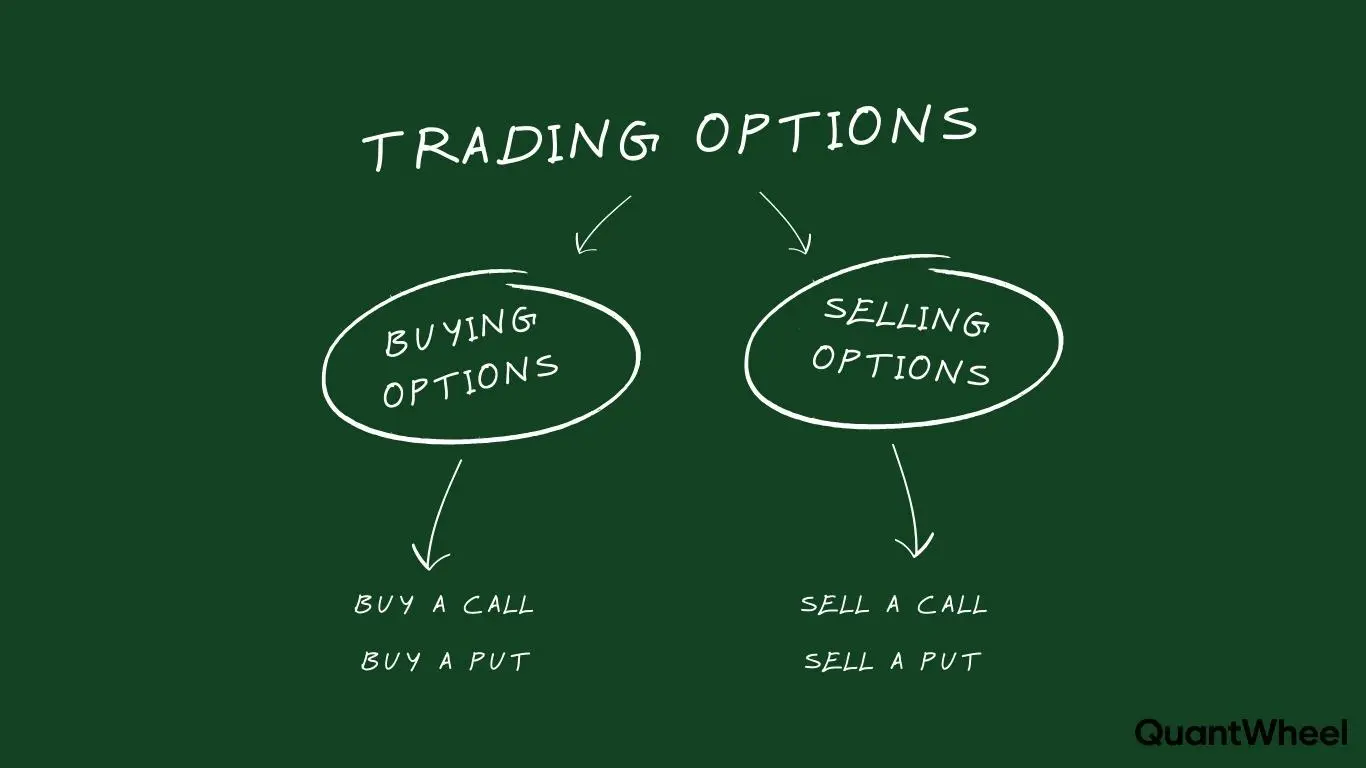
To explain in greater detail what these mean, we will look at 2 different analogies. First analogy will help you understand what happens when you buy options. We will use an "apartment buying reservation" point of view.
Second analogy will help you understand what happens when you sell options. We will use an "“insurance company” point of view.
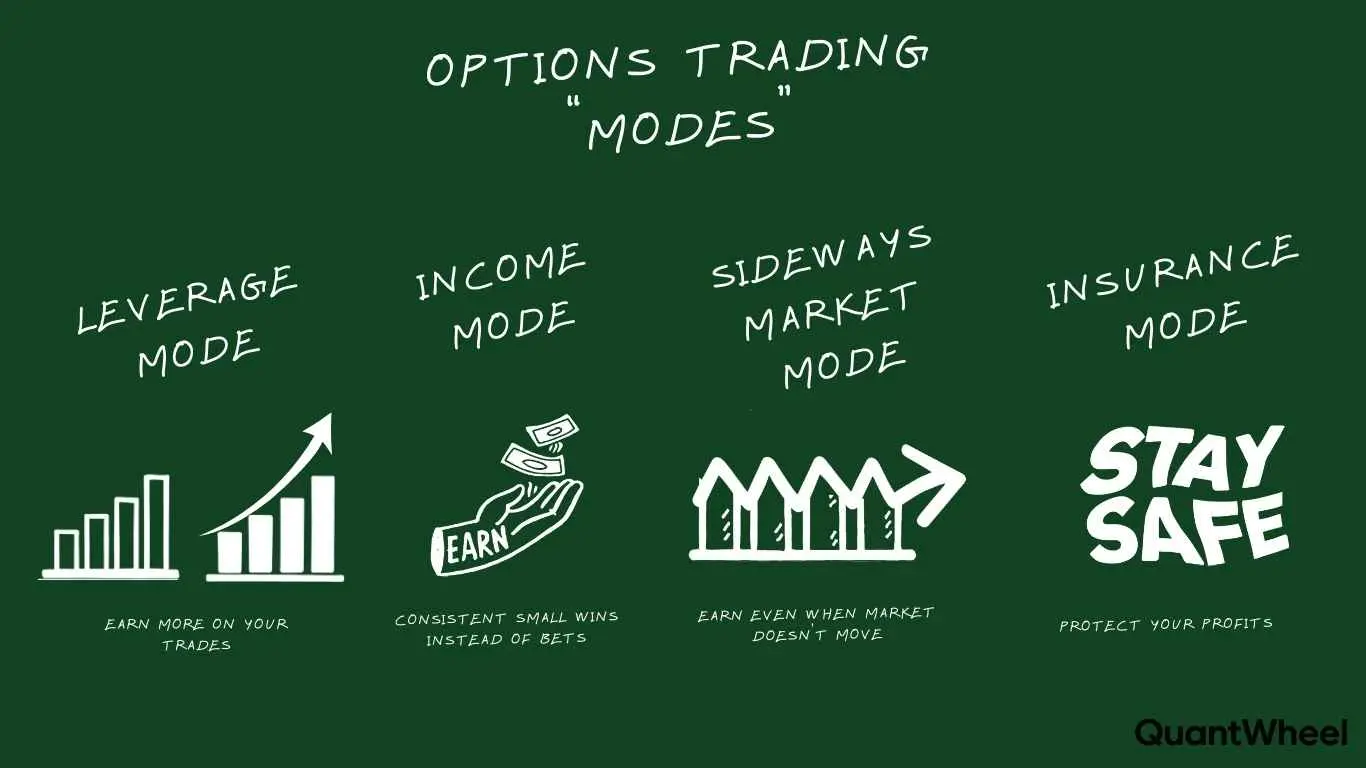
How to look at options trading if you're buying options (buy call example):
The Setup
You find a good neighborhood in a crowded city where the apartments are being built. The apartment costs $300,000 right now. The neighborhood is in development and it might get extremely good if it gets better traffic connection, or it might become bad if it stays isolated for a long time. You see the potential and pay the owner of a building $5,000 to reserve the apartment for the next 90 days to see what are the plans for the neighborhood. The owner of a building (the seller) agrees to keep the apartment for you in the next 90 days for the price of $300,000. This means that for the next 90 days you can buy that apartment for $300,000, no matter what happens with the neighborhood.
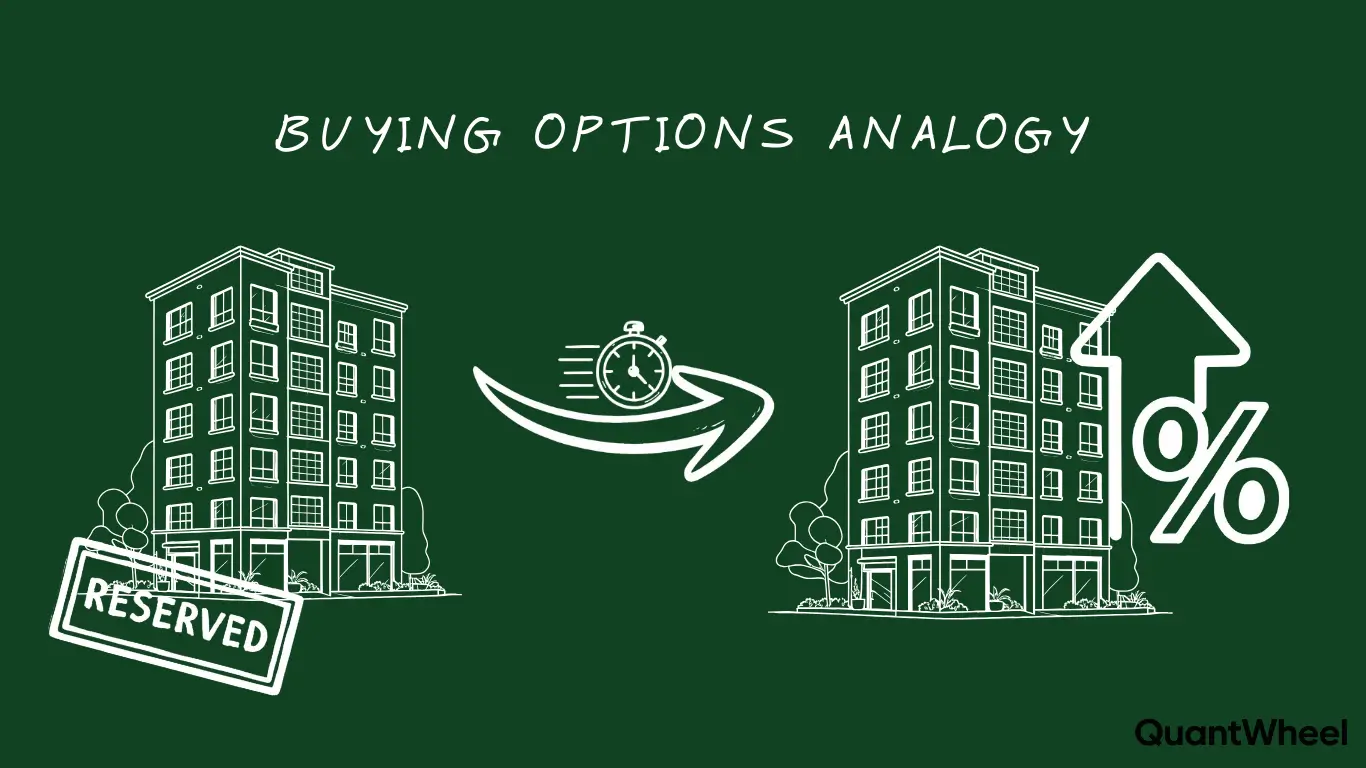
Now, there are 3 scenarios that can happen:
1) news are bad - the neighborhood traffic will stay as it is and it will become a factory zone, isolated from the city.
Your locked price of $300K suddenly looks like a terrible deal.
You don't “exercise”: You simply don't buy the apartment
You lose: Your $5K premium (gone)
You avoid: Buying at $300K when it's worth $250K = avoiding a $50K mistake
Your maximum loss was $5K from day one. You knew the risk upfront.
2) news are great - the neighborhood gets additional traffic connections, parks, shops..
Your locked price of $300K is now worth a fortune.
You exercise: Buy the apartment at your locked $300K price
You now own: An apartment worth $400K
Your profit: $400K - $300K - $5K (your fee) = $95K profit
You controlled a $300K asset by paying only $5K upfront.
3) Nothing new
A developer wants to buy the whole block. He speculates that the area is about to boom.
His offer: "I'll pay you $15K for your right to buy that apartment at $300K."
You sell your reservation: $15K
You never buy the apartment: You don't need to. You just sell the option.
Your profit: $15K - $5K (your original fee) = $10K profit
Congratulations - you made money without ever owning the apartment. You just controlled it for 30 days, then sold your control rights to someone else.
Let’s apply that way of looking at a trade on a chart:
If stock x is at $10 now,
You buy an option which is cheaper ($1),
Pick a price of $11 and give it time (30 days)
You start profiting if it goes above $12 in the next 30 days.
Your full profit is anything above $12 minus how much you paid for a bet - also called a premium.
Let’s recap: 1) Your loss is capped
- Max loss = $5K (your premium)
- NOT $50K if the market tanks
- You control without owning
- For 90 days, nobody else can buy that apartment at $300K
- You have leverage: controlling a $300K asset with $5K
- You identified a good opportunity before others but are not interested in actually owning what you reserved.
- You sell your reservation to someone else
- You pocket the profit without ever needing the apartment
- This is the most often scenario
This recap example explains how everything works if you’re betting on something to go up, the same rules apply if you were to bet on something to go down.
How to look at options trading if you’re selling options (sell a call example):
The Setup
You're now the BUILDING OWNER (the seller), not the buyer. You own an apartment building in that same neighborhood. The apartment is currently worth $300,000. You think: "The neighborhood will stay stable for the next 90 days. Nothing major will change. The value won't spike." A buyer comes to you and says: "I think this neighborhood is about to boom. I'll pay you $5,000 today if you agree to sell me this apartment at $300,000 anytime in the next 90 days, no matter how much it's worth." You think: "Great! I get $5,000 just for agreeing to this. And I don't think the neighborhood will boom anyway, so the buyer probably won't exercise this deal." You agree and collect $5,000 immediately. This is an exact story you can use when you're out there finding a good trade - in this case, sell a call (covered call strategy).
Three Scenarios
Scenario 1: Bad news - Neighborhood becomes isolated (stock falls to $250K)
- Your apartment is now worth $250,000
- The buyer says: "No thanks, I'm not exercising. This deal is worthless to me."
- You keep: $5,000 premium (free money)
- Your profit: $5,000
- You still own the apartment worth $250K
Scenario 2: Great news - Neighborhood booms (stock rises to $400K)
- Your apartment is now worth $400,000
- The buyer exercises: "I'm taking your offer! Sell me the apartment at $300,000."
- You're forced to sell at $300,000
- You receive: $300,000 (your sale price) + $5,000 (premium you collected) = $305,000 total
- Your apartment is worth $400K, but you only got $305K
- You "missed" $95,000 in potential gains
- But you DID make $5,000 that you wouldn't have made otherwise if you just held
Scenario 3: Moderate news - Someone else wants the rights (stock at $330K)
- The original buyer sees the neighborhood is improving slightly
- Another investor offers you: "I'll pay you $10,000 for your obligation. I want to take over that deal."
- You can accept: You pocket $10,000 total ($5,000 original + $5,000 new offer)
- The new buyer now has the right to buy at $300,000
- You're out of the obligation
- Your profit: $10,000 without ever having to sell the apartment
Why Someone Would Sell a Call
Use Case 1: You own the apartment and want extra income
- You already own it at $300K
- You don't think it'll go above $350K soon
- You sell a call at $350K for $5K premium
- If it stays below $350K, you keep the apartment AND the $5K
- If it rises to $350K, you sell at your target price PLUS keep the $5K you earned waiting
Analogy that may fit you: It’s like renting the stock you own
Use Case 2: You don't own it, but you think it won't move
- You're confident the neighborhood will stay stable
- You sell a call at $330K for $5K
- If it doesn't rise to $330K, you pocket $5K with zero risk
- If it rises to $330K, you're forced to buy at market price and sell at $330K (you lose money)
Let’s apply that way of looking at a trade on a chart: “if stock x is at $10 now,
You own a stock, you entered at $8, you had enough of the profits
Pick a price of $13 and give it time (30 days)
If it doesn’t reach that price, you keep the payment and the apartment. If it does, you sell it for even more profit from stock rising plus you already received money for wanting to sell it at that price
Your full profit depends on what happens in the meantime, but you either:
Get paid and keep the stock
Get paid and sell stock for much more
Get paid, stock falls a little - the money you got “negates that fall” a little
As an option buyer (holder), you pay a premium upfront. As an option seller (writer), you collect the premium immediately. Buying options gives you leverage with limited downside. You can control more of the underlying asset for less money. However, these options lose value over time. Selling options generates income right away. Many sellers win more trades than buyers. These options have time on your side. Your choice depends on your risk tolerance and market outlook. Buying works well for smaller accounts and beginners. Selling requires more capital and experience but can provide much more of a “steady income”. Both strategies have their place in options trading. Understanding each side helps you make better decisions about which approach fits your goals. As an option buyer (holder), you pay a premium upfront. You get the right to buy or sell the underlying asset at a set price. Your risk is limited to what you paid for the option. As an option seller (writer), you collect the premium immediately. You must buy or sell the underlying asset if the buyer exercises their right. This strategy makes you honor the deal you got paid for receiving the premium and that can either be:
- Selling your stock at a certain price (sell a call - a strategy called covered call)
- Buying the asset at the price you said would buy at (sell a put - a strategy called cash secured put)
Risk and Reward Comparison:
| Position | Maximum Gain | Maximum Loss |
|---|---|---|
| Buy Call | Unlimited | Premium paid |
| Buy Put | Strike price minus premium | Premium paid |
| Sell Call | Premium received | Depends on how the stock moves |
| Sell Put | Premium received | Price of the underlying asset that you have to buy minus the premium you already received |
Buying options gives you leverage with limited downside. You can control more of the underlying asset for less money. However, these options lose value over time. Selling options generates income right away. Many sellers win more trades than buyers. But when sellers lose, the losses can be much larger. Your choice depends on your risk tolerance and market outlook. Buying works well for smaller accounts and beginners. Selling requires more capital and experience but can provide steadier income. Both strategies have their place in options trading. Understanding each side helps you make better decisions about which approach fits your goals.
Buying vs Selling Options: Strategies & Risks
Types of Options
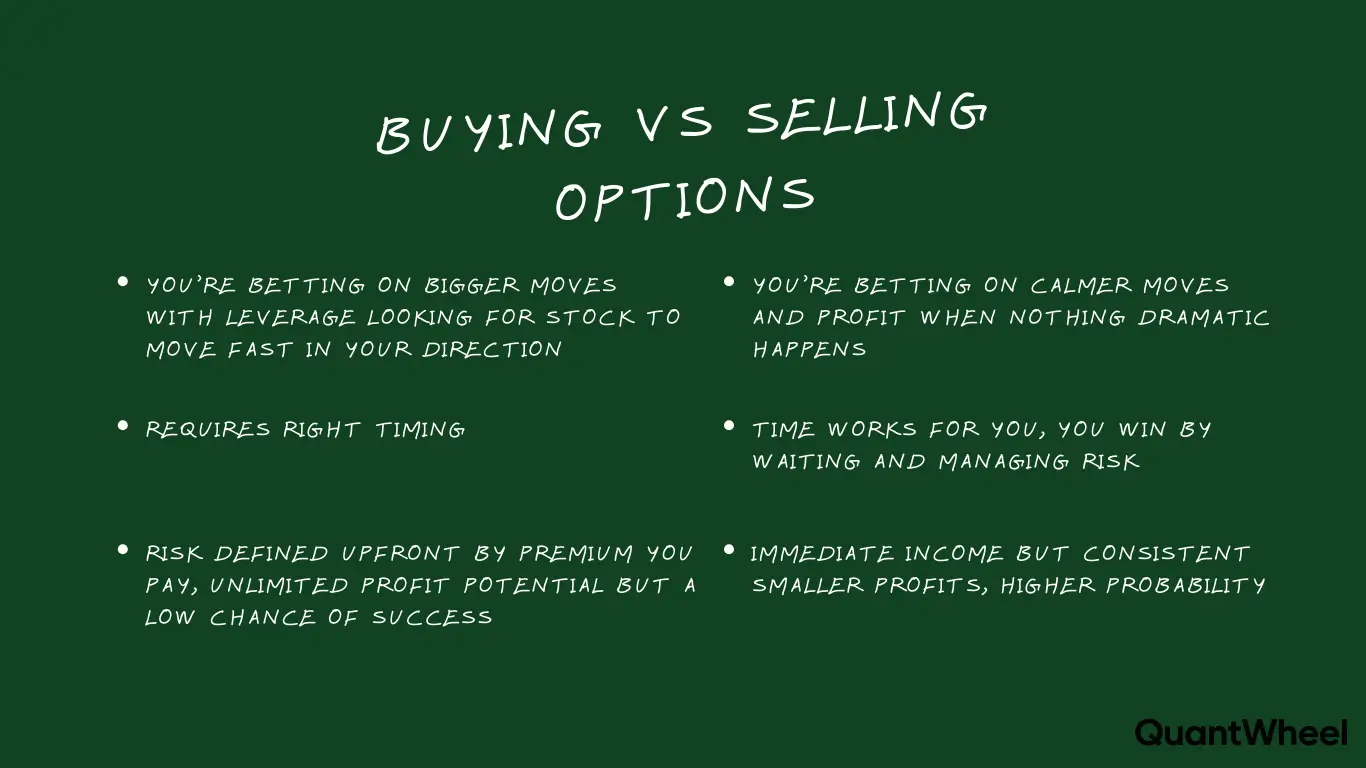
Options contracts give you the right, but not the obligation, to buy or sell an asset at a set price. There aretwo types of options that everything else builds on: CALLS and PUTS. They then branch out to additional two types of positions: To SELL or to BUY the option. Call options let you buy the underlying asset at the strike price. If you buy a call, you're hoping the asset's price climbs above that strike before expiration. If you sell a call, you’re most often hoping the asset’s price doesn’t reach that price. Put options give you the right to sell at the strike price. If you buy a put, you’re aiming for the price to drop below that level. If you sell a put, you’re most often aiming for the price to not go below that level.
| Option Type | Right Granted | Market Outlook |
|---|---|---|
| Call Option | Right to buy | Bullish (expecting price increase) |
| Put Option | Right to sell | Bearish (expecting price decrease) |
Most stock options cover 100 shares per contract. It's a lot of leverage for a relatively small amount of money. The buyer pays a premium for this right and can choose to exercise or let the contract expire. Meanwhile, the seller gets the premium upfront but has to honor the contract if the buyer exercises. Both calls and puts can be bought or sold, which gives you four basic positions: buying calls, selling calls, buying puts, and selling puts.
Option Terms to Know
If you want to trade options, you really need to know some key terms. These basic definitions show up in almost every options strategy. Premium is what you pay to buy the option. That's the most a buyer can lose. Sellers get this as instant income. Strike price is the agreed price where you can exercise the option. Whether the option ends up valuable depends on how this compares to the market price. The underlying is just the asset the option is based on - stocks, ETFs, indices, you name it. Its price swings drive the option's value. Exercise means you use your right to buy or sell. Call holders exercise to buy at the strike, put holders to sell. Leverage lets you control big positions with less cash. Options are famous for this, and it's a big draw for many traders. Margin is the collateral you need to sell options. Spread strategies use more than one option at a time. They can help you reduce risk or lower the cost of getting into a trade. Liquidity is about how easily you can get in or out of an option. More liquidity usually means tighter spreads and easier trades.
How to Buy Options
You need a brokerage account to buy options. Most online brokers will let you trade them, but you'll need to get approved first. Brokers will ask about your trading experience and risk tolerance. Steps to buy an option:
- Pick the underlying stock or asset
- Decide if you want to buy a call or put (which direction do you want to trade?)
- Choose your strike price that you think the asset will reach
- Check your breakeven price - this is the price at which you actually start earning on your trade
- Pick an expiration date - how much time you’re giving to the asset to reach that price and more
- Place your order and pay the premium
The premium is what you pay upfront when your order fills. That's your total risk.
Things to check:
- Strike price - the price you can buy or sell at
- Breakeven price - to know when your trade actually gets profitable
- Expiration date - when the option ends
Optional:
- Volume - how much the option trades
- Bid-ask spread - the gap between buy and sell prices
When you buy an option, the most you can lose is what you paid. If it expires worthless, that's it - your premium is gone. How do you close an options trade? You can close your position early by selling the option back to the market. This is good if you don’t have money to actually buy the stock and you earned money for being right about the direction of price. Or, you can exercise it if you want the underlying asset. What to look for when buying calls or buying puts? For calls, you want the price to jump above the strike plus what you paid. For puts, you want the price to fall below the strike price plus the premium you paid.
How to Sell Options
If you want to sell options, be aware that not every account qualifies - brokers have requirements and will check your experience. Two main ways to sell options:
- Covered calls - Sell calls on stocks you already own.
- Cash-secured puts - Sell puts with enough cash in your account to buy the stock if needed.
Depending on if you want to sell calls or sell puts: If you sell a put - your account needs enough cash to cover possible stock buying. If you sell a call - you have to own the stock already. Getting Your Account Ready Most brokers want you to have level 2 or higher options approval. They'll ask about your finances and trading background. Sometimes, you'll need at least $2,000 in your account to start selling options. If you get the error where you can’t sell options on your account, this might be the issue.
Selling Process
- You pick the stock and strike price you want to sell.
- Find a "sell to open" order in your trading platform.
Depending on what you want to do - sell a call (covered call strategy) or sell a put (cash secured put strategy) you first have to locate the "call" or "put" side. In this case, a screenshot from IBKR shows calls on left and puts on the right hand side. What do you then? Simply find a red column on left if you're selling a call or find a red column if you're selling a put.
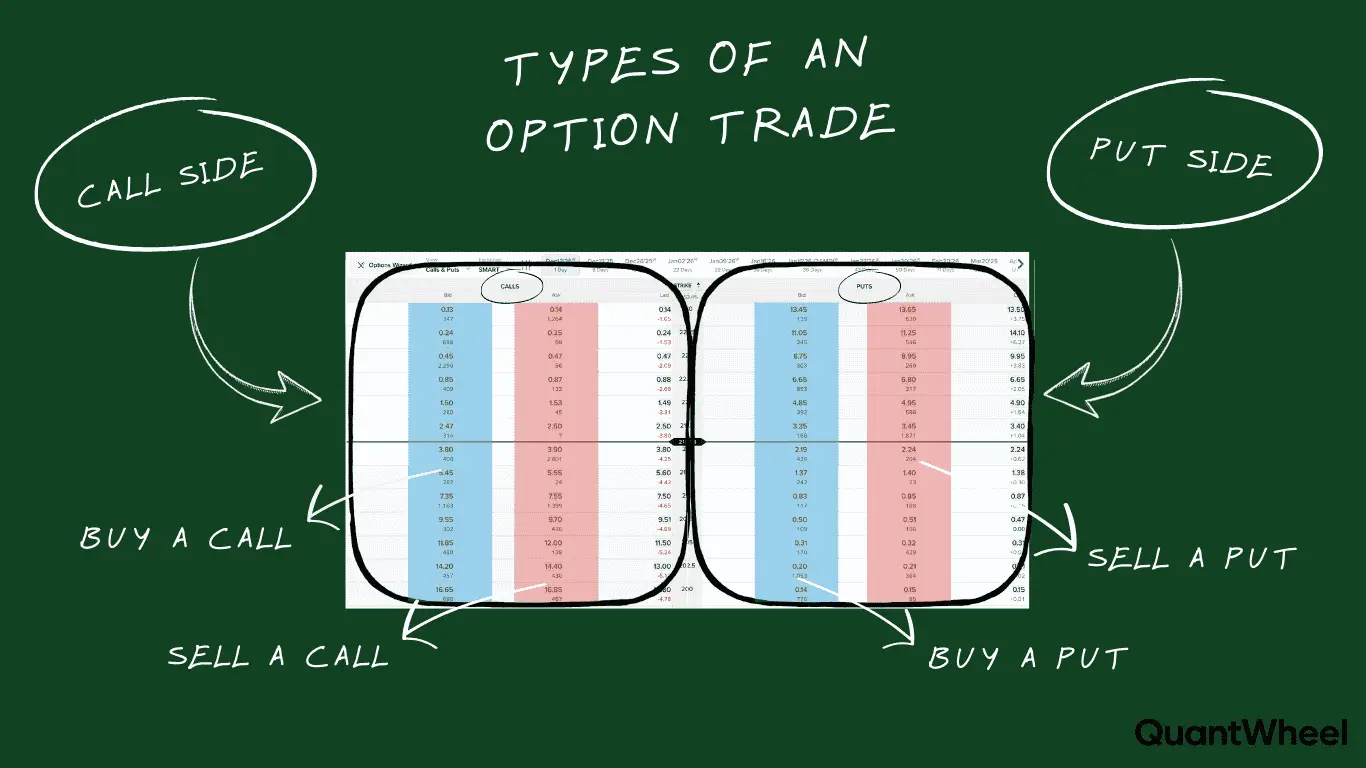
You'll collect the premium right away if you sell a call or sell a put. The only difference between those two is where you pick the strike price. You can see that on the image above. Tips for selling calls and puts For selling a call you typically pick a price that is currently higher than the stock. For selling a put you typically pick a price that is currently lower than the stock. How to sell an option step by step:
- Go to your stock and find “options chain” (that's the picture from above)
- Set expiration
- Choose a strike price
- Find the sell call or sell put on either the left or right side
- Click order
- Select quantity
- Select order type (market)
- Receive the premium
Managing Your Trade
Keep an eye on your sold options every day. You can buy back the same contract to close out early - this is called "buy to close." It's smart to set alerts for price moves. Many traders close out when they've made about 50% of the premium depending on the situation. You can learn more about assignment later on in the course or jump straight to it here.
Buying Options: Common Strategies
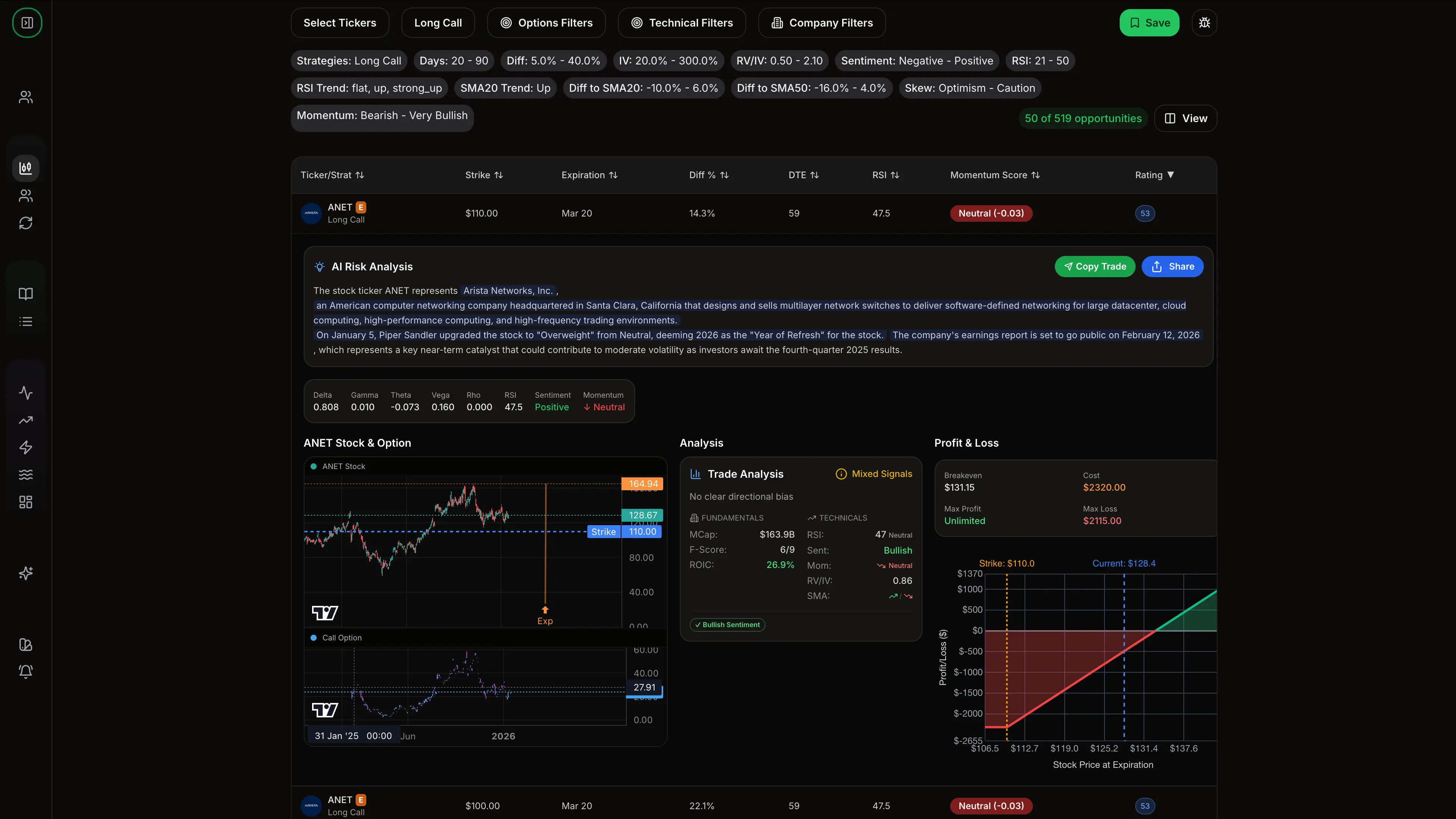
Buying options gives you a few solid ways to try to profit from market moves. Each one fits different conditions and risk appetites. Call Options for Bullish Markets Buy calls if you think prices will go up. This gives you unlimited upside, but your loss is capped at what you paid. For example, you might buy a call on XYZ stock with a $50 strike for $2. If the stock jumps to $60, you're in the money. Here's a more vivid example of a trade that QuantWheel has found.
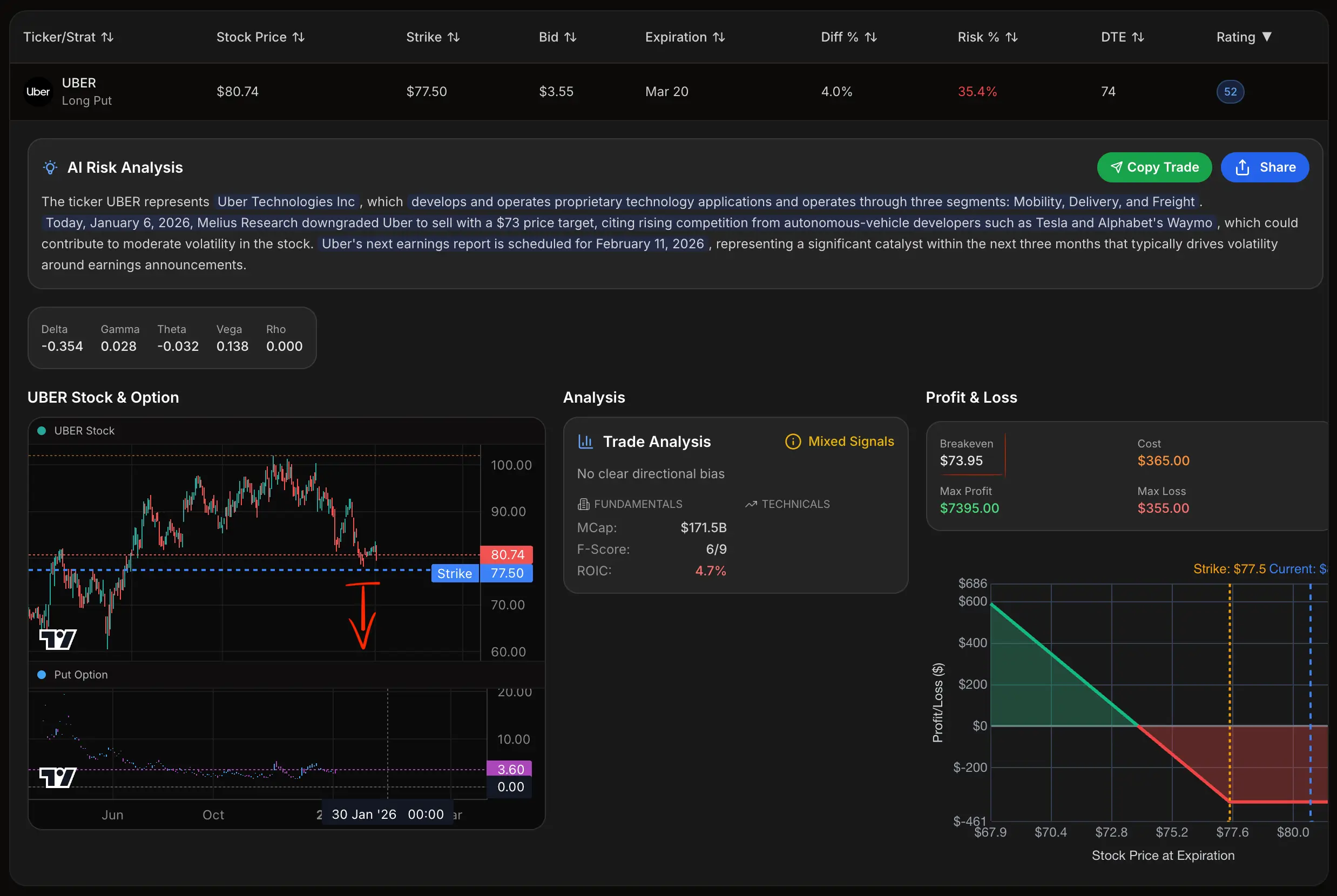
Put Options for Bearish Markets Buy puts if you expect prices to drop. You get the right to sell at a set price and profit as the stock falls. For example, you might buy a put on XYZ stock with a $50 strike for $2. If the stock falls to $40, you're in the money. What does In-the-money mean? In short, it means you’re in profit. Here's a more vivid example of a trade that QuantWheel has found.
Long Straddle This one's a bit more advanced and if you’re just starting out to learn options I recommend you to skip this one. You buy both a call and a put on the same stock, same strike, same expiration. If the stock moves big in either direction, you can make money. Straddles work best when you're expecting big news or volatility - think earnings reports. Cool right? But don’t worry, we go more into detail and explain it simply here. Timing Matters Options lose value as expiration gets closer - at least if you buy them. What you need is quick, favorable moves for these strategies to really pay off. Key Buying Strategies:
- Long calls - Bet on rising prices
- Long puts - Bet on falling prices
- Long straddles - Bet on big moves, any direction
- LEAPS - Longer-term options for more time
Your risk is always limited to the premium you paid. This makes buying options attractive for smaller accounts or anyone wanting clear risk limits.
Selling Options: Strategies That Work
Selling options can help generate income and manage risk, but every approach has its own pros and cons. Covered calls are great for investors who already own the stock. You sell calls against your shares, capping your upside but getting steady premium income. This is just a fancy name for “sell a call” option trade. Cash-secured puts let you collect premiums while maybe buying stocks at a discount. You need enough cash to buy 100 shares if assigned, though. This is a fancy name for “sell a put” option trade. Credit spreads involve selling one option and buying another at a different strike. This limits your risk and reward compared to selling naked options.
| Strategy | Risk Level | Income Potential | Capital Needed |
|---|---|---|---|
| Covered Calls | Low | Moderate | Stock + Margin |
| Cash-Secured Puts | Medium | Moderate | 100% Cash |
| Credit Spreads | Medium | Lower | Margin Only |
| Naked Options | High | Higher | High Margin |
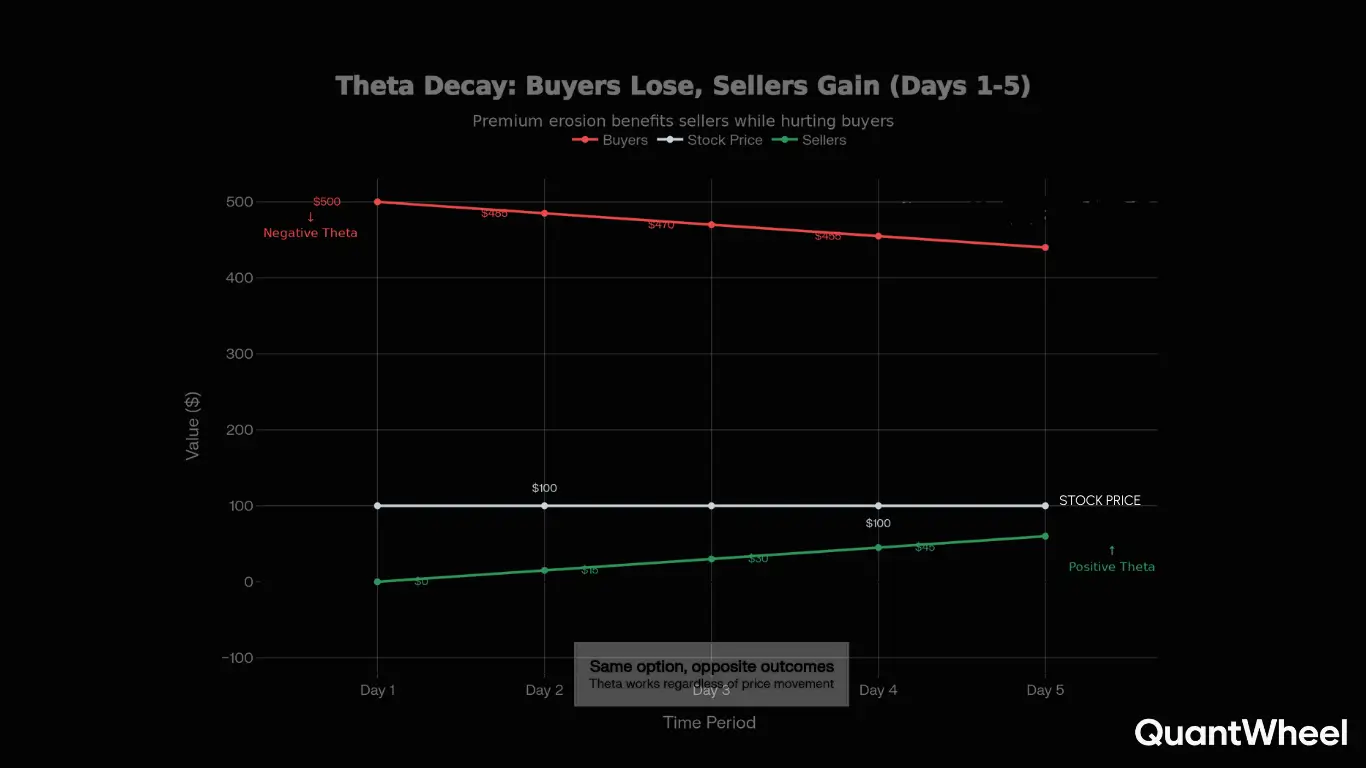
Time decay is your friend as a seller. Options lose value every day, especially close to expiration, and you keep the premium if they expire worthless. Still, managing risk is crucial. Use stop-losses and keep your position sizes reasonable, because things can move fast and losses can pile up.
Options Trading: Risks & Rewards
Options trading is a balancing act between potential gains and possible losses. Both buyers and sellers face different risks. Risk Profiles If you buy options, your risk is limited to the premium you paid. If the option expires worthless, that's all you lose. Selling options, though, can mean unlimited risk. If the market moves against you, losses can go way beyond the premium you collected.
Reward Potential
| Strategy | Max Gain | Max Loss |
|---|---|---|
| Buying Options | Unlimited | Premium paid |
| Selling Options | Premium received | Depends on the movement of a stock |
Buyers can see unlimited upside if the market moves just right. A small premium controls a big position, so the leverage can be wild. This is rare. Sellers get paid upfront and hope the options expire worthless. If that happens, they keep the whole premium as profit. This occurs often.
Market Factors
Volatility plays a huge role in option prices. High volatility means higher premiums, which is nice for sellers but makes buying more expensive. Time decay chips away at an option's value each day. Buyers need the market to move fast, or the option loses value just from the clock ticking.
Using Options for Protection
Options can help you hedge against portfolio losses. They work a lot like insurance for your investments. With aprotective put, investors buy put options on stocks they own. If the stock price falls, the put option gains value while the stock is dropping and helps cover some of the loss with what you earned. Covered calls are another way to hedge. Investors sell call options on stocks they already own. This brings in extra income from the premium. It also cushions the loss if prices dip just a little. In other words, if stock dropped 5%, you might have felt only the 3% fall.
| Hedging Strategy | Purpose |
|---|---|
| Protective Put | Protect against price drops |
| Covered Call | Generate income, minor protection |
Hedging with options usually costs less upfront than buying or selling the actual stocks. This is the advantage of options and why they are present. Options hedging works best when you understand the specific risks you face. It's important to match the strategy to your protection needs. Some hedges defend against big losses. Others are more about steady income. Hedging cuts down both possible losses and possible gains. You give up some upside to get more stability. It’s a trade-off, but it can smooth out returns over time.
Taxes and Options Trading
Options trading has its own set of tax rules. The IRS treats buyers and sellers differently. For Option Buyers: If you buy calls or puts, you’ve got two choices: exercise the option or let it expire worthless. If you buy a call or a put, you pay capital gains tax. If you exercise a call and then sell the shares, you’ll pay capital gains tax. The rate depends on how long you hold the stock after exercising. If you let the option expire, you can claim the premium paid as a capital loss. This is almost always a short-term loss, no matter how long you held it. For Option Sellers: Sellers get premiums upfront, but taxes work differently for them. If the buyer exercises your option, the seller pays tax on the proceeds. When options expire worthless, sellers report the premium as a short-term capital gain. This applies even if they held the underlying stock for a while. Special Cases:
| Contract Type | Tax Treatment |
|---|---|
| Stock options | Regular capital gains rules |
| Index options | 60/40 rule (60% long-term, 40% short-term) |
| Futures options | Section 1256 contracts |
Active traders might qualify for Trader Tax Status (TTS). This lets them deduct business expenses and avoid some limits on capital losses. Good record keeping is critical for options traders. You need to track premiums, sales, and exercise dates to file taxes correctly.