
Choosing the right broker for options trading can save you thousands of dollars per year in fees and hours of frustration with clunky platforms. But with more than a dozen brokers now offering options trading - some with zero fees, others with professional-grade tools - finding the right fit for your strategy is harder than it looks.
This guide breaks down the best brokers for options in 2026 based on real trading needs: fees, platform quality, options-specific tools, customer service, and how well each broker handles income strategies like covered calls and cash-secured puts. Whether you are a beginner placing your first options trade or an experienced theta seller managing dozens of positions, this article covers what you actually need to know.
This article is written by the QuantWheel team. We recommend brokers based on our own trading experience. We do not have affiliate relationships with the brokers listed. Also, we evaluated brokers based on 4 months of personal use. Fee structures are verified directly from each broker's fee disclosure pages as of February 2026, and community feedback from 60+ wheel strategy traders.
Author: David Romic
Best Brokers for Options in 2026: The TLDR
Here is everything you need to know about choosing an options broker in 2026.
The short version: Most brokers charge between $0 and $0.65 per options contract. Free brokers like Robinhood and Webull work fine for beginners, but serious options traders need better tools. Tastytrade, Schwab (thinkorswim), and Interactive Brokers are the top three for people who trade options regularly.
A simple example: Say you sell 10 cash-secured put contracts per month. At Schwab, that costs $6.50 per trade ($0.65 × 10 contracts). At tastytrade, the same trade costs $10 to open and $0 to close. At Robinhood, it costs $0. The fee difference is small, but the tools and execution quality can make a much bigger difference in your actual results.
How to pick: If you just want the cheapest option, go with Robinhood or Webull (free). If you want the best tools for actively trading options, go with tastytrade or Schwab (thinkorswim). If you trade hundreds of contracts per month, Interactive Brokers gives you the lowest per-contract rate. If you already have investments at Fidelity or Schwab, you can trade options there without opening a new account.
One thing most guides skip: Your broker handles order execution and options chains - but it does not track your cost basis after assignment, calculate your real premium income, or manage your wheel cycles.
That is where a dedicated tracking tool comes in. None of the brokers have a clean and insightful trade tracking solution. That's the problem which QuantWheel journaling software has solved.
Below are ranked brokers from our and other traders experience in our community, from best to worst:
| Broker | Contract Fee | Best For |
|---|---|---|
| Tastytrade | $1.00 open / $0 close (cap: $10/leg) | Active options sellers |
| Charles Schwab | $0.65/contract | Full-service + thinkorswim tools |
| Interactive Brokers | $0.15-$0.65/contract (tiered) | High-volume / professional traders |
| Fidelity | $0.65/contract | Research-focused investors |
| E*TRADE | $0.50-$0.65/contract (tiered) | Intermediate active traders |
| Robinhood | $0 | Cost-conscious beginners |
| Webull | $0 | Mobile-first beginners |
| Moomoo | $0 (equity options) | Zero-fee with better tools |
Tastytrade: Best Broker for Active Options Traders
Tastytrade consistently ranks as the best broker for options trading among dedicated options sellers. The platform was built by options traders, for options traders,
Why Options Traders Choose Tastytrade
The biggest draw is the fee structure. Tastytrade charges $1.00 per contract to open a position and $0 to close, with a $10 cap per leg per trade. For traders who sell premium and manage positions actively, this pricing model often results in lower total costs compared to the flat $0.65 per contract fee at Schwab or Fidelity.
Beyond pricing, tastytrade's platform is designed around probability-based trading. The options chain displays probability of profit, expected move, and implied volatility front and center. You can build multi-leg strategies in just a few clicks, and the platform shows real-time net Greeks across your entire portfolio.
The mobile app is great - it mirrors the full desktop experience, including multi-leg order entry and portfolio Greeks. That is unusual among brokers, where mobile platforms are often stripped-down versions of the desktop.
Where Tastytrade Falls Short
Tastytrade is an options-focused platform, which means it is not ideal if you also want robust stock research, fundamental analysis, or retirement planning tools. There are no mutual funds, no financial planning services, and limited traditional market research. It also lacks Level II quotes and direct routing, which matter for stock day traders (though not for typical options sellers).
Tastytrade Fee Summary
| Fee Type | Amount |
|---|---|
| Options (open) | $1.00/contract |
| Options (close) | $0.00 |
| Cap per leg | $10.00 |
| Stock trades | $0.00 |
| Account maintenance | $0.00 |
Best For
Active premium sellers who trade options frequently and want a platform optimized entirely around options strategies. If the wheel strategy is your primary approach, tastytrade's combination of low fees and options-first design is hard to beat for the execution side of trading.
Charles Schwab (Thinkorswim): Best Full-Service Options Broker
Charles Schwab retains its position as the top-ranked overall broker in 2026, and the integration of TD Ameritrade's thinkorswim platform gives it arguably the most powerful options trading tools available from any full-service broker.
Why is Schwab good
The thinkorswim platform gets the most praise from traders/investors . It offers 374 technical indicators, advanced options chain analysis, probability analysis, and the ability to create custom studies. For options traders specifically, the platform pairs multi-leg positions for easy viewing and management - particularly useful when you are tracking covered calls alongside the underlying stock position.
Schwab also brings deep fundamental research, educational webinars, and a physical branch network for in-person support. If you want one broker for everything - retirement accounts, stock investing, options trading, and financial planning - Schwab covers it all.
The paper trading feature on thinkorswim lets beginners practice options strategies with simulated money, which is valuable for learning without risking capital.
Where Schwab is not so great
The main limitation is that the advanced tools live primarily within thinkorswim, while Schwab's standard web interface feels more basic by comparison. The per-contract fee of $0.65 is standard but not the lowest available. There are no volume discounts on options commissions.
Schwab Fee Summary
| Fee Type | Amount |
|---|---|
| Options per contract | $0.65 |
| Stock trades | $0.00 |
| Account maintenance | $0.00 |
| Transfer/closure fees | $0.00 |
Best For
Traders who want a full-service brokerage experience with professional-grade options tools. Especially strong for people who trade options alongside long-term investing, retirement accounts, and other financial needs. Schwab's own educational content covers the wheel strategy in detail, making it a solid home for premium sellers who also value research and support.
Interactive Brokers: Best for High-Volume and Professional Options Traders
Interactive Brokers has long been the go-to platform for professional and institutional options traders, and 2026 is no exception. If you trade large volumes or need global market access, IBKR's combination of low costs and deep analytical tools is unmatched.
Why IBKR?
The pricing structure rewards volume. Commissions start at $0.65 per contract but drop on a sliding scale - down to $0.25 for 50,000+ contracts per month and as low as $0.15 for truly massive volume. For high-frequency options traders, these savings add up quickly.
But IBKR is not just about cost. The Trader Workstation (TWS) platform includes an Options Strategy Lab for building and backtesting multi-leg orders, a Volatility Lab for analyzing implied volatility patterns, a Probability Lab for modeling outcome likelihoods, and Risk Navigator for portfolio-level risk assessment. The SmartRouting technology seeks the best available prices across exchanges, which can improve fill quality - something that matters more than many traders realize.
Interactive Brokers also provides global market access. If you want to trade options on international exchanges, IBKR is one of the few retail brokers that makes this possible.
Problems with IBKR
The learning curve is steep. Trader Workstation is powerful but can feel overwhelming for traders who are not already comfortable with professional-grade platforms. The interface prioritizes functionality over simplicity, which means beginners may struggle initially.
Customer service is adequate but not a strength. Schwab and Fidelity both offer significantly better support experiences.
IBKR Fee Summary
| Fee Type | Amount |
|---|---|
| Options per contract | $0.15-$0.65 (volume tiered) |
| Minimum per order | $1.00 |
| Stock trades | $0.00 (IBKR Lite) |
| Account maintenance | $0.00 |
Best For
Experienced traders who prioritize execution quality and low costs at scale. If you trade hundreds of contracts per month, IBKR's tiered pricing delivers meaningful savings. The analytical tools are best-in-class for traders who want to model and backtest options strategies before execution.
Fidelity: Best for Research-Driven Options Traders
Fidelity brings together strong options tools, deep research, and one of the best customer service experiences in the industry. For traders who want to analyze stocks thoroughly before selling options on them, Fidelity's research library is a significant advantage.
Why Research-Focused Traders Choose Fidelity
Fidelity aggregates research from multiple independent providers, giving you a broader perspective than brokers who rely on a single in-house research team. For options traders who select underlying stocks based on fundamental analysis - as many wheel strategy traders do - this depth matters.
The Active Trader Pro platform provides profit/loss calculators, real-time Greeks, and customizable workspaces. While not quite as advanced as thinkorswim, it covers what most options traders need. The mobile app is highly rated and continues to improve.
Customer service is the best among all brokers you can choose from. Fidelity offers 24/7 phone, chat, and email support, plus a network of more than 200 physical branches. When you have a question about options assignment, margin requirements, or account setup, reaching a knowledgeable person quickly is valuable.
Fidelity has eliminated nearly all account fees, including transfer and closure fees. The $0.65 per-contract options fee is standard, with no volume discounts available.
What users say about problems with Fidelity
The options trading experience, while solid, is not as specialized as tastytrade or as powerful as thinkorswim. Active Trader Pro is a capable platform but does not match the options-first design philosophy of dedicated options brokers. Fidelity does not offer futures trading, which limits some advanced hedging strategies.
Fidelity Fee Summary
| Fee Type | Amount |
|---|---|
| Options per contract | $0.65 |
| Stock trades | $0.00 |
| Account fees | $0.00 |
| Transfer fees | $0.00 |
Best For
Investors who combine options selling with fundamental stock research and long-term portfolio management. If you want solid options tools within a comprehensive brokerage that also handles your IRA, 529 plan, and cash management, Fidelity is an excellent all-in-one choice.
E*TRADE (Power E*TRADE): Best for Intermediate Options Traders
E*TRADE, now part of Morgan Stanley, provides a balanced platform for traders who have moved beyond the basics but do not need institutional-grade tools.
Why Traders Like E*TRADE
The Power E*TRADE platform offers snapshot analysis for trade risk/reward, technical studies, and an intuitive options chain interface. The mobile app supports multi-leg order entry, which not every broker offers. For traders who split time between desktop and mobile, this consistency matters.
E*TRADE also provides volume discounts. The standard per-contract fee is $0.65, but it drops to $0.50 for traders who execute more than 30 options trades per quarter. That threshold is achievable for most active options traders.
Paper trading is available, giving newer options traders a way to practice strategies without risk.
E*TRADE weakpoints
The platform does not match thinkorswim's depth of analytical tools or tastytrade's options-first workflow. The integration with Morgan Stanley's broader ecosystem is still evolving, and some features feel like they are in transition.
E*TRADE Fee Summary
| Fee Type | Amount |
|---|---|
| Options per contract (standard) | $0.65 |
| Options per contract (30+ trades/quarter) | $0.50 |
| Stock trades | $0.00 |
Best For
Traders who want solid options tools with volume discounts and a good mobile experience. A reasonable choice for someone who trades options regularly but does not need the most advanced platform available.
Zero-Fee Options Brokers: Robinhood, Webull, Moomoo, and Firstrade
The biggest trend in options trading for 2026 is the continued expansion of zero-fee brokers. Several platforms now offer completely free options trading - no base commission and no per-contract fee.
Robinhood
Robinhood pioneered commission-free trading and remains the simplest entry point for new options traders. The platform charges $0 across the board for options - no base commission, no contract fee, and no exercise or assignment fees. The interface is intentionally minimal, which makes it easy to learn but limits advanced analysis.
Robinhood's limitation for serious options traders is the lack of advanced tools. There are no profit/loss diagrams for complex strategies, limited Greeks display, and basic order types. If you are selling simple covered calls or cash-secured puts, Robinhood handles it fine. For multi-leg strategies or active position management, you will outgrow it.
Webull
Webull offers zero-fee options trading with a more capable platform than Robinhood. The charting tools are significantly better, and the options chain provides more data points. The mobile-first design appeals to traders who primarily use their phone.
Webull works well for beginner to intermediate options traders who want more analytical capability than Robinhood provides without paying per-contract fees.
Moomoo
Moomoo charges $0 per contract for equity options (index options are $0.50 per contract). The platform has impressed reviewers with its balance of clean interface design and advanced features, including real-time data, technical analysis tools, and options-specific analytics.
For traders looking for a zero-fee broker with better tools than Robinhood, Moomoo is worth evaluating.
Firstrade
Firstrade offers completely free options trading and has for years. The platform is straightforward and reliable, though it lacks the analytical depth of paid alternatives. It is a solid choice for buy-and-hold investors who occasionally trade options and want to minimize costs entirely.
Who Zero-Fee Brokers Are Best For
If you are new to options trading, want to keep costs at absolute zero, or trade simple strategies like single-leg puts and calls, a zero-fee broker is a reasonable starting point.
However, there is an important trade-off to understand. Zero-fee brokers typically earn revenue through payment for order flow (PFOF), which means market makers pay the broker for the right to fill your orders. This can result in slightly worse execution prices. For a single contract, the difference is negligible. For larger orders or frequent trading, the execution quality at brokers like Interactive Brokers or tastytrade may save more money than the contract fee costs.
How to Choose the Best Broker for Options Based on Your Trading Style
There is no single best broker for every options trader. The right choice depends on how you trade, how often you trade, and what else you need from your brokerage account.
For Premium Sellers and Wheel Strategy Traders
If your primary strategy involves selling cash-secured puts and covered calls - the wheel strategy - your broker needs to handle a few things well.
First, per-contract fees matter because you are opening and closing trades frequently. Tastytrade's capped fee structure and zero close fee make it the most cost-effective for active premium sellers. Schwab and Fidelity's $0.65 per contract is reasonable but adds up across dozens of monthly trades.
Second, you need clean options chains that show implied volatility, delta, and probability of profit. Tastytrade and thinkorswim both excel here. Fidelity's Active Trader Pro is adequate. Robinhood's options chain is too basic for serious analysis.
Third, and this is where most brokers fall short: none of them handle the tracking side well. When you sell a cash-secured put, collect $2 in premium, get assigned at $50, and then sell covered calls against the position, your real cost basis is $48 - but your broker shows $50. You need to track the premium adjustment manually.
After managing multiple wheel positions across several months, this manual tracking becomes a genuine problem. Your spreadsheet gets messy. You lose track of which premiums belong to which positions. Tax time becomes a headache.
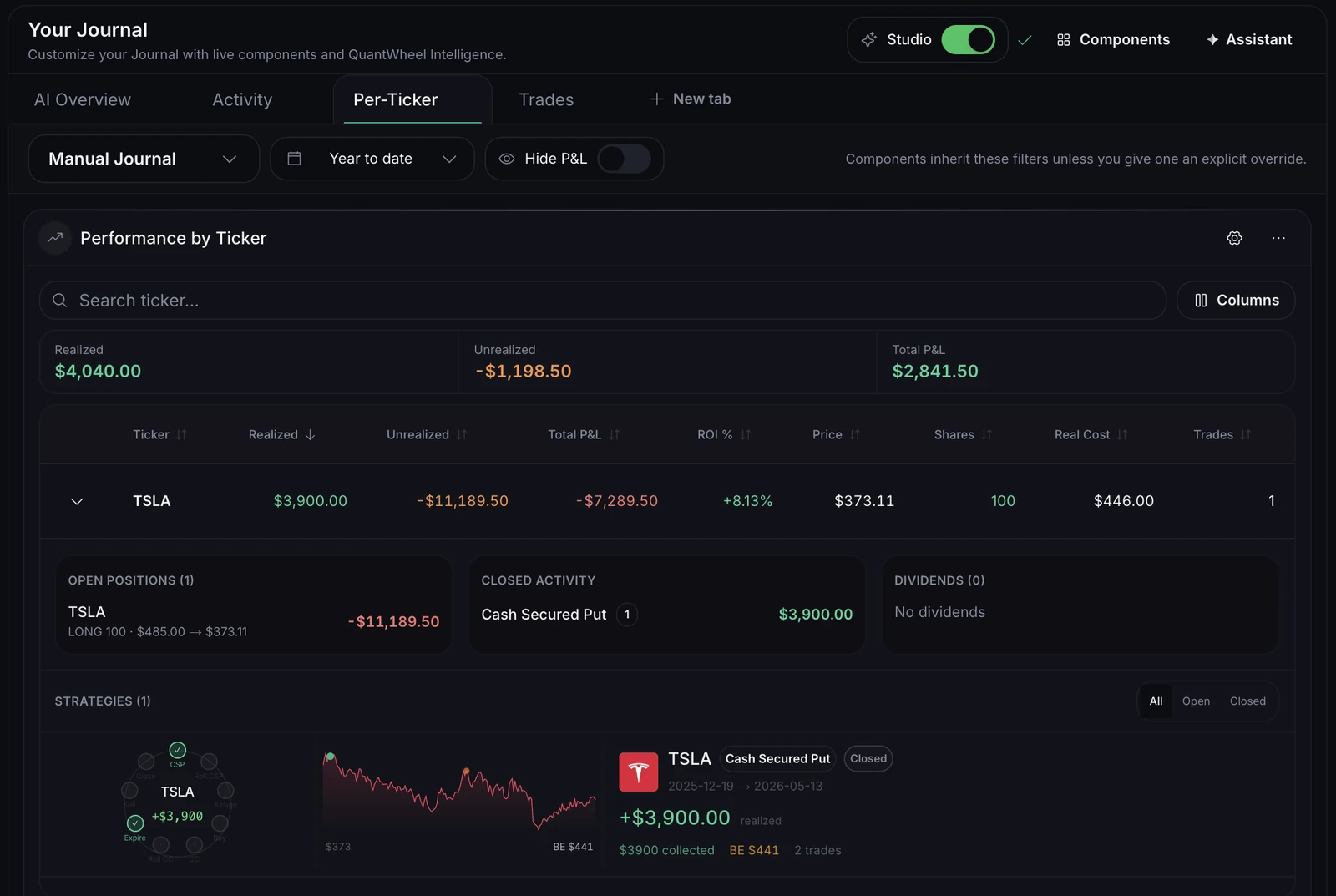
That gap in accounting is where we built QuantWheel - it was the same problem we ran into managing 10+ wheel positions manually.
$1 for 7 days • Cancel anytime • 14-day money-back guarantee
For Beginners
Start with a broker that offers paper trading and good education. Schwab (thinkorswim), tastytrade, and E*TRADE all provide practice modes where you can learn options mechanics without risking money. Robinhood and Webull are fine for first trades, but you may outgrow their tools within a few months.
For High-Volume Traders
If you trade 100+ contracts per month, Interactive Brokers' tiered pricing delivers the lowest per-contract cost. The execution quality through SmartRouting also provides potential savings on fills that do not show up on a fee comparison chart.
For All-in-One Account Holders
If you want one brokerage for everything - IRA, taxable accounts, cash management, and options trading - Schwab and Fidelity are the strongest choices. Both offer comprehensive account types, strong customer service, and competitive options tools.
Tax Reporting: What Your 1099-B Will Look Like (Broker breakdown)
tastytrade
1099s are issued by Apex Clearing Corporation (their clearing firm), not tastytrade directly. This is important - if you have a reporting dispute, you're dealing with Apex, not tastytrade support.
Apex Clearing's 1099-B is notoriously compact and harder to parse than IBKR's. Assigned positions and multi-leg rolls in particular require careful manual reconciliation.
tastytrade charges $5 per options exercise/assignment - this fee also appears on the 1099 as a transaction cost and needs to be tracked separately.
Specific ID support is available but requires you to designate lots in the platform before trade execution - the interface for doing this is not prominently surfaced.
Best for: Traders who mostly let positions expire, keep trade counts lower, and don't mind using a third-party tool.
Interactive Brokers (IBKR)
IBKR self-clears, meaning they generate and control the 1099-B directly - no intermediary clearing firm. This gives them more flexibility in how data is presented.
The IBKR 1099-B walkthrough is one of the most detailed in the industry - assignments, rolls, and cost basis adjustments are clearly broken out per transaction.
Flex Reports in IBKR allow you to export trade data in fully customizable formats - useful for feeding into tax software or manual spreadsheet reconciliation.
IBKR supports Specific ID with explicit lot selection in the trading interface.
Charges $0 for options exercise and assignment - unlike tastytrade's $5 fee.
Best for: High-frequency wheel traders running 10+ positions who need granular data and want to do their own reconciliation.
Charles Schwab / thinkorswim
Schwab has a dedicated Form 1099-B: Cost Basis and Options Trading guide published on their site - one of the few brokers that actively educates clients on this.
Post-TD Ameritrade merger, thinkorswim accounts issue 1099s through Schwab's own clearing; the forms are clear and well-organized.
Supports Specific ID via the website's tax lot selector before trade execution.
Assigned covered calls: Schwab correctly adds the premium to proceeds on the stock sale, and their 1099 breaks this out clearly.
Best for: Traders who want the best combination of clear tax documentation and strong customer support if something looks wrong.
Fidelity
Among the clearest 1099-B presentations in the industry - Fidelity explicitly labels which entries relate to options assignments and breaks out cost basis adjustments.
Supports Specific ID with lot selection available during order entry.
Fidelity's Active Trader Pro platform allows you to preview which tax lot will be used before you submit an order.
Best for: Tax-sensitive traders holding multiple lots of the same stock across different entry dates who want assignment lot control to be straightforward.
Options Trading Fees Compared: The Full 2026 Breakdown
Here is the complete fee comparison for every major options broker in 2026.
| Broker | Base Commission | Per-Contract Fee | Volume Discount | Exercise/Assignment Fee |
|---|---|---|---|---|
| Tastytrade | $0 | $1.00 open / $0 close | $10 cap per leg | $5 per leg |
| Charles Schwab | $0 | $0.65 | None | $0 |
| Fidelity | $0 | $0.65 | None | $0 |
| Interactive Brokers | $0 | $0.15-$0.65 | Volume tiered | $0 |
| E*TRADE | $0 | $0.50-$0.65 | 30+ trades/quarter | $0 |
| Ally Invest | $0 | $0.50 | None | $0 |
| Vanguard | $0 | $1.00 | Account balance tiers | $0 |
| Robinhood | $0 | $0 | N/A | $0 |
| Webull | $0 | $0 | N/A | $0 |
| Moomoo | $0 | $0 (equity) / $0.50 (index) | N/A | $0 |
| Firstrade | $0 | $0 | N/A | $0 |
| Public | $0 | Rebates paid to you | N/A | $0 |
| Merrill Edge | $0 | $0.65 | None | $0 |
Key takeaway: The per-contract fee gap is narrowing. The difference between brokers in 2026 is not the fee itself - it is the quality of the platform, execution, stability and tools that come with that fee.
What to Look for in an Options Broker: Features That Actually Matter
Beyond fees, these features have a direct impact on your trading results.
Options Chain Quality
The options chain is where you spend most of your time as an options trader. A good chain shows bid/ask spreads, implied volatility, volume, open interest, and the Greeks clearly. Tastytrade and thinkorswim display this information best. IBKR's chain is data-rich but can feel cluttered. Robinhood's chain is clean but lacks depth.
Probability and Risk Analysis Tools
Understanding the probability of your trade expiring profitable is essential for premium sellers. Tastytrade displays probability of profit directly in the options chain. IBKR's Probability Lab lets you model outcome distributions. Thinkorswim offers detailed risk graphs. These tools help you select strikes and expirations based on data rather than guesswork.
Order Types and Execution Quality
Limit orders, stop orders, and trailing stops are standard. What differs is execution quality - how close to the midpoint your orders fill. IBKR's SmartRouting is the industry leader for seeking best execution. Tastytrade also prioritizes execution quality. Zero-fee brokers using payment for order flow may not fill at the most competitive prices.
Mobile Trading Capability
If you manage positions throughout the day, mobile matters. Tastytrade stands out for offering the full desktop experience on mobile, including multi-leg order entry and portfolio Greeks. Schwab's thinkorswim mobile is solid. Robinhood and Webull are mobile-first but limited in analytical depth.
Paper Trading Availability
Practice makes better. Schwab, tastytrade, Interactive Brokers, and E*TRADE all offer paper trading for options. This is very handy for learning complex strategies like iron condors, spreads, and rolling techniques before committing real capital.
Options Approval Process
Every broker requires options approval. Level 1 covers covered calls. Level 2 adds cash-secured puts. Higher levels enable spreads, straddles, and naked options. Most brokers grant Level 1-2 approval quickly based on a standard questionnaire about your experience and financial situation.
Why Your Broker Is Only Half the Equation
What "best brokers for options" articles do not tell you - your broker is great at executing trades, but it is not designed to manage your options strategy over time.
When you run the wheel strategy - selling cash-secured puts, taking assignment, selling covered calls, and repeating - the tracking gets complex quickly. Let's use the same example from before.
Consider what happens across just one complete wheel cycle:
- You sell a cash-secured put on a stock at the $50 strike and collect $2.00 in premium.
- The stock drops and you get assigned at $50. Your broker shows your cost basis as $50. But your real cost basis is $48 because of the $2 premium you collected.
- You sell a covered call at $52 and collect another $1.50 in premium. Your adjusted cost basis is now $46.50.
- The stock gets called away at $52. Your broker shows a $2 gain ($52 - $50). But your real gain is $5.50 per share when you count the premiums.
Now multiply this by ten or fifteen simultaneous positions across several months. Your broker's reporting does not track any of the premium adjustments. You are on your own with a spreadsheet.
This is the problem QuantWheel is solving. It connects to your broker, imports your trades automatically, tracks each wheel cycle from start to finish, adjusts cost basis when assignments happen, and calculates your real premium income across every position. Your broker handles the execution. QuantWheel handles the strategy management.
If you are running two or three wheel positions, a spreadsheet works fine. Once you scale past that, the manual tracking becomes the bottleneck.
$1 for 7 days • Cancel anytime • 14-day money-back guarantee
The Bottom Line: Picking Your Best Broker for Options in 2026
For most options traders in 2026, the decision comes down to three strong choices.
Tastytrade if you are a dedicated options trader who wants the lowest effective fees, the best options-first workflow, and a platform built around probability-based trading.
Charles Schwab (thinkorswim) if you want a full-service brokerage with professional-grade options tools, deep research, excellent customer support, and the ability to manage everything in one account.
Interactive Brokers if you trade at high volume, want the best execution quality, and need access to global markets and professional analytical tools.
For beginners, start with a free broker like Robinhood or Webull to learn the mechanics, then move to tastytrade or Schwab as your skills develop. For investors who primarily buy and hold but occasionally sell covered calls, Fidelity is an excellent fit.
And remember - once you are actively trading options, especially income strategies like the wheel, tracking your positions and cost basis is just as important as choosing the right broker. A good broker gets your orders filled. A dedicated tracking tool like QuantWheel makes sure you know exactly how your strategy is performing.
Risk Disclosure: Options trading involves substantial risk and is not suitable for all investors. Past performance does not guarantee future results. This content is for educational purposes only and should not be considered investment advice. Always do your own research and consider consulting with a financial advisor before making investment decisions. The examples used in this article are for educational purposes only and are not recommendations to buy or sell any security.