
How Are Options Taxed? The Complete 2026 Guide to Options Taxation
If you're selling covered calls, trading spreads, or running the wheel strategy, this guide breaks down how options are taxed. We covered everything from simple strategies to complex multi-leg positions.
The Tax Reality Every Options Trader Must Understand
Before diving into the technical rules of how options are taxed, here's the critical reality check that experienced traders constantly emphasize: Every closed option position is a taxable event - whether you withdraw money or not. Many new traders make the dangerous assumption that unrealized gains or cash sitting in their brokerage account is "free money" until they withdraw it. This is false. If you make $50,000 trading options this year, you owe taxes on that $50,000, even if every penny remains in your Interactive Brokers account. The cash in your brokerage account is NOT the same as cash in your pocket after taxes. Traders who don't plan for this reality often face shocking tax bills in April that they can't pay because they've already reinvested their gains or lost them in subsequent trades. Let's get it going, below is everything you need to know on how are options taxed.
How Are Options Taxed? Understanding the Three Main Categories
The IRS classifies options into three distinct categories, and how options are taxed depends entirely on which category your trades fall into:
1. Employee Stock Options (ESOs)
Employee stock options are compensation-based options granted by employers and not traded on public markets. How these options are taxed differs completely from listed options:
- Non-qualified stock options (NSOs): Gains from exercising NSOs are taxed as ordinary income at your marginal tax rate
- Incentive stock options (ISOs): May qualify for preferential long-term capital gains rates if specific holding requirements are met (hold shares 2+ years from grant date and 1+ year from exercise)
ESOs follow employment income rules rather than investment tax rules and are reported via W-2 forms. These are entirely different from how listed options are taxed.
2. Equity Options (Listed Stock and ETF Options)
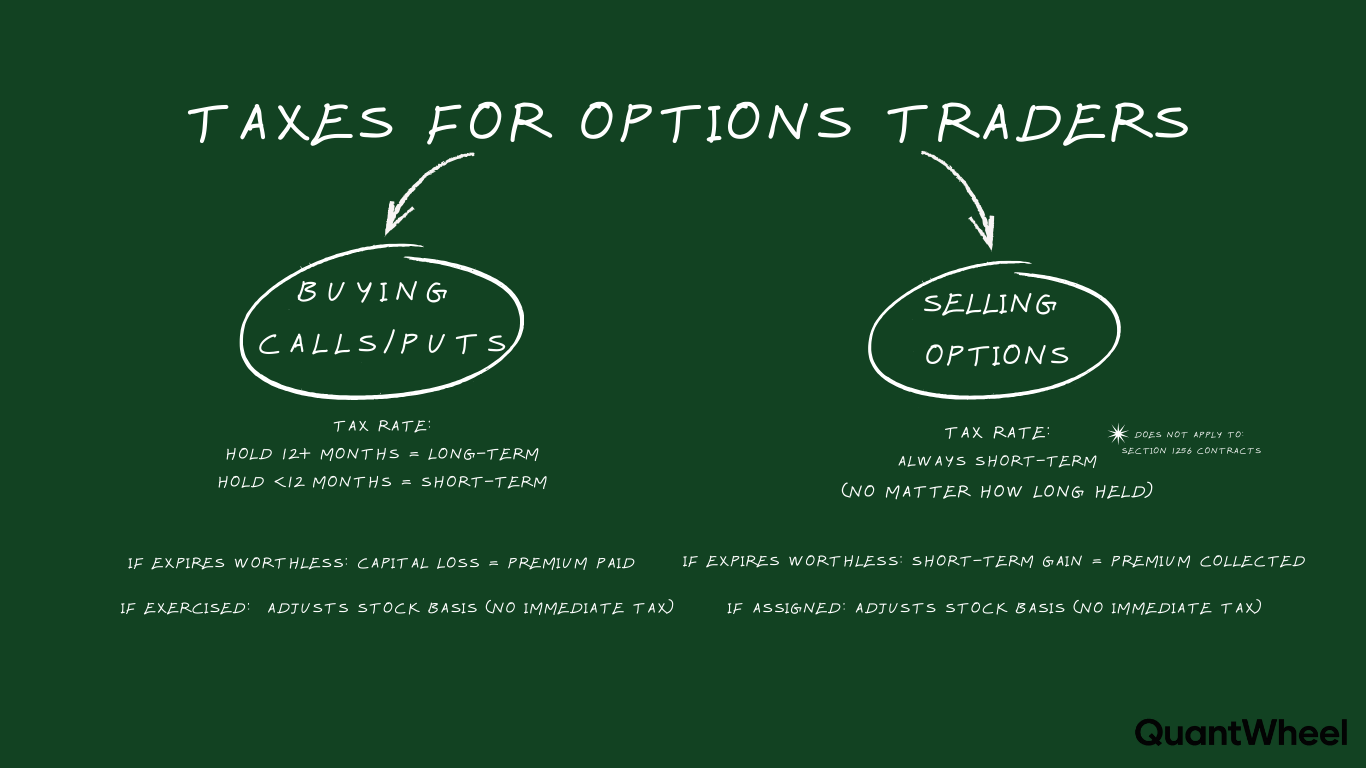
Equity options are publicly traded contracts on individual stocks and stock ETFs - the type most retail traders use. How are options taxed, in this case equity options, depends on whether you're buying or selling options:
For Long Positions (Buying Calls or Puts):
- Closing the position before expiration creates a capital gain or loss
- Holding period determines short-term vs. long-term treatment (must hold 12+ months for long-term rates)
- Exercising the option adjusts your stock basis; no immediate taxable event occurs
- Options that expire worthless generate a capital loss equal to the premium paid
For Short Positions (Selling/Writing Options):
- All gains and losses are short-term capital gains, regardless of how long you hold them
- Premium received is not taxable income at collection - it's only taxed when the position closes
- Assignment adjusts the underlying stock basis by the premium amount
- Options that expire worthless generate short-term capital gains equal to the premium collected
This is in general a concise answer for those who sell covered call and cash-secured puts and are looking to learn how are options taxed. We go a bit more in detail about this below.
3. Non-Equity Options (Section 1256 Contracts)
How options are taxed changes dramatically for Section 1256 contracts, which include options on:
- Broad-based indexes (SPX, NDX, RUT)
- Futures contracts
- Foreign currencies
- Certain commodities
Section 1256 contracts receive preferential tax treatment under IRC Section 1256:
- 60/40 tax split: 60% of gains taxed at long-term capital gains rates (max 20%), 40% at short-term rates - regardless of actual holding period
- Mark-to-market accounting: Open positions are deemed sold at market value on December 31 each year
- No wash sale rules: Section 1256 contracts are exempt from wash sale restrictions
- Lower effective tax rate: The blended rate can be 10-12% lower than ordinary income rates
For active traders, understanding that index options are taxed differently than equity options can save thousands.
When Premium Becomes Taxable: Critical Timing Rules
One of the most common misconceptions about how are options taxed relates to premium collection timing:
Misconception: "I sold a cash-secured put and collected $500 in premium today, so I made $500 in taxable income today."
Reality: Premium received from selling options is NOT taxable income at the moment of sale.
Understanding how options are taxed means knowing that premium becomes part of a capital gain or loss calculation only when:
1. You buy-to-close the position (realized gain/loss = premium received minus buy-back cost)
2. The option expires worthless (premium becomes short-term capital gain)
3. You get assigned (premium adjusts your stock cost basis - no separate gain/loss event)
This timing rule has important implications:
- You can't deduct the premium as an expense until one of these closure events occurs
- You don't report premium as income until the position is fully resolved
- Rolled positions may create taxable events in one year and offsetting events in another
- Assignment doesn't create a taxable event by itself - tax happens when you eventually sell the shares
For wheel strategy traders, this means your put premium only becomes taxable when the put expires or you close it - not when you collect it. If assigned, the premium reduces your stock cost basis instead.
How Options Are Taxed: Transaction-by-Transaction Breakdown
Closing Transactions (Selling to Close)
When you close an option position by selling it:
- Calculate gain/loss: Sale proceeds minus original cost basis
- Report on Form 8949 and Schedule D
- Apply appropriate holding period (short-term = under 12 months, long-term = 12+ months)
- All short options (positions you sold to open) are always short-term when closed
Example: You bought a call for $300. Later you sold it for $800. Your capital gain is $500. If you held it less than 12 months, it's a short-term capital gain taxed at your ordinary income rate (up to 37% federal).
Option Expiration
How options are taxed at expiration depends on your position:
For buyers (long options expiring worthless):
- Report the premium paid as cost basis with zero proceeds
- Results in a capital loss
- The expiration date is your transaction date
For sellers (short options expiring worthless):
- Report the premium collected as proceeds with zero cost basis
- Results in a short-term capital gain
- Always short-term, regardless of how long the option was open
Example: You sold a $50-strike put for $200 premium, and it expired worthless. You report a $200 short-term capital gain on the expiration date.
Option Exercise and Assignment
How options are taxed through exercise and assignment creates basis adjustments rather than immediate taxable events:
Exercising a call option (you're long):
- Add the option premium to your stock purchase price
- New stock basis = Strike price + Premium paid + Commissions
- Holding period for the stock begins on exercise date (option holding period doesn't carry over)
- No taxable event until you sell the shares
Example: You bought a $100 call for $5 and exercised it. Your stock basis is $105 per share. When you eventually sell the stock, you'll calculate gain/loss using this $105 basis.
Exercising a put option (you're long):
- Subtract the option premium from your stock sale proceeds
- Effective sale proceeds = Strike price - Premium paid - Commissions
- The holding period of your underlying stock determines short-term or long-term treatment
- This IS a taxable event (you're selling stock)
Example: You owned stock with a $90 basis, bought a $100 put for $3, and exercised it. Your sale proceeds are $97 ($100 strike - $3 premium). Your gain is $7 per share ($97 - $90 basis).
Assignment on short calls (you sold a covered call):
- Add the premium received to your stock sale proceeds
- Effective sale proceeds = Strike price + Premium received
- Holding period of the stock determines if gain is short-term or long-term
- This IS a taxable event (you're selling stock)
Example: You owned stock with a $90 basis, sold a $100 call for $2, and were assigned. Your sale proceeds are $102 ($100 + $2). Your gain is $12 per share ($102 - $90), taxed based on how long you held the stock.
Assignment on short puts (you sold a cash-secured put):
- Subtract the premium received from your stock purchase price
- New stock basis = Strike price - Premium received
- Holding period begins on assignment date
- No taxable event until you sell the shares
Example: You sold a $50 put for $2 and were assigned. Your stock basis is $48 per share. No taxable event occurs until you sell the shares.
Capital Loss Offset Hierarchy
Understanding how are options taxed requires you to know how losses offset gains:
The IRS offsetting order:
- Short-term losses offset short-term gains first
- Remaining short-term losses then offset long-term gains
- Long-term losses offset long-term gains first
- Remaining long-term losses then offset short-term gains
Why this matters: Since most options trading generates short-term gains, harvesting short-term losses from options positions can directly offset those gains. This is why experienced traders engage in "tax loss harvesting" toward year-end.
Net capital loss limitation:
- If total losses exceed total gains, you can deduct up to $3,000 against ordinary income per year
- Unused losses carry forward indefinitely to future years
- Losses carried forward maintain their character (short-term or long-term)
Complex Option Strategies: How Advanced Positions Are Taxed
Straddle Loss Deferral Rules
When you hold offsetting positions that substantially reduce risk, IRS straddle rules may defer your losses:
The rule: You can only deduct losses exceeding any unrecognized gains on offsetting positions. This prevents taxpayers from realizing losses in one year while deferring offsetting gains to the next year.
How are options taxed in this case:
- Deferred losses carry forward to the next tax year
- Holding period is suspended (prevents long-term capital gains treatment)
- Affects multi-leg spreads like iron condors, butterflies, vertical spreads, and collars
What qualifies as a straddle:
- Any offsetting positions on actively traded property
- Positions that substantially reduce your risk of loss
- Applies even if you didn't intend to create a tax straddle
Important exceptions:
- Qualified covered calls (QCCs) with proper strike prices and expiration dates (30+ days, not deep in-the-money)
- Section 1256 straddles (both legs must be Section 1256 contracts)
- Hedging transactions for businesses
Example: You sell a $50 put and buy a $45 put (bull put spread). If you close the long $45 put at a loss while the short $50 put has unrealized gains, the loss may be deferred until the short put closes.
Wash Sale Rules for Options
When looking at how are options taxed you have to look at wash sale rules.
The rule: If you sell an option at a loss and buy a substantially identical position within 30 days (before or after the sale), the loss is disallowed and added to the new position's basis.
Critical points:
- "Substantially identical" includes options on the same underlying with different strike prices or expiration dates
- Applies across all accounts you control, including IRAs
- IRA wash sales permanently destroy losses - they don't get added to IRA basis (IRAs have no cost basis)
- Brokers only report identical positions, not substantially identical ones
Critical for understanding how options are taxed:
- Rolling positions (sell to close at a loss, sell to open a new one) often triggers wash sales
- Trading both stock and options on the same underlying creates wash sale exposure
- You must manually track substantially identical positions
Example: You close a $50 call at a $200 loss, then sell a $55 call within 30 days. The $200 loss is disallowed as a wash sale and added to your $55 call basis.
Constructive Sales on Tight Collars (IRC Section 1259)
How options are taxed gets complex with tight collars. Under IRC Section 1259, creating a "tight collar" on appreciated stock can trigger constructive sale treatment - meaning you're taxed as if you sold the stock, even though you still own it.
What is a tight collar:
- A combination of a long put and short call with strikes close together
- Limits both upside and downside to a narrow range (typically within 15-20% or less)
- Essentially "locks in" your gain without selling the shares
The constructive sale rule: If your collar eliminates substantially all risk of loss and opportunity for gain, the IRS treats it as a constructive sale:
- You must recognize the capital gain as if you sold the stock at fair market value
- Happens even though you still technically own the shares
- Your stock basis adjusts to the market value on the date of the constructive sale
- Designed to prevent taxpayers from locking in gains without paying tax
Example: You own stock with a $50 basis, now trading at $100. You buy a $95 put and sell a $105 call. This tight collar may trigger constructive sale treatment, requiring you to report a $50 gain even though you didn't sell.
Qualified Covered Calls
How covered calls are taxed depends on whether they're "qualified":
To maintain qualified status and avoid straddle rules:
- Expiration must be more than 30 days from the writing date
- Strike price cannot be "deep in-the-money" (specific rules in IRS Publication 550 Table 4-3)
- Must meet IRS strike price requirements based on the underlying stock price
Unqualified covered calls:
- Are taxed as straddles with loss deferral rules
- Suspend the holding period on your stock (can turn long-term gains into short-term)
- Create complications if you're holding stock for long-term capital gains
Example: You've held stock for 11 months and 20 days. You sell a deep-in-the-money call (unqualified). The holding period suspends, potentially preventing long-term treatment when assigned.
Quarterly Estimated Payments
You also need to look at quarterly payments if you're trying to understand how are options taxed - not just annual filing.
The IRS Requirement
If you'll owe more than $1,000 in taxes when you file, you're generally required to make quarterly estimated payments throughout the year.
Why This Matters for Options Traders
- Options profits are not subject to withholding (unlike W-2 wages)
- The IRS charges interest and penalties on underpayments throughout the year (currently around 8% annually)
- Underpayment penalties can add hundreds or thousands in costs on large profits
Practical Guidance from Experienced Traders
- Set aside 30-40% of options profits for taxes (covers federal, state, and self-employment tax if applicable)
- Make quarterly payments using Form 1040-ES
- Payment due dates: April 15, June 15, September 15, and January 15
- Use IRS Direct Pay (www.irs.gov/payments) or EFTPS for electronic payments
Safe Harbor Protection
You avoid underpayment penalties if you pay the lesser of:
- 100% of your previous year's tax liability (110% if AGI > $150,000), OR
- 90% of current year's tax liability
Meeting the safe harbor protects you from penalties even if you ultimately owe more when you file. For profitable traders, using the prior-year safe harbor (pay 100%/110% of last year's tax) is often the safest approach.
Example: Last year you owed $20,000 in total federal tax. This year you're making great profits trading options. If you pay $20,000 in quarterly estimated payments (4 equal installments of $5,000), you're protected from penalties even if you owe $40,000 when you file.
The Real-World Tax Workflow Most Active Traders Use
Knowing how are options taxed is one thing - actually handling your taxes efficiently is another. Here's the step-by-step workflow many of us option traders use:
Step 1: Don't Manually Track Every Trade
If you're making dozens or hundreds of trades, manual tracking is error-prone and time-consuming. Your broker is required to report to the IRS anyway, so leverage their systems instead of reinventing the wheel.
Step 2: Export From Your Broker
- Download Form 1099-B from your broker in January/February (usually available by February 15)
- Export complete trade history as CSV (most brokers offer this under tax center or account statements)
- Verify broker provides software-compatible formats for TurboTax, TaxAct, H&R Block, etc.
Popular brokers and their export options:
- Interactive Brokers: Flexible Query / FlexWeb Service / Pre-configured tax reports
- TD Ameritrade/Schwab: Tax Center with TurboTax direct import
- E*TRADE: Tax Center with downloadable 1099 and trade confirmations
- Fidelity: Tax Forms & Information with software integration
Step 3: Import Into Tax Software
- Use tax software that supports broker data imports (TurboTax Premier, TaxAct Deluxe, or higher tiers)
- Software automatically populates Form 8949 and Schedule D
- Handles thousands of transactions without manual entry
- Calculates short-term and long-term totals
Step 4: Manual Adjustments for Edge Cases
Even with automated imports, you must review for:
- Substantially identical wash sales (brokers don't track across different strikes/expirations)
- Assignment transactions (some brokers report these inconsistently)
- Section 1256 classification (verify index options are properly marked)
- Positions rolled across tax years (may need to link transactions)
- Straddle loss deferrals (software may not detect these automatically)
Step 5: Professional Review for Complex Situations
Consider hiring a CPA experienced in trader taxation if you:
- Trade full-time or generate substantial income from options (6-figure+ profits)
- Rolled complex multi-leg positions across tax years
- Have straddles, collars, or hedged positions
- Trade in multiple account types (IRA + taxable + entity accounts)
- Want to elect Section 475 Mark-to-Market or claim trader tax status
- Face IRS audit, examination, or notice
Tax Forms and Reporting: Where Options Are Taxed Gets Documented
Form 1099-B: Proceeds From Broker Transactions
Starting with the 2014 tax year, brokers report options as "covered securities" on Form 1099-B. However:
- Brokers only track identical positions for wash sales (not substantially identical)
- Exercise and assignment transactions may be reported differently by different brokers
- Some brokers split 1099-B into multiple pages (short-term vs. long-term, covered vs. non-covered)
- Always verify broker reporting matches IRS rules in Publication 550
What to check:
- Box 1a: Description of property (should specify option contract details)
- Box 1b: Date acquired or entered into
- Box 1c: Date sold or disposed of
- Box 1d: Proceeds (what you received)
- Box 1e: Cost or other basis (what you paid)
- Box 1g: Wash sale loss disallowed (only for identical positions)
Form 8949: Sales and Other Dispositions of Capital Assets
This is where you actually report how options are taxed:
- Part I: Short-term transactions (assets held 12 months or less)
- Part II: Long-term transactions (assets held more than 12 months)
- Must report each transaction separately or in aggregate (if reported on 1099-B)
- Use codes to indicate adjustments (wash sales, basis adjustments, etc.)
Schedule D: Capital Gains and Losses
Summary of all capital gains and losses:
- Combines totals from Form 8949
- Calculates net short-term and long-term gains/losses
- Applies $3,000 loss limitation
- Carries forward unused losses
Form 6781: Gains and Losses From Section 1256 Contracts
How Section 1256 options are taxed is reported on Form 6781:
- Part I: Section 1256 contracts marked-to-market (60/40 treatment)
- Part II: Gains and losses from straddles
- Automatic mark-to-market on December 31 for open positions
- 60% goes to Schedule D Part II (long-term), 40% to Part I (short-term)
Example: You made $10,000 trading SPX options. On Form 6781:
- $6,000 reported as long-term capital gain (taxed at max 20%)
- $4,000 reported as short-term capital gain (taxed at ordinary rates)
- Effective blended rate much lower than if all short-term
Advanced Tax Strategies for Options Traders
Section 475 Mark-to-Market Election
Traders qualifying for trader tax status can elect Section 475(f) MTM accounting, which fundamentally changes how their options are taxed:
Benefits:
- Exempts positions from wash sale rules (huge advantage for active traders)
- Exempts positions from straddle loss deferral rules
- Converts capital losses to ordinary losses (can offset any income, not just capital gains)
- No $3,000 annual capital loss limitation (deduct all losses immediately)
- Mark-to-market treatment (recognize unrealized gains/losses each year)
Requirements and considerations:
- Must qualify for trader tax status first (trading is your business, not investment activity)
- Must file election by deadline (generally by April 15 of the year preceding election, or new entity deadline rules)
- Applies to ALL trading positions (cannot cherry-pick)
- Unrealized gains/losses are taxed each year (cash flow consideration)
- Losses become ordinary losses (better) but gains become ordinary income (worse if you had long-term gains)
Who should consider it:
- Full-time traders with consistent volume
- Traders generating losses due to wash sales
- High-volume traders impacted by straddle rules
- Traders with substantial short-term trading losses
Tax-Advantaged Accounts: How Options Are Taxed in IRAs
Options trading in retirement accounts changes the tax game entirely:
Benefits:
- No immediate capital gains tax on trades within the account
- No wash sale issues between IRA transactions
- Tax-deferred growth (Traditional IRA) or tax-free growth (Roth IRA)
- No quarterly estimated payments needed on IRA profits
Drawbacks:
- All distributions become ordinary income (Traditional IRA)-no preferential capital gains rates
- Losses inside IRAs cannot offset taxable income
- IRA wash sales permanently destroy losses in taxable accounts (the loss cannot be recovered - it's gone forever)
- Most IRA custodians limit options strategies (usually only defined-risk strategies allowed)
Critical IRA wash sale warning:
If you sell stock or an option at a loss in your taxable account and buy the same or substantially identical position in your IRA within 30 days (before or after), the loss is permanently disallowed. It does NOT get added to basis anywhere - IRAs don't have cost basis tracking. The loss simply vanishes.
Example: You sell AAPL at a $5,000 loss in your taxable account. 10 days later, you buy AAPL in your Roth IRA. The $5,000 loss is permanently disallowed. You cannot deduct it now or ever.
Common Tax Mistakes to Avoid
Understanding how options are taxed means avoiding these frequent errors:
- **Assuming broker reports are complete**: Brokers don't track substantially identical wash sales across different strikes/expirations - that's your responsibility
- **Ignoring straddle rules**: Complex spreads (iron condors, butterflies, verticals) may trigger unexpected loss deferrals that your broker won't flag
- **Misunderstanding exercise and assignment**: Premium affects stock basis, not current-year capital gains. Many traders incorrectly report these.
- **Trading across account types**: Buying in an IRA after selling at a loss in a taxable account permanently destroys the loss
- **Not tracking holding periods**: Short written options are ALWAYS short-term gains/losses, regardless of how long you held them open
- **Missing Section 1256 benefits**: Index options (SPX, NDX, RUT) qualify for 60/40 treatment - verify your broker classified them correctly
- **Forgetting quarterly payments**: Sudden $30K-50K tax bills with penalties and interest are easily avoided with proper planning
- **Ignoring constructive sale rules**: Tight collars on appreciated stock can trigger unexpected capital gains
- **Rolling into wash sales**: Closing a losing position and immediately opening a similar one disallows the loss
- **Not keeping detailed records**: If audited, you need to substantiate every transaction, adjustment, and election
Best Practices for Options Tax Planning
Throughout the Year:
- Use specialized trade accounting software (TradeLog, GainsKeeper) that tracks substantially identical positions for wash sales
- Consider tax implications before entering positions: Will this create a straddle? Could this trigger a wash sale?
- Understand which options qualify for Section 1256: SPX, NDX, RUT get 60/40 treatment; SPY, QQQ, IWM don't
- Make quarterly estimated payments: Don't wait until April 15
- Keep detailed record: Trade confirmations, assignment notices, roll documentation
Year-End Tax Planning (November-December)
- Review open positions for unrealized gains/losses: Consider tax loss harvesting
- Be aware of straddle rules: If holding offsetting positions across year-end, losses may defer
- Remember Section 1256 mark-to-market: Open index option positions are deemed sold December 31
- Avoid creating wash sales: Wait 31 days after harvesting losses before repurchasing substantially identical positions
- Consider assignment timing: Assignment right before year-end may affect which tax year gains/losses are recognized
- Project total tax liability: Ensure you've paid enough in quarterly estimates (safe harbor rules)
- Consider year-end Roth conversions: If you have trading losses, your tax rate may be lower
Authoritative Resources for Understanding How Options Are Taxed
For detailed guidance on how options are taxed, consult these primary sources:
- IRS Publication 550: Investment Income and Expenses (Chapter 4 covers options in detail, including Table 4-3 on puts and calls)
- IRS Form 6781 Instructions: Section 1256 contracts and straddles
- IRS Publication 17: General guide to federal income tax for individuals
- IRS Topic 429: Traders in Securities (trader tax status requirements)
- Broker education pages: Schwab, Fidelity, Interactive Brokers, TD Ameritrade provide options tax guides
- Green Trader Tax (greentradertax.com): Robert A. Green, CPA provides trader-focused tax guidance
- Tax professionals: CPAs and enrolled agents specializing in trader taxation
Conclusion: Mastering How Options Are Taxed
Understanding how options are taxed is not optional for serious traders - it's an essential skill that directly impacts your after-tax returns. The difference between effective tax planning and costly mistakes often comes down to understanding the nuances of:
- When taxable events occur (at closure, not at position entry)
- How premium is taxed (capital gains, not ordinary income)
- Which options get preferential treatment (Section 1256 vs. equity options)
- How exercise and assignment affect stock basis
- When complex rules apply (straddles, wash sales, constructive sales)
- Why quarterly payments matter (avoid penalties and interest)
Every closed option position is a taxable event, regardless of whether you withdraw funds. Every premium collected must eventually be reported as a capital gain or loss. Every complex strategy carries potential tax implications that may not be immediately obvious. For wheel strategy traders, this means understanding that put premiums adjust your stock basis when assigned, and call premiums increase your sale proceeds when assigned. For spread traders, this means being aware of straddle rules that can defer losses. For index option traders, this means taking advantage of Section 1256 treatment.